A Staircase at the Edge of Georgetown
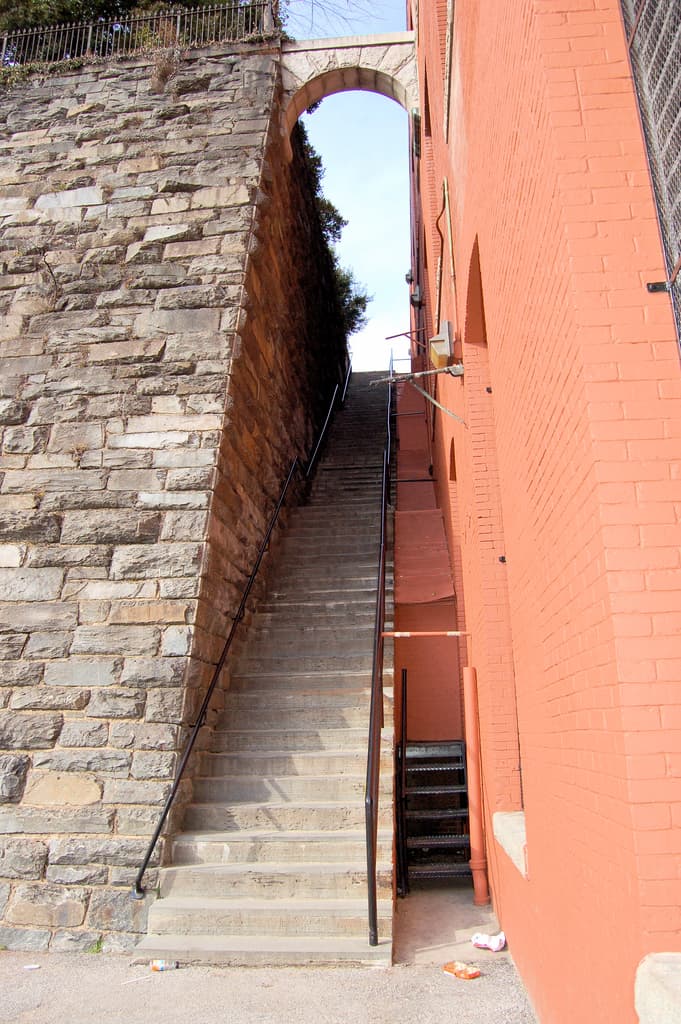
There is nothing decorative about the Exorcist steps, and that is exactly why they work. The staircase continues the line of 36th Street NW where the street gives up, plunging from the corner of Prospect Street down a steep, walled slot beside the old Georgetown Car Barn to a small parking lot set back from the tangle of M Street, Canal Road, and the Whitehurst Freeway. It is narrow, it is steep, and on a damp evening, with the light going and the walls closing in, it is easy to feel the drop in your stomach before you take the first step. Count them and you join a long-running local argument, but the city's official plaque settles it: seventy-five steps.
What you are standing on is a public outdoor staircase — a working piece of city infrastructure, a public right of way that happens to double as a film pilgrimage site and an open-air gym. There is no ticket, no gate, and no attraction infrastructure beyond the plaque at the base. The house that made the steps famous stands at the top, at 3600 Prospect Street NW, and it needs saying plainly: the "Exorcist house" is a private residence. It is not a museum, it is not open, and the respectful way to experience this landmark is from the public steps and the public street.
Built for Cable Cars in 1895
Long before Hollywood, the steps had a job. They were built in 1895 by George Killeen, a prominent local Democratic figure, during construction of the adjacent Capital Traction Company Barn — the great car barn, still standing, that served Georgetown's cable cars. The stairway served as a lightwell and a public right of way, letting pedestrians drop from the Prospect Street bluff to the street level below in a neighborhood being engineered for streetcars. Killeen family legend holds that the wall's construction rested on a handshake agreement and that he was never paid for its completion — a grievance preserved, appropriately, in the folklore of a staircase everyone would later know by someone else's name.
That earlier name is a small pleasure of the place. Before 1973, locals informally called these the "Hitchcock steps," after Alfred Hitchcock — a nod to their vertiginous, suspense-set geometry decades before a film crew actually arrived. Stand midway, where the walls pinch and the flight steepens, and the nickname explains itself: this is a staircase that seems designed by a suspense director, all forced perspective and consequences. The car barn beside it, part of the Capital Traction property developed in the 1890s, gave the steps their working context; the movies would give them everything else.
1973: Father Karras Falls
The Exorcist, directed by William Friedkin and released in 1973, was adapted by William Peter Blatty from his own novel. Blatty was a Georgetown University alumnus who had set his story of a possessed girl, Regan MacNeil, and the two Jesuit priests who try to save her in the streets around his old university — the campus, its halls and chapel all appear in the film. In the climax, Father Damien Karras, played by Jason Miller, takes the demon into himself and hurls himself from the window of the MacNeil house, tumbling down the Georgetown steps to his death. It is one of the most imitated falls in cinema, and it happens here, on real concrete, in a real neighborhood.
The production had to cheat the geography slightly, and the cheat is part of the story. The house at 3600 Prospect Street sits a little too far back from the steps for Karras's fall to work on camera, so the crew built an eastward extension — a false front — onto the house to close the distance between Regan's window and the stairway. The steps themselves needed no set dressing, only protection: they were padded with half-inch-thick rubber so the stunt performer could survive the tumble, which he performed twice. Georgetown students, sensing an economy, reportedly charged onlookers for rooftop vantage points to watch the filming. The interiors of the house, for the record, were shot on studio sets in New York; what Georgetown supplied was the exterior, the neighborhood, and these steps.
A Plaque, a Mayor, and a Halloween Homecoming
For four decades the steps were an unofficial landmark — universally known, formally nothing. That changed on Halloween weekend 2015. In a ceremony attended by Friedkin and Blatty themselves, Mayor Muriel Bowser recognized the Exorcist steps as a D.C. landmark and official tourist attraction, and a plaque was unveiled at the base of the steps honoring their place in Washington and film history. The plaque's inscription keeps it admirably brief: these iconic steps were featured in William Friedkin's 1973 Warner Bros. classic, based on the novel and screenplay by William Peter Blatty, and in the film's climactic ending Father Karras "plummets the seventy-five steps to his death." It is commemorated, the marker notes, on October 30, 2015.
The ceremony was a homecoming as much as a designation — the aging director and writer returning to a Georgetown corner that their film had permanently annexed. The steps joined the very short list of film locations that a city has formally adopted as its own, in the company of the Rocky steps in Philadelphia or the Potemkin stairs in Odesa: staircases whose screen lives completely overtook their civic ones. Georgetown, to its credit, leaned in. The plaque does not apologize for the horror film or dress the site up as something grander; it simply records that a movie happened here, and that the movie mattered.
The Steps Today
Today the staircase lives three lives at once. Film fans make the pilgrimage — photographing the plaque, climbing to the top to peer (from the street) at the corner house, and recreating the poster's shaft-of-light composition as best the real geometry allows. Athletes claim the steps for the other obvious use: seventy-five steep steps in a walled chute are a brutal natural workout, and joggers and Georgetown crew teams run them in repeats while tourists flatten themselves against the wall to let them pass. And underneath both groups, the steps go on doing their 1895 job, carrying ordinary pedestrians between Prospect Street and M Street as the neighborhood's vertical shortcut.
Come at dusk if you want the atmosphere the location scouts saw — the walls shadowed, the drop theatrical. Come on a bright morning if you want the place to yourself and the honest view: Georgetown's rooftops above, the car barn's brick flank beside you, and the Potomac a few blocks beyond M Street. Either way, the etiquette is simple. The steps and the street are public; the house is someone's home. Take the climb, take the photograph, count the steps if you must — and let the count come out however it comes out. The plaque says seventy-five, and the plaque, unusually for a horror landmark, is the least frightening authority on the scene.
Key Facts
- The Exorcist steps are a public concrete staircase at Prospect and 36th Streets NW in Georgetown, continuing 36th Street down to a parking lot near M Street NW, Canal Road, and the Whitehurst Freeway.
- Built in 1895 by George Killeen during construction of the adjacent Capital Traction Company Barn for cable cars; they served as a lightwell and public right of way and were once informally called the "Hitchcock steps."
- The 1973 film The Exorcist (dir. William Friedkin; screenplay and novel by William Peter Blatty) ends with Father Damien Karras (Jason Miller) falling down the steps; the flight was padded with half-inch rubber for the stunt, performed twice.
- The film's MacNeil house at 3600 Prospect St NW was extended with a temporary false front to sit closer to the steps; the house is a private residence and is not open to visitors.
- On October 30, 2015, during Halloween weekend ceremonies with Friedkin and Blatty present, Mayor Muriel Bowser recognized the steps as a D.C. landmark and official tourist attraction, unveiling the plaque at their base.
- The official plaque counts seventy-five steps; joggers and Georgetown crew teams now use the staircase for training alongside visiting film fans.
Visitor Details
Address: The Exorcist Steps, 3600 Prospect St NW, Washington, DC 20007 — top of the steps at Prospect and 36th Streets NW, Georgetown; the plaque is at the base, reached from the M Street NW side near the Georgetown Car Barn.
Transit: Georgetown has no Metro station; use Foggy Bottom–GWU or Rosslyn (Blue/Orange/Silver lines) and walk or take a Georgetown-bound bus along M Street NW. Driving is possible but street parking in Georgetown is scarce.
Hours/Admission: A public outdoor staircase and right of way, open at all hours with no admission charge; the adjacent "Exorcist house" at 3600 Prospect St NW is a private residence — view it from the public street only and do not approach or disturb the occupants.
Best timing: Dusk for the full cinematic mood and the plaque in raking light; early morning for an empty staircase and to share it only with training runners. Halloween season draws the biggest crowds of fellow fans.
The Exorcist Steps — Context Photography