Swimming in a Hole in the Ground
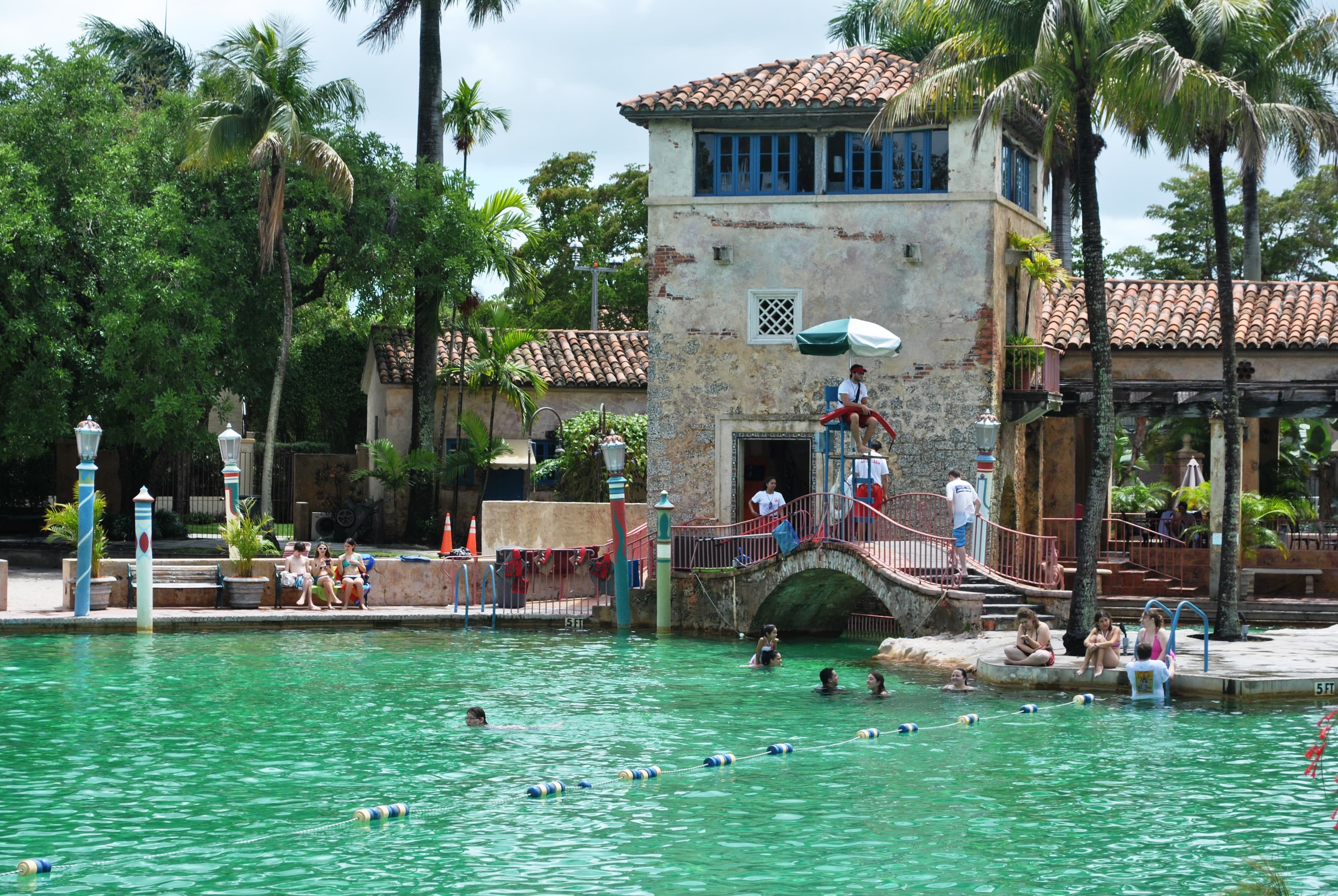
Every great Florida pool promises an escape, but only one lets you swim inside the hole the city was built from. The Venetian Pool in Coral Gables occupies a four-acre coral rock quarry on De Soto Boulevard: a lagoon of startlingly clear, cool water edged by waterfalls, vine-draped loggias, striped Venetian mooring posts, and rough coral walls that are quite literally the inside of the earth the neighborhood came out of. It holds some 820,000 gallons of fresh water drawn from artesian wells fed by the underground aquifer — in its busy seasons, the City of Coral Gables notes, the pool is filled and drained daily — making it the largest freshwater pool in the United States. The depth runs from about four feet to more than eight feet near the grand waterfall, with a shallow two-foot children's pool near the lifeguard station. Nothing about it reads as municipal. It reads as a set from a silent film about Venice, crossed with a grotto from a romantic painting — which, in a sense, is exactly what its makers intended when they opened it in 1924.
Merrick's Problem, Merrick's Answer
Coral Gables was the vision of developer George Merrick, who in the early 1920s set out to build an entire city in Mediterranean Revival style — grand entrances, plazas, and homes of tinted stucco and coral rock, under a master plan he called his Grand Plan for the "City Beautiful." Building that city took stone, and lots of it: crews quarried oolitic limestone on this site, and the rock cut from the pit went into some of Coral Gables' earliest buildings. When the quarry was abandoned in 1921, it left Merrick with an embarrassment — a gaping, unsightly rock pit in the middle of his showcase suburb. His answer was characteristically theatrical. Rather than fill it, he had artist Denman Fink, his uncle and close collaborator, and architect Phineas Paist, the supervising architect of Coral Gables, reimagine the pit as a Venetian lagoon. Construction transformed the quarry through 1923, and in 1924 the "Venetian Casino" opened — "casino" in the older sense of a pleasure pavilion, not a gambling hall. It was a public pool as a civic monument: proof, in Merrick's pitch, that in Coral Gables even a hole in the ground would be finished in the Mediterranean manner.
Venice, Built From Coral Rock
Fink and Paist kept the quarry's bones and dressed them in Venice. The irregular pit became the pool basin, its coral rock edges left as cliffs, caves, and a grotto where water-filled passages reach back more than twelve feet into the hillside. Two waterfalls pour over the rock — swimmers once dove from a high platform above the grand waterfall, long since removed — and two large historic lookout towers rise over the complex, offering views across the City Beautiful. A bridge crosses to a small island planted with two full-size palm trees, where Venetian-style gondolas once docked; the gondolas, like the diving platform, are gone, but the bridge, the classic mooring posts, the porticos, the loggias, and the fountain room at the entrance remain. Around the water are a sandy sunning area, a café terrace often used for weddings and receptions, and a walking path that circles the whole complex. The effect is layered and deliberate: native coral rock and tinted stucco, barrel tile and hanging lamps, tropical palms against Italianate arches. It is the purest surviving expression of Merrick's Coral Gables — a city that insisted every public work, down to a swimming pool, advance one continuous architectural fantasy.
Orchestras in an Empty Pool
The Venetian Casino was glamorous from the start, a destination for celebrities and a stage set for Coral Gables' self-promotion. Movie stars of the era appeared here — Johnny Weissmuller, the Olympic swimmer turned Tarzan, and Esther Williams, Hollywood's swimming star, are both part of its lore — and beauty pageants, fashion events, and concerts filled its calendar. Its most famous trick exploited the quarry itself: the pool was regularly drained completely so the Miami Symphony could perform on the dry pool bottom, taking advantage of the rock pit's natural acoustics, with the audience looking down into the stone bowl. In 2001, to celebrate the 75th anniversary of Coral Gables, the city drained the pool and restaged the scene, seating an orchestra in the empty basin once again. The pool survived the collapse of Merrick's empire, the Depression, and decades of Florida reinvention with its 1924 fabric largely intact — helped by a major historical renovation completed in 1989 that restored many original features, and a second renovation in 2009–2010. In 1981 it was added to the National Register of Historic Places; it is routinely described as the only swimming pool in the United States to hold that listing.
A Million Gallons of Conscience
The pool's defining ritual — draining 820,000 gallons every night and refilling it fresh each morning — eventually drew criticism from environmentalists, who pointed out that discarding that much fresh water daily could not be good for Florida's aquifers. In 1998 the city devised a fix worthy of the pool's ingenuity: the drained water is now returned to the aquifer through natural ground filtration, recycling the resource while keeping the water the fresh, clear, and famously chilly spring water swimmers expect. Even arrival is part of the preservation: visitors enter through the historic fountain room, where, the city notes, the pool's rich history can still be observed in its historic photographs — a small gallery of pageants, orchestras, and swimmers from the 1920s onward, hung steps from the water their grandchildren now swim in. What remains is a working piece of 1920s civic theater that South Florida still uses exactly as intended — not as a museum, but as its swimming pool, generational in the way of the best public places: grandparents bring grandchildren to swim under the same waterfalls. Few American pools ask swimmers to meet any standard beyond a ticket, but Venetian Pool has always been a managed piece of theater, with lifeguards posted by the bridge and island, a café serving the terrace, and capacity limits that, on the busiest summer days, can close the gates by early afternoon — one more reason the city's own advice, echoed by generations of regulars, is simply to come early. Arrive when the gates open, before the crowds, and the illusion is complete: the towers, the bridge, the grottoes, the cold green water in its coral bowl — Venice, improbably, holding its own in Coral Gables a hundred years on.
Key Facts
- Venetian Pool was created in 1923–1924 from a four-acre coral rock (oolitic limestone) quarry abandoned in 1921; the stone quarried here was used in some of Coral Gables' earliest buildings.
- It was designed by artist Denman Fink and architect Phineas Paist for Coral Gables founder George Merrick, and opened in 1924 as the "Venetian Casino," part of Merrick's Mediterranean Revival Grand Plan.
- The pool holds about 820,000 gallons of fresh water from artesian wells fed by the underground aquifer — the largest freshwater pool in the United States — ranging from about four feet deep to over eight feet near the waterfall, with a two-foot children's pool.
- Features include two waterfalls, a grotto reaching over twelve feet into the hillside, two historic lookout towers, a bridge to a palm-topped island, Venetian mooring posts, loggias, and porticos; gondolas and a high-diving platform were later removed.
- In its early years the pool was regularly drained so the Miami Symphony could perform on its bottom, using the quarry's natural acoustics — a scene restaged in 2001 for Coral Gables' 75th anniversary.
- Added to the National Register of Historic Places in 1981, it is the only U.S. swimming pool on the register; major renovations were completed in 1989 and in 2009–2010, and since 1998 its drained water is recycled back into the aquifer by natural filtration.
Visitor Details
Address: 2701 De Soto Boulevard, Coral Gables, FL 33134
Transit: Venetian Pool sits in a residential section of Coral Gables west of downtown Miami; most visitors arrive by car, and the Coral Gables trolley and Miami-Dade Transit buses serve the surrounding Coral Gables street grid. Parking is limited on busy days.
Hours/Admission: The pool is city-operated and its hours vary by season, and admission differs for Coral Gables residents and non-residents — check the official City of Coral Gables page (coralgables.com/venetian-pool) for current hours and fees before you go, and consider buying tickets ahead on summer weekends, when the pool can reach capacity.
Best timing: Arrive at opening on a weekday for the clearest water and the quietest grottoes. The water is spring-fed and cold year-round — bracing even in August. Children must meet the city's age and height requirements; check the official page before bringing small children.
Location Photography