A Castle With No Builders
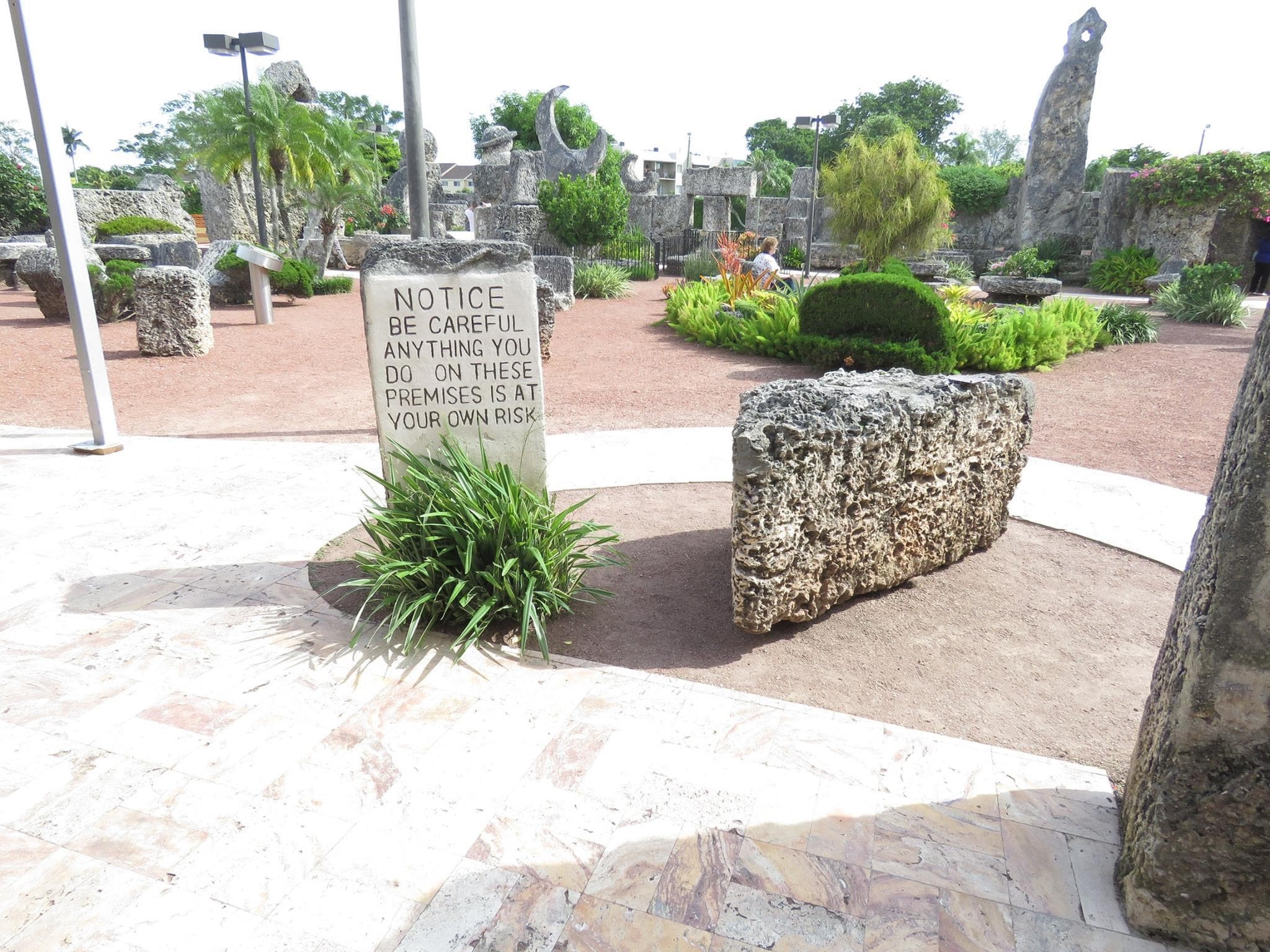
Nothing about Coral Castle adds up at first sight. The grounds, just off South Dixie Highway in unincorporated Miami-Dade County near Homestead, hold some 1,100 tons of oolite limestone shaped into perimeter walls, a two-storey tower, stone tables and chairs, a sundial, a Polaris telescope, and a gate weighing nine tons that was long famous for turning at the push of a finger. Castles are supposed to be the work of kings, armies of masons, and generations. This one is the work of a single man: Edward Leedskalnin, a Latvian immigrant who stood about five feet tall and weighed about 100 pounds, had a fourth-grade education, and spent more than 28 years, from 1923 to 1951, quarrying and sculpting the place essentially alone and largely at night. He called it first Ed's Place, then Rock Gate. Only after his death did new owners rename it Coral Castle — a romantic name for a rock that is not, strictly, coral at all, but oolite, a sedimentary limestone made of tiny concentric grains, found just inches under the topsoil across southeastern Florida. The misnomer stuck because the stone looks like coral, and because the name fits what visitors feel they are seeing.
Sweet Sixteen
Leedskalnin's own promotional story, repeated by the attraction ever since, begins with a heartbreak. Born in Latvia in 1887 into a family of stonemasons, he was, by that account, 26 years old and engaged to a 16-year-old girl named Agnes Skuvst when she rejected him the day before their wedding. He left Latvia for North America in 1912, worked his way through Canada and the United States, and contracted tuberculosis — then often a death sentence. He later said he had recovered, and credited magnets with some effect on his disease, an early sign of the private theories about magnetism he would publish and preach for the rest of his life. Drawn by the warm climate, he reached Florida and, around 1923, bought an acre of land in Florida City, at the edge of the Everglades, from Ruben Moser, whose wife had helped nurse him through another bout of illness. There, in one of the most remote spots in the young state, he began to carve. When visitors later asked why he had built the castle, he would answer vaguely that it was for his "Sweet Sixteen" — widely taken to be the lost fiancée, though in his own pamphlet A Book in Every Home he implied that his Sweet Sixteen was more an ideal than a real girl waiting somewhere. Billy Idol turned the phrase into a hit song in 1986, fixing the legend in pop culture: a candy castle built for a runaway bride who never came.
Built at Night, Then Moved Ten Miles
Secrecy was Leedskalnin's method and his mystique. He refused to let anyone watch him work, laboring after dark and stopping if anyone approached; a few teenagers later claimed they had glimpsed blocks moving "like hydrogen balloons," and the only advanced device he ever spoke of was something he called a "perpetual motion holder." What is documented is more ordinary and more impressive: photographs and eyewitness accounts show a man using tripods, pulleys, winches, wedges, and tools he fashioned himself, applying patience and leverage on an industrial scale. Orval Irwin, who watched him quarry and erect wall stones, later illustrated those workmanlike methods in a book. The stones are set without mortar, fitted so precisely that, guides like to note, no light passes through the joints — and the eight-foot vertical slabs of the perimeter wall have not shifted in decades. In about 1936, hearing that a subdivision was planned near his Florida City land and determined to protect his privacy, Leedskalnin did the unthinkable a second time: he moved the castle. Over roughly three years he loaded his multi-ton carvings onto a borrowed truck, hauled them ten miles north to a ten-acre site outside Homestead, and rebuilt — adding new walls quarried on the spot, from pits beside the walls that visitors can still see. He named the new place Rock Gate, after the great swinging gate in its back wall, charged visitors twenty-five cents (ten cents back in Florida City), let the penniless in free, and conducted tours himself, descending from his tower rooms when visitors rang the bell twice, as a carved sign instructed.
Inside the Walls
A tour of Coral Castle is a tour of one man's inner life rendered in stone. He lived in the two-storey tower, in quarters reached by stone stairs, and furnished the grounds with a household no one else ever used: beds, a bathtub, a barbecue and a well, twenty-five rocking chairs, chairs shaped like crescent moons, and tables with meanings — one in the shape of Florida, and the heart-shaped table known as the Feast of Love, made, the story goes, for the bride. His mind ran to the sky as much as to the heart. He carved a crescent moon and celestial bodies, built an obelisk, a fountain, and a sundial accurate enough to tell both the time and the season, and raised a Polaris telescope aligned on the North Star. The most famous object is the nine-ton revolving gate: an eight-foot slab fitted within a quarter-inch of the walls around it, drilled top to bottom, threaded on a metal shaft, and balanced on an old truck bearing so finely that a child could reportedly swing it open with one finger. When it finally failed in 1986, it took six men and a 50-ton crane to lift it out and discover that secret — the rusted bearing — and even after repairs in 1986 and again in 2005, it has never again turned quite so easily. The largest single stone on the grounds weighs about 30 tons; two monoliths stand 25 feet tall.
"It's Not Difficult If You Know How"
Leedskalnin took his method to the grave, on purpose. Asked how he moved the stones, he would say only that he understood the laws of weight and leverage, that he had "discovered the secrets of the pyramids," and that "it's not difficult if you know how." In November 1951 he hung a sign on the gate — "Going to the Hospital" — took a bus to Jackson Memorial Hospital in Miami, and died 28 days later, aged 64, of a kidney infection; $3,500 in tour and pamphlet earnings was found among his things. The castle passed to a nephew, was sold to an Illinois family in 1953, became a commercial attraction under the Coral Castle name, and was sold in 1981 to Coral Castle, Inc., which still runs it. In 1984 it was listed on the National Register of Historic Places — entered as Rock Gate, renamed Coral Castle on the register in 2011 — and television, from In Search of... to Ancient Aliens, has made it a pilgrimage site for mystery lovers. Skeptics have largely solved the puzzle: porous oolite is lighter than it looks, and leverage, rollers, and decades of nightly labor explain the rest. But inside those mortarless walls, before a feast table set for a guest who never arrived, the engineering answer feels beside the point. Florida's Stonehenge is really a love letter — 1,100 tons of it.
Key Facts
- Coral Castle was built single-handedly by Latvian-American Edward Leedskalnin (1887–1951) over more than 28 years, 1923–1951, working mostly at night with hand tools, tripods, pulleys, and levers.
- The grounds hold about 1,100 tons of oolite limestone (not true coral) in walls, carvings, furniture, and a two-storey tower; the largest stone weighs about 30 tons and the tallest monoliths stand 25 feet.
- Leedskalnin first built "Ed's Place" in Florida City around 1923, then moved the entire castle ten miles north to its present site near Homestead over about three years starting in 1936, renaming it Rock Gate.
- The famous 9-ton revolving gate was balanced on a metal shaft and an old truck bearing; when it failed in 1986, six men and a 50-ton crane were needed to remove it.
- Leedskalnin said the castle was for his "Sweet Sixteen," the fiancée who, by the site's own account, rejected him the day before their wedding in Latvia — the story behind Billy Idol's 1986 song "Sweet Sixteen."
- Listed on the National Register of Historic Places in 1984 (as Rock Gate; renamed Coral Castle in 2011) and still operated as a private tourist attraction by Coral Castle, Inc.
Visitor Details
Address: 28655 South Dixie Highway, Miami, FL 33033 (unincorporated Miami-Dade County, near Homestead / Leisure City)
Transit: The site sits on U.S. 1 (South Dixie Highway) south of Miami and is reached primarily by car; it is a straightforward drive down the highway from Miami and Homestead, with parking on site. No rail station serves it directly.
Hours/Admission: Coral Castle is a privately operated attraction offering tours; hours and admission change, so check the official site, coralcastle.com, for current hours and fees before you go.
Best timing: Go in the morning, when the low sun rakes across the carvings and the Homestead heat has not yet peaked; take the guided tour — the gate, telescope, and Feast of Love table mean far more with Leedskalnin's story attached. Allow about an hour.
Location Photography