

The red palace across from the White House
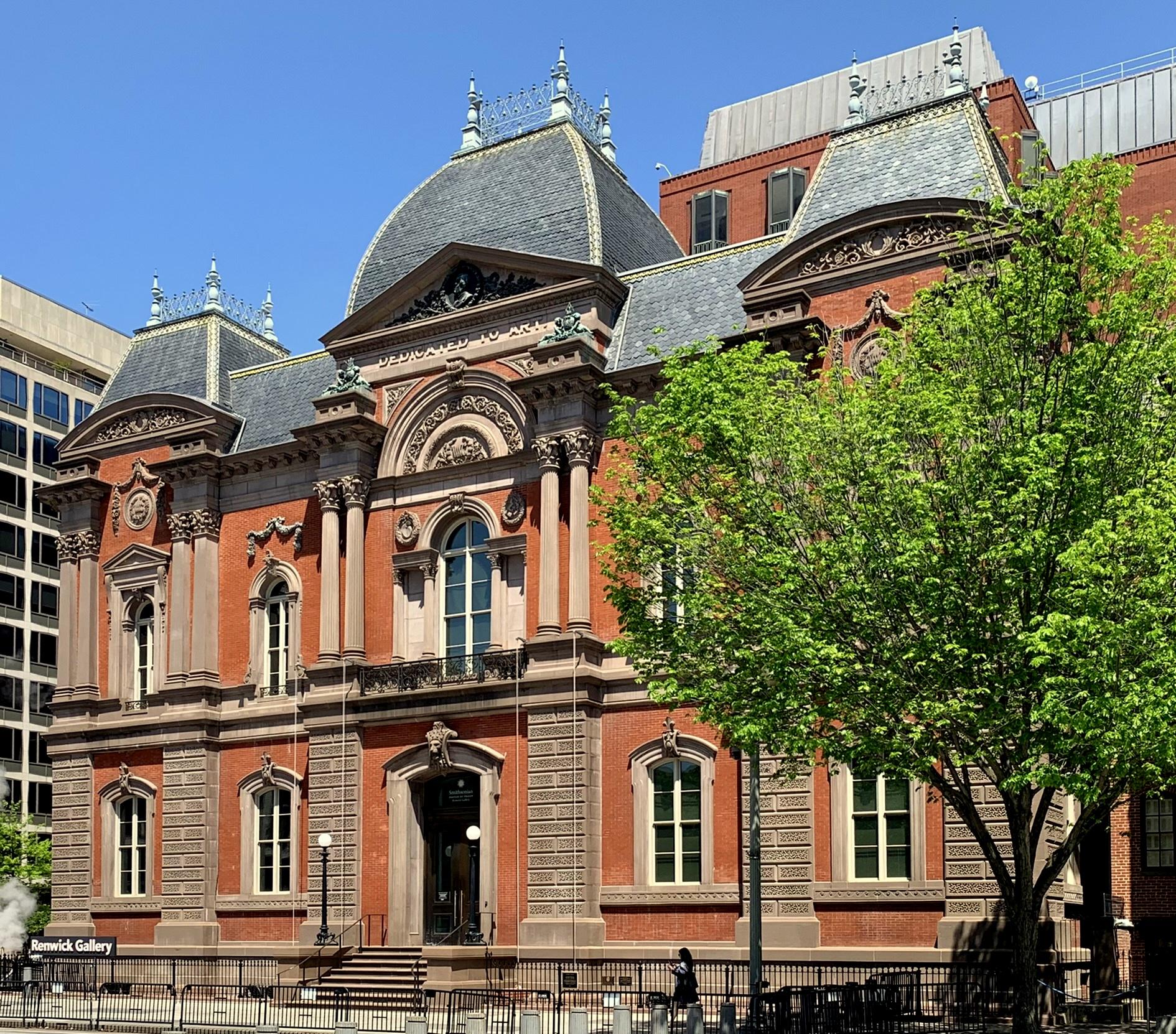
The Renwick Gallery stands at 1661 Pennsylvania Avenue NW, at the corner of 17th Street, diagonally across from the White House and beside Blair House, the president's official guest house for visiting heads of state. It is impossible to walk past without stopping. The building is a blaze of red brick and brownstone trim, two stories of arched windows framed by paired Corinthian columns, topped by a steep gray slate mansard roof with a domed central pavilion and iron cresting along its ridges. Above the front door, carved into the stone, are the words "Dedicated to Art." Blue banners reading "american craft" hang on either side of the entrance. It looks like a small French palace that somehow landed on the most powerful street in America — which is more or less what it was meant to be.
The Renwick is a branch of the Smithsonian American Art Museum, and it is the home of the museum's program of contemporary craft and decorative arts — American work in glass, fiber, clay, wood, and metal from the nineteenth century to the present. But the building is at least as famous as anything inside it. It is the first building in the United States designed expressly as an art museum, one of the first and finest examples of Second Empire architecture in America, and a National Historic Landmark. It was called "the American Louvre" when it was built, and it has survived a civil war, a courthouse, and a wrecking ball to earn the name all over again.
A banker's palace for his pictures
The building was the idea of William Wilson Corcoran (1798–1888), a Washington banker, philanthropist, and art collector who had made his fortune in banking and in selling bonds to finance the Mexican-American War. Corcoran had traveled in Europe in the 1850s and come home troubled by the contrast: Paris and London had great public galleries, while Washington — the capital of a young republic that fancied itself the heir of Rome and Athens — had almost nothing of the kind. He believed that fine art conveyed wealth, prosperity, and taste, and that a nation without a public art museum was a nation announcing its own provincialism. So he decided to build one himself, at his own expense, on a site diagonally across from the White House, and to fill it with his collection of American and European art.
In 1858 Corcoran engaged the architect James Renwick Jr., a New Yorker who had already designed the Smithsonian Institution Building — the red sandstone Castle on the National Mall — and who would go on to design St. Patrick's Cathedral in New York. Renwick was then the most fashionable architect in America, and Corcoran gave him a fashionable brief: model the new gallery on the newest additions to the Louvre in Paris, the Tuileries pavilions then rising under Napoleon III, and make it in the Second Empire style that was the height of French taste. Construction began in 1859.
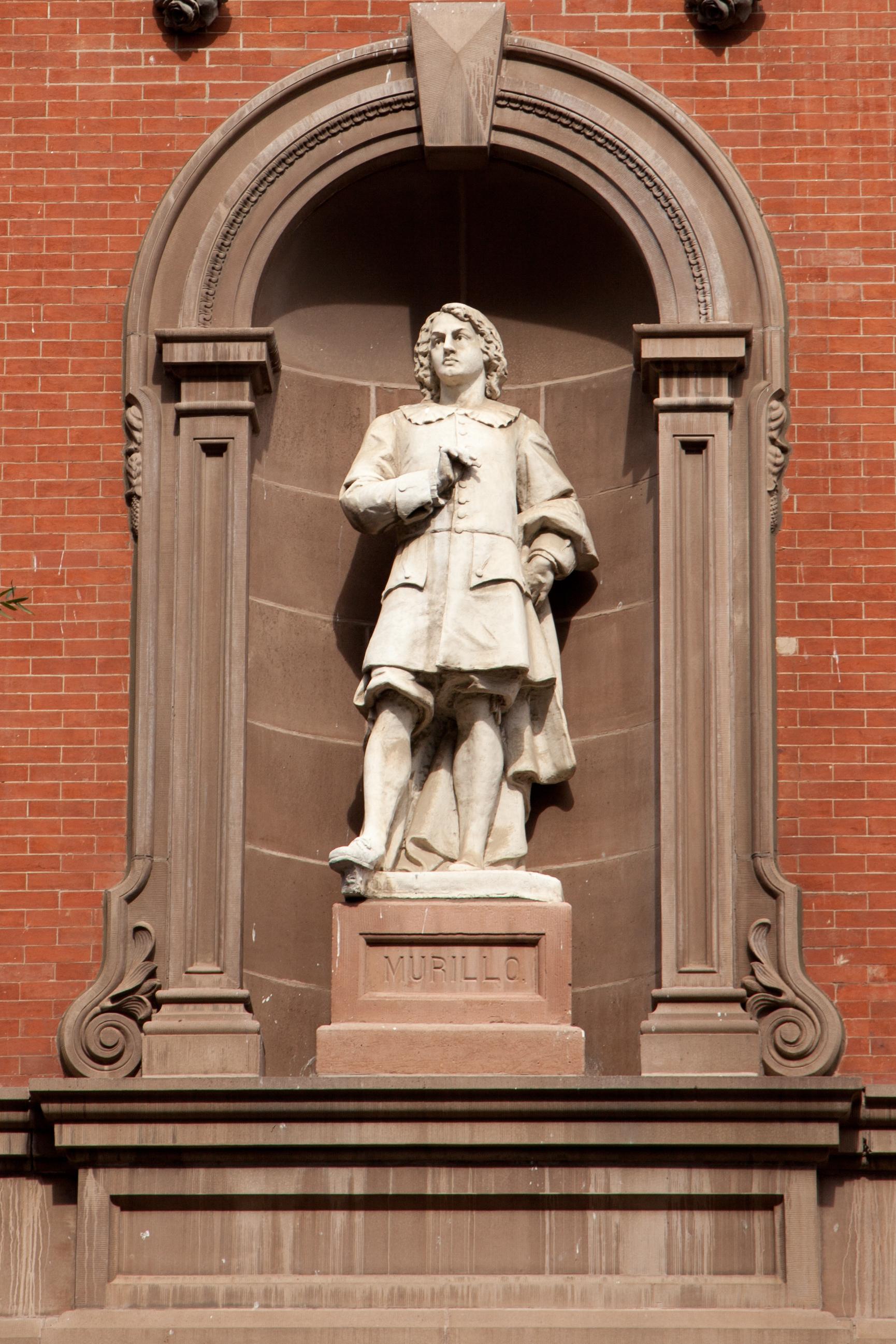
The result was a deliberate piece of cultural diplomacy in brick and stone. The red brick facade is dressed with brownstone: rusticated stonework on the ground floor, arched windows with carved surrounds, paired Corinthian columns, swags and medallions, and a mansard roof of patterned slate with a domed center. Renwick's most playful American touch was in the capitals of those Corinthian columns: where a Greek temple would have acanthus leaves, the Renwick's columns are carved with cornhusks — a classical order translated into an American crop. The building was, in the Smithsonian's own words, the first built expressly as an art museum in the United States, and it helped introduce a new style of architecture to Washington and to the nation.
When the gallery was finished after the Civil War, Senator Charles Sumner and The Philadelphia Bulletin both called it "the American Louvre," and the name stuck. It was a compliment with a dare inside it: the young republic was announcing that it could build a palace for art to match Europe's, and that it intended to.
Seized by the Union Army
The building was near completion when the Civil War broke out, and it never got to open as a museum on schedule. In August 1861 the U.S. Army seized it as a temporary military warehouse for the records and uniforms of the Quartermaster General's Corps — a palace for pictures turned into a storehouse for army blankets. In 1864, General Montgomery C. Meigs, the Quartermaster General, cleared the building and converted it into his headquarters office.
Corcoran himself was part of the problem. He was a Southern sympathizer who had bankrolled much of the Confederate cause, and he fled to France for the duration of the war, leaving his unfinished gallery behind. The government, which had questioned his loyalty, was in no hurry to hand it back. The building was not returned to Corcoran until May 10, 1869, and only then after he agreed to open it as a public gallery rather than a private one. On January 19, 1874, the Corcoran Gallery of Art finally opened to the public — fifteen years after construction began, and a decade after the war that had interrupted it.
The collection inside was, by the standards of the day, remarkable: American landscapes by the Hudson River School painters, European old masters, sculpture, and bronzes, arranged in a main picture gallery, a hall of bronzes, and rooms for sculpture. The second-floor Grand Salon, hung in later years with seventy paintings by fifty-one American artists — most of them made between 1840 and 1930, including landscapes, sentimental portraits, and George Catlin's portraits of Native Americans — became one of the most famous art-filled rooms in Washington.
Outgrown, abandoned, and handed to the courts
The Corcoran's success was its undoing in this building. The collection grew quickly, and within two decades the gallery had outgrown the palace Corcoran built for it. In 1897 the Corcoran Gallery of Art moved to a new, larger building a few blocks south, at 17th Street and New York Avenue — the building that is now the Corcoran School of the Arts & Design at George Washington University. The old gallery on Pennsylvania Avenue was left behind.
The federal government bought the building in 1901, and starting in 1899 it became the home of the United States Court of Claims, the federal court that heard claims against the government. For more than sixty years the Renwick was a courthouse, and it was not a happy one for the building. The grand spaces were chopped into offices — the Grand Salon was divided into two separate rooms — and the palace became, in the Smithsonian's phrase, a kind of glorified office building. By the 1950s the Court of Claims had outgrown it too, and the court's chief justice, complaining that the old building was a fire hazard, urged Congress to demolish it and put up larger government offices in its place. In 1956 the court formally announced that it wanted the building torn down.
Saved by Jacqueline Kennedy
The Renwick was saved by the most famous preservation campaign in Washington's history. First Lady Jacqueline Kennedy had made the restoration of Lafayette Square — the historic neighborhood around the White House — a personal cause, and she was appalled by the plans to replace its nineteenth-century buildings with characterless office blocks in the name of urban renewal. When the General Services Administration proposed demolishing the old Corcoran gallery, she wrote to its head in 1962 in defense of a building she admitted was unfashionable: "It may look like a Victorian horror, but it is really quite a lovely and precious example of the period of architecture which is fast disappearing. I so strongly feel that the White House should give the example in preserving our nation's past." She proposed alternative uses for the building, including a museum, and pressed her case even after President Kennedy's assassination in November 1963. Largely because of her efforts, the demolition plans were halted.
The building was added to the National Register of Historic Places in 1969 and designated a National Historic Landmark in 1971. But its future was still undecided: President Lyndon B. Johnson at one point suggested making it a conference center for foreign dignitaries visiting Blair House next door. Then, in 1964 and 1965, S. Dillon Ripley, the new secretary of the Smithsonian Institution, persuaded Johnson that the gallery could become a showcase for American folk and decorative art — and for the crafts of foreign nations when their envoys were in the capital. In 1965 President Johnson signed an executive order transferring the Renwick building to the Smithsonian for use as a "gallery of arts, craft and design."
After a careful restoration under the direction of Lloyd E. Herman, the building opened on January 28, 1972, as the home of the Smithsonian American Art Museum's contemporary craft program — and was named the Renwick Gallery, in honor of its architect. It was the third opening of the building as an art museum, in its third century: 1874, 1972, and — as it would turn out — 2015.
The home of American craft
The Renwick's mission is craft: the art of making things by hand, in materials that the fine-art world once dismissed as merely useful — glass, clay, fiber, wood, metal — and that the Renwick insists are high art. Its collection spans the nineteenth to the twenty-first centuries, and its greatest hits are the kind of objects that make visitors stop and stare: Dale Chihuly's glass globules floating in their sandbox sanctuaries; Wendell Castle's Ghost Clock, a trompe l'oeil clock in carved wood; Sam Maloof's furniture; Larry Fuente's Game Fish, a mounted sailfish covered in dice, poker chips, dominoes, Scrabble letters, yo-yos, and badminton shuttlecocks; Kim Schmahmann's Bureau of Bureaucracy (1993–1999), a wooden cabinet full of cupboards to nowhere, bottomless drawers, and drawers within drawers — a metaphor for the workings of government, built a block from the White House.
The gallery's regular program keeps the building in motion. The Renwick Craft Invitational, a biennial survey of contemporary fine craft, has showcased makers working in glass, fiber, ceramic, and wood; the 2012 exhibition "40 Under 40: Craft Futures" featured forty artists under forty in boundary-pushing interpretations of their materials; the tenth invitational, Sharing Honors and Burdens (2023), featured Native American artists. Since 2011 the Renwick has also hosted a quarterly "Handi-hour," a crafting-themed happy hour with craft beers, inspired by the do-it-yourself movement. The first-floor galleries typically host temporary exhibitions that rotate about twice a year, and the whole building is small enough to see in an hour — which is part of its charm, and part of why it is one of the most beloved museums in Washington.
The renovation and "Wonder"
By 2013 the building needed serious work. It had been slightly damaged in the 2011 Washington earthquake, and its infrastructure — heating, cooling, plumbing, electrical, fire suppression — dated from the 1972 restoration. On December 9, 2013, the Renwick closed for a comprehensive two-year, $30 million renovation led by the Cleveland-based architecture and engineering firm Westlake Reed Leskosky, with construction overseen by Consigli Construction of Milford, Massachusetts. The work replaced all of the building's mechanical systems, restored its original window configuration and two vaulted ceilings on the second floor, reconfigured the basement for staff offices and workshops, and added LED lighting and Wi-Fi throughout. Fundraising was completed in June 2014 when the financier and philanthropist David Rubenstein donated $5.4 million toward the project; the Grand Salon was renamed the Rubenstein Grand Salon in his honor.
The gallery reopened on Friday, November 13, 2015, with an exhibition that became a phenomenon. WONDER filled all nine of the Renwick's exhibition spaces with site-specific installations by nine contemporary artists, each invited to take over a room and transform it: Jennifer Angus covered a pink room in spiraling geometric patterns made from more than 5,000 shimmering insects — beetles, moths, and cicadas — in In the Midnight Garden; Chakaia Booker built Anonymous Donor from old tires and stainless steel; Gabriel Dawe wove a rainbow of thread across a room in Plexus A1; Tara Donovan built a landscape from thousands of index cards; Patrick Dougherty wove a willow-branch structure called Shindig; Janet Echelman suspended a vast knotted-fiber net, 1.8 Renwick, above a printed textile floor, its form drawn from data on the waves of the 2011 Japan tsunami; John Grade reassembled a mold of a century-old hemlock tree in Middle Fork; Maya Lin mapped the Chesapeake Bay in glass marbles; and Leo Villareal hung a pulsing LED chandelier, Volume, from the ceiling of the Grand Salon.
WONDER ran from November 13, 2015, to July 10, 2016, and drew 732,000 visitors — nearly doubling the gallery's attendance and turning the Renwick into one of the most photographed museums in the country, tagged more than 20,000 times on Instagram in its first months. More than 20,000 people came through the doors in the reopening weekend alone. The show was criticized by some for stretching the Renwick's commitment to craft, but it proved the point the renovation had been built to make: the most valuable object in the Renwick's collection, as curator Nicholas R. Bell put it, is the building itself.
The Renwick today
Since the reopening, the Renwick has settled into its role as the Smithsonian's most intimate museum — a palace-sized jewel box where the building is the first exhibit and the craft inside it is the second. The Grand Salon, stripped of its red carpeting, formal curtains, and red velvet furniture in the renovation, is now a contemporary event and exhibition space; the paintings that once hung there have mostly moved to the Smithsonian American Art Museum's main building at 8th and G Streets. What remains is the architecture: the vaulted ceilings, the restored windows, the cornhusk columns, and the light.
That is the Renwick's particular magic. Most museums are containers for art; the Renwick is a work of art that happens to contain a museum. It was built to prove that a young republic could have a palace for art, then spent a century proving that a republic could also forget why it built one — warehouse, courthouse, demolition target — before a First Lady, a president, and a Smithsonian secretary remembered. Stand on Pennsylvania Avenue and look up at the dome, the mansard roof, and the words carved above the door, and the building tells you its own story in a single glance: dedicated to art, and — after everything — still standing.
How to visit
The Renwick Gallery is at 1661 Pennsylvania Avenue NW, at the corner of 17th Street NW, diagonally across from the White House — a short walk from the Farragut West (Blue/Orange/Silver) and Farragut North (Red) Metro stations. Admission is free and no tickets are required, as verified against the Smithsonian American Art Museum's official visit page (americanart.si.edu) in this run. The gallery's usual hours are 10:00 a.m. to 5:30 p.m. daily, as listed on that same official page. Important: as of this writing the gallery is temporarily closed to the public to prepare for the exhibition Handwork: Contemporary Craft at the Renwick Gallery, which opens November 13 — check americanart.si.edu before visiting for current status and hours. Allow about an hour for a visit; the building is compact, and the Grand Salon and the second-floor galleries reward a slow look up at the ceilings. Bags are hand-screened by security on entry. Pair the visit with a walk around Lafayette Square and the White House, which is directly across the avenue.

Key Facts
- The Renwick Gallery is a branch of the Smithsonian American Art Museum at 1661 Pennsylvania Avenue NW, at 17th Street NW, diagonally across from the White House. Coordinates: 38.8991, -77.0391.
- The building was commissioned in 1858 by the Washington banker, philanthropist, and art collector William Wilson Corcoran (1798–1888) to house his collection of American and European art, and designed by the architect James Renwick Jr., who also designed the Smithsonian Institution Building (the Castle) and St. Patrick's Cathedral in New York. Construction began in 1859.
- The Renwick is the first building in the United States designed expressly as an art museum, and one of the first and finest examples of Second Empire architecture in America. Renwick modeled it on the Louvre's Tuileries addition in Paris. Its red brick and brownstone facade, slate mansard roof, and domed central pavilion carry the inscription "Dedicated to Art" above the front door. The Corinthian columns are carved with cornhusks instead of the traditional acanthus leaves.
- When the gallery was completed after the Civil War, Senator Charles Sumner and The Philadelphia Bulletin called it "the American Louvre."
- The building was near completion when the Civil War broke out. In August 1861 the U.S. Army seized it as a temporary warehouse for the records and uniforms of the Quartermaster General's Corps; in 1864 General Montgomery C. Meigs converted it into his headquarters office. Corcoran, a Southern sympathizer, fled to France for the war. The building was returned to him on May 10, 1869, and the Corcoran Gallery of Art opened to the public on January 19, 1874.
- The Corcoran collection outgrew the building and moved in 1897 to a new building a few blocks south (now the Corcoran School of the Arts & Design at George Washington University). The federal government bought the old building in 1901, and starting in 1899 it housed the United States Court of Claims for more than sixty years.
- By the 1950s the Court of Claims wanted the building demolished for larger government offices; in 1956 the court formally announced it wanted the building torn down. First Lady Jacqueline Kennedy led the campaign to save it in 1962, writing that "it may look like a Victorian horror, but it is really quite a lovely and precious example of the period of architecture which is fast disappearing." The demolition plans were halted largely because of her efforts.
- The building was added to the National Register of Historic Places on March 24, 1969, and designated a National Historic Landmark on November 11, 1971.
- In 1965 President Lyndon B. Johnson signed an executive order transferring the building to the Smithsonian Institution for use as a "gallery of arts, craft and design." After restoration under Lloyd E. Herman, it opened on January 28, 1972, as the home of the Smithsonian American Art Museum's contemporary craft program, named the Renwick Gallery for its architect.
- The Renwick's craft collection includes works by Dale Chihuly, Wendell Castle (Ghost Clock), Sam Maloof, Maria Martinez, Albert Paley, Larry Fuente (Game Fish), and Kim Schmahmann (Bureau of Bureaucracy, 1993–1999). The second-floor Grand Salon was historically hung with 70 paintings by 51 American artists, most made between 1840 and 1930, including portraits of Native Americans by George Catlin; since the 2015 reopening those paintings are no longer on display there.
- The gallery closed on December 9, 2013, for a comprehensive two-year, $30 million renovation led by Westlake Reed Leskosky, with construction overseen by Consigli Construction. The work replaced all HVAC, electrical, plumbing, and fire-suppression systems, restored the original window configuration and two vaulted second-floor ceilings, reconfigured the basement, and added LED lighting throughout. David Rubenstein donated $5.4 million in June 2014, and the Grand Salon was renamed the Rubenstein Grand Salon in his honor. The building had been slightly damaged in the 2011 Washington earthquake.
- The gallery reopened on Friday, November 13, 2015, with the exhibition WONDER, featuring site-specific installations by nine artists: Jennifer Angus, Chakaia Booker, Gabriel Dawe, Tara Donovan, Patrick Dougherty, Janet Echelman, John Grade, Maya Lin, and Leo Villareal. WONDER ran to July 10, 2016, drew 732,000 visitors, and nearly doubled the gallery's attendance; more than 20,000 people visited in the reopening weekend.
- The Renwick Craft Invitational is a biennial survey of contemporary fine craft; the 2012 exhibition "40 Under 40: Craft Futures" featured forty artists under forty, and the tenth invitational, Sharing Honors and Burdens (2023), featured Native American artists. Since 2011 the gallery has hosted a quarterly crafting-themed happy hour, "Handi-hour."
- The building has opened as an art museum three times in three centuries: 1874, 1972, and 2015.
Visitor Details
Address: Renwick Gallery, 1661 Pennsylvania Avenue NW (at 17th Street NW), Washington, DC 20006.
Transit: A short walk from Farragut West Metro (Blue/Orange/Silver lines) and Farragut North Metro (Red line). The gallery stands diagonally across Pennsylvania Avenue from the White House, beside Blair House.
Hours/Admission: Admission is free and no tickets are required, as verified against the Smithsonian American Art Museum's official visit page (americanart.si.edu/visit/renwick) in this run. The gallery's usual hours are 10:00 a.m. to 5:30 p.m. daily, as listed on that page. Important: as of this writing the gallery is temporarily closed to the public to prepare for the exhibition Handwork: Contemporary Craft at the Renwick Gallery, opening November 13 — check americanart.si.edu before visiting for current status and hours.
Best timing: Allow about an hour. The building is compact; go straight to the second-floor Grand Salon and look up at the vaulted ceilings and the restored windows, then work through the craft galleries. Combine the visit with a walk around Lafayette Square and the White House across the avenue.