
From the Vet to a ballpark
To understand Citizens Bank Park, you have to start with what it replaced. For more than three decades, the Philadelphia Phillies played at Veterans Stadium — "the Vet" — a circular, multipurpose concrete bowl in the South Philadelphia Sports Complex that hosted both the Phillies and the Eagles, and pleased almost no one. It was vast, impersonal, and famously hostile to baseball: a symmetrical, artificial-turf field in a stadium designed for everything and therefore for nothing. When the Vet was demolished in 2004, Philadelphia did not just get a new stadium. It got a new idea of what a stadium should be.
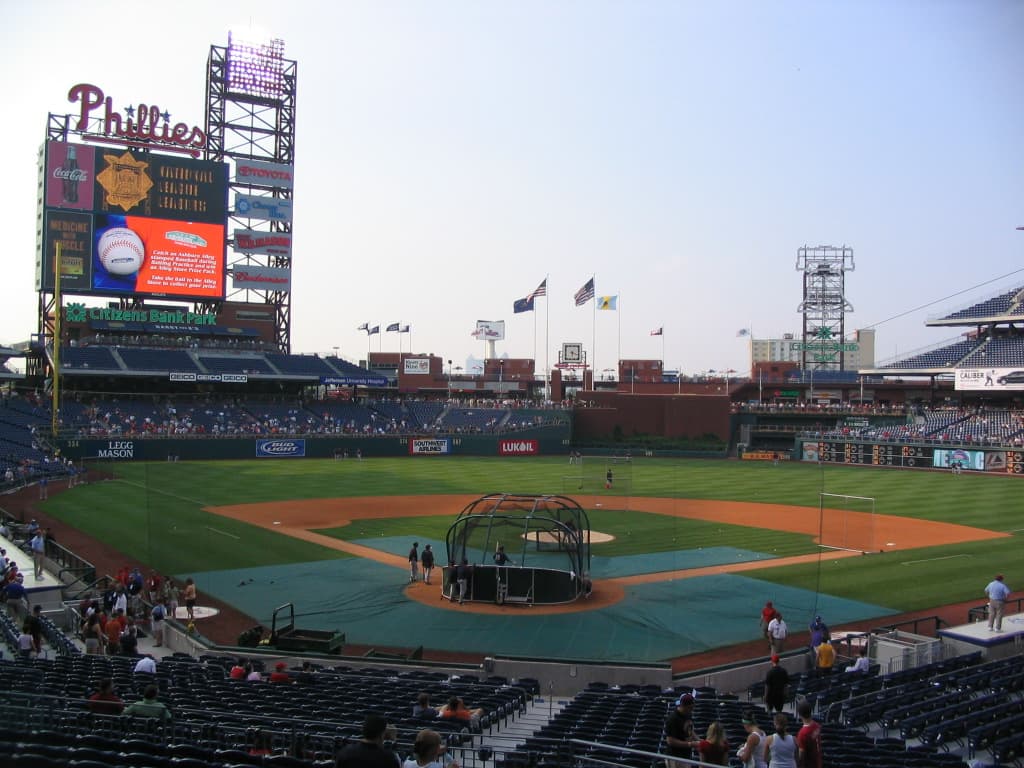
Citizens Bank Park opened on April 3, 2004, and hosted its first regular-season game on April 12, 2004, against the Cincinnati Reds. It was built on the northeast corner of the South Philadelphia Sports Complex, alongside Lincoln Financial Field (home of the Eagles, opened 2003) and what is now Xfinity Mobile Arena, and it was designed from the start as a baseball-only park: natural grass and dirt, a seating bowl shaped for the game, and a scale — about 43,000 seats — that keeps the farthest seat close to the field. The Phillies, the oldest team in Major League Baseball, remaining in Philadelphia since their genesis in 1883, finally had a home built for their sport alone.
The park's architecture tells that story in brick and steel. Multi-story buildings housing fan facilities, team offices, and services surround the grandstand bowl, facing 11th Street to the west, Pattison Avenue to the south, and Darien Street to the east. The seating bowl's distinctive angles recall Shibe Park — Connie Mack Stadium — the Phillies' beloved early home, and the park's brick, its exposed steel, and its open outfield concourses give it a warmth the Vet never had. It is a ballpark in the retro-classic mode of Camden Yards and PNC Park, but with a Philadelphia accent: unpretentious, working-class, and loud.
Ashburn Alley, and the bell
The park's signature space is Ashburn Alley, the outfield concourse behind center field named for Richie Ashburn, the Hall of Fame center fielder who played for the Phillies from 1948 to 1959 and broadcast their games from 1963 until his death in 1997. Ashburn Alley is not a concourse in the usual sense — a corridor for getting from one seat to another — but a destination: local restaurants and food stands, baseball-themed interactive displays, a climbing wall, a bullpen speed pitch, and the open outfield, where fans can watch the game from the standing areas and the rooftop bleachers, nearly 400 seats on the roof of the outfield pavilion, offering a view of the downtown Philadelphia skyline beyond the center-field fence.
Ashburn Alley's food is part of the experience, and it is deliberately Philadelphian: cheesesteak sandwiches, hoagies, soft pretzels, Tastykakes, and Yards and Yuengling beer, alongside the park's own specialties. The Schmitter — a steak sandwich with fried onions, tomatoes, and a secret sauce, served at the park's McNally's stand — is a local legend, and Bull's BBQ, named for former Phillie Greg "the Bull" Luzinski, is a fixture. Eating in Ashburn Alley, with the game in front of you and the skyline behind you, is the park's essential pleasure.
And then there is the bell. The park's most iconic feature is the massive Liberty Bell in right-center field: 50 feet high and 35 feet wide, modeled on the city's great symbol, which swings and lights up after every Phillies home run, accompanied by a recording of the bell's ring. It is a piece of civic theater — Philadelphia's founding symbol, repurposed as a home-run celebration — and on a night when the Phillies are hitting, it swings often. The bell, the skyline, and the brick together make Citizens Bank Park unmistakably a Philadelphia place, not a generic ballpark that could be anywhere.
The baseball, and the nights to remember
The park has hosted its share of baseball history, and quickly. In its first decade it saw the Phillies' great run of the late 2000s — five straight National League East titles from 2007 to 2011, a World Series championship in 2008, and another pennant in 2009 — and the park's atmosphere during that run, especially in October, became part of its reputation: a loud, red-clad, standing crowd, with the bell swinging and the skyline dark behind the outfield. The park hosted Game 3 of the 2022 National League Division Series and Game 3 of the 2022 World Series, among other postseason nights, and its reputation as one of baseball's best postseason atmospheres has only grown since.
The park's design serves that atmosphere. The seating bowl is steep and close, the outfield is open to the city, and the main HD video scoreboard above the outfield seats keeps the crowd connected to the game even from Ashburn Alley. The rooftop bleachers, the standing areas, and the concourses mean that a ticket here does not have to mean a seat — for many regulars, the park is a place to gather, eat, and watch from wherever the game looks best that night. It is a ballpark built for the way Philadelphians actually watch baseball: together, loudly, and with food in hand.
The Phillies' own history is honored throughout the park. The Philadelphia Baseball Wall of Fame, behind center field, honors the franchise's great players and figures, and plaques around the park mark moments like Jim Thome's 400th career home run, hit on June 14, 2004, in the park's first season. The park's statues and displays — including the bronze of Connie Mack, the legendary manager and owner, and the sculptures of the game's greats — turn a walk around the concourse into a tour of Phillies history, from the 1883 beginnings to the present.
How to visit
Citizens Bank Park is at One Citizens Bank Way, in the South Philadelphia Sports Complex, at Pattison Avenue and Broad Street. It is reachable by SEPTA's Broad Street Line to NRG Station, the southern terminus, with a short walk to the park, and by bus and car, with parking lots throughout the Sports Complex. No fixed ticket price is stated in this article, since none was verified against an official source in this run: ticket prices vary by opponent, date, seat, and demand, and the park's event schedule — Phillies games from spring through autumn, plus concerts and other events — changes through the year, so check the official Phillies and ballpark pages before visiting for current prices, schedules, and gate and bag policies.
Come early, especially for a weekend or postseason game: the gates open well before first pitch, and Ashburn Alley, the Wall of Fame, and the outfield areas are best explored before the crowd fills in. The park's Photo Day tradition — when gates open early to allow fans with cameras onto the warning track — is a beloved annual event for photographers. And plan for the neighborhood: the Sports Complex is a destination in itself, with Lincoln Financial Field and the arena next door, and the Broad Street subway makes a car unnecessary for most visitors. Pair a game with a cheesesteak run in South Philadelphia — the city's great debate, Pat's versus Geno's, is a short ride away — for a full Philadelphia day.
Key Facts
- Citizens Bank Park is a baseball stadium in Philadelphia, Pennsylvania, home of Major League Baseball's Philadelphia Phillies, in the South Philadelphia Sports Complex.
- The park opened on April 3, 2004, and hosted its first regular-season game on April 12, 2004, against the Cincinnati Reds, replacing Veterans Stadium (demolished 2004).
- It seats about 43,000 (42,901 at opening) and features a natural grass-and-dirt playing field.
- The Phillies are the oldest team in Major League Baseball, remaining in Philadelphia since 1883; Citizens Bank Park is the fifth venue they have called home.
- The park sits on the northeast corner of the South Philadelphia Sports Complex, alongside Lincoln Financial Field and Xfinity Mobile Arena.
- Ashburn Alley, the outfield concourse, is named for Hall of Fame center fielder Richie Ashburn (Phillies 1948–1959, broadcaster 1963–1997).
- The Liberty Bell in right-center field is 50 feet high and 35 feet wide; it swings and lights up after every Phillies home run.
- Nearly 400 rooftop bleacher seats sit on the roof of the outfield pavilion, with a view of the downtown Philadelphia skyline beyond center field.
- The park hosted the Phillies' 2008 World Series championship run, five straight NL East titles (2007–2011), and postseason games including the 2022 NLDS and World Series.
- A plaque marks the landing point of Jim Thome's 400th career home run, hit on June 14, 2004.
- Address: One Citizens Bank Way, Philadelphia, PA 19148.
- Coordinates: 39.9061, -75.1665.
Visitor Details
Address: One Citizens Bank Way, Philadelphia, PA 19148 (South Philadelphia Sports Complex, Pattison Avenue and Broad Street).
Transit: SEPTA Broad Street Line to NRG Station, then a short walk; bus and car access with parking lots throughout the Sports Complex.
Hours/Admission: No fixed ticket price is stated in this article, since none was verified against an official source in this run. Check the official Phillies and ballpark pages for current prices, schedules, gate times, and bag policies.
Best timing: Come early for a weekend or postseason game to explore Ashburn Alley, the Wall of Fame, and the outfield before the crowd fills in. Pair with a South Philadelphia cheesesteak stop for a full Philadelphia day.
Location Photography