
A cultural center twenty years in the making
The Adrienne Arsht Center for the Performing Arts did not arrive quickly. Miami had talked about a proper performing arts center since the 1980s, when the city's opera, ballet, and symphony companies were performing in borrowed and inadequate spaces — the Miami City Ballet in a converted space, the Florida Grand Opera at the Dade County Auditorium, the New World Symphony wherever it could find a stage. The Performing Arts Center Trust was formed to turn the talk into a building, and in 1990 the Miami-Dade County Commission approved an initial budget of $165 million for a center on Biscayne Boulevard, in the Omni district — the neighborhood that had been Miami's high-end shopping district in the 1940s and had been fading ever since.
What followed was sixteen years of fundraising, redesign, and delay. Private donors were asked to carry a large share of the cost, and they did: a $150 million private capital campaign, led by the Performing Arts Center Foundation, ran alongside public funding drawn largely from the county's Convention Development Tax and the Omni Redevelopment District's community redevelopment agency. The budget grew as the ambitions grew — from $165 million in 1990 to nearly $450 million by the time construction was under way — and the opening slipped again and again. Ground was finally broken in 2001, and five years of construction followed, on a site that included the 1929 Art Deco tower of the old Sears, Roebuck and Company department store, a landmark the architects were determined to keep.
When the doors finally opened on October 5, 2006, the city treated it as the civic event of a generation. The gala opening weekend featured the center's resident companies — the New World Symphony, the Florida Grand Opera, and the Miami City Ballet — and a guest list that ran from Gloria Estefan to Bernadette Peters. The final cost was $472 million, nearly three times the 1990 budget, and the building that resulted was one of the largest performing arts centers in the United States: 570,000 square feet, two purpose-built halls, a black-box theater, an education center, and a public plaza, all straddling one of Miami's busiest boulevards.
Two halls, one boulevard
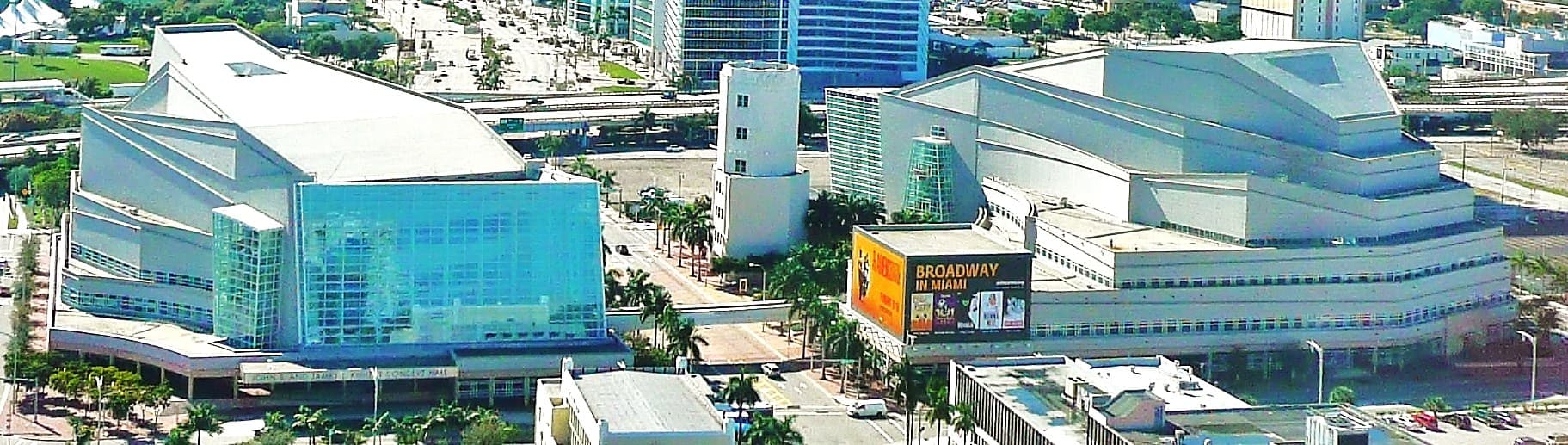
The center was designed by César Pelli, the Argentine-American architect of Pelli Clarke Pelli, chosen after an international competition. Pelli — whose work includes the Petronas Towers in Kuala Lumpur — believed that buildings should be "responsible citizens," and the Arsht Center is a building that takes its citizenship seriously. Rather than a single monolith, Pelli split the center into two pavilions on opposite sides of Biscayne Boulevard, joined by a pedestrian bridge that arcs over the traffic. The larger pavilion, on the west side, holds the opera house; the smaller, on the east, holds the concert hall. Between them, at street level, lies the Plaza for the Arts, a public square that belongs to the city as much as to the center.
The Sanford and Dolores Ziff Ballet Opera House seats 2,400 and is the center's grand stage, built for opera and ballet: a horseshoe auditorium with warm woods, deep reds, and a stage house large enough for the full productions of the Florida Grand Opera and the Miami City Ballet. The John S. and James L. Knight Concert Hall, across the boulevard, seats 2,200 and is a different kind of room entirely — a shoebox concert hall tuned for orchestral sound, with acoustics designed by Russell Johnson's firm, Artec Consultants, that have drawn praise from visiting musicians since the opening. A third venue, the Carnival Studio Theater, is a flexible black-box space of about 200 to 300 seats for experimental work, and the Peacock Education Center anchors the center's teaching programs.
The most quietly remarkable piece of the design is the one Pelli inherited rather than drew: the Art Deco tower of the 1929 Sears department store, restored and incorporated into the complex as a visible link to the Omni district's past. In a city that has too often demolished its history, the tower — with its stepped crown and limestone face — stands as the center's memory, a reminder that this was once a shopping street before it was a cultural district. The halls themselves are clad in limestone and glass, their facades catching the Biscayne Bay light, and at night the buildings glow from within, turning the boulevard into a kind of stage set for the city.
The name on the building
The center has had three names, and each one tells a chapter of its funding story. It was planned as the Miami Performing Arts Center. In 2006, a $20 million gift from Carnival Corporation — on top of an earlier $10 million gift from the Arison family — earned the cruise company naming rights, and the building opened as the Carnival Center for the Performing Arts. The opera house was named for Sanford and Dolores Ziff, who gave $10 million, and the concert hall for John S. and James L. Knight, whose foundation gave $10 million more.
Then, on January 10, 2008, came the gift that gave the center its present name and its financial footing. Adrienne Arsht, a business leader and philanthropist, donated $30 million — the largest single gift in the center's history — paid over three years. The money retired a bank loan, funded programming, and seeded a $16 million endowment, and in recognition the Carnival Center became the Adrienne Arsht Center for the Performing Arts of Miami-Dade County. Carnival's naming rights were unwound, though the Arison family's original gift was kept and honored with the naming of the Studio Theater, the pedestrian bridge, and the Art Deco Tower.
The resident companies
A performing arts center is only as good as the companies that live in it, and the Arsht Center's three resident companies are the reason the building exists. The Miami City Ballet, founded in 1985 by Edward Villella, performs its seasons in the Ziff Ballet Opera House, where its Balanchine repertory — the company is one of the great interpreters of George Balanchine's work — has a stage built to its scale. The Florida Grand Opera, one of the oldest performing arts organizations in Florida, stages its productions in the same hall, with full orchestra and chorus. And the New World Symphony, Michael Tilson Thomas's orchestral academy for young musicians, performs in the Knight Concert Hall.
Beyond the residents, the center hosts more than 300 events a year: touring Broadway productions, visiting orchestras and dance companies, popular music, comedy, and the free community programming that has become one of its signatures — concerts and festivals on the Plaza for the Arts that cost nothing to attend and draw crowds that would never buy a ticket. In 2020, the center was chosen to host the second presidential debate of that year's election; the debate was ultimately cancelled, but the selection itself said something about how far the building had traveled in fourteen years — from a delayed civic project to a place the country associated with Miami itself.
The plaza and downtown's revival
The Arsht Center was sold, from the start, as more than a theater: it was the anchor of an urban revitalization effort for downtown Miami, and by that measure it has delivered. The center's own figures credit it with catalyzing more than $1 billion in economic investment in the surrounding area, and the evidence is visible in the blocks around it. The Omni district, once a fading shopping quarter, is now the Arts & Entertainment District, home to the Pérez Art Museum Miami and the Phillip and Patricia Frost Museum of Science a short walk away on Biscayne Bay, and to the Museum Park that ties them together. The Metromover's Adrienne Arsht Center station — on the Omni Loop, steps from the plaza — makes the center one of the easiest cultural destinations in Miami to reach without a car.
The Plaza for the Arts is the key to that role. It is not a lobby or a forecourt but a genuine public square, open to the boulevard, where free concerts, festivals, and community gatherings spill out of the halls and into the city. On a performance night the plaza fills with audiences crossing between the two pavilions over the bridge; on a free-event day it fills with families who may never set foot inside. That openness was the point of Pelli's split design: a performing arts center that does not turn its back on the street but stages itself across it, so that even a passerby on Biscayne Boulevard is part of the audience.
How to visit
The Adrienne Arsht Center is at 1300 Biscayne Boulevard, between NE 13th and 14th Streets in downtown Miami, in the Arts & Entertainment District. The easiest way to arrive is the Metromover: the Adrienne Arsht Center station on the Omni Loop stops at the plaza. Metrorail's Government Center station is a short Metromover ride away, and buses serve Biscayne Boulevard. Drivers will find parking garages in the surrounding district, though on performance nights the area is busy and arriving early is wise.
No fixed ticket price or opening hour is stated in this article, since none was verified against an official source in this run: performance prices vary widely by show, seat, and company, and the box office and building hours change with the season, so check the official Arsht Center site before visiting for current prices, performance times, and ticketing details. Many of the center's plaza events are free, and the resident companies offer a range of ticket options, including lower-priced seats and community programs — the center's own site is the place to find them.
Plan the visit around a performance: pick a Miami City Ballet program or a Florida Grand Opera production in the Ziff Ballet Opera House, or a New World Symphony concert in the Knight Concert Hall, and arrive early enough to walk the plaza, cross the bridge between the pavilions, and look up at the restored Art Deco tower. Pair the evening with the Pérez Art Museum Miami and the Frost Museum of Science in Museum Park, a ten-minute walk down Biscayne Boulevard, for a full day in the district the Arsht Center helped create. Miami spent decades waiting for a stage of its own; the evening you spend in it is the payoff.
Location Photography


Key Facts
- The Adrienne Arsht Center for the Performing Arts of Miami-Dade County opened on October 5, 2006, as the Carnival Center for the Performing Arts, at 1300 Biscayne Boulevard in downtown Miami.
- It was designed by César Pelli of Pelli Clarke Pelli, with acoustics by Russell Johnson's firm, Artec Consultants; it occupies 570,000 square feet on two sites straddling Biscayne Boulevard, joined by a pedestrian bridge.
- The Sanford and Dolores Ziff Ballet Opera House seats 2,400; the John S. and James L. Knight Concert Hall seats 2,200; the Carnival Studio Theater is a flexible black-box space of about 200 to 300 seats.
- The total project cost was $472 million, against an initial 1990 budget of $165 million; funding combined a $150 million private capital campaign with county Convention Development Tax revenues and Omni Redevelopment District funds.
- On January 10, 2008, Adrienne Arsht donated $30 million to the center, and it was renamed in her honor; earlier naming gifts included $10 million each from Sanford and Dolores Ziff, the Knight Foundation, and the Arison family / Carnival Corporation.
- The resident companies are Miami City Ballet, Florida Grand Opera, and the New World Symphony.
- The center incorporates the restored 1929 Art Deco tower of the old Sears, Roebuck and Company department store.
- The Plaza for the Arts, the public square between the two pavilions, hosts free community concerts and festivals.
- The center is credited with catalyzing more than $1 billion in economic investment in downtown Miami.
- The center's address is 1300 Biscayne Boulevard, Miami, FL 33132.
- Coordinates: 25.7875, -80.1995.
Visitor Details
Address: 1300 Biscayne Boulevard, Miami, FL 33132 (between NE 13th and 14th Streets, Arts & Entertainment District).
Transit: Metromover Omni Loop to Adrienne Arsht Center station, at the plaza; Metrorail to Government Center, then Metromover; buses along Biscayne Boulevard; parking garages in the surrounding district.
Hours/Admission: No fixed ticket price or opening hour is stated in this article, since none was verified against an official source in this run. Check the official Arsht Center site before visiting for current performance prices, times, box office hours, and ticketing details. Many plaza events are free.
Best timing: Arrive early for an evening performance to walk the plaza, cross the pedestrian bridge, and see the Art Deco tower; pair with the Pérez Art Museum Miami and Frost Museum of Science in Museum Park, a short walk down Biscayne Boulevard.