
A monastery that crossed an ocean
The Cloisters begins, like many great New York stories, with an obsessive collector. George Grey Barnard was an American sculptor who lived in France in the early twentieth century and spent years buying the architectural remains of medieval monasteries — cloister arcades, capitals, doorways, and carved stonework — from farmers and dealers in the French countryside, where centuries of revolution and neglect had left abbeys in ruins and their stones scattered. By 1914 he had gathered enough material to open a museum of his own in Upper Manhattan, near Fort Washington Avenue, displaying his medieval fragments in a building of his own design.
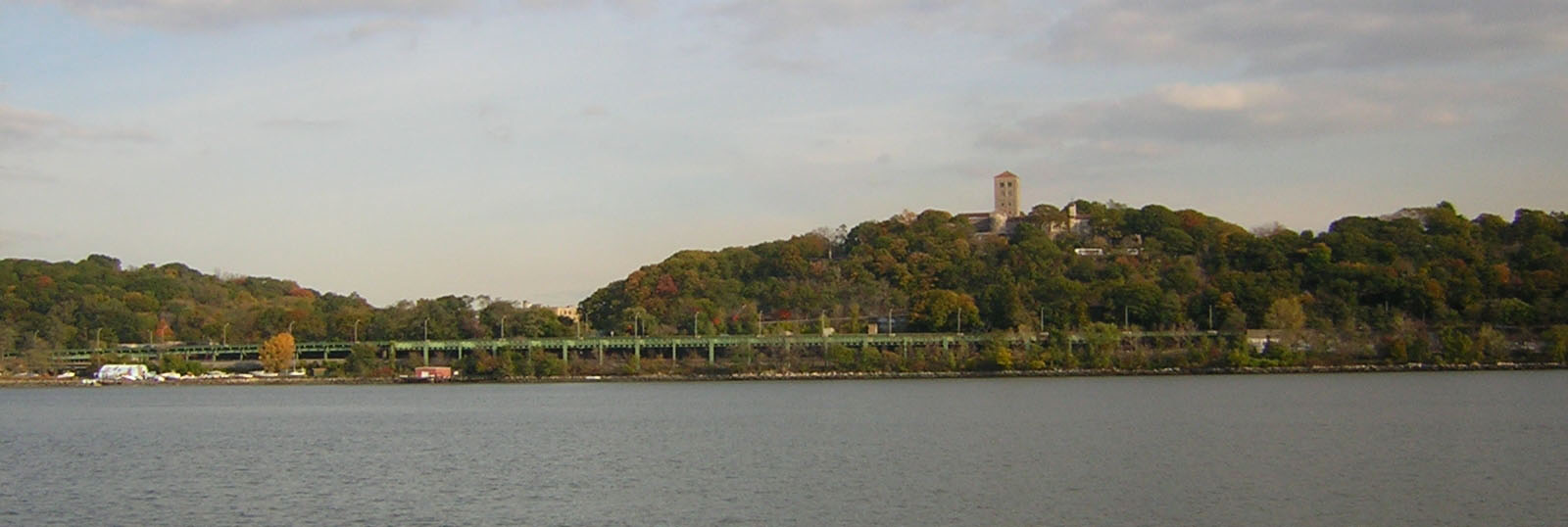
Barnard's finances, however, were as chaotic as his collecting was inspired, and in 1925 he sold his collection to John D. Rockefeller Jr. Rockefeller, who had already bought the Unicorn Tapestries in 1922, saw something larger in Barnard's stones than a private collection: a whole museum, built around them, in a new park at the top of Manhattan. He financed the purchase of the land that became Fort Tryon Park — some 66 acres on a high ridge above the Hudson, laid out by the Olmsted Brothers firm, Frederick Law Olmsted Jr. among them — and he bought hundreds of acres across the river in New Jersey, donating the land to preserve the Palisades cliffs so that the view from the new museum would never be spoiled by development. The park, the view, and the museum were conceived as one gift, and they still work that way: you cannot understand The Cloisters without the hill it stands on and the river it looks over.
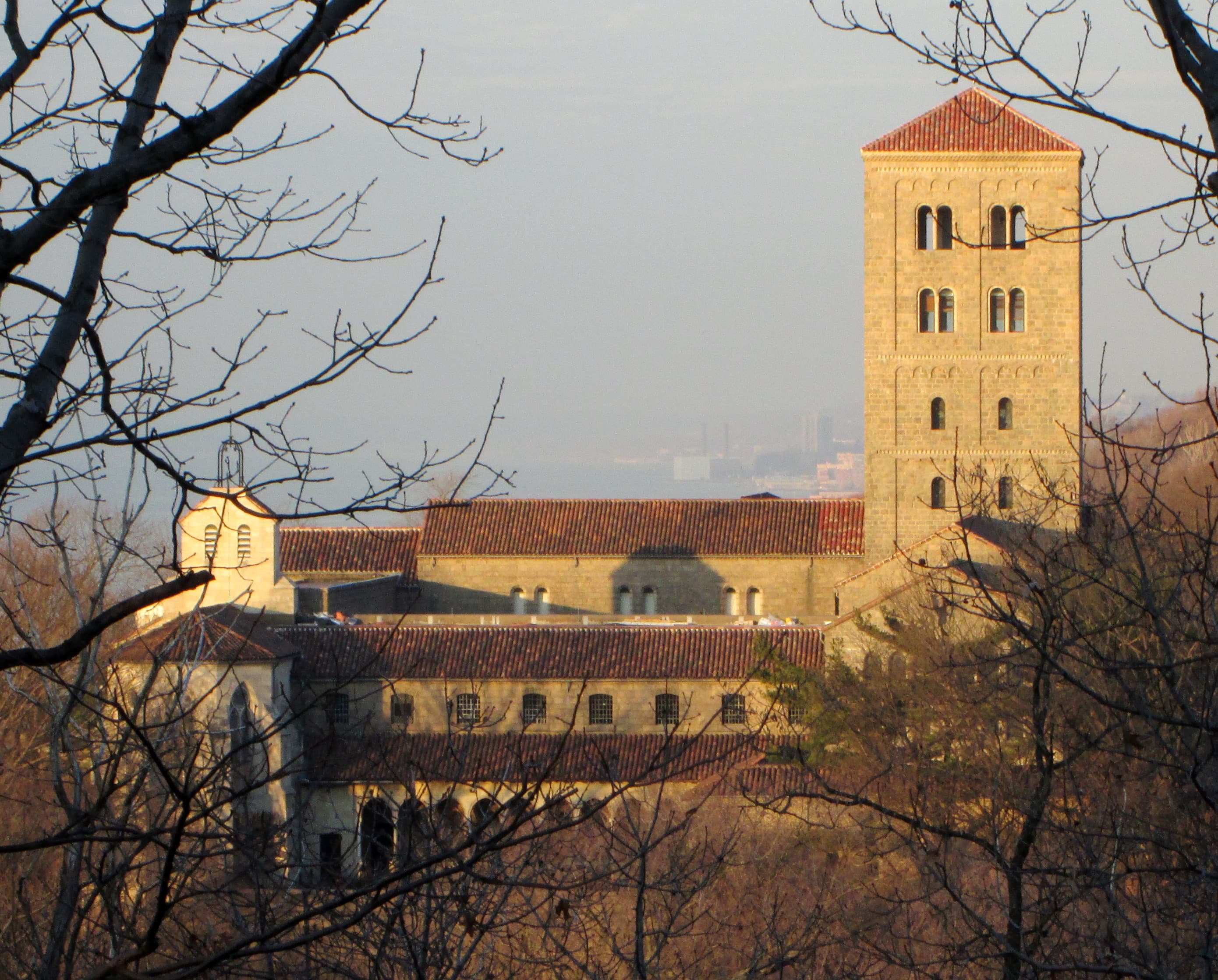
The architect Rockefeller chose was Charles Collens, of the Boston firm Allen, Collens and Willis — the same architect behind Riverside Church, a few miles down the Hudson. Collens faced a problem no architect had faced before: how to build a coherent modern museum out of the disassembled pieces of five medieval cloisters, a chapter house, and a Romanesque chapel, shipped stone by stone across the Atlantic. Construction began in the mid-1930s, and the new building opened on May 10, 1938, as a branch of the Metropolitan Museum of Art. It was described at the time as a collection shown informally in a picturesque setting, meant to stimulate the imagination — and that remains the best description of what it feels like to walk through it. The Cloisters is not a replica of any single monastery, and it does not pretend to be. It is a modern building, designed in the 1930s, that incorporates genuine medieval architecture into its very walls, so that the building itself is the first and largest work in the collection.
The building is the collection
That point is worth dwelling on, because it is what makes The Cloisters different from every other museum in New York. At the Met on Fifth Avenue, the galleries are rooms that hold art. At The Cloisters, the rooms are art. The museum takes its name from its cloisters — the covered walkways that surrounded the open courtyards of medieval monasteries, where monks walked, read, and meditated — and its galleries are organized around the real cloister arcades Barnard brought from France, reassembled here as passageways between the exhibition rooms, just as they were in their original monasteries.
The heart of the museum is the Cuxa Cloister, built from elements of the Benedictine abbey of Saint-Michel-de-Cuxa in the French Pyrenees, founded in 878, whose twelfth-century cloister — carved around 1130 to 1140 — was dismantled after the French Revolution scattered its stones. Walk its arcade slowly and look at the capitals: no two are alike, and their carvings — acanthus leaves, wrestlers, griffins, biblical scenes, monsters — are among the finest Romanesque sculpture in America, carved in the warm pink marble of the Pyrenees. The Cuxa Cloister is the largest of the museum's cloisters and its center of gravity; the galleries radiate from it, and its garden, the Judy Black Garden, with its central fountain and crossed paths dividing the garth into quadrants, is the museum's quiet center.
The other cloisters each have their own character, and learning to tell them apart is one of the pleasures of a visit. The Saint-Guilhem Cloister, from the abbey of Saint-Guilhem-le-Désert in southern France, is a showcase of twelfth-century carving, its columns and capitals densely worked with foliage and figures. The Bonnefont Cloister, assembled largely from a Cistercian abbey at Bonnefont-en-Comminges in southwestern France, surrounds one of the museum's three gardens — a herb garden of raised beds planted with species grown and used in the Middle Ages. The Trie Cloister, from a Carmelite house at Trie-sur-Baïse in the Pyrenees, encloses a garden planted to evoke the flowering meadows of medieval tapestries. Together with fragments from Froville, these cloisters span the Romanesque and Gothic periods, and walking from one to the next is a walk through the architectural history of the Middle Ages: from the heavy, rounded arches and thick walls of the Romanesque to the pointed arches, ribbed vaults, and great traceried windows of the Gothic, which let in the light that medieval builders associated with the divine.
Two rooms deserve special attention. The first is the Fuentidueña Chapel, the museum's largest room, which holds the apse of the church of San Martín at Fuentidueña, near Segovia in Spain — a Romanesque apse dated to about 1175 to 1200, built of more than 3,300 individual stone blocks. The apse was dismantled in 1957, shipped to New York in 839 crates, and reconstructed at The Cloisters, where it was presented in 1961 as a long-term loan from the Spanish government, in an exchange that sent frescoes from San Baudelio de Berlanga to the Prado in Madrid. Stand in the center of the chapel, under its barrel vault and semi-dome, before the great crucifix that hangs there, and you are standing inside a twelfth-century Spanish church — not a copy, but the thing itself, moved across an ocean and rebuilt stone by stone. The second is the Gothic Chapel, a soaring, light-filled room of pointed arches and stained glass, where French and Spanish tomb effigies lie in state beneath windows that turn the afternoon light into color. Between these two rooms — the heavy Romanesque apse and the soaring Gothic chapel — you can feel, in your body, the five centuries of architectural experiment that separate them.
The Unicorn Tapestries and the treasures within
The Cloisters holds about 5,000 works of art and architecture, nearly all European, mostly from the twelfth through fifteenth centuries — but one group of objects draws visitors from around the world, and it is worth the trip on its own. The Hunt of the Unicorn, known as the Unicorn Tapestries, is a series of seven tapestries woven in the Southern Netherlands around 1495 to 1505, probably designed in Paris and woven in Brussels, depicting noblemen and hunters pursuing a unicorn through an idealized French landscape. Woven in wool, silk, and metallic thread, their colors — made from dye plants including weld for yellow, madder for red, and woad for blue — are still vivid five centuries later, and their millefleur backgrounds, scattered with a thousand tiny flowers, are among the most recognizable images in all of medieval art.
The tapestries' own history is nearly as dramatic as the hunt they depict. Owned for centuries by the La Rochefoucauld family of France, they were looted during the French Revolution, when — according to the museum's own telling — they were at one point used by French soldiers to cover potatoes against the frost. Recovered by the family in the 1850s, they were bought by John D. Rockefeller Jr. in 1922; six hung in his New York home until they were donated to the museum, and the two surviving fragments were secured in time for The Cloisters' opening in 1938. They were cleaned and restored in 1998, and today they hang in a dedicated gallery on the museum's upper floor, in the order of the hunt: the hunters entering the woods, the unicorn at the fountain, the pursuit, the capture, and finally the unicorn at rest in a garden, chained to a pomegranate tree, surrounded by flowers. Whether the unicorn is a symbol of Christ, of chaste love, of marriage, or of all three at once has been debated for a century, and the museum does not settle the question — which is part of the pleasure. Stand before the final tapestry, the unicorn resting in its flowery enclosure, and decide for yourself.
The rest of the collection rewards the same slow looking. The Mérode Altarpiece, by Robert Campin and his workshop from around 1425 to 1428, is a foundational work of Early Netherlandish painting — a triptych of the Annunciation set in a contemporary Flemish interior, its domestic details (a mousetrap on the windowsill, a kettle over the fire) as carefully painted as its angels. The Cloisters Cross, a twelfth-century English walrus-ivory cross, carries more than ninety intricately carved figures and nearly a hundred inscriptions on a surface smaller than a dinner plate. The Treasury room holds liturgical gold and silver, ivory statuettes, reliquaries, and boxwood miniatures carved with a virtuosity that seems impossible at their scale. And the museum's small but exceptional collection of illuminated manuscripts — including the Hours of Jeanne d'Evreux, a tiny prayer book made for a queen of France around 1324 to 1328, and the Belles Heures du Duc de Berry, made by the Limbourg brothers around 1399 to 1416 — is displayed in the Treasury, where the low light protects pages that have survived seven centuries. The Cloisters has never chased masterpieces for their own sake; its objects are chosen to deepen the atmosphere of the rooms they sit in, and the effect is cumulative. You leave with the feeling of having visited a place, not just a collection.
Three gardens, planted from the Middle Ages
No account of The Cloisters is complete without its gardens, which were designed as an integral part of the museum from its opening in 1938 and remain one of its great attractions. There are three, each inside a cloister, each planted according to medieval sources — garden plans, herbals, and the flowers depicted in tapestries and manuscripts — and maintained by a horticultural staff that researches the living collection as seriously as the curators research the stone one.
The Judy Black Garden in the Cuxa Cloister is the most formal: a garth divided by crossed paths into four grass plots, each with a pollarded crab apple tree, around a central fountain — the classic plan of a monastic garden, a small earthly paradise for contemplation. In winter the arcades are glassed in, and the walkway becomes a conservatory of tender plants: date palm, orange, rosemary, and bay. The Bonnefont Cloister Herb Garden, on the lower level, is the most specialized: raised beds holding some 300 species, all of them grown and used during the Middle Ages, for food, medicine, magic, and artists' materials — a living herbal, arranged as a medieval gardener would have arranged it, around a central wellhead. The Trie Cloister Garden, also on the lower level, is the most poetic: planted to evoke the flowering meadow of the Unicorn Tapestries themselves, with the violets, wild strawberries, and periwinkle that appear woven into the tapestries hanging just inside the walls. In late spring and early summer, when the gardens are at their peak, the walk from tapestry to garden and back — from the woven flowers to the living ones — is the most quietly magical sequence in any New York museum.
The park, the river, and the walk there
The Cloisters' setting is half the experience, and visitors should treat the journey as part of the visit. Fort Tryon Park, designed by the Olmsted Brothers and completed in 1935, is one of New York's most beautiful parks: a high, wooded ridge of winding paths, stone terraces, and the Heather Garden, with views across the Hudson to the Palisades that Rockefeller preserved. The museum sits at the park's northern end, at 99 Margaret Corbin Drive, and the approach — up through the park, past the Linden Terrace, to the museum's tower, modeled on the tower of Saint-Michel-de-Cuxa — is deliberately theatrical: the building reveals itself slowly, through trees, like a monastery glimpsed on a pilgrimage route. The park is also historic ground in its own right: the ridge was the site of Fort Washington and the Battle of Fort Washington in November 1776, and Margaret Corbin, for whom the museum's drive is named, fought in that battle beside her husband's cannon — one of the first women to fight for the American cause, and the first to receive a military pension from the United States.
Inside, allow at least two to three hours, and more if you linger in the gardens. The museum's layout rewards a slow, looping route rather than a checklist: start in the Romanesque Hall and the Fuentidueña Chapel, work through the Cuxa Cloister and its garden, climb to the Unicorn Tapestries and the Gothic Chapel, and finish in the lower-level gardens of Bonnefont and Trie, where the light is softer and the crowds thinner. Photography of the collection for personal use is generally permitted in the museum's galleries, though flash and tripods are not, and some special exhibitions may differ — check the museum's posted gallery rules on arrival. The museum shop, in the spirit of the place, sells the standard guidebook, The Cloisters: Medieval Art and Architecture, by Peter Barnet and Nancy Wu, which is the best single introduction to the building and its collection if you want to go deeper after your visit.
How to visit
The Cloisters is at 99 Margaret Corbin Drive, Fort Tryon Park, in Washington Heights, Manhattan. It is reachable by subway — the A train to 190th Street, then a walk through Fort Tryon Park, or the A train to Dyckman Street — and by bus, including the M4, which runs up Madison Avenue and across to Fort Tryon Park. No fixed ticket price or opening hour is stated in this article, since none was verified against an official source in this run: admission arrangements and hours vary, and the museum's schedule changes through the year, so check the official Met Cloisters site before visiting for current prices, hours, and any timed-entry requirements. The Cloisters is a branch of the Metropolitan Museum of Art, and the Met's site is the authoritative source for planning a visit.
Pair the visit with the rest of Fort Tryon Park — the Heather Garden, the Linden Terrace, the Hudson views — and, if you have the energy, with the walk south through the park to the Dyckman Marina or the subway at 190th Street. The Cloisters is not a detour from New York; it is a reminder of what New York has always done best, which is to gather the world into itself — in this case, quite literally, stone by stone — and to put it on a hill above a river, where anyone willing to ride the subway to the end of the line can walk into the Middle Ages.
Key Facts
- The Cloisters opened May 10, 1938, as a branch of the Metropolitan Museum of Art, in Fort Tryon Park, Washington Heights
- America's only museum dedicated exclusively to medieval art and architecture, about 5,000 works, 12th–15th centuries
- Building designed by Charles Collens, incorporating portions of five medieval cloisters — Cuxa, Saint-Guilhem, Bonnefont, Trie-sur-Baïse, and Froville
- Cuxa Cloister from Saint-Michel-de-Cuxa, about 1130–1140, the museum's largest cloister
- Fuentidueña Apse from San Martín, Fuentidueña, Spain, about 1175–1200, more than 3,300 stone blocks, dismantled 1957, shipped in 839 crates, reconstructed 1961
- Hunt of the Unicorn tapestries, seven tapestries woven Southern Netherlands around 1495–1505, bought by Rockefeller 1922, donated 1938
- Mérode Altarpiece about 1425–1428, Cloisters Cross 12th century, Hours of Jeanne d'Evreux about 1324–1328
- Three cloister gardens — Judy Black Garden, Bonnefont Herb Garden, Trie Garden
- Fort Tryon Park designed by Olmsted Brothers, completed 1935
- Address: 99 Margaret Corbin Drive, New York, NY 10040
- Coordinates: 40.8648, -73.9319
Location Photography


Visitor Details
Address: 99 Margaret Corbin Drive, Fort Tryon Park, New York, NY 10040.
Transit: Subway A to 190th Street then walk through Fort Tryon Park, or Dyckman Street; buses including M4.
Hours/Admission: No fixed price or hour stated — check the official Met Cloisters site.
Best timing: Allow 2–3 hours or more; gardens best late spring/early summer.