
The marble box on the Potomac
On the eastern bank of the Potomac, at the edge of Foggy Bottom, stands a 630-foot box of white Carrara marble — the national cultural center of the United States, and a living memorial to the president who championed it. Inside are three great halls, a foyer the Washington Monument could lie down in, a free stage that plays every night, and the best rooftop view in the city. It took forty years to get built, and it has never really stopped being argued about since.
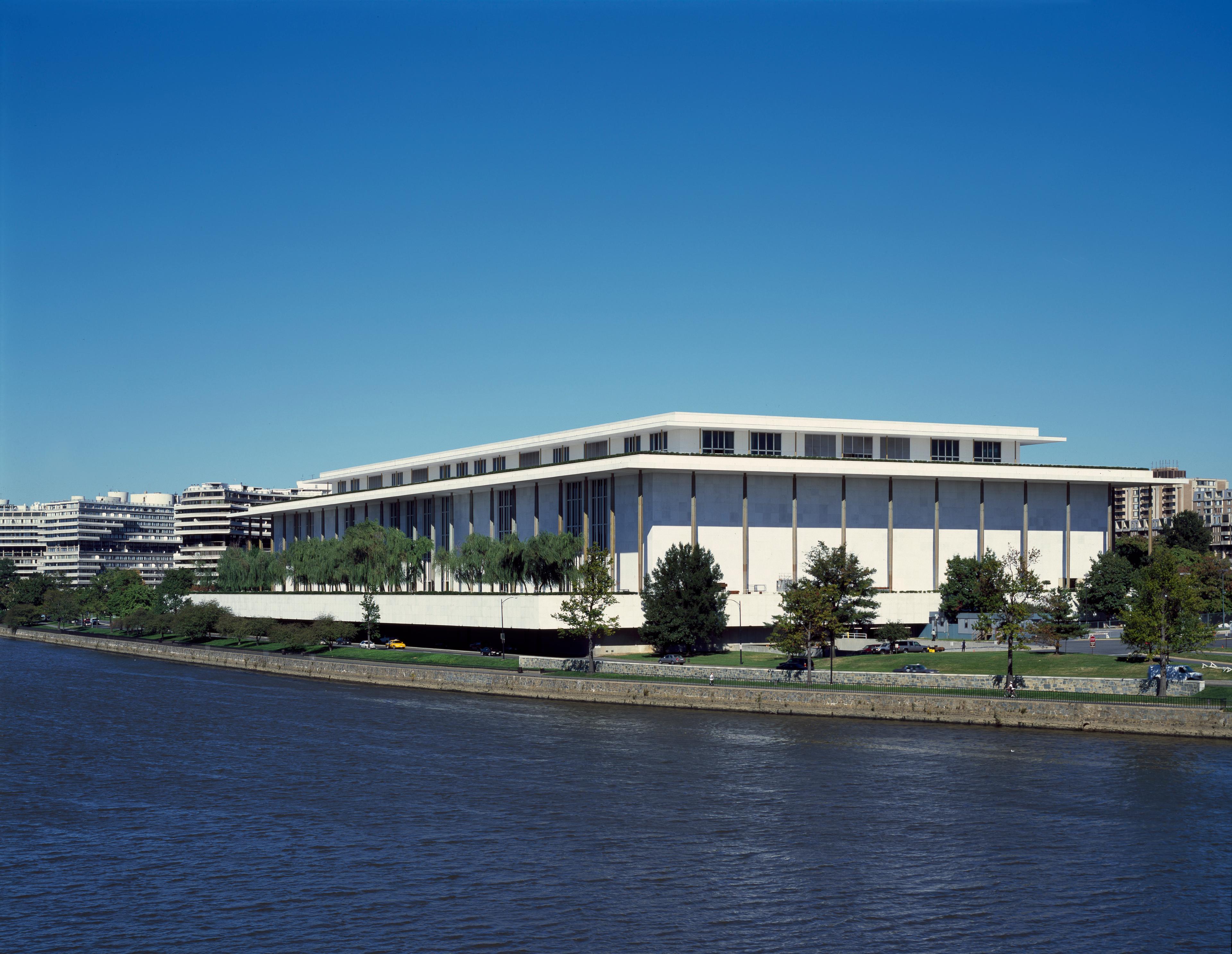
The John F. Kennedy Center for the Performing Arts sits on the eastern bank of the Potomac River at 2700 F Street NW, at the western edge of Foggy Bottom, just south of the Watergate complex. From the Virginia side of the river it reads as a single long, low, gleaming white box — 630 feet long, 300 feet wide, and 100 feet high, clad in white Carrara marble — and that is almost exactly what it is: one enormous building holding three theaters, a foyer the size of a city block, rehearsal rooms, classrooms, restaurants, and a roof terrace, all under one roof. It is the national cultural center of the United States, the home of the National Symphony Orchestra, the stage for the Kennedy Center Honors, and, by act of Congress, a living memorial to John F. Kennedy.
It is also, famously, a building people have strong opinions about. Critics have called it too big, too far from the Metro, too plain, too grand. Audiences have filled it for more than fifty years anyway — more than 2,000 performances a year across its stages, from opera and ballet to jazz, hip hop, Broadway, and free concerts on a stage that costs nothing to attend. The way to understand the Kennedy Center is not as a monument or a museum but as a working theater that happens to be the size of a monument, and a memorial that happens to be alive every night of the week.
The best first approach is from the river. Walk the Potomac waterfront or cross from Virginia on the Theodore Roosevelt Bridge, and the building shows its intended face: the long marble wall rising from the bank, the colonnade of the roof terrace, the Watergate's curves behind it. Come inside and the scale flips — the Grand Foyer is 630 feet long and 63 feet high, one of the largest rooms in the world, hung with sixteen hand-blown Swedish crystal chandeliers and carpeted in red. If the Washington Monument were laid on its side, it would fit inside this room with 75 feet to spare.
A national cultural center, forty years in the making
The idea of a national cultural center in Washington is older than the building by nearly forty years. It dates to 1933, when First Lady Eleanor Roosevelt raised the idea of a national theater as a way to relieve unemployment among actors during the Great Depression. Congress held hearings in 1935 for a Cabinet-level "Department of Science, Art and Literature" and a monumental theater on Capitol Hill; a 1938 resolution called for a public building to be known as the National Cultural Center near Judiciary Square. None of it materialized.
The idea resurfaced in 1950, when Representative Arthur George Klein of New York introduced a bill to authorize funds to plan and build a cultural center — a bill that notably required the center to prohibit discrimination in casting and audiences. In 1955 the Stanford Research Institute was commissioned to pick a site and make recommendations, and from 1955 to 1958 Congress debated the proposal amid considerable controversy. A bill finally passed in the summer of 1958, and on September 4, 1958, President Dwight D. Eisenhower signed the National Cultural Center Act into law. It was the first time the federal government had helped finance a structure dedicated to the performing arts.
The act required a share of the cost to be raised privately within five years, and fundraising went badly at first. The board of trustees Eisenhower established in January 1959 raised only $13,425 in its first three years. The architect Edward Durell Stone was selected in June 1959, and his preliminary designs — with cost estimates that had already doubled to $50 million — were approved by the Commission of Fine Arts, the National Capital Planning Commission, and the National Park Service. But the money was not there, and the project stalled.
What saved it was John F. Kennedy. The new president was genuinely interested in bringing culture to the capital, and he gave the project leadership and support it had lacked. In 1961 he asked the theater producer Roger L. Stevens to develop the National Cultural Center and serve as chairman of its board of trustees. Stevens recruited First Lady Jacqueline Kennedy as honorary chairman and former First Lady Mamie Eisenhower as co-chairman. Fundraising began to move. By the time of Kennedy's assassination in November 1963, the center had raised $13 million — still far short, but a real project at last.
A living memorial
After the assassination, the board re-envisioned the project as a living memorial to the slain president, and Congress agreed. On January 23, 1964, President Lyndon B. Johnson signed a bill renaming the National Cultural Center the John F. Kennedy Center for the Performing Arts — a memorial that would not be a statue or a tomb, but a working theater. The words matter: a living memorial, a place where the arts Kennedy had championed would be performed every night.
President Johnson broke ground for the building on December 2, 1964, with Roger Stevens looking on. Debate over the Foggy Bottom site continued for another year — some still argued for Pennsylvania Avenue — but excavation began on December 11, 1965, and the site was cleared by January 1967. Construction ran from 1966 to 1971 under the Philadelphia contractor John McShain, and the final cost was $70 million: Congress provided $43 million, including a $23 million outright grant and $20 million in bonds, and private donations made up the rest, including $5 million from the Ford Foundation and about $500,000 from the Kennedy family. Foreign governments gave gifts that are still part of the building: the Italian government donated 3,700 tons of Carrara marble, mined in the Apuan Alps and worth $1.5 million, which clads the facade and the interior walls; Sweden gave the sixteen Orrefors crystal chandeliers in the Grand Foyer; Austria gave the Lobmeyr crystal chandelier in the Opera House; Japan gave the Opera House's red and gold silk curtain; Norway gave the Hadeland crystal chandeliers in the Concert Hall.
The marble is the building's signature and its argument. Stone's design is unapologetically monumental — a long, symmetrical, white box on a terrace above the river, its facades broken by tall, narrow windows and a colonnade. An earlier proposal had been curvier, almost spaceship-like, resembling the neighboring Watergate. Stone's final building is restrained to the point of severity from the outside, and it has drawn criticism for its scale and its distance from the city's Metro stations ever since. The critic Ada Louise Huxtable, in her book On Architecture, called it "gemütlich Speer" — cozy Speer, after Hitler's architect Albert Speer. The praise, from the start, has been for what is inside: the halls, the acoustics, and the terrace over the river.
Opening night: Bernstein's Mass
The first performance at the Kennedy Center was on September 5, 1971, when 2,200 members of the general public attended the premiere of Leonard Bernstein's Mass in the Opera House. The official opening came three days later, on September 8, 1971, with a formal gala and a second performance of Mass — a theater piece for singers, players, and dancers that Jacqueline Kennedy had commissioned from Bernstein for the occasion, and which remains one of the most ambitious works ever written for an opening night. Rose Kennedy and Ted Kennedy watched from the presidential box.
The rest of that first week filled in the building's identity. The Concert Hall was inaugurated on September 9, 1971, with the National Symphony Orchestra conducted by Antal Doráti. Alberto Ginastera's opera Beatrix Cenci premiered in the Opera House on September 10. The Eisenhower Theater, named for the president who had signed the 1958 act, was inaugurated on October 18, 1971, with A Doll's House starring Claire Bloom. The building was complete, the company was in residence, and the living memorial was open for business.
The building: marble, glass, and a box within a box
Walk into the Kennedy Center and the first thing you meet is the Grand Foyer: 630 feet long, 63 feet high, red carpet underfoot, glass walls at either end looking out over the river and the city. The sixteen Orrefors chandeliers hang in rows, each one a cascade of hand-blown crystal. At the center of the foyer, opposite the entrance to the Opera House, stands the building's centerpiece: an eight-foot bronze bust of John F. Kennedy, sculpted by Robert Berks in 1971, weighing 3,000 pounds and seated on a ten-foot marble pedestal. It has stood there since opening night.
Running off the foyer are the two great corridors that organize the building: the Hall of States and the Hall of Nations, each 250 feet long and 63 feet high. The Hall of States displays the flags of the fifty states; the Hall of Nations displays the flags of the nations of the world — a reminder that this is a national center that thinks of itself in international terms, and that foreign governments helped build it.
The auditoriums themselves were designed by the acoustician Cyril M. Harris, and the building's cleverest piece of engineering is invisible: because the Kennedy Center sits directly under the flight path to Ronald Reagan Washington National Airport, with heavy helicopter traffic along the river as well, each auditorium was built as a box within a box, with an extra outer shell to keep the noise of the sky out of the music. It works. The halls are famously quiet, and their acoustics have been praised since the day they opened.
Outside, the plaza holds two more gifts. Near the north end stands War or Peace, and at the south end America — two 50-foot-long reliefs by the German sculptor Jürgen Weber, created between 1965 and 1971 as a gift from the West German government. War or Peace shows five scenes of war, murder, family, and creativity; America shows four scenes of threats to liberty, technology, foreign aid, and free speech. Weber spent four years sculpting them in plaster, making two hundred castings, and another two years having them cast in Berlin. Nearby, at the northeast corner of the building, stands Don Quixote by Aurelio Teno, given by King Juan Carlos I and Queen Sofía of Spain for the United States Bicentennial in 1976.
Three great halls — and a few smaller ones
The Kennedy Center has three main theaters, stacked side by side inside the marble box.
The Concert Hall, at the south end, is the largest performance space in the building, seating 2,465, and it is the home of the National Symphony Orchestra. The orchestra was founded in 1931 by the cellist Hans Kindler, originally based at Constitution Hall, and it has been housed at the Kennedy Center since the venue opened; it became a formal artistic affiliate in 1986. The hall was renovated in 1997 with a high-tech acoustical canopy, new seating sections, and repositioned Hadeland crystal chandeliers, and a new pipe organ by the Canadian builder Casavant Frères was installed in 2012. The NSO plays the hall's subscription season, its Pops programs, and the annual televised A Capitol Fourth and National Memorial Day Concert broadcasts.
The Opera House, in the middle, is the center's major opera, ballet, and large-scale musical venue, with about 2,347 seats. Its walls are covered in red velvet, its curtain is the red and gold silk given by Japan, and its Lobmeyr crystal chandelier, with matching pendants, was a gift from Austria. It is the home of the annual Kennedy Center Honors, and it was the home of the Washington National Opera for half a century. It closed for the 2003–04 season for renovations that revised the seating and redesigned the orchestra-level entrances.
The Eisenhower Theater, on the north side, seats about 1,161 and primarily hosts plays and musicals, smaller operas, ballet, and contemporary dance. It has an orchestra pit for up to 35 musicians that can be converted into a forestage or extra seating, and it reopened in October 2008 after a sixteen-month renovation that altered its color scheme and seating.
The smaller venues fill out the building: the Terrace Theater, with 490 seats, built on the roof terrace level in the late 1970s as a Bicentennial gift from the people of Japan and renovated between 2015 and 2019; the Family Theater, with 320 seats, opened December 9, 2005, for children's and family programming; and the Theater Lab, with about 398 seats, which housed the whodunit Shear Madness — the longest-running non-musical in American theater history — from August 1987 until its final performance on June 7, 2026, a run of 14,737 shows.
The Honors, the free stage, and the joke prize
Three of the Kennedy Center's programs have made it a national institution beyond its own walls.
The Kennedy Center Honors have been awarded annually since 1978. Each year, five artists or groups are honored in the Opera House for their lifetime contributions to American culture — dance, music, theater, opera, film, and television — in a December gala attended by the president and broadcast nationally. The honorees are announced each year to the kind of attention usually reserved for the Nobel Prizes, and the ceremony's signature image — the honorees seated in the presidential box, the house rising to them — has become part of American civic ritual.
The Millennium Stage is the opposite of the Honors in almost every way, and it is the Center's most democratic idea. Created in the 1990s as part of the "Performing Arts for Everyone" initiative, it presents free performances in the Grand Foyer nearly every evening, featuring artists from all fifty states and across every genre — classical, jazz, folk, dance, theater, world music. The performances are livestreamed and archived on the Center's website, so the free stage reaches far beyond the building. For a visitor, it is the best deal in Washington: world-class performance, no ticket, in one of the great rooms in America.
The Mark Twain Prize for American Humor has been awarded annually since 1998 to the nation's outstanding humorists, named for the nineteenth-century writer who did more than anyone to define American comedy. The Center also runs major education programs — the Kennedy Center American College Theater Festival, which for decades involved more than 18,000 students a year from over 600 colleges, and Changing Education Through the Arts, which trains hundreds of teachers a year in arts integration — and it has presented large-scale international festivals, from African Odyssey and AmericArtes to the Festival of China and Nordic Cool 2013.
The REACH: the Center grows south
For nearly fifty years the Kennedy Center was a single building. Then, in 2013, a competition selected Steven Holl Architects to design an expansion, and the REACH — the name is a statement of intent — opened in September 2019 on the Center's south lawn, toward the river.
The REACH is three white pavilions of curving, sculptural concrete and glass, set in landscaped grounds with a reflecting pool, an outdoor stage, and a grove of ginkgo trees. Inside are rehearsal studios, classrooms, and flexible performance spaces: the River Pavilion, a 268-seat room with a wall of windows and views of the Potomac; the Skylight Pavilion, a 425-person event space under a vaulted ceiling; Studio K, the largest multipurpose room, now home to the Kennedy Center Jazz Club; and the Justice Forum, a 144-seat lecture hall. The REACH is where the Center does its work in the open — rehearsals you can watch, classes you can join, performances that spill outdoors — and its lawns have become one of the most pleasant places in Foggy Bottom to sit with the river in front of you.
The roof terrace
The one part of the Kennedy Center every visitor should see, even without a ticket, is the roof terrace. It runs the length of the building at the top, open to the sky, and it offers one of the great views in Washington: the Potomac below, the Lincoln Memorial and the National Mall to the east, the National Cathedral to the north, and the Air Force Memorial across the river in Arlington. At sunset the terrace fills with people who have come for the view alone, and on a clear evening it is the best free panorama in the city. The Terrace Theater sits at this level, and the terrace is also the place where the building's scale finally makes sense — a 630-foot-long roof garden above a 630-foot-long foyer, the whole marble box turned into a viewing platform for the capital it serves.
The Center today
A travel article about the Kennedy Center written in 2026 has to note, briefly, that the institution has been through a turbulent two years. In February 2025, President Donald Trump dismissed the Center's board of trustees, replaced them, and was elected chairman; the new board voted to add his name to the Center, a move later determined to be unlawful. Ticket sales fell, dozens of performances were canceled, and the Washington National Opera, resident since 1971, ended its affiliation in January 2026. In February 2026 the Center's leadership said the building would close that July for two years of renovations; in May 2026, U.S. District Judge Christopher R. "Casey" Cooper blocked the Center from closing during renovations and ordered the added name removed from the building, which was done on June 13, 2026. The Center remains open, and its programming continues — but it is a fast-moving situation, and visitors should check kennedy-center.org for current programming and schedules before planning a trip, rather than relying on any single article.
How to visit
The Kennedy Center is at 2700 F Street NW, at the western edge of Foggy Bottom, on the Potomac just south of the Watergate complex. The nearest Metro station is Foggy Bottom–GWU (Blue, Orange, and Silver lines), about a ten-minute walk, and the Center runs a free shuttle between the station and the building; the D10 Metrobus also serves the Center. If you are driving, the Center has its own parking garage beneath the building — check kennedy-center.org for current parking arrangements before visiting, since they change.
The building itself is free to enter and explore: the Grand Foyer, the Hall of States, the Hall of Nations, the Art and Ideals: President John F. Kennedy exhibit (a permanent exhibit on Kennedy's relationship with art, opened in September 2022), and the roof terrace are all open to the public without a ticket. Allow an hour to wander the foyer and the halls and take in the terrace view, longer if you want to linger. The best free experience in the building is a Millennium Stage performance in the early evening — check the day's schedule on kennedy-center.org, arrive early, and take a seat in the foyer as the chandeliers come on.
For a ticketed performance, book through kennedy-center.org. No ticket prices are stated in this article, since none was verified against the Center's official site in this run — prices vary widely by performance, seat, and season, and the only reliable source is the Center's own listings. The same applies to opening hours and the schedule of free performances: check the official site before visiting, since programming changes frequently. Free guided tours of the building have historically been offered; confirm availability on kennedy-center.org before your visit.
Come at dusk if you can. The marble catches the last light over the river, the foyer glows, and the terrace gives you the city in a single sweep — the reason the building is where it is, on the bank of the Potomac, facing the capital it was built to serve.
Location Photography