
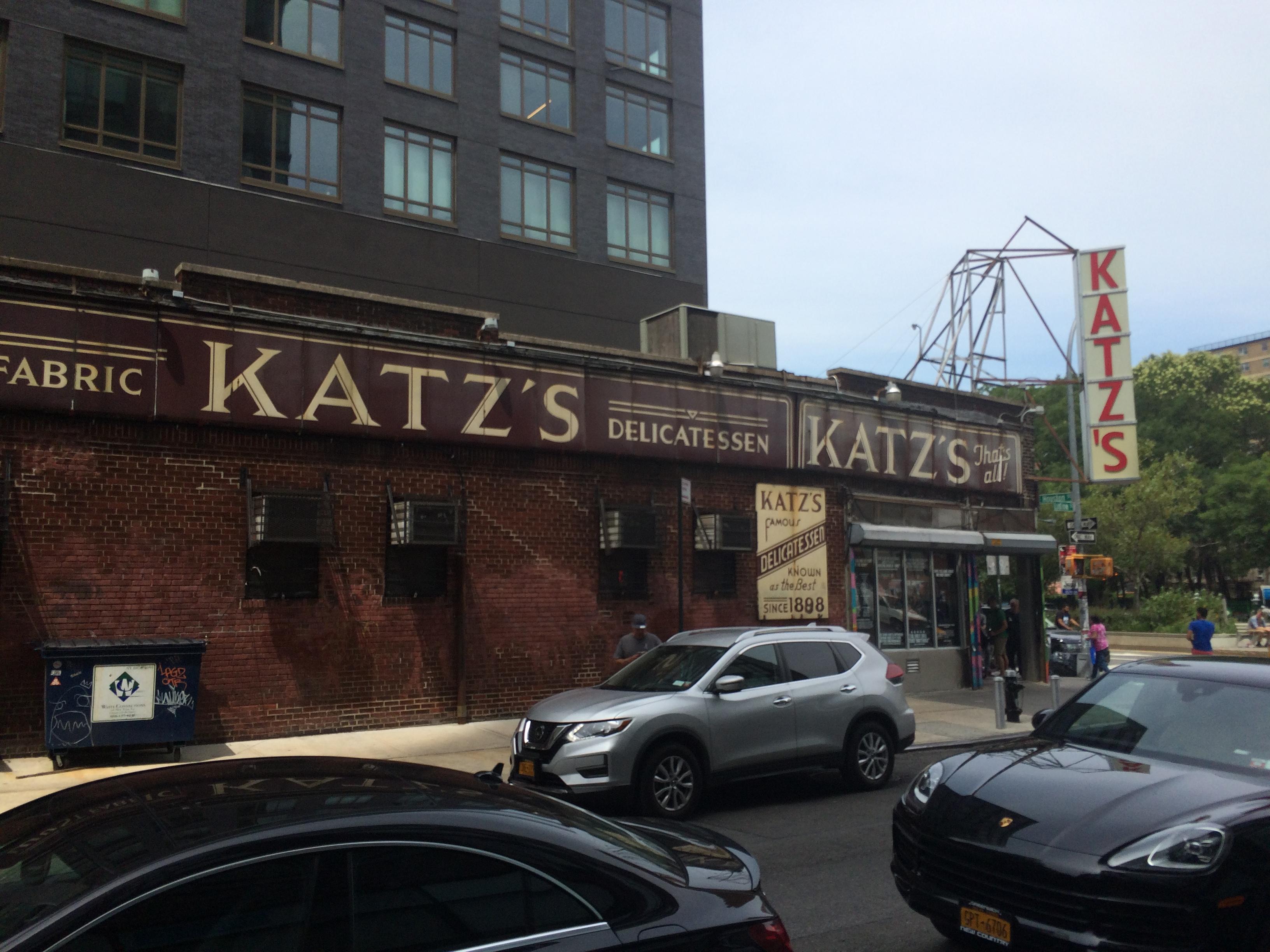
The corner of Houston and Ludlow
Katz's Delicatessen stands at 205 East Houston Street, on the southwest corner of Houston and Ludlow Streets on the Lower East Side of Manhattan. The building is unremarkable — a low brick storefront with a painted sign that runs the length of the facade — and the room inside is, by the standards of a city that rebuilds itself every generation, almost absurdly unchanged. There is a long counter where cutters in white aprons carve pastrami and corned beef by hand. There are salamis hanging from the ceiling. There are communal tables with Formica tops, bottles of mustard and pickles, and walls covered floor to ceiling with framed photographs of famous people who have eaten here. At the door, a man hands you a small numbered paper ticket. That ticket is your bill, your receipt, and your way out.
Katz's has been serving food on this corner since 1888. That is the claim the deli makes, and it is printed on the side of the building: "Known as the Best Since 1888." By that reckoning it predates the zipper, the automobile, the airplane, the motion picture, and the consolidation of the five boroughs into Greater New York. It is widely described as the oldest deli in New York City and the oldest continuously operating deli in the United States — a claim worth stating with a small grain of salt, since the food writer Robert F. Moss has pointed out that Ellis Island records show the founding Iceland brothers immigrating only in 1902, and that their delicatessen may not have opened until around 1911. The deli's own chronology says 1888, and 1888 is the date on the wall. What is not in doubt is that Katz's has been in continuous operation on this corner, in one form or another, for well over a century — longer than any other deli in the city — and that it has served the same food, in the same way, to the same cross-section of New York for most of that time.
Each week, Katz's serves about 15,000 pounds of pastrami, 8,000 pounds of corned beef, 2,000 pounds of salami, and 4,000 hot dogs. In 2016, Zagat gave the deli a food rating of 4.5 out of 5 and ranked it the number one deli in New York City. The pastrami on rye is the reason people come, and the reason the line outside the door can run the length of the block. But the pastrami is only half the story. The other half is everything around it: the ticket, the slogan, the table, the photographs, and the room itself — a piece of the old Lower East Side that survived when almost everything else on the block did not.
Iceland Brothers and the Lower East Side of 1888
The Lower East Side of 1888 was the most densely populated neighborhood in the United States, and possibly in the world. Tens of thousands of Jewish immigrants from Eastern Europe were arriving every year, crowding into tenements on streets like Ludlow, Orchard, and Hester, and building a world of pushcarts, synagogues, theaters, and small food shops. The delicatessen was one of the institutions they brought with them and remade in America: a shop selling cured and smoked meats — pastrami, corned beef, salami — along with pickles, mustard, and rye bread, food that kept without refrigeration and could be eaten standing up or carried home.
According to Katz's own chronology, two brothers named Morris and Hyman Iceland — Iceland being a name Jewish immigrants of the period sometimes adopted on arrival — established what is now Katz's Delicatessen on Ludlow Street in 1888. Their shop was one among dozens in the neighborhood, distinguished mostly by its location: the corner of Houston and Ludlow, at the edge of the Jewish quarter, where the neighborhood met the wider city. The deli was a takeout counter and a gathering place at once. In the early part of the twentieth century, with little public or private transportation and thousands of newly immigrated families living within a few blocks, Katz's became a focal point for congregating — a place where the neighborhood turned out on Fridays for franks and beans, a long-standing tradition, and where the news of the street was exchanged over the counter.
The deli's early history is inseparable from the Yiddish theater. During the peak of the Yiddish stage, actors, singers, and comedians from the many theaters on Second Avenue, as well as the National Theater on Houston Street, were regulars at Katz's. The deli was the green room of the neighborhood: the place you went after the show, and the place you were seen. That habit — famous people eating at Katz's, and Katz's photographing them doing it — never stopped. It is the origin of the celebrity wall that now covers the dining room.
The Katz family takes over
In 1903, Willy Katz arrived and joined the Iceland operation as a partner. The name changed from Iceland Brothers to Iceland & Katz. In 1910, Willy's cousin Benny joined him, and the two bought out the Iceland brothers; the name became Katz's Delicatessen, and it has stayed that way ever since. Their landsman Harry Tarowsky bought into the partnership in April 1917, and the three families — Katz, Katz, and Tarowsky — ran the deli together for the next seventy years.
The Katz family's management philosophy, in essence, was to change nothing that was working. The menu that Willy Katz and the Iceland brothers had developed in the 1880s and 1890s — built around cured and smoked meats, particularly pastrami and corned beef on rye, served with half-sour pickles and yellow mustard — remained the menu. The meats were cured in-house, the sandwiches were cut by hand, and the room was run the way it had always been run. When Willy Katz died, his son Lenny took over. In 1980, both Benny Katz and Harry Tarowsky died, leaving the store to Benny's son-in-law Artie Makstein and Harry's son Izzy. And in 1988, on the one-hundredth anniversary of the deli's founding, with no offspring of their own to leave the business to, Lenny, Izzy, and Arthur sold Katz's to the longtime restaurateur Martin Dell, his son Alan — who had been a chef and a manager at a neighboring deli — and Martin's son-in-law Fred Austin. Alan's son Jake joined the business in late 2009 and, as of 2020, is in charge of major operations. The current ownership is the Dell family, who have run Katz's since 1988 while keeping the name, the menu, and the room intact.
The subway moves the deli
Katz's has not always stood exactly where it stands now — it has stood on the same corner, but on the other side of the street. The construction of the New York City Subway's Houston Street line in the 1930s required the deli to move to the present side of Houston Street, although the entrance remained on Ludlow Street. The vacant lot on the Houston Street side held barrels of meat and pickles until the storefront facade was added in the period from 1946 to 1949. That facade is the one you see today: the long painted sign, the brick, the vertical neon "KATZ'S" sign at the corner, and the painted panel that reads "Katz's Famous Delicatessen — Known as the Best Since 1888."
The move is the reason the building looks the way it does — a low, flat-roofed, almost shed-like structure that seems out of scale with the apartment towers around it — and it is part of why the room inside feels so old. The deli was rebuilt once, in the late 1940s, and then, essentially, never again.
"Send a Salami to Your Boy in the Army"
Katz's most famous slogan was born in the Second World War, and it was born out of a family habit. During the war, the sons of the owners — Lenny Katz and Izzy Tarowsky — were both serving in the armed forces, and the families began sending them food from the deli. The tradition became the company slogan: "Send A Salami To Your Boy In The Army." The slogan was coined by Izzy's mother, Rose Tarowsky, whose son served in the South Pacific as a bomber pilot. Katz's printed it on signs, on packaging, and on the wall, and it caught on far beyond the Lower East Side: it became a national catchphrase, a piece of wartime Americana, and a way for families all over the country to send a taste of home to a son overseas.
The phrase outlived the war. It is part of the lyrics of a song in the 1950 Martin and Lewis film At War with the Army, and it is referenced in the Tom Lehrer song "So Long, Mom (A Song for World War III)" — "Remember, Mommy, I'm off to get a commie, so send me a salami, and try to smile somehow." Katz's still ships salami to American troops today: the deli has arranged special international shipping for U.S. military addresses only, and has been a source of gift packages to troops stationed in Afghanistan and Iraq. The sign is still on the wall, and the slogan is still, more than eighty years on, the most famous sentence ever written about a sandwich.
The deli's other catchphrase is shorter, and it is painted on the side of the building: "Katz's, that's all!" It came about, according to the deli's lore, when a signmaker asked Harry Tarowsky what the sign should say, and Harry replied, "Katz's, that's all." The signmaker took him literally and painted the sign as it stands today. Both slogans say the same thing about the place: that it needs no explanation, and that it has never felt the need to offer one.
The pastrami: thirty days, hand-carved
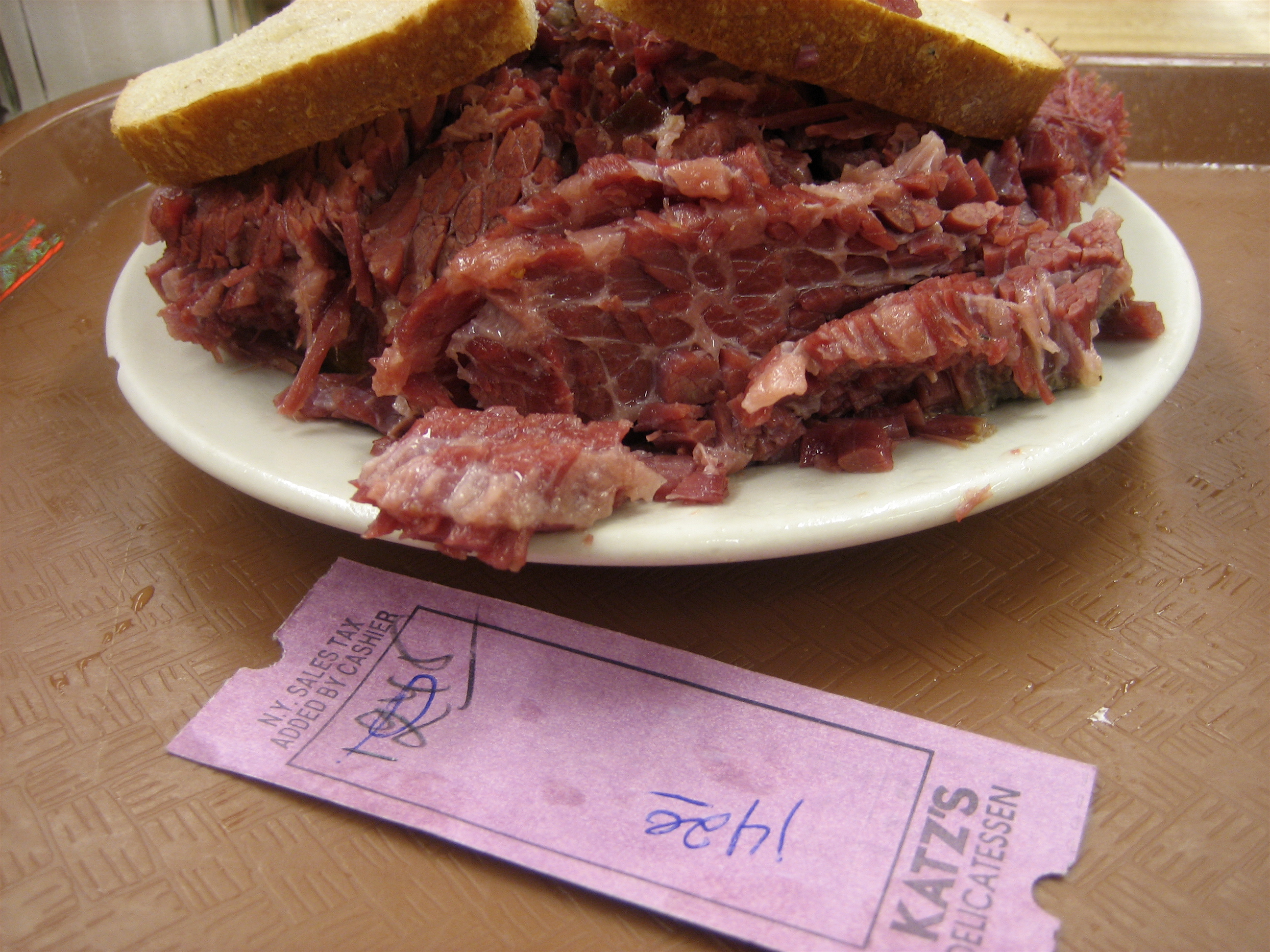
The food is the point, and the pastrami is the food. Katz's pastrami is made from the navel cut of beef — the belly, where the meat is fattest and most flavorful — cured and smoked, then boiled and steamed. The corned beef is brisket from the shoulder, pickled rather than smoked. Both are cured for thirty days, with no additives; commercially prepared corned beef, by contrast, is pressure-injected to cure in about thirty-six hours. Both are cut by hand, to order, at the counter — never by machine, never sliced in advance.
The ritual of ordering is part of the meal. You walk in and are handed a paper ticket. You join the line at the counter and tell a cutter what you want — pastrami on rye, lean or fatty, with mustard — and he carves it in front of you, stacking the meat on rye bread, often handing you a sample slice to taste while you wait. The sandwiches are enormous, the meat piled high and steaming, the bread barely visible underneath. The pickles are half-sour, served on the side, and the mustard is the bright yellow deli kind. There is no table service: you carry your own tray to a communal table, share it with strangers, and eat with your hands. The menu beyond the pastrami is the classic Jewish deli canon — corned beef, salami, Reubens, matzo ball soup, knishes, latkes, blintzes, kugel, egg creams, and Dr. Brown's sodas — but the pastrami on rye is the order, and everyone in the room knows it.
The scale of the operation is part of the spectacle. Fifteen thousand pounds of pastrami a week means the cutters are carving all day, every day, and the line at the counter is a permanent feature of the room. The wait is long, the room is loud, and the sandwich is worth it — which is why the line exists in the first place.
Inside Katz's Delicatessen


The ticket system
The paper ticket is the most old-fashioned thing in a room full of old-fashioned things, and it is the one visitors most often misunderstand. As each customer enters Katz's, a door attendant hands them a printed, numbered ticket. As they receive food from the various stations throughout the deli — separate stations for sandwiches, hot dogs, bottled drinks, and fountain drinks — employees compute a running total of the pre-tax bill on the ticket. If several people's orders are combined on a single ticket, a cashier collects the blank tickets. You pay at the exit, and you must return your ticket even if you bought nothing.
Katz's has instituted a lost-ticket fee: if a customer loses a ticket, a surcharge is added to the bill — reported as $50 by Eater NY and Wikipedia, though that figure was not verified against the deli's official site in this run. The fee's purpose, as stated by management, is to encourage patrons to go back and find the lost ticket, in the hopes of preventing theft — substituting a smaller ticket for a larger one. Truly lost tickets are rare, according to the deli's owner Jake Dell, and the historical timeline posted in the deli's window states that the first lost ticket didn't happen until 1962. The system dates to the deli's earliest days, and it has survived every change in the restaurant business around it: no table service, no tabs, no reservations, just a slip of paper and a man at the door who remembers your face.
"I'll have what she's having"
The table is the reason half the people in line are here. In 1989, Katz's was the location for the most famous scene in the romantic comedy When Harry Met Sally...: Meg Ryan's character, sitting across from Billy Crystal, fakes an orgasm in the middle of the crowded dining room to prove a point about men and women, and a woman at the next table — played by Estelle Reiner, the director Rob Reiner's mother — delivers the line that became one of the most quoted in film history: "I'll have what she's having."
The table at which Ryan and Crystal sat is marked with a sign that hangs above it and reads, "Where Harry met Sally... hope you have what she had! Enjoy!" It is almost always occupied, and it is photographed almost constantly. The scene made Katz's a global landmark in a way that eighty years of pastrami had not: people who had never heard of the Lower East Side knew the room, the tables, and the line. The deli has leaned into it without ever turning into a theme restaurant — the sign is small, the table is an ordinary table, and the pastrami is the same pastrami.
The film's shadow is long. In February 2025, Meg Ryan and Billy Crystal returned to Katz's to film a Hellmann's mayonnaise advertisement that first aired during Super Bowl LIX, parodying the original scene — Crystal commenting, "I can't believe they let us back in here!" — with Sydney Sweeney delivering the "I'll have what she's having" line. The advert was filmed in the restaurant, at the same table. Thirty-six years after the film, the table is still the most famous table in New York.
The celebrity wall and the deli in popular culture
Look at the walls, and you will see the other half of Katz's fame. The dining room is covered, floor to ceiling, with framed photographs of famous people eating at Katz's: presidents, actors, musicians, athletes, comedians, writers, and politicians, going back decades. The wall is a living archive — new photographs go up, old ones stay — and it is the direct descendant of the Yiddish theater days, when the actors from Second Avenue were regulars and the deli was their canteen. The habit of photographing the famous at the table has never stopped, and the wall has become an attraction in its own right: visitors walk the length of it the way they would walk a gallery.
Katz's has appeared on screen so often that the list reads like a filmography of New York itself. Johnny Depp's character met an FBI contact at Katz's in Donnie Brasco (1997). The deli is the site of a scene in Across the Universe (2007), in which Max reveals he has been drafted into the Vietnam War, and it appears in We Own the Night (2007) and Enchanted (2007), in which Nathaniel contacts Queen Narissa from the deli's kitchen. Katz's appears in the background of the claymation film Mary and Max (2009), and the 2010 Ugandan action comedy Who Killed Captain Alex? opens with a scene in which soldiers destroy the deli in an explosion. The deli was featured in the 2014 documentary Deli Man, about the fading world of the Jewish delicatessen, and it has been a location for Law & Order, Man v. Food, Impractical Jokers, and The Jim Gaffigan Show. It is, by now, less a restaurant that appears in films than a piece of the city's scenery that films come to find.
The Dell family and the modern era
The last forty years of Katz's history are the story of a family business learning to be an institution without becoming a chain. The Dell family, who bought the deli in 1988, have kept the room, the menu, and the ticket system intact while quietly modernizing everything around them. In 2013, the deli celebrated its 125th anniversary by opening a pop-up art gallery next door, featuring original art by local New York City artists. In 2017, Katz's opened its first auxiliary location, in the DeKalb Market Hall in Downtown Brooklyn, and also instituted mail-order sales — the salami, at last, available to anyone with an address. In 2021, Katz's partnered with Hendrick's Gin to make gin-inspired pickles, a brine built around juniper, cubeb berries, and coriander, a botanical shared by the gin and the deli's own pickles.
Not all of the modern era has been smooth. In 2011, the U.S. government sued Katz's for violations of the Americans with Disabilities Act, after federal officials read a Zagat guide ranking the fifty most popular restaurants in New York City and investigated whether they were accessible; the guide had ranked Katz's forty-second. In December 2024, as part of a settlement with the U.S. government, Katz's agreed to renovate its Ludlow Street building to make it wheelchair-accessible. The deli has also weathered the Lower East Side's transformation around it — the tenements giving way to boutiques and bars, the old neighborhood becoming one of the most expensive in the city — without changing the room. The line still forms. The cutters still carve by hand. The ticket is still paper.
That is the achievement. New York has a habit of turning its institutions into memories and its memories into plaques. Katz's is still a working deli, still crowded, still loud, still serving the sandwich it has served for more than a century. It is a landmark you can eat in — and, on a busy Saturday, a landmark you will wait in line to eat in. The wait is the price of the room being real, and it is the reason the room has survived.
How to visit
Katz's Delicatessen is at 205 East Houston Street, on the southwest corner of Houston and Ludlow Streets on the Lower East Side — reach it by subway on the F to Second Avenue (Houston Street) or the J/M/Z to Essex Street. Walk in and take the ticket from the attendant at the door; do not lose it. Join the line at the counter, order from a cutter, and carry your tray to a communal table. Expect a line, especially at lunch and on weekends, and allow an hour or more for the full experience. Look for the "Where Harry met Sally" table, walk the celebrity wall, and note the "Send a Salami to Your Boy in the Army" signs. No fixed prices or opening hours are stated in this article, since none was verified against the deli's official site in this run: check katzsdelicatessen.com before visiting for current prices and hours.