
The arena that is not a building
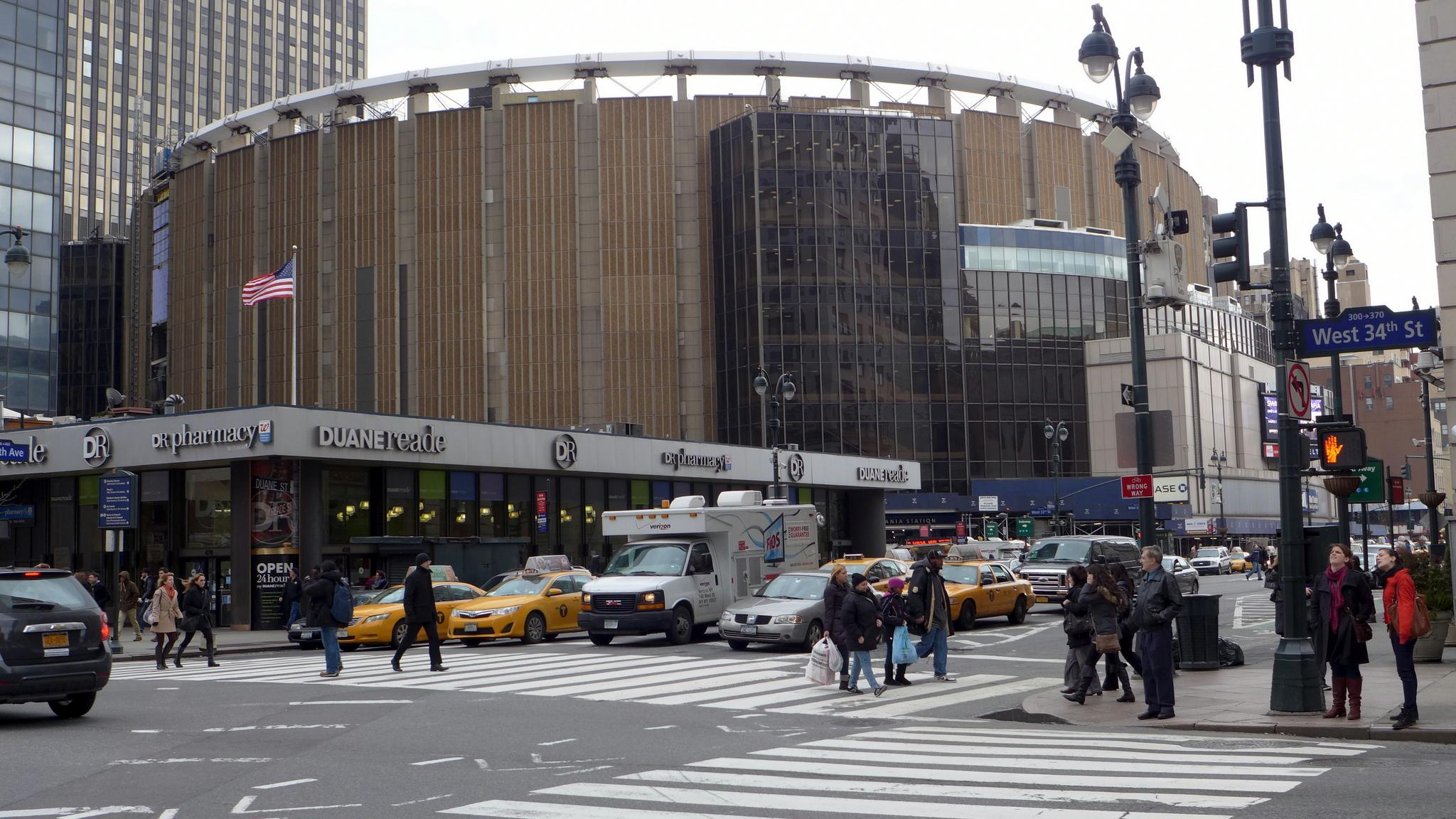
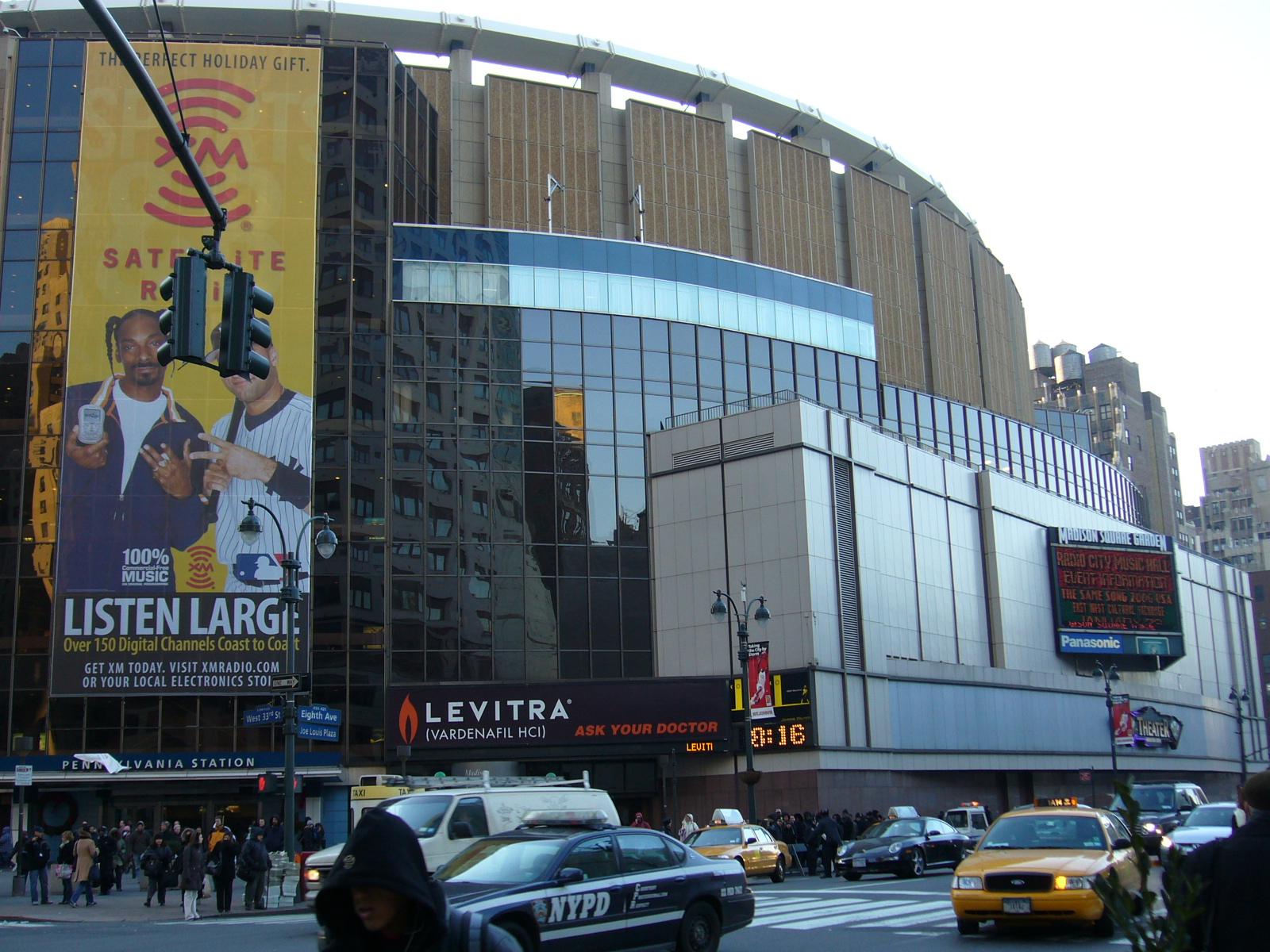
Madison Square Garden — the Garden, MSG — is a multi-purpose indoor arena in Midtown Manhattan, between Seventh and Eighth Avenues and West 31st and 33rd Streets, directly above Pennsylvania Station. Its address is 4 Pennsylvania Plaza. It is the home arena of the New York Knicks of the NBA and the New York Rangers of the NHL, and it calls itself "The World's Most Famous Arena," a slogan no rival has ever seriously disputed. On a night when the Knicks or the Rangers are playing, or when a singer the whole country knows is on stage, it holds about 20,000 people — about 20,000 for basketball, about 18,000 for hockey — and it is the loudest room in the city.
The first thing to understand about the Garden is that the name refers to a succession of four arenas, not a single building. The first two stood beside Madison Square itself, at Madison Avenue and East 26th Street. The third stood on Eighth Avenue between West 49th and 50th Streets. The current Garden, the fourth, opened on February 11, 1968, above Penn Station — miles, in New York terms, from the square that gave it its name. None of the first three buildings survives. What survives is the name, the reputation, and the strange fact that every generation of New Yorkers has rebuilt the same idea in a new place: a big room where the whole city can gather to watch a fight, a game, or a singer, and feel, for one night, like one crowd.
The second thing to understand is that the current Garden was born in controversy, and the argument has never really ended. It stands on the site of the original Pennsylvania Station, the great Beaux-Arts terminal opened in 1910 and demolished beginning in 1963 to make way for the arena and the office complex around it. The destruction of Penn Station became one of the defining events of New York's historic-preservation movement and led directly to the city's Landmarks Preservation Law of 1965. Sixty years later, the Garden still sits on top of the station, the station is still cramped and unloved below it, and the city is still arguing about whether the arena should stay. That argument is part of the place now, as much as the banners in the rafters.
A hippodrome on Madison Square
The story begins not with a sports arena but with a circus. The site at the northeast corner of Madison Square — the park at 23rd Street and Madison Avenue, named for President James Madison — had been a railroad depot. The showman P. T. Barnum took it over and turned it into his "Great Roman Hippodrome," an open-air venue for circuses, exhibitions, and spectacles, which opened in 1874. It was a rough, drafty place, open to the elements, hot in summer and freezing in winter, but it drew crowds for Barnum's circuses and for events like the Westminster Dog Show, which has been associated with the Garden ever since.
In 1879, William K. Vanderbilt, the railroad heir who had taken over the lease, renamed the venue Madison Square Garden. The first Garden lasted barely a decade. It had a leaky roof and dangerous balconies — balconies that collapsed, with fatal results — and in 1890 it was demolished. It had proved one thing, though: New York wanted a big indoor room for spectacle, and it wanted it in the middle of Manhattan.
Stanford White's palace — and a murder on the roof
What replaced it was the most beautiful building ever to carry the name. In 1890, a syndicate that included J. P. Morgan, Andrew Carnegie, P. T. Barnum, and W. W. Astor opened the second Madison Square Garden on the same Madison Square site, designed by the celebrated society architect Stanford White of McKim, Mead & White. It was a Beaux-Arts and Moorish-inspired palace, fully enclosed, with a concert hall, a theater, a restaurant, and a rooftop garden — and above it all, a soaring tower modeled on the Giralda bell tower in Seville, Spain, which became an instant landmark and, at the time, one of the tallest structures in the city. It cost more than $3 million, an enormous sum for 1890, and it was the grandest entertainment complex New York had ever seen.
The second Garden hosted everything: circuses and horse shows, boxing and bicycle races, political conventions — including the 1924 Democratic National Convention, one of the longest and most bitterly deadlocked conventions in American history — and the society events of the Gilded Age. But it is remembered today as much for a murder as for any event it staged. On the evening of June 25, 1906, Stanford White was shot and killed in the Garden's rooftop theater by Harry K. Thaw, a wealthy Pittsburgh businessman, over White's past relationship with Thaw's wife, the actress and model Evelyn Nesbit. The "trial of the century" that followed was one of the great tabloid sensations of its age, and the Garden — White's own building — was the scene of its first act.
The second Garden outlived its architect by less than twenty years. Financial difficulties mounted, and the building was demolished in 1925. The name, however, had become too valuable to retire. It moved uptown.
Tex Rickard's Garden on 50th Street
The third Madison Square Garden opened in 1925 on Eighth Avenue between West 49th and 50th Streets, built by the boxing promoter Tex Rickard and designed by the theater architect Thomas W. Lamb. It was a bigger, plainer, more modern arena than its predecessor, built for sport first and spectacle second — and it was in this building that the Garden earned the nickname it still carries in boxing: the Mecca of Boxing. The Rangers, founded in 1926 — their name a wordplay on "Tex's Rangers" — made it their home from the start, winning Stanley Cups there in 1928, 1933, and 1940. The Knicks, founded in 1946, made it theirs too. The Westminster Dog Show, the circus, the ice shows, and the political rallies all followed the name uptown.
The third Garden's most famous night as a concert hall came on May 19, 1962, when Marilyn Monroe sang "Happy Birthday" to President John F. Kennedy at his 45th-birthday celebration there — a performance, breathy and unforgettable, that has outlived everyone in the room. Two years later, in February 1964, the Garden nearly hosted another piece of music history that never happened. After the Beatles played two concerts at Carnegie Hall on February 12, 1964, the promoter Sid Bernstein offered their manager Brian Epstein $25,000 plus a $5,000 donation to the British Cancer Fund for a follow-up concert at Madison Square Garden the following week, assuring him it would sell out instantly. Epstein declined, saying "let's leave this for next time" — and the Beatles never played Madison Square Garden at all. They played Shea Stadium instead, in 1965, in the first great stadium rock concert. The Garden's Beatles story is the concert that did not happen, and it is worth telling straight, because the myth that they played there is repeated so often that it has almost become fact. What did happen at the Garden, a decade later, was John Lennon's last performance before a paying audience: on November 28, 1974, he joined Elton John on stage for three songs, including "Whatever Gets You Thru the Night."
The third Garden closed in 1968, when the name moved again — this time to the site that would define it for the next half-century and more. The building on 50th Street was demolished, and the block is now offices and shops, with nothing to mark what stood there except the memory of the fights and the games.
The station that had to die
The fourth Garden exists because the Pennsylvania Railroad, financially struggling by the early 1960s, decided to sell the air rights above its great terminal. The original Pennsylvania Station, designed by McKim, Mead & White — the same firm as Stanford White's Garden — and opened in 1910, was one of New York's great Beaux-Arts landmarks: a vast, pink-granite temple of a train station covering two full city blocks, with a main waiting room modeled on the Baths of Caracalla in Rome. In November 1960, Irving Mitchell Felt, president of Madison Square Garden, bought the rights to build on the site from the railroad. The plan was to demolish the above-ground station, keep the trains running below street level on the same tracks and platforms, and build a new arena and office complex on top.
Demolition began on October 28, 1963, with the removal of one of the station's great stone eagles. The destruction caused an enormous public outcry. Architects, writers, and ordinary New Yorkers watched a building barely fifty years old — younger than many of the people protesting — being torn down for a sports arena, and the protest became one of the defining events of the city's historic-preservation movement. The New York City Landmarks Preservation Commission was established in 1965, while the loss of Penn Station was still fresh in the public mind, and the landmarks law it administers has since saved Grand Central Terminal and hundreds of other buildings. Penn Station's demolition is the reason New York has a preservation movement at all.
The new Garden was one of the first structures of its kind built above the platforms of an active railroad station, and it was an engineering feat in its own right. Ground was broken on October 29, 1964; the arena, designed by Charles Luckman Associates, rose as a great windowless cylinder — a drum of concrete and glass, 820,000 square feet, built at a cost of $123 million — with the trains still running underneath it throughout construction. It opened on February 11, 1968, with a "Salute to the USO" variety show hosted by Bob Hope and Bing Crosby, broadcast nationally by NBC. Three days later, the Knicks played their first game there, beating San Diego. The Rangers followed. The Garden had a new home, and Penn Station had a basement.
The Fight of the Century
If the third Garden was the Mecca of Boxing, the fourth inherited the title and staged the fight that defined it. On March 8, 1971, Muhammad Ali and Joe Frazier met at Madison Square Garden in the "Fight of the Century" — the first time two undefeated fighters had ever met for the world heavyweight title. Ali was 31–0, Frazier 26–0, and the demand for tickets was so great that the promoters had to run a lottery. Frank Sinatra, unable to get a ringside seat any other way, took a job as a ringside photographer for Life magazine. The crowd was a roll call of the famous and the powerful, and the fight lived up to it: fifteen rounds, and in the fifteenth Frazier's signature left hook sent Ali to the canvas. Ali got up, but Frazier won the unanimous decision, handing Ali his first professional loss. It was the first of their trilogy — Ali won the two rematches, both also at the Garden — and it remains the most famous boxing match ever held in America.
The Garden's boxing history runs much deeper than one night. The original 18.5-by-18.5-foot ring, carried over from the second and third Gardens, was used at the current Garden until it was retired on September 19, 2007; it now sits at the International Boxing Hall of Fame. Generations of champions fought under the Garden's lights, and the building's reputation as the place a fighter had to conquer was already fixed before Ali and Frazier ever laced up. To fight at the Garden, in boxing's language, was to have arrived.
The Knicks, the Rangers, and the banners
For New York sports fans, the Garden is first and foremost the home of two teams, and its rafters tell their story in banners. The Knicks won their first NBA championship at the Garden in May 1970, beating the Los Angeles Lakers in a seventh game — a night remembered above all for Willis Reed, the Knicks' injured captain, limping out of the tunnel and onto the court for Game 7, his mere presence lifting the team and the building to a roar that is still talked about as one of the great moments in American sports. The Knicks won again in 1973. Those two titles, more than fifty years ago now, are still the franchise's only championships, and the wait has become part of the Garden's lore — the building where the crowd believes, every spring, that this might finally be the year.
The Rangers' wait was longer and ended more dramatically. The team had not won a Stanley Cup since 1940, and the "Curse" — the supposed jinx that kept the Cup away — had become a running joke and then a genuine ache. On June 14, 1994, in Game 7 of the Stanley Cup Finals against the Vancouver Canucks, the Rangers won 3–2 at the Garden, with captain Mark Messier lifting the Cup on home ice after 54 years. The Garden had hosted the Stanley Cup Final and the NBA Finals in the same spring twice, in 1972 and 1994; in 1994 the building was the center of the sporting world for weeks, and the ticker-tape parade that followed drew more than a million people. The Rangers' Cup is the only one they have won at the current Garden, and the image of Messier raising it still hangs in the memory of every Rangers fan who was there.
The Garden's other tenants fill out the calendar: St. John's University's Red Storm have played college basketball there since 1969; the New York Liberty of the WNBA played there from 1997 to 2017; the Westminster Kennel Club Dog Show, the Millrose Games track meet, professional wrestling, the circus, and the ice shows have all been regulars. The banners overhead — retired numbers, championship flags, and, since the renovation, the performance banners for the musicians who have played the room most often — are the building's autobiography, written in cloth and hung where everyone can read it.
The world's most famous stage
No room in America has hosted more music history than the Garden. The current building came of age with arena rock: George Harrison's Concert for Bangladesh in 1971, the first great rock benefit concert; Elvis Presley, sold out, in 1972, the performances released as a live album; Led Zeppelin's three-night stand in 1973, filmed for "The Song Remains the Same"; Frank Sinatra's return in 1974; the Rolling Stones, the Who, Bob Dylan, Bruce Springsteen, and, across the decades, nearly every major act that has ever toured. Two popes have visited — John Paul II in 1979 and Francis in 2015 — and the building has hosted two Democratic National Conventions, in 1976 and 1980, and the Concert for New York City in October 2001, the benefit held weeks after the September 11 attacks, when Paul McCartney and a roster of the biggest names in music played to a city trying to grieve in public.
The Garden's most political night as a concert hall came in September 1979. Between September 19 and 23, five sold-out No Nukes concerts filled the arena, organized by Musicians United for Safe Energy (MUSE) — founded that year by Jackson Browne, Graham Nash, Bonnie Raitt, John Hall, and Harvey Wasserman in the months after the partial meltdown at the Three Mile Island nuclear plant in Pennsylvania. The lineup across the five nights included Crosby, Stills and Nash, Bruce Springsteen and the E Street Band, James Taylor, Carly Simon, Tom Petty and the Heartbreakers, the Doobie Brothers, Chaka Khan, and Gil Scott-Heron. Springsteen played on September 21 and 22, in performances later released as a live album and film, and the series closed with a rally at Battery Park that drew an estimated 200,000 people. The concerts raised money and headlines, and they were preserved in a triple album and a concert film released in 1980 — an early model for the benefit concert as a cultural event.
No musician belongs to the Garden the way Billy Joel does. The Long Island native first played there on December 14, 1978, and in December 2013 he was named the Garden's first-ever music franchise, joining the Knicks and the Rangers as a permanent resident of the building. The following month, in January 2014, he began a monthly residency — one show a month, "as long as the demand continues," as he put it — that ran for more than a decade, with surprise guests, a different setlist every night, and a crowd that treated the room like a neighborhood bar that happened to hold 18,000 people. He played his 100th lifetime show at the Garden in July 2018, and the residency concluded on July 25, 2024, with his 150th lifetime show at the venue. Two banners hang in the rafters for him: most consecutive performances by any artist, and most lifetime performances by any artist. The residency redefined what a residency could be — not a Vegas stand, but a hometown musician playing his home room, once a month, for ten years.
Other artists have left their own marks on the rafters. Phish played thirteen consecutive shows in 2017 — the "Baker's Dozen" — and earned a banner. Harry Styles played fifteen consecutive sold-out shows in 2022 and earned one too. The banners are the Garden's way of keeping score, and the scoreboard is crowded.
The billion-dollar renovation
By 2011, the Garden was showing its age. The building had already been renovated once, in 1989–1991, but the arena that opened in 1968 — with its low ceilings, its cramped concourses, and its obstructed views in the upper bowl — no longer matched the building's reputation. In 2011, Madison Square Garden began a three-phase, roughly $1 billion transformation, carried out during the offseasons so the Knicks and Rangers could keep playing. The work, designed by Brisbin Brook Beynon Architects, was completed in October 2013.
The renovation rebuilt the arena from the inside out: new seating throughout, wider concourses, new clubs and suites, and a new center-hung scoreboard. Its signature addition was the Chase Bridges — two glass-enclosed walkways suspended high above the court and the ice, spanning the arena from one side to the other, where fans can watch the game from directly above the action. The bridges were controversial — some fans loved the view, others found them vertiginous — but they became the renovation's most recognizable feature, and the symbol of a building trying to be both historic and modern at once. The Garden that reopened in the fall of 2013 was, in the company's own phrase, a transformation: the same drum, the same address, a different room inside.
The Garden and Penn Station, still arguing
The renovation did not settle the Garden's oldest argument. When the arena was built, New York granted it a special permit to operate on the site — first issued in 1963 for fifty years. In 2013, the city renewed the permit for ten years. When that permit expired in 2023, MSG sought permission to operate there permanently. The City Planning Commission approved a ten-year renewal; the City Council cut it to five years, stating that the arena use "should not take precedence over public access to Penn Station" and that the long-term viability of an arena on the site could not yet be determined. The Garden's permission to operate at its current address is therefore expected to require action again in 2028.
The argument has sharpened because the station below has changed. In 2021, Moynihan Train Hall opened across Eighth Avenue in the old Farley Post Office building, giving Amtrak riders a grand hall again — and making the contrast with the cramped, low-ceilinged Penn Station underneath the Garden starker than ever. The Metropolitan Transportation Authority, Amtrak, and New Jersey Transit remain committed to a Penn Station master plan intended to improve the station while allowing the arena to remain, and the Garden's owner has said emphatically that the arena will not move. As of this writing there is no completed agreement requiring Madison Square Garden to relocate, and the future relationship between the arena and a rebuilt Penn Station remains unresolved. It is the same argument the city has been having since 1963, and it will be having it for years yet: a beloved arena sitting on top of a station everyone agrees needs rebuilding, in a city that cannot quite decide which one matters more.
How to visit
Madison Square Garden sits at 4 Pennsylvania Plaza, between Seventh and Eighth Avenues and West 31st and 33rd Streets, directly above Penn Station — reach it by subway at 34th Street–Penn Station (1, 2, 3, A, C, E) or 34th Street–Herald Square, or by Amtrak, Long Island Rail Road, or NJ Transit to Penn Station itself, or PATH to 33rd Street. Moynihan Train Hall, across Eighth Avenue, is worth a look on the same trip: it is the grand station hall the neighborhood lost in 1963, rebuilt in a different building.
Most people experience the Garden from the inside, at a game or a concert, and that is how it should be experienced — the building's magic is the crowd, the noise, and the bowl, not the facade. But even without a ticket, the block repays a walk: the great windowless drum of the arena, the marquee announcing the next event, the flow of commuters in and out of Penn Station below, and, across the street, the contrast of Moynihan's light-filled hall. Come on a game night and the whole neighborhood is part of the event, the bars full, the streets full, the building lit. No ticket prices or event times are stated in this article, since none was verified against an official source in this run: check the Garden's official site at msg.com before visiting for the event schedule, ticket prices, and entry details, since they change with every event.
Location Photography



Key Facts
- Madison Square Garden is a multi-purpose indoor arena in Midtown Manhattan, between Seventh and Eighth Avenues and West 31st and 33rd Streets, directly above Pennsylvania Station, at 4 Pennsylvania Plaza. Coordinates: 40.7505, -73.9934. It is home to the New York Knicks (NBA) and the New York Rangers (NHL), and it bills itself as "The World's Most Famous Arena." Capacity is about 20,000 for basketball (20,012) and about 18,000 for ice hockey (18,006).
- The name has belonged to four arenas. Garden I (1879–1890) began as P. T. Barnum's "Great Roman Hippodrome" (opened 1874) at Madison Avenue and East 26th Street beside Madison Square, and was renamed Madison Square Garden in 1879 by William K. Vanderbilt; it was demolished in 1890 after a leaky roof and fatal balcony collapses. Garden II (1890–1925), on the same site, was designed by Stanford White of McKim, Mead & White, with a tower modeled on the Giralda in Seville; White was shot and killed in its rooftop theater on June 25, 1906, by Harry K. Thaw. It hosted the 1924 Democratic National Convention and was demolished in 1925. Garden III (1925–1968), on Eighth Avenue between West 49th and 50th Streets, was built by boxing promoter Tex Rickard and designed by Thomas W. Lamb; it was the home of the Rangers (founded 1926) and the Knicks (founded 1946) and the scene of Marilyn Monroe's "Happy Birthday" to President Kennedy on May 19, 1962. Garden IV, the current arena, opened February 11, 1968.
- The current Garden stands on the site of the original Pennsylvania Station (McKim, Mead & White, opened 1910). Demolition of the above-ground station began October 28, 1963; the outcry led to the creation of the New York City Landmarks Preservation Commission and the Landmarks Preservation Law in 1965. Ground was broken for the new Garden on October 29, 1964; it was designed by Charles Luckman Associates, built above the platforms of the active station at a cost of $123 million, and opened February 11, 1968, with a "Salute to the USO" show hosted by Bob Hope and Bing Crosby.
- The "Fight of the Century" — Muhammad Ali vs. Joe Frazier, March 8, 1971 — was held at the current Garden: both men undefeated (Ali 31–0, Frazier 26–0), Frazier winning by unanimous decision over 15 rounds after dropping Ali in the fifteenth. Frank Sinatra photographed the fight ringside for Life magazine after being unable to get a seat. The Garden's original 18.5-by-18.5-foot ring, carried over from the earlier Gardens, was retired September 19, 2007, and now sits at the International Boxing Hall of Fame.
- The Knicks won their first NBA championship at the Garden in May 1970, beating the Los Angeles Lakers in Game 7, a night remembered for the injured captain Willis Reed limping onto the court; they won again in 1973. The Rangers won the Stanley Cup at the Garden on June 14, 1994, beating the Vancouver Canucks 3–2 in Game 7 — their first Cup in 54 years, with captain Mark Messier lifting the trophy. The Garden hosted both the Stanley Cup Final and the NBA Finals in 1972 and 1994. St. John's Red Storm have played college basketball at the Garden since 1969.
- The Beatles never played Madison Square Garden. After two Carnegie Hall concerts on February 12, 1964, promoter Sid Bernstein offered manager Brian Epstein $25,000 plus a $5,000 charity donation for a Garden concert the following week; Epstein declined, and the band never played the venue. John Lennon's last performance before a paying audience was at the Garden on November 28, 1974, when he joined Elton John on stage for three songs.
- The No Nukes concerts — five sold-out nights, September 19–23, 1979, organized by Musicians United for Safe Energy (founded by Jackson Browne, Graham Nash, Bonnie Raitt, John Hall, and Harvey Wasserman after the Three Mile Island accident) — featured Crosby, Stills and Nash, Bruce Springsteen and the E Street Band (September 21–22), James Taylor, Carly Simon, Tom Petty, the Doobie Brothers, and Chaka Khan, and were followed by a Battery Park rally estimated at 200,000 people. A triple album and a concert film followed in 1980.
- Billy Joel first played the Garden on December 14, 1978; he was named the Garden's first-ever music franchise in December 2013, began a monthly residency in January 2014, played his 100th lifetime show there in July 2018, and concluded the residency on July 25, 2024, with his 150th lifetime show at the venue. He holds the Garden records for most consecutive and most lifetime performances by any artist. Phish played thirteen consecutive shows ("Baker's Dozen") in 2017 and Harry Styles fifteen consecutive sold-out shows in 2022; both earned banners in the rafters.
- The Garden was renovated in 1989–1991 and again in 2011–2013, a roughly $1 billion, three-phase transformation completed in October 2013, which added new seating, concourses, a new scoreboard, and the Chase Bridges suspended above the arena floor.
- The Garden's special permit to operate on the site, first issued in 1963 for fifty years, was renewed for ten years in 2013; in 2023 the City Council approved a five-year extension instead of the permanent permission MSG sought, so the permit is expected to require action again in 2028. Moynihan Train Hall opened across Eighth Avenue in 2021.
- Other Garden history: George Harrison's Concert for Bangladesh (1971), Elvis Presley sold out (1972), Led Zeppelin's three-night stand filmed for "The Song Remains the Same" (1973), Frank Sinatra (1974), visits by Pope John Paul II (1979) and Pope Francis (2015), Democratic National Conventions in 1976 and 1980, and the Concert for New York City in October 2001 after the September 11 attacks.
Visitor Details
Address: Madison Square Garden, 4 Pennsylvania Plaza, between Seventh and Eighth Avenues, West 31st–33rd Streets, New York, NY 10001 (Midtown Manhattan, directly above Penn Station).
Transit: Subway to 34th Street–Penn Station (1, 2, 3, A, C, E) or 34th Street–Herald Square; Amtrak, Long Island Rail Road, and NJ Transit to Penn Station; PATH to 33rd Street. Moynihan Train Hall is across Eighth Avenue.
Hours/Admission: The Garden is an event venue, not a walk-in attraction — admission is by ticket to a game, concert, or other event. No ticket prices, event times, or tour details are stated in this article, since none was verified against an official source in this run. Check the Garden's official site at msg.com before visiting for the event schedule, ticket prices, and entry details.
Best timing: Come on a game or concert night, when the arena and the surrounding blocks are at their liveliest. Allow time before an event to walk the block, look up at the arena drum, and visit Moynihan Train Hall across Eighth Avenue.