
The landing that named it
In the late summer of 1682, William Penn sailed from Deal, England, aboard the Welcome, bound for the colony King Charles II had granted him the year before. The ship made landfall at New Castle, in present-day Delaware, on October 27, 1682, and the next day Penn sailed up the Delaware River to the Swedish settlement of Upland — present-day Chester, Pennsylvania — where he first set foot in his own colony. That spot, in Chester, is the actual site of Penn's landing. Philadelphia, however, bought the right to use the name, and the waterfront at the foot of its oldest streets became Penn's Landing: the place the city chose to remember its founding.
The name is a piece of civic myth-making, but it is honest myth-making. Penn came upriver from Chester within days of landing, to the peninsula between the Delaware and the Schuylkill that his surveyor, Thomas Holme, was laying out as Philadelphia — the "City of Brotherly Love." He came ashore near Dock Creek, around what is now Third and Dock streets, where the Blue Anchor Tavern would later stand and the first rows of houses rose. Within three years of his arrival, the settlement counted hundreds of houses. The river was the reason the city was there at all: the Delaware was its highway to the Atlantic, its market, and its defense. To stand at Penn's Landing today is to stand at the edge of the decision that made Philadelphia — a Quaker proprietor choosing a high, dry bank on a great river for his "holy experiment" in religious tolerance and self-government.
The landing story also carries a harder truth that the waterfront itself now acknowledges. Penn's colony was built on land taken from the Lenape, the people who had lived along the Delaware for centuries, and the treaties and purchases that followed were the beginning of their displacement. The waterfront's public art includes the Irish Memorial, a sculpture at Penn's Landing commemorating the Irish men, women, and children who arrived in Philadelphia during the Great Famine of the 1840s — a reminder that this riverbank has been a place of arrival for many peoples, under very different circumstances, for more than three centuries.
A working riverfront
For most of its history, the Delaware riverfront was not a park. It was Philadelphia's workplace. Through the eighteenth and nineteenth centuries, the wharves along the Delaware made Philadelphia one of the busiest ports in America: ships from the Caribbean, Europe, and the American coast unloaded sugar, coffee, lumber, and manufactured goods at piers that stretched from South Street to Vine Street, and warehouses, sail lofts, and chandleries crowded the streets behind them. The city's great merchant houses were built on this trade, and the riverfront's labor — sailors, stevedores, shipwrights — was the engine of the early city.
The twentieth century took the work away. Container shipping moved to larger terminals downstream, the old piers fell into disuse, and the construction of Interstate 95 along the riverfront in the 1960s and 1970s cut the waterfront off from the neighborhoods behind it with a wall of highway. By the middle of the century, the river's edge in Center City was a strip of parking lots, derelict piers, and fenced-off water — a city that had turned its back on the river that founded it.
The reclamation began in the 1970s, when a 35-acre redevelopment site between Columbus Boulevard (then Delaware Avenue) and the river was set aside as Penn's Landing. The newly formed Penn's Landing Corporation, spun off in 1970, oversaw the renewal: the Great Plaza, the broad concrete amphitheater at Columbus Boulevard and Chestnut Street, became the centerpiece, and the historic ships arrived at the piers. In 2009, the Delaware River Waterfront Corporation (DRWC) replaced the Penn's Landing Corporation with a broader mandate — the whole seven-mile central waterfront, from Oregon Avenue to Allegheny Avenue — and released a master plan in 2011. Its long-planned cap over I-95 and Columbus Boulevard, which would put a park over the highway and reconnect Old City to the river on foot, is the next chapter of that reclamation, and the reason the waterfront keeps changing each time you visit.
The ships at the pier
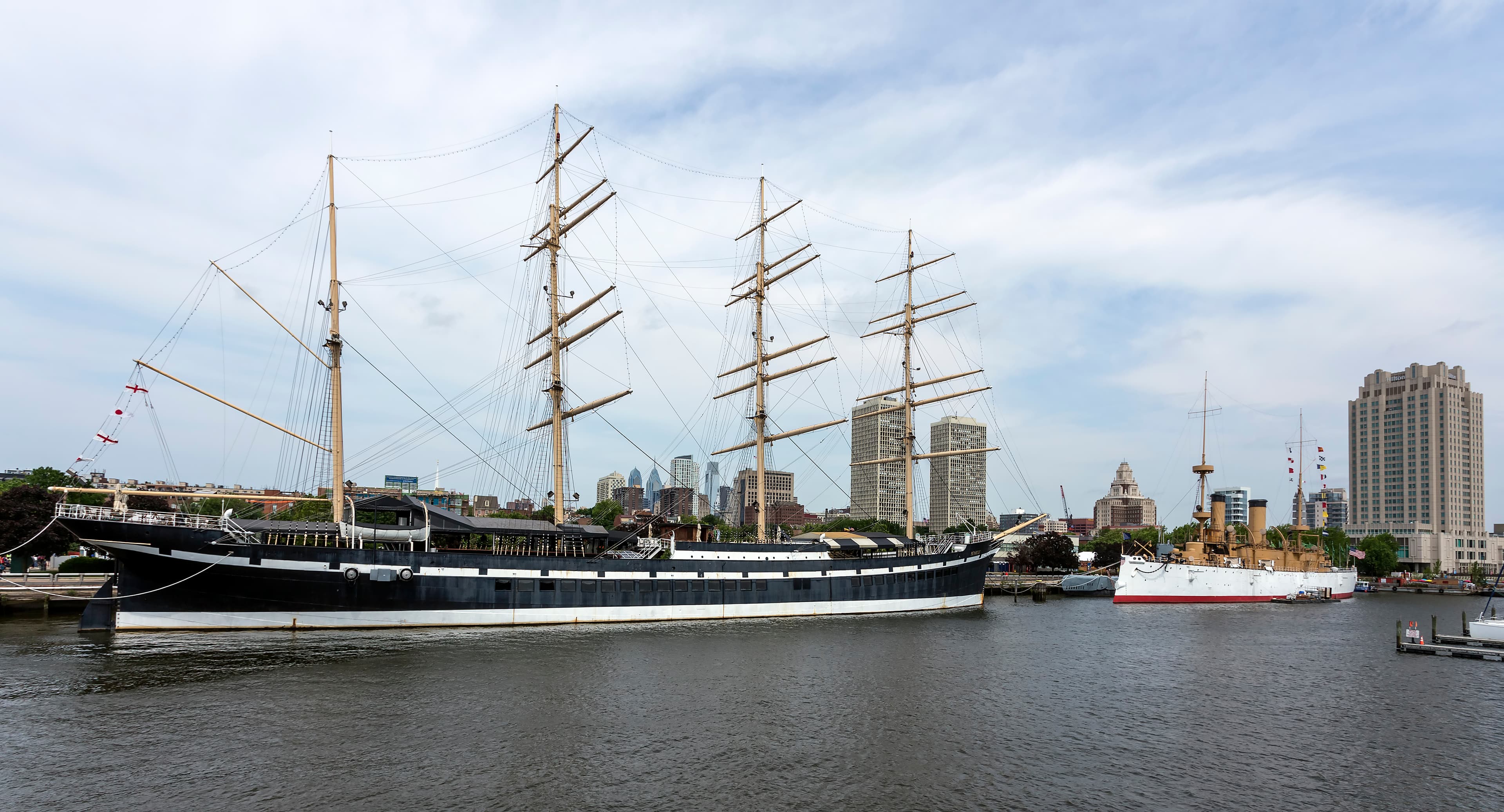
The most unmissable thing at Penn's Landing is the fleet. Berthed at the pier is the cruiser USS Olympia (C-6), the oldest steel warship still afloat. Launched in 1892 and commissioned in 1895, the Olympia was Commodore George Dewey's flagship at the Battle of Manila Bay on May 1, 1898, the opening battle of the Spanish-American War — the morning Dewey gave the order, "You may fire when you are ready, Gridley." The ship came to Philadelphia in 1957 and has been a museum ship at Penn's Landing ever since, its white-and-buff paintwork and twin funnels one of the most photographed sights on the river.
Alongside her lies the submarine USS Becuna (SS-319), a Balao-class boat launched in 1944 that served in the Pacific in World War II and later in the Cold War. Together the two ships anchor the Independence Seaport Museum, which stands on the pier between them. The museum, founded in 1961 as the Philadelphia Maritime Museum, moved to its Penn's Landing home in 1995, and its galleries tell the Delaware's story from the Lenape's canoes to the age of container shipping, with a working boat shop and exhibits on the river's trade, immigration, and ecology.
The third ship on the waterfront needs no ticket. The Moshulu, a four-masted steel barque launched in 1904 as the German cargo ship Kurt, is the largest sailing vessel of her kind still afloat, and she has been a floating restaurant at Penn's Landing since 2003. Her white hull and four masts are the waterfront's landmark silhouette — filmgoers may recognize her from Rocky and The Godfather Part II — and her deck is one of the best places in the city to watch the sun set over the Delaware, with the Benjamin Franklin Bridge lit up to the north.
The Great Plaza and the seasons
The Great Plaza is the public heart of Penn's Landing: a broad, mostly concrete amphitheater at Columbus Boulevard and Chestnut Street, built as part of the 1970s redevelopment, that functions as Philadelphia's outdoor living room. On summer weekends it hosts concerts, festivals, and cultural celebrations; on the Fourth of July it is the front row for Wawa Welcome America, the city's Independence Day festival, with the fireworks over the river. The plaza's hard surfaces and open sightlines were designed for crowds, and at their best — a warm evening, a band playing, the river behind the stage — it feels like the whole city decided to come down to the water at once.
The seasons give the waterfront its rhythm. In summer, Spruce Street Harbor Park, the seasonal pop-up park just south of the plaza, fills with hammocks, food vendors, and a boardwalk atmosphere, and the Blue Cross RiverRink becomes a roller rink. In winter, the RiverRink turns to ice skating, with a lodge, fire pits, and a lighted waterfront — Winterfest — that draws Philadelphians out to the river in the coldest months. The RiverLink Ferry runs seasonally across to Camden, and Cherry Street Pier and Race Street Pier, the old piers rebuilt as public space, extend the walkable waterfront north and south. Penn's Landing is not a single attraction but a district that changes its character with the calendar, and regulars come back to see what the season has made of it.
Across the river
One of the great pleasures of Penn's Landing is that it is a place to look from, not just at. Standing at the rail, you are looking east across the Delaware at Camden, New Jersey — and at the river itself, still a working waterway, with tugs, barges, and the occasional tall ship moving past. The Benjamin Franklin Bridge, opened in 1926, spans the river just to the north, its steel towers framing the view and its pedestrian walkway offering the return view back toward Philadelphia's skyline.
Across the water, Camden's waterfront holds its own attractions: the Adventure Aquarium and the Battleship New Jersey, the most decorated battleship in American history, berthed as a museum on the Camden side. The ferry makes the two riverfronts a single outing, and the contrast is the point — two cities, one river, and a crossing that takes minutes but feels like a small voyage. It is worth remembering, standing at Penn's Landing, that the Delaware is not a boundary so much as a shared street: the ferries, bridges, and river traffic that cross it are the oldest form of connection between the two shores, older than the city itself.
How to visit
Penn's Landing sits at the eastern end of Chestnut Street, at Columbus Boulevard on the Delaware River, a short walk east from Old City and Independence Hall. It is reachable by the Market-Frankford Line to 2nd Street station, then a walk east across Front Street and Columbus Boulevard, and by bus along Market and Chestnut streets; parking is available in nearby lots and garages. No fixed ticket price or opening hour is stated in this article, since none was verified against an official source in this run: the waterfront itself is public space, while the Independence Seaport Museum and its ships have their own admission and hours, so check the museum's official site before visiting for current prices, hours, and ship-tour availability. Seasonal attractions — Spruce Street Harbor Park, the RiverRink, and the ferry — operate on their own seasonal schedules, so check the Delaware River Waterfront Corporation's site for what is running on the day you plan to go.
Come for the ships first, then let the waterfront set the pace. Tour the Olympia and the Becuna and the museum, walk the Great Plaza and the piers, and finish at the rail looking across to Camden as the light changes on the river. Pair the visit with Old City — Independence Hall, the Liberty Bell, and Elfreth's Alley are all a short walk west — and you have the full arc of the city's founding in a single afternoon: the documents of independence inland, and the river that brought the people who wrote them.
Location Photography


Key Facts
- Penn's Landing is the Delaware River waterfront of Center City Philadelphia, bounded by Front Street to the west, the Delaware River to the east, Spring Garden Street to the north, and Washington Avenue to the south, focused on the Christopher Columbus Boulevard (Delaware Avenue) corridor.
- Its name commemorates William Penn's landing in 1682. Penn sailed from Deal, England, aboard the Welcome, reached New Castle on October 27, 1682, and first set foot in Pennsylvania at Upland (present-day Chester) the next day; the city of Philadelphia purchased the right to use the name for this waterfront.
- Penn came ashore near Dock Creek, around present-day Third and Dock streets, and founded Philadelphia on the peninsula between the Delaware and Schuylkill rivers.
- The Delaware riverfront was one of America's busiest ports in the eighteenth and nineteenth centuries, then declined with container shipping; Interstate 95, built along the riverfront in the 1960s and 1970s, cut the waterfront off from the city.
- The 35-acre Penn's Landing redevelopment began in the 1970s; the Penn's Landing Corporation was formed in 1970, and the Delaware River Waterfront Corporation replaced it in 2009 with a mandate covering the seven-mile central waterfront.
- The Great Plaza, the waterfront's main public space, stands at Christopher Columbus Boulevard and Chestnut Street and hosts concerts, festivals, and the Fourth of July Wawa Welcome America celebration.
- USS Olympia (C-6), launched 1892, was Commodore George Dewey's flagship at the Battle of Manila Bay on May 1, 1898; she is the oldest steel warship still afloat and has been at Penn's Landing since 1957.
- USS Becuna (SS-319), a Balao-class submarine launched in 1944, served in the Pacific in World War II; she is berthed alongside the Olympia.
- The Independence Seaport Museum, founded in 1961 as the Philadelphia Maritime Museum, has stood at Penn's Landing since 1995.
- The Moshulu, a four-masted steel barque launched in 1904 as the German cargo ship Kurt, has been a floating restaurant at Penn's Landing since 2003.
- The Irish Memorial at Penn's Landing commemorates the Irish immigrants who arrived in Philadelphia during the Great Famine of the 1840s.
- Seasonal attractions include Spruce Street Harbor Park, the Blue Cross RiverRink (ice skating in winter, roller skating in summer), Cherry Street Pier, Race Street Pier, and the RiverLink Ferry to Camden, where the Adventure Aquarium and the Battleship New Jersey stand.
- The Benjamin Franklin Bridge, opened in 1926, spans the Delaware just north of Penn's Landing.
- Coordinates: 39.9527, -75.1417.
Visitor Details
Address: Penn's Landing, Columbus Boulevard and Chestnut Street, Philadelphia, PA 19106 (Great Plaza).
Transit: Market-Frankford Line to 2nd Street station, then walk east to the river; buses run along Market and Chestnut streets; parking is available in nearby lots and garages.
Hours/Admission: No fixed ticket price or opening hour is stated in this article, since none was verified against an official source in this run. The waterfront and Great Plaza are public space; the Independence Seaport Museum and its ships have separate admission and hours — check the museum's official site before visiting for current prices, hours, and ship-tour availability. Seasonal attractions (Spruce Street Harbor Park, RiverRink, ferry) run on their own schedules — check the Delaware River Waterfront Corporation's site for what is operating on the day of your visit.
Best timing: Come for the ships first, then walk the Great Plaza and the piers; late afternoon gives the best light on the river and the view across to Camden. Pair with Old City — Independence Hall, the Liberty Bell, and Elfreth's Alley are a short walk west.