
A lunch counter before Miami Beach was a city
Joe's Stone Crab predates the city it sits in. Joe Weiss, a Hungarian-born immigrant who had been working in restaurants in New York, came to Miami Beach in 1913 on doctors' advice — the warmer climate was thought to ease his asthma. His wife Jennie and their young son Jesse followed, and that same year Joe opened a small seafood lunch counter at Smith's Bathing Casino, serving fish sandwiches and fries to beachgoers on what was then barely more than a sandbar. Miami Beach would not incorporate as a city until 1915, so Joe's is, by a couple of years, older than Miami Beach itself — and it is today the city's oldest surviving restaurant.
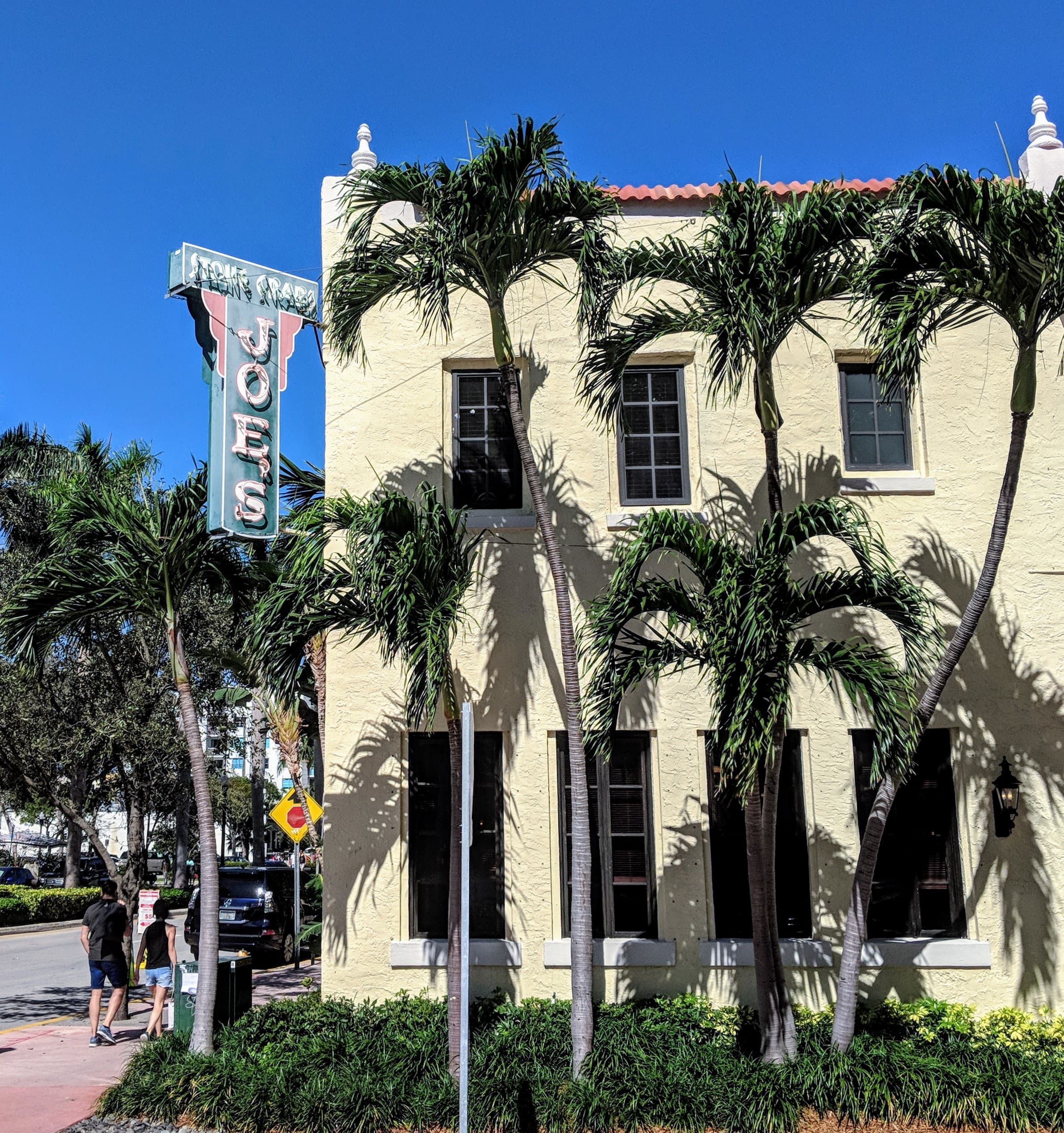
The business grew the way family businesses do: a step at a time, and never far from the beach. In 1918 Joe and Jennie bought a small bungalow across the street on Biscayne Street, moved into the back rooms, and set seven or eight tables on the front porch, cooking in the house kitchen. That porch became Joe's Restaurant, which opened in December 1920. As Miami Beach boomed in the 1920s, the restaurant boomed with it, and the family kept expanding the building around the original house until it occupied much of the block. The restaurant moved to its present home at 11 Washington Avenue, in the South of Fifth neighborhood at the quiet southern tip of South Beach, and it has been a fixture of that corner ever since — designated a Miami Beach historic landmark in 1975.
What is remarkable is not just the age but the continuity. Joe's is still owned by the founder's family, now in its fourth generation, led by Stephen Sawitz, Joe's great-grandson, alongside Jo Ann Bass, Joe's granddaughter, who ran the restaurant for decades. In a city that reinvents itself every decade, Joe's has survived by barely reinventing itself at all: the menu, the room, and the rituals have changed less than almost anything else in Miami Beach.
The crab nobody knew was edible
The dish that made Joe's famous was, famously, an accident of curiosity. In the restaurant's early years, stone crabs were not on the menu at all — Joe's served fish and crawfish, and the local stone crabs, abundant in Biscayne Bay, were considered inedible, or at least not worth eating. The story the restaurant itself tells is that in 1921, after developer James Allison built an aquarium nearby, a visiting Harvard ichthyologist — a scientist who studied fish and marine life — asked Joe why he had never tried serving the stone crabs from the bay. Joe reportedly answered that nobody would want to eat them. The scientist brought over a burlap sack of live stone crabs, Joe boiled them, and the bay, it turned out, was full of them.
The discovery changed the restaurant and, in a real sense, created a fishery. Joe's began serving stone crab claws chilled and cracked, and the dish caught on so fast that demand outran the local supply within years. Joe's became the biggest buyer of Florida stone crab claws in the state, financing crabbers and helping build the industry that now stretches from the Keys up both coasts. The restaurant's own history is blunt about the sequence: first nobody knew the crab was edible, then everybody wanted it.
There is a reason the dish works, and it is also the reason it is sustainable. Only the claws are harvested: fishermen take one claw from a crab of legal size and return the animal to the water alive, where the claw regrows over the following year or two. Egg-bearing females are protected, and the harvest is regulated by the Florida Fish and Wildlife Conservation Commission, with the season running from October 15 to May 1. Joe's serves fresh claws during the season; outside it, the restaurant has historically served frozen claws and operated on a reduced schedule. The seasonality is part of the ritual: stone crab season is an event in Miami, and Joe's is where it is celebrated most loudly.
The room: tuxedos, bibs, and no fuss
Walk into Joe's and the first surprise is how un-fancy a famous restaurant can feel. The building is a rambling, Spanish-flavored warren of rooms arranged around leafy courtyards with outdoor tables and a stone fountain, entered beneath a small red neon sign that simply says "Joe's" in cursive. Inside, the dining room is mahogany and white tablecloths, tiled floors, ladder-backed chairs with leather cushions, and waiters in pressed black tuxedos — the restaurant's signature uniform for generations — who tie lobster-emblazoned bibs around diners' necks before the claws arrive. It is formal and casual at the same time: the tuxedos say occasion, the bibs say roll up your sleeves.
That combination is the point, and it is why Joe's has always drawn a mixed crowd. The tuxedoed service and the white tablecloths come from an era when dinner out was a ceremony, but the food is served without ceremony at all: claws arrive cracked, on ice, with the mustard sauce, and you eat them with your hands. The restaurant's own regulars describe it as un-fine dining — a place that refuses to be precious about the thing it is most famous for. A Romero Britto painting of a multicolored stone crab hangs in the reception area, a gift to the family for the restaurant's centenary in 2013, and it fits the room precisely: bright, a little gaudy, and entirely Miami.
The second surprise is the scale. Joe's is enormous — a full city block of dining rooms, bars, and courtyards, serving hundreds of thousands of meals a year. In 2017 it served more than 316,000 meals, and by 2019 it was the highest-grossing independent restaurant in the United States, with sales of about $38.4 million; more recent reporting puts its 2024 sales near $50 million, again the highest in the country. Those numbers are not an accident of pricing alone: they are a measure of how many people, over how many decades, have made Joe's a stop on a Miami trip.
What to order
Order the stone crabs, obviously — but know what you are ordering. The claws are served chilled and already cracked, on a bed of ice, with Joe's famous mustard sauce, a mayonnaise-and-mustard blend whose recipe is one of the restaurant's closely held secrets. They come in sizes — medium, large, jumbo, and, when available, colossal — and they are priced by the claw, so the bill depends on the size you choose and how many you eat. The meat is sweet and firm, denser than most crab, and the ritual is to eat it cold, with sauce, and not much else getting in the way.
The rest of the menu is the other half of the Joe's story, and regulars will tell you to treat it as seriously as the crabs. The fried chicken is the restaurant's second legend: crisp, simply seasoned, and famously inexpensive by Joe's standards, it is the dish the staff themselves recommend to first-timers who want to understand the place. Around it, the classic sides have barely changed in decades: hash brown potatoes, creamed spinach, chopped salad, grilled tomatoes, onion rings, and Lyonnaise potatoes. The seafood menu runs wider — shrimp cocktail, crab cakes, king crab legs, and a range of fish and steaks — but the Joe's order, the one that has been repeated for generations, is stone crabs, fried chicken, hash browns, creamed spinach, and a slice of key lime pie to finish. The pie is the third legend: cold, tart, and topped with meringue or whipped cream depending on the telling, it is the dessert against which Miami's other key lime pies are judged.
If the dining room line daunts you, there is a second door. Joe's Take Away, opened next door in 1987, serves the same kitchen's food — stone crabs, fried chicken, key lime pie — to go or at a casual counter, with no table wait. It was created for the people who could not get a table or did not have time to sit for one, and it has become an institution in its own right: a way to eat Joe's on the beach, at a picnic table, or at home, without the ceremony. The takeaway shop also sells the restaurant's sauces and souvenirs, including the cookbook written by the family.
A century of famous tables
Joe's has always been a place where famous people eat, and the list of reported guests reads like a century of American celebrity: gangster Al Capone in the Prohibition years, the Duke and Duchess of Windsor, Will Rogers, Amelia Earhart, Gloria Swanson, Muhammad Ali, and a long run of presidents, athletes, and movie stars. The restaurant does not make a fuss of it — there are no velvet ropes and no photograph wall as the main event — but the stories are part of the furniture. Capone is said to have dined there during his Miami years; the Duke and Duchess of Windsor visited; and modern presidents and candidates have made the obligatory stop. The through-line is that Joe's has never been a scene for one decade's famous people: it has been the room where every decade's famous people, and plenty of unfamous ones, have eaten the same meal.
The restaurant's place in popular culture is quieter but real. It won a James Beard Foundation America's Classics Award in 1998, the foundation's honor for beloved regional restaurants, and it has appeared in films and television as shorthand for old Miami — the Miami that existed before the condos, when the city was a winter playground reached by train and the biggest building on the beach was a casino bathhouse. That is the Joe's that survives in the present building: not a theme-park version of old Miami, but the actual room, still run by the actual family, still serving the actual dish.
The family, the fishery, and the branches
Joe's success eventually outgrew a single room, but the family kept the original distinct. In 1999 the restaurant partnered with the Chicago-based Lettuce Entertain You Enterprises group, which opened Joe's Seafood, Prime Steak & Stone Crab branches in Chicago, followed by Las Vegas in 2005 and Washington, D.C. in 2014. Those restaurants carry the Joe's name and the stone crab menu, but they are deliberately named differently — Joe's Seafood, not Joe's Stone Crab — to mark the Miami original as the one true Joe's, still family-owned and still the flagship. The Miami restaurant remains the biggest buyer of claws and the anchor of the business.
The fishery relationship is worth understanding before you judge the price or the portion. Joe's does not just buy stone crabs; it has, for decades, financed the crabbers who catch them, advanced them money against the season, and bought at a scale that sets the market. That is why the restaurant can serve hundreds of thousands of pounds of claws a year, and why its fortunes rise and fall with the health of the Florida stone crab stock. The one-claw harvest rule, the closed season, and the protected females are what make that scale possible year after year — a managed fishery, not a mined one — and Joe's is both its biggest customer and one of its oldest stewards.
How to visit
Joe's Stone Crab is at 11 Washington Avenue, Miami Beach, in the South of Fifth neighborhood at the southern tip of South Beach — a short walk from South Pointe Park and the beach, and a world away from the noise of Ocean Drive a few blocks north. It is the kind of place to build an afternoon around: arrive early, expect a wait in season, and treat the wait as part of the visit rather than an obstacle to it. For most of its history, the dining room famously took no reservations, and the line outside — sometimes hours long — became part of the restaurant's legend. The takeaway counter next door has always been the pressure valve: same food, no wait, no tuxedos required.
No fixed price or opening hour is stated in this article, since none was verified against the official restaurant source in this run: prices vary by claw size and season, and hours vary by season and day, so check the official Joe's Stone Crab site before visiting for current hours, current reservation policy, and seasonal schedules. Stone crab season itself runs from October 15 to May 1 under Florida regulations, and the restaurant is at its fullest, and its most itself, during those months. Come for the crabs, stay for the chicken and the pie, and leave by way of the takeaway shop — the way generations of Miami visitors have done, with a container of mustard sauce and the feeling of having eaten a piece of the city's history.
Key Facts
- 11 Washington Avenue, Miami Beach, FL 33139, South of Fifth, South Beach
- Joe Weiss opened a seafood lunch counter at Smith's Bathing Casino in 1913, before Miami Beach incorporated in 1915, making it the city's oldest surviving restaurant
- Joe and Jennie Weiss bought a bungalow on Biscayne Street in 1918 and opened Joe's Restaurant in December 1920
- Stone crabs added around 1921 after a visiting Harvard ichthyologist suggested trying the local crabs
- Designated a Miami Beach historic landmark in 1975
- James Beard Foundation America's Classics Award, 1998
- Still family-owned, fourth generation, led by Stephen Sawitz, Joe's great-grandson
- Claws served chilled and cracked with mustard sauce
- Signature supporting cast: fried chicken, hash brown potatoes, creamed spinach, key lime pie
- Florida regulated stone crab season October 15 to May 1; only one claw harvested per crab, animal returned alive
- Joe's Take Away opened in 1987
- Branches in Chicago (1999), Las Vegas (2005), and Washington D.C. (2014) as Joe's Seafood, Prime Steak & Stone Crab, distinct from the Miami original
- Highest-grossing independent restaurant in the US in 2019 (about $38.4 million); recent reporting puts 2024 sales near $50 million
- Coordinates: 25.7692, -80.1350
Location Photography


Visitor Details
Address: 11 Washington Avenue, Miami Beach, FL 33139 (South of Fifth, South Beach).
Getting there: Short walk from South Pointe Park and the beach; foot from South Beach hotels, rideshare, or Miami Beach trolley/bus serving South of Fifth.
Hours/Admission: No fixed price or hour stated — check the official Joe's Stone Crab site for current hours, reservation policy, and seasonal schedules.
Best timing: Stone crab season October 15 to May 1 for fresh claws; arrive early in season; use Joe's Take Away if the dining-room wait is long.
Pair with a South Pointe Park and South Beach Art Deco district walk.