
A zoo that started as a rescue mission
The Bronx Zoo opened on November 8, 1899, as the New York Zoological Park, and it opened with a purpose that still shapes it today. Its founders in the New York Zoological Society — created in 1895 — were not showmen. They were naturalists, and their first great cause was an animal that was vanishing before their eyes: the American bison. By the late nineteenth century, a species that had numbered in the tens of millions on the Great Plains had been hunted to a few hundred. The zoo's first director, William Temple Hornaday, made bison conservation a founding mission, and in 1907 the zoo sent fifteen bison west to the Wichita Mountains Wildlife Refuge in Oklahoma — one of the first reintroductions of a species to the wild, and a model for the conservation breeding programs zoos run today.
That origin story matters because it explains why the Bronx Zoo has never felt like a menagerie. From the start, its exhibits were organized as landscapes rather than cages, and its scientists treated the zoo as a field station. The zoo sits inside Bronx Park, a 718-acre park in the Bronx, and the Bronx River — New York City's only freshwater river — runs through its grounds. The combination of river, forest, and open meadow gives the zoo a setting no other big-city zoo can match: you can stand in the African Plains exhibit, watch giraffes against a skyline of oak trees, and forget, for a moment, that you are in New York at all.
The zoo's scale is part of the experience, and visitors should plan for it. At 265 acres, with more than 4,000 animals representing hundreds of species, the Bronx Zoo is the largest metropolitan zoo in the United States. A full visit is a full day, not a morning detour, and the park's size is the point: the animals here live in exhibits measured in acres, not feet, and the walking between them — past the river, through woodland, under the elevated monorail — is part of the visit, not dead time between attractions.
The buildings are landmarks too
One of the Bronx Zoo's most surprising pleasures is its architecture. The zoo's original buildings, designed by the firm of Heins & LaFarge in the Beaux-Arts style, are landmarks in their own right. The Zoo Center, built in 1908 as the Elephant House, is the centerpiece: a great domed hall with limestone and brickwork that was, in its day, one of the grandest animal houses ever built. The Lion House, the Primate House, and the other early buildings share the same vocabulary — red brick, limestone trim, copper domes — and they give the zoo a civic grandeur that newer zoos, built as themed parks, rarely attempt.
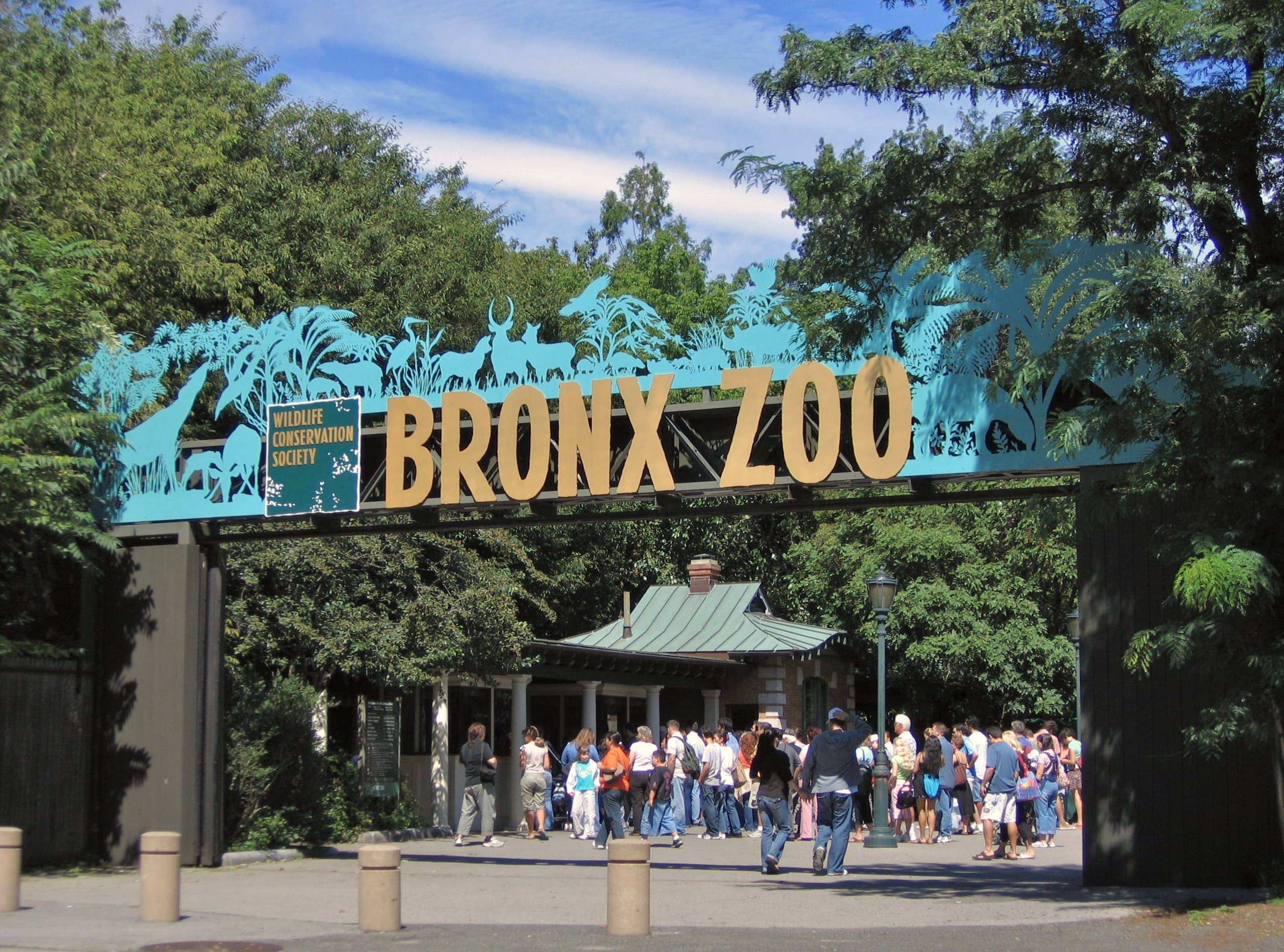
The Rainey Memorial Gates, at the zoo's Fordham Road entrance, are another landmark: great bronze gates given in memory of Paul James Rainey, a big-game hunter turned conservationist, and a reminder of the era in which the zoo was built — an era when the line between hunting and conservation was only beginning to be drawn, and the zoo's founders were on the conservation side of it. Walking through those gates is, in a small way, walking into the history of American conservation itself.
The zoo's later architecture tells the second half of that story: the move from animal houses to habitats. The Congo Gorilla Forest, opened in 1999, is a 6.5-acre rainforest habitat that houses western lowland gorillas and other Central African species in a landscape of dense planting, mist, and winding paths, with no bars in sight. Tiger Mountain, opened in 2003, gives Amur tigers a wooded, hilly habitat with pools and viewing shelters that put visitors at the tigers' eye level. JungleWorld, Madagascar!, the World of Birds, and the World of Reptiles each build a whole environment — a rainforest, an island, a flight aviary, a reptile house — rather than a row of enclosures. The contrast between the 1908 Elephant House and the 1999 gorilla forest, a short walk apart, is the history of zoos in miniature.
The exhibits to build a day around
Start with the animals that made the zoo famous. The Congo Gorilla Forest is the zoo's signature exhibit and the one to see first, before crowds build: a troop of western lowland gorillas in a rainforest clearing, with okapi, mandrills, and red river hogs nearby, and a conservation message — about the threats facing Central African forests — woven into the path rather than bolted on at the end. Tiger Mountain is the other essential stop: Amur tigers, the largest cats on earth, in a habitat that lets them swim, climb, and stalk through tall grass, with glass viewing that brings you startlingly close.
From there, follow the zoo's geography. The African Plains, one of the zoo's great open exhibits, mixes giraffes, zebras, gazelles, and other savanna species on a broad, grassy landscape, with lions nearby in a separate habitat. The Wild Asia Monorail — a guided ride, not a walk-through — carries visitors over the Asian exhibits, past elephants, rhinos, and deer, and it is the best way to see the zoo's largest animals in its largest spaces. The World of Birds, a two-story indoor aviary, and JungleWorld, an indoor Asian rainforest, are the weather-proof anchors of a visit: warm, humid, and full of free-flying birds, gibbons, and langurs even on a cold or rainy day.
Families with young children should build in the Children's Zoo, a separate area with smaller animals, climbing structures, and hands-on encounters, and the Butterfly Garden in season. And no visit is complete without a stop at the Zoo Center, the 1908 building, which now houses Komodo dragons and other species in its great hall — a reminder that the zoo's oldest building is still a working animal house, not a museum piece.
Conservation, in the open
The Bronx Zoo is run by the Wildlife Conservation Society, the organization that grew out of the New York Zoological Society, and the zoo's conservation work is not a side exhibit — it is the institution. The society runs field programs in dozens of countries, from the Congo Basin to the Andes, and the zoo's exhibits are designed to connect what visitors see to that work: the bison story, the gorilla forest, the tiger habitat, each with a conservation thread that names a real place, a real threat, and a real program.
That work has a complicated history, and the zoo does not hide it. The early zoo, like the conservation movement of its day, reflected the prejudices of its era, and the zoo has in recent years confronted that history openly, including the 1906 exhibition of Ota Benga, a Congolese man displayed in the Monkey House — an episode the Wildlife Conservation Society has publicly apologized for and now teaches as part of its history. It is a sobering counterpoint to the bison story, and it is worth knowing before you visit: the zoo's conservation mission was born in an age that did not extend its compassion to all people, and the institution's reckoning with that fact is part of what it is today.
How to visit
The Bronx Zoo is in Bronx Park, in the Bronx, at 2300 Southern Boulevard. It is reachable by subway — the 2 and 5 trains to East 180th Street or West Farms Square, with a walk or bus connection — and by bus from Manhattan and elsewhere in the Bronx, and there is parking on site. No fixed ticket price or opening hour is stated in this article, since none was verified against an official source in this run: admission varies by season, day, and ticket type, and the zoo's hours change through the year, so check the official Bronx Zoo site before visiting for current prices, hours, and any timed-entry requirements. Some exhibits, including the Wild Asia Monorail and the Children's Zoo, may carry separate arrangements, and the zoo's seasonal schedule — with some outdoor exhibits and rides operating only in warmer months — is worth checking in advance.
Allow a full day, wear walking shoes, and plan a route rather than wandering: the zoo is too big to see well without one. Start at the Congo Gorilla Forest and Tiger Mountain, take the monorail in the middle of the day, save the indoor exhibits — JungleWorld, the World of Birds, the World of Reptiles — for the hottest or wettest part of the afternoon, and finish at the Zoo Center and the Rainey Gates. Pair the visit with the New York Botanical Garden, which shares Bronx Park and sits directly next door, for a full day in one of New York's great green spaces — a pairing that turns a zoo trip into a tour of the Bronx's two great institutions.
Key Facts
- The Bronx Zoo opened on November 8, 1899, as the New York Zoological Park, in Bronx Park in the Bronx, New York City.
- It covers 265 acres and houses more than 4,000 animals, making it the largest metropolitan zoo in the United States.
- It is run by the Wildlife Conservation Society, founded as the New York Zoological Society in 1895.
- Its first director, William Temple Hornaday, made American bison conservation a founding mission; in 1907 the zoo sent fifteen bison to the Wichita Mountains Wildlife Refuge, an early species reintroduction.
- The Bronx River, New York City's only freshwater river, runs through the zoo's grounds within the 718-acre Bronx Park.
- The zoo's original Beaux-Arts buildings were designed by Heins & LaFarge; the Zoo Center, built in 1908 as the Elephant House, is the centerpiece.
- Signature exhibits include Congo Gorilla Forest (opened 1999, 6.5 acres), Tiger Mountain (opened 2003), JungleWorld, Madagascar!, the World of Birds, the World of Reptiles, African Plains, and the Wild Asia Monorail.
- The Rainey Memorial Gates stand at the Fordham Road entrance.
- The zoo's address is 2300 Southern Boulevard, Bronx, New York.
- Coordinates: 40.8506, -73.8747.
Visitor Details
Address: 2300 Southern Boulevard, Bronx Park, Bronx, NY 10460.
Transit: Subway 2/5 to East 180th Street or West Farms Square, then walk or bus; buses serve the zoo from Manhattan and the Bronx; on-site parking is available.
Hours/Admission: No fixed ticket price or opening hour is stated in this article, since none was verified against an official source in this run. Check the official Bronx Zoo site before visiting for current prices, hours, timed-entry rules, and seasonal exhibit schedules.
Best timing: Allow a full day; start with Congo Gorilla Forest and Tiger Mountain, take the Wild Asia Monorail midday, and save indoor exhibits for the hottest or wettest hours. Pair with the neighboring New York Botanical Garden in Bronx Park.
Bronx Zoo Gallery