The most famous street in Miami Beach
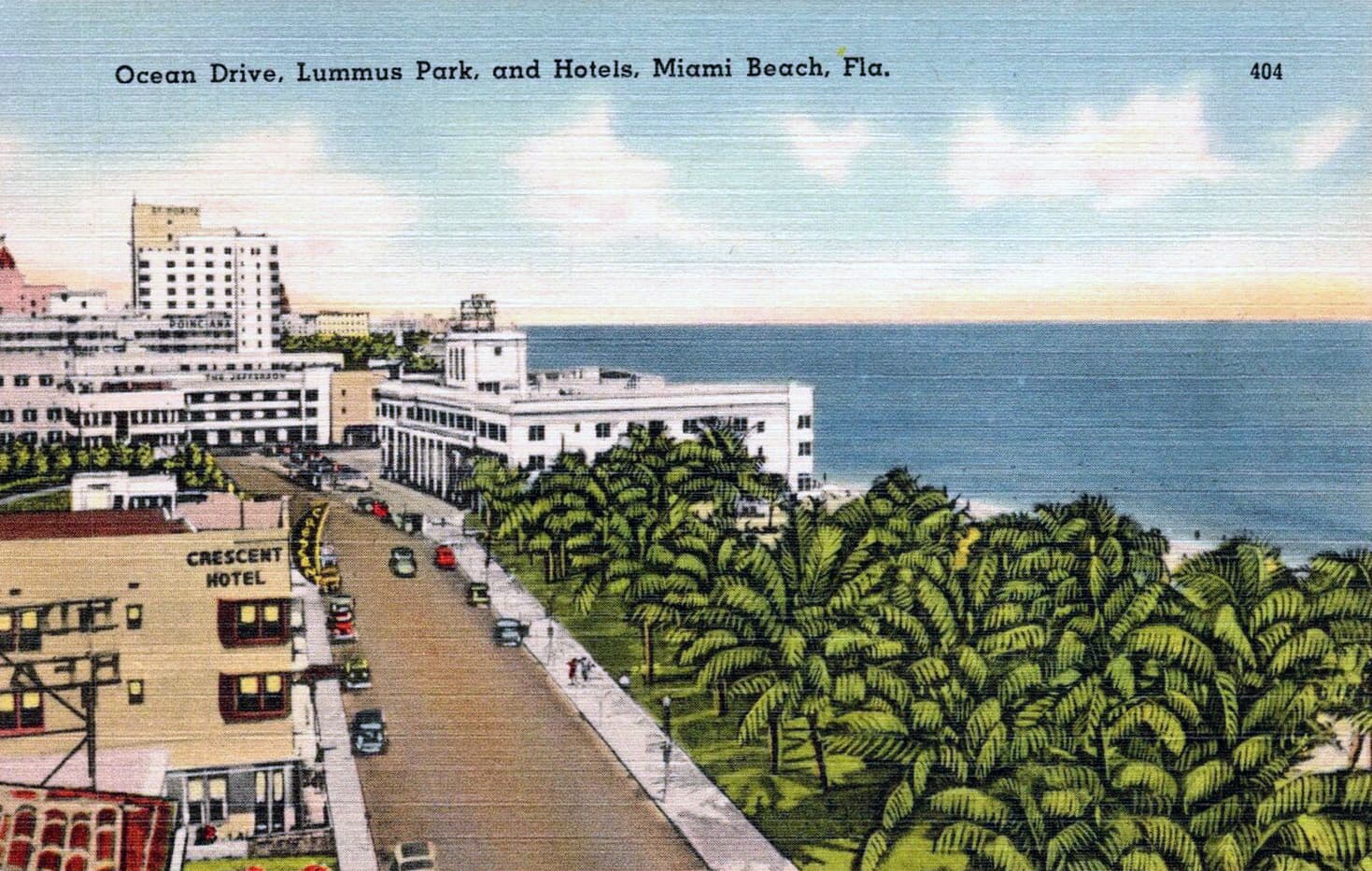
There is one street in Miami Beach that a first-time visitor must walk, and it is Ocean Drive. It runs along the Atlantic edge of South Beach, from South Pointe Drive in the south up to 15th Street, and for most of its length it is only a few blocks of pure spectacle: on the west side, a nearly unbroken row of low-rise Art Deco hotels in pastel pink, mint, cream, and sky blue, their facades trimmed with porthole windows, curved corners, glass block, and vertical neon signs; on the east side, Lummus Park, a strip of palms, lawns, and winding paths; and beyond the park, the wide white sand of South Beach and the Atlantic itself. No other street in America compresses so much color, history, and theater into so short a walk.
Ocean Drive is the postcard, but it is also a working neighborhood street. The hotels are real hotels, the cafes are full of real breakfasts, and the beach across the park is one of the most used public beaches in the country. People come here to swim before breakfast, to photograph the facades in the morning light, to sit under an umbrella with a Cuban coffee, and to come back after dark, when the neon comes on and the whole strip changes character. A visit that only covers one of those moods has missed half the street. The right way to see Ocean Drive is twice: once by day, for the architecture and the beach, and once after sunset, for the neon.
The street is also the front door of the Miami Beach Architectural District, better known as the Art Deco Historic District — the largest collection of Art Deco architecture in the world, with more than 800 contributing buildings, most raised between the 1920s and the 1940s, and listed on the National Register of Historic Places in 1979. Ocean Drive holds the district's greatest hits in a single row, which is why it feels like an open-air museum even when you are just out for a stroll. You do not need a ticket or a tour to see it. You only need to walk slowly and look up.
From barrier island to resort town
Miami Beach was not always a resort. The barrier island across Biscayne Bay from Miami was farmland and mangrove for much of its early history, and the city itself was only incorporated in 1915, after developers including John Collins, Carl Fisher, and the Lummus brothers — John Newton Lummus and James E. Lummus — bought up land, built a bridge to the mainland, and began selling the island as a winter playground. The 1920s brought the first great wave of money and building, and the 1930s brought the second, which is the wave that made Ocean Drive.
The hotels that define the street today were built in a remarkably short burst, mostly in the 1930s and early 1940s, to serve a middle-class tourist trade that arrived by train and, increasingly, by car. They were small by modern standards — many only a few stories tall, with a few dozen rooms — and they were designed to be looked at. Architects such as Henry Hohauser, L. Murray Dixon, Albert Anis, and Roy France gave them the streamlined language of the machine age: horizontal banding like the stripes on a speeding train, rounded corners like a ship's bow, eyebrows shading the windows, portholes, glass block, and terrazzo floors. The style is often called Streamline Moderne, the nautical, speed-obsessed cousin of Art Deco, and Miami Beach has more of it than anywhere else on earth.
The buildings were originally mostly white, with painted trim. The pastel palette that now defines the street came later, and it is one of the great second acts in American preservation. By the 1970s, South Beach had faded badly: the grand hotels of the postwar years had moved north, the small Deco hotels were run down, and demolition threatened the whole district. Preservationists led by Barbara Baer Capitman founded the Miami Design Preservation League in 1976, campaigned for the district's listing on the National Register in 1979 — the first twentieth-century urban district in the country to be listed — and, working with designer Leonard Horowitz, gave the weathered white buildings a new palette drawn from sunrise, sunset, sand, and sea. The pastels were a rescue strategy that became an identity, and they are the reason Ocean Drive looks the way it does in every photograph you have ever seen of it.
The hotels that made the strip famous
The best way to read Ocean Drive is hotel by hotel, walking north from the southern end, because each facade is a small essay in Deco design. A few names anchor the walk, and they are worth knowing before you go.
The Colony Hotel, at 736 Ocean Drive, is the strip's most photographed building and the place to start. Designed by Henry Hohauser and opened in 1935, it is widely regarded as one of the first fully streamlined buildings on Ocean Drive: a three-story facade of sweeping horizontal bands, curved corners, ribbon windows, and a tall vertical neon sign that spells out its name in blue light after dark. Its lobby keeps its original terrazzo floors and a Vitrolite-clad fireplace with a mural above it. The Colony has appeared as a backdrop in films and television for decades, and its blue sign is the single most recognizable image on the street.
A few blocks north, at 1020 Ocean Drive, stands the Clevelander, the loud, joyful counterpart to the Colony's elegance. Built in the late 1930s to a design by Albert Anis, it is famous for its glass-block bar, its pool terrace, and its outdoor stage — the place where Ocean Drive's party reputation is most visibly on display. By day it is a hotel like its neighbors; by night its neon and music make it the strip's loudest corner, and it is the best illustration of how Ocean Drive changes character after dark.
At 940 Ocean Drive, the Breakwater — officially the Hotel Breakwater South Beach — is the classic Streamline Moderne composition: designed by Anton Skislewicz and built in 1939, it pairs a central tower with symmetrical wings and blue-and-white racing stripes that suggest speed even standing still. Its vertical neon sign is one of the great Deco signs in America, and its tower gives the middle of the strip a vertical accent that the low-rise street otherwise lacks.
Farther north, at 1250 Ocean Drive, the Carlyle is the film star of the row. Completed in 1941 to a design by Richard Kiehnel, it is a textbook example of the Deco "rule of thirds," with three vertical sections capped by stepped tops, and its facade has appeared in films including Scarface and The Birdcage. The Carlyle is now a condominium building rather than a hotel, but its exterior is preserved and it remains one of the most elegant facades on the street.
Between and around these anchors are dozens more worth a pause: the Cardozo (1939), with its rounded corners and streamlined front; the Park Central (1937), another Hohauser design and one of the purest Deco facades on the drive; the Leslie (1937), in white and yellow; the Cavalier (1936); the Waldorf Towers (1937); and the Beacon. No single building is the sight. The sight is the row, and the row rewards a slow pace: cross to the Lummus Park side, where you can see whole facades at once, and look for the details — the eyebrows over the windows, the portholes, the terrazzo, the glass block, the spires and finials that cap the rooflines.
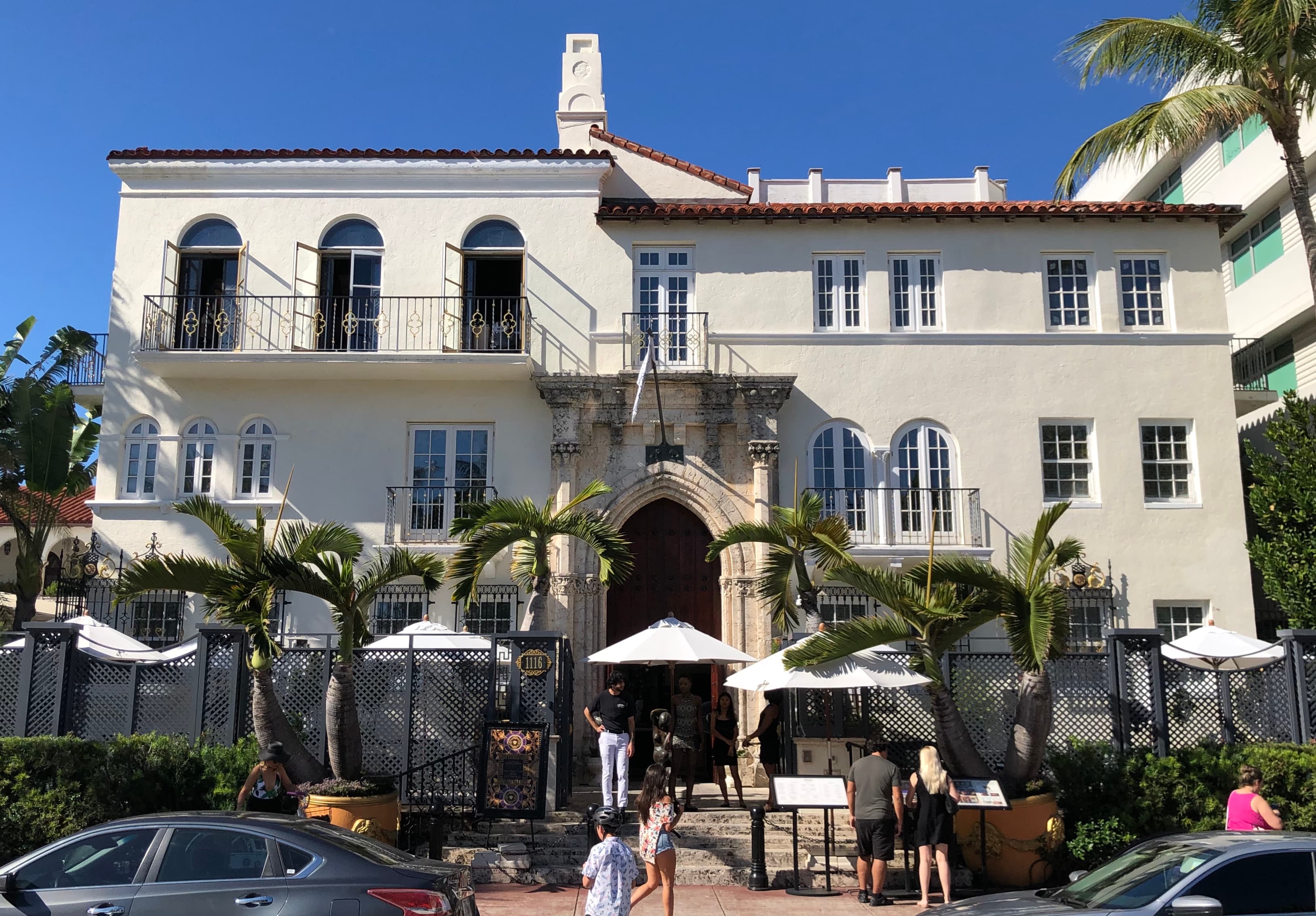
One building deserves a passing note rather than a stop: the former Versace mansion, Casa Casuarina, at 1116 Ocean Drive, the Mediterranean Revival villa bought by designer Gianni Versace in 1992. It is a famous address, and it has its own article on this site; on an Ocean Drive walk, it is best appreciated as one more extraordinary facade in a street full of them, not as the destination — the Deco hotels are the story here.
Lummus Park, the beach, and the promenade
What makes Ocean Drive unlike any other famous street is what faces it. Between the hotels and the sand lies Lummus Park, the long, narrow oceanfront park named for the Lummus brothers, which runs along the ocean side of Ocean Drive. It is the strip's front yard and its breathing room: palm trees, lawns, winding paths, benches, volleyball courts, outdoor gym equipment, and the winding Beach Walk promenade that carries walkers, joggers, and cyclists along the shore. The park is where the postcard view is taken from — stand in Lummus Park, look west, and the whole pastel row lines up in a single frame — and it is where the street's energy spills over: morning joggers, afternoon picnics, and the slow parade of people heading to and from the sand.
Beyond the park is South Beach itself, a wide, white-sand public beach on the Atlantic, with the colorful lifeguard towers that have become symbols of the city in their own right. The beach is the reason the hotels are here, and it is the natural second half of any Ocean Drive visit: walk the strip, cross the park, and swim. The Beach Walk promenade runs the length of the park and continues north and south along the shore, so a walk that starts on Ocean Drive can easily become a longer beachfront stroll, with the Deco hotels always in view to the west.
The park is also home to the Art Deco Welcome Center, at 1001 Ocean Drive, run by the Miami Design Preservation League — the preservation organization that saved the district. It is the natural starting point for a deeper visit: the League's guided walking tours leave from here, and its shop and exhibits explain the architecture you are about to see. Tour days and times change, so check the League's official information before visiting if a guided tour is part of your plan.
Cafes, day to night, and how to walk it well
Ocean Drive's ground floors are almost entirely cafes, restaurants, and bars, with sidewalk tables facing the street and the park. The cafe culture is part of the architecture's story: the Deco hotels were built for a resort trade that lived outdoors, and the sidewalk terrace is where that life still happens. Mornings belong to coffee and breakfast under the umbrellas, afternoons to long lunches and people-watching, and evenings to cocktails as the light fades. Prices and menus change with the seasons and the establishments, so treat any figure you see online as a snapshot, not a fact — the street is best enjoyed without a fixed budget in mind, and the park and the beach themselves cost nothing.
The street's two moods are its great gift, and planning around them is the single best tip for a first visit. Come in the morning, when the light is soft on the east-facing facades and the crowds are thin, and walk the full length from south to north with the park on your right, stopping for the Colony, the Clevelander, the Breakwater, and the Carlyle. Cross into Lummus Park for the classic photograph of the row, then spend time on the beach. Come back after sunset, when the neon signs switch on and the hotels glow in pink, blue, and white, and walk the strip again — it is a different street at night, louder, brighter, and more theatrical, and the neon is the Deco district's second great art form after the architecture itself.
A good first visit takes about half a day if you include the beach, or about two hours for the walk alone. Wear comfortable shoes and a hat — there is little shade on the park side — and bring water. The street is flat and fully walkable, and the best photographs come from across the street in Lummus Park, where whole facades fit in the frame, or from the beach side at golden hour. And remember that Ocean Drive is a living street, not a museum: the hotels are open for business, the cafes are open for lingering, and the beach is open for swimming. The architecture is the reason to come, but the street life is the reason to stay.
More than any single building, Ocean Drive endures because it is a complete world in a mile of pavement: a 1930s vision of the future, rescued in the 1970s, repainted in the 1980s, and still working today as the place where Miami Beach shows itself to the world. Walk it slowly, look up at the signs, cross the park to the sand, and come back after dark — and you will have seen the Miami that everyone pictures, in the place where it actually exists.
Key Facts
Ocean Drive is the oceanfront boulevard of South Beach, Miami Beach, Florida, running from South Pointe Drive in the south to 15th Street, with the Art Deco hotel row on its west side and Lummus Park and South Beach on its east side.
Ocean Drive is the centerpiece of the Miami Beach Architectural District (the Art Deco Historic District), the largest collection of Art Deco architecture in the world, with more than 800 contributing buildings, most built between the 1920s and the 1940s, and listed on the National Register of Historic Places in 1979 — the first twentieth-century urban district in the country to be listed.
The Colony Hotel, 736 Ocean Drive, was designed by Henry Hohauser and opened in 1935; it is regarded as one of the first fully streamlined buildings on Ocean Drive, with a vertical blue neon sign, terrazzo floors, and a Vitrolite-clad lobby fireplace.
The Clevelander, 1020 Ocean Drive, was built in the late 1930s to a design by Albert Anis and is known for its glass-block bar, pool terrace, and outdoor stage.
The Hotel Breakwater South Beach, 940 Ocean Drive, was designed by Anton Skislewicz and built in 1939, with a central tower, symmetrical wings, blue-and-white racing stripes, and a prominent vertical neon sign.
The Carlyle, 1250 Ocean Drive, was completed in 1941 to a design by Richard Kiehnel, follows the Deco "rule of thirds" with three vertical sections and stepped tops, appeared in films including Scarface and The Birdcage, and is now a condominium building with a preserved exterior.
Other notable Ocean Drive hotels include the Cardozo (1939), Park Central (1937, Henry Hohauser), Leslie (1937), Cavalier (1936), Waldorf Towers (1937), and Beacon.
The buildings were originally mostly white; the pastel palette was introduced in the 1980s by designer Leonard Horowitz, working with the preservation movement, drawing on sunrise, sunset, sand, and sea.
The Miami Design Preservation League was founded in 1976, led by Barbara Baer Capitman, and campaigned for the district's National Register listing; its Art Deco Welcome Center stands at 1001 Ocean Drive in Lummus Park.
Lummus Park, named for Miami Beach pioneers John Newton Lummus and James E. Lummus, runs along the ocean side of Ocean Drive, with palms, lawns, paths, volleyball courts, outdoor gym areas, and the Beach Walk promenade; beyond it lies the wide white sand of South Beach and its colorful lifeguard towers.
Casa Casuarina, the former Versace mansion at 1116 Ocean Drive, is a Mediterranean Revival villa bought by Gianni Versace in 1992; it has its own article on this site and is mentioned here only in passing.
Ocean Drive's architecture has appeared extensively in photography, film, and television, notably the 1980s television series Miami Vice, which helped make the strip internationally famous.
Visitor Details
Address: Ocean Drive, Miami Beach, FL 33139 (South Beach; the Art Deco hotel row runs from South Pointe Drive to 15th Street, with Lummus Park and South Beach on the ocean side)
Getting there: Ocean Drive is the easternmost street in South Beach; it is reached on foot from Collins Avenue and Washington Avenue one block west, and by bus and rideshare along the South Beach grid. The street is flat and walkable end to end.
Hours/Admission: Ocean Drive is a public street and Lummus Park and South Beach are public spaces, open to walk at any hour; individual hotels, cafes, restaurants, bars, and clubs set their own hours, which change from time to time — check the official source for any specific establishment before visiting. The Art Deco Welcome Center (1001 Ocean Drive) and the Miami Design Preservation League's guided walking tours operate on schedules that change; check the League's official information before visiting if a tour is part of your plan.
Best timing: Come twice if you can — in the morning for soft light on the east-facing facades, thin crowds, and the classic Lummus Park photograph of the hotel row, and again after sunset, when the neon signs come on and the strip takes on its nighttime character. Allow about two hours for the walk alone, or about half a day including the beach. Wear comfortable shoes and a hat, bring water, and photograph the facades from Lummus Park, where whole buildings fit in the frame. No ticket is needed to walk the street, the park, or the beach.
Location Photography