The house everyone photographs on Ocean Drive
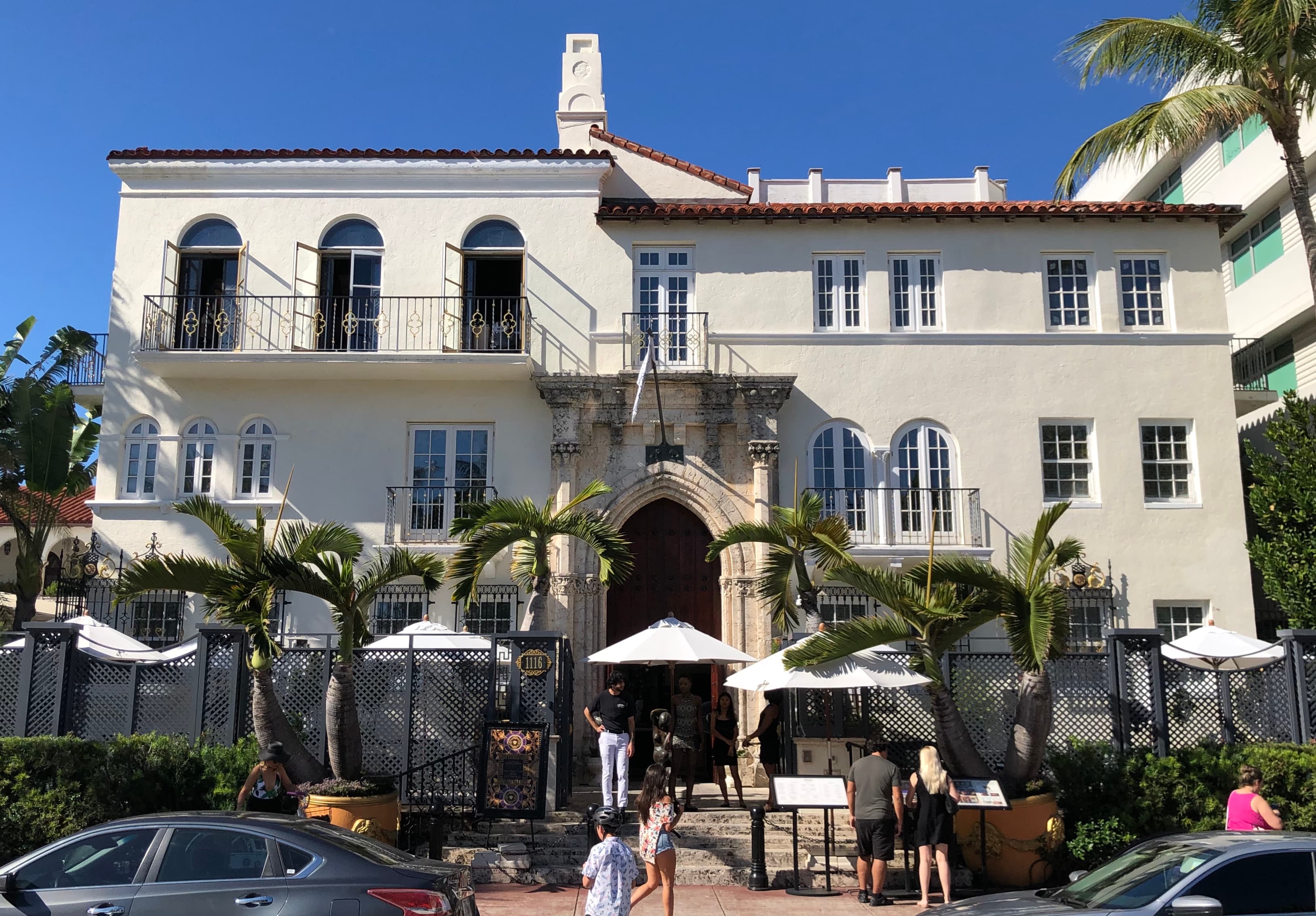
Walk Ocean Drive in South Beach on any afternoon and you will find one stretch of sidewalk where the crowd thickens for no apparent reason. People stop, raise their phones, and frame the same shot through the same wrought-iron gates: a pale Mediterranean palace with a tower, a loggia, and a gold Medusa worked into the ironwork. This is 1116 Ocean Drive, the house the world knows as the Versace Mansion and whose proper name is Casa Casuarina — "house of the Australian pine," after the casuarina trees that once shaded the lot.
It is routinely described as one of the most photographed private houses in America, behind only the White House and Graceland. That ranking is the kind of claim that is impossible to verify precisely, but stand on the sidewalk for ten minutes and you will believe it. The mansion is not a museum and it is not a ruin. It is a working boutique hotel with a restaurant, and its fame rests on two lives lived inside it: the eccentric millionaire who built it in 1930, and the fashion designer who remade it in the 1990s into the most opulent private house in Miami. To understand South Beach — its Art Deco streetscape, its 1980s revival, its taste for spectacle — there is no better single address.
The mansion also anchors the Miami Beach Architectural District, the Art Deco Historic District that runs along Ocean Drive. It is not itself an Art Deco hotel; it predates the district's pastel hotels and belongs to an older, grander idiom, the Mediterranean Revival palace. That contrast is part of the sight. The low, neon-lit hotels of Ocean Drive are about the street. Casa Casuarina turns inward, behind a wall, and that inwardness — the sense of a private world glimpsed through gates — is exactly what draws the cameras.
Alden Freeman's 1930 palace
Casa Casuarina was built in 1930 for Alden Freeman, a philanthropist, author, and amateur architect who was heir to a Standard Oil fortune. Freeman was a world traveler with strong opinions about architecture, and he modeled his house on the Alcázar de Colón in Santo Domingo, in the Dominican Republic — the palace built in 1510 for Diego Columbus, son of Christopher Columbus, and the oldest viceregal residence in the Americas. The house was built of coral rock, in the Mediterranean Revival style, with the thick walls, arched openings, and shaded loggias suited to a tropical climate and a man who wanted his home to feel like a piece of old Europe transplanted to a barrier island.
Freeman filled the house with the marks of his own enthusiasms. It has an observatory — a small tower room with a porthole window facing the ocean, from which he could watch the stars — and a small replica of the Homage Tower of the Fortaleza Ozama in Santo Domingo. About a hundred medallions of notable historical figures are set into the walls: Cleopatra, Gandhi, Rockefeller, Mussolini, Lenin, and others, a private hall of fame chosen by a man who evidently liked to argue with history. Local lore also holds that Freeman hid a time capsule in one of the walls during construction. Freeman lived in the house with his adopted son Charles Boulton and Boulton's family, and he died at the house on December 29, 1937.
That is the first life of the house, and it matters, because almost everything visitors admire about the exterior — the massing, the tower, the coral stone, the sense of a small fortress-palace — is Freeman's, not Versace's. Versace bought a palace. He decorated it beyond recognition, but he did not invent its bones.
From palace to apartments: the Amsterdam Palace years
After Freeman's death, the house lost its status as a private residence. It was purchased by Jacques Amsterdam and converted into an apartment building called the Amsterdam Palace, later known as the Christopher Columbus Apartments. The grand rooms were divided, the palace became a warren of rentals, and the building slid, over the decades, from fashionable address to faded rooming house. By the time Gianni Versace encountered it, it was a rundown apartment building in a neighborhood that was itself still rough around the edges — Ocean Drive in the early 1990s was an odd collection of small hotels, modeling agencies, and senior-citizen residences, not yet the polished promenade it is today.
This middle chapter is worth remembering because it explains the scale of what came next. Versace was not buying a pristine mansion and adding curtains. He was rescuing a building that had been cut up and worn down, and returning it to single, private use — restoring its original name, Casa Casuarina, in the process. The rescue is also a small parable of South Beach itself, which was revived in the same years by people who saw grandeur in buildings others had written off.
Versace finds his house
The story, much repeated, is that Gianni Versace spotted the house while walking on Ocean Drive during a vacation and fell in love with it on sight. He bought it in 1992 for $2.95 million. The following year he bought the neighboring Revere Hotel for nearly $4 million and demolished it, clearing the ground for a pool, a garden, and a new south wing. All told, he spent more than $32 million turning the rundown apartment building back into a palace — his palace, in the fullest sense, decorated as an extension of his own aesthetic: bold, sensual, Baroque, Italian, and instantly recognizable.
Inside, the 24 apartments became a suite of grand rooms — bedrooms, sitting rooms, a library, a bar, and living rooms — many of them designated for the people closest to him. His sister Donatella had the Venus Suite; his brother Santo had his own suite; guests of the caliber of Madonna, Princess Diana, and Elton John were given rooms designed with them in mind. The house filled with frescoes, hand-painted tiles, marble, and classical statuary, and the Versace signature was everywhere: the Greek key pattern on the gates and walls, and the Medusa head — the logo of the fashion house, chosen because, as Versace put it, she made people fall in love with her and there was no going back — in gold bas relief.
Versace's presence changed Ocean Drive. His celebrity parties at the mansion, his daily walks to the News Café a couple of blocks away, and his sheer visibility made the house a symbol of South Beach's glittering resurgence in the 1990s. The mansion became a landmark not because it was old, but because it was alive — a working home of a famous man, in the middle of a public street, behind gates that everyone photographed and almost no one passed.
The Million Mosaic Pool
The single most famous feature of the house is the pool. Versace's 54-foot pool — the Million Mosaic Pool — is lined with more than one million mosaic tiles, thousands of them 24-karat gold, arranged in patterns drawn from Roman and Greco-Roman mosaic traditions and inspired by his Marine Vanuras collection. Medusa presides, of course, worked into the pool floor itself. The tiles were crafted in Italy and shipped to Miami in sections before being assembled on site.
It is worth pausing on what the pool represents. A swimming pool is a common luxury; a pool lined with a million hand-set tiles, thousands of them gold, is something else — a work of decorative art that happens to hold water. That is the Versace sensibility in one object: domestic luxury pushed until it becomes spectacle, and spectacle executed with genuine craftsmanship. The pool courtyard, with its mosaic garden of Greek-mythological figures, is the heart of the house as Versace remade it, and it is the image most visitors carry away, whether they have seen it in person or only in photographs and on television.
July 15, 1997
On the morning of July 15, 1997, Gianni Versace was fatally shot on the front steps of the house by Andrew Cunanan, as he returned from his morning walk to the News Café. He was 50 years old, and he had lived in the house for five years.
That is the fact, and it is enough. The steps have since become one of the most photographed spots in Miami, which is a strange and somber kind of fame: a place of beauty and pleasure marked by a violent death. Visitors should treat the steps with the respect they would give any place where a person died. The hotel does not merchandise the tragedy — there is no plaque, no tour built around it — and the right way to see the house is to take in the whole of it: the palace Freeman built, the home Versace made, and the hotel it has become, rather than reducing it to a single morning.
After Versace: auction, hotel, and television
After Versace's death the house passed through several hands. It operated at various times as a private club and then, from 2009, as a boutique hotel, restaurant, and event venue. In 2013 it was sold at auction for $41.5 million to VM South Beach LLC, associated with the Nakash family of Jordache Enterprises. Since 2015 it has operated as The Villa Casa Casuarina, a luxury boutique hotel with ten suites, the restaurant Gianni's, a bar and lounge, and a rooftop.
In 2018 the house reached a new audience when the television series The Assassination of Gianni Versace: American Crime Story filmed scenes on location at the actual mansion. The series' opening images — the exterior, the pool, the palazzo — introduced Casa Casuarina to viewers who had never been to Miami, and cemented its place in popular culture as the definitive image of Versace's world. The current owners have kept almost everything Versace created, which is why a stay or a meal there still feels like stepping into the designer's house rather than into a generic luxury hotel that happens to occupy it.
How to see it well
Casa Casuarina is not a museum, and that shapes the visit. The interior is a hotel, and non-guests cannot simply wander in; the famous pool courtyard is for guests and diners. What every visitor can do, free, is see the exterior properly — and the exterior repays attention. Stand across Ocean Drive, on the beach side, and take in the whole composition: the tower, the loggia, the coral stone, the gates with their Greek key and Medusa. Walk the block slowly and look at the medallions and the ironwork, details that reward a close look. Come at dusk, when the house is lit and the Ocean Drive neon comes on, for the view the night photographs capture.
The practical way inside is to book a table at Gianni's restaurant or a stay in one of the ten suites — both are the hotel's public face, and both should be arranged in advance. Either way, pair the mansion with its street. Walk Ocean Drive north and south from 11th Street, through the Art Deco Historic District, past the pastel hotels and sidewalk cafes, and into Lummus Park and onto the sand. The mansion is the district's great exception — a Mediterranean palace among Art Deco hotels — and seeing it in that context, as the grand house at the center of a beachfront promenade, is the point. A morning walk that ends at the gates, a coffee at a nearby cafe, and the beach across the street: that is the South Beach day the mansion belongs to.
Casa Casuarina endures because it holds three stories at once. It is Freeman's palace, built by a rich eccentric who wanted to live inside a piece of colonial history. It is Versace's house, where a designer turned his taste into architecture at a scale few private homes ever reach. And it is a working hotel on a public street, photographed a thousand times a day by people who will never sleep inside it. Walk Ocean Drive, stop at the gates, and you are looking at all three — a palace, a legend, and a neighborhood, in a single frame.
Key Facts
- Casa Casuarina, known as the Versace Mansion, stands at 1116 Ocean Drive, Miami Beach, FL 33139, in the South Beach neighborhood, within the Miami Beach Architectural District (the Art Deco Historic District).
- The house was built in 1930 in the Mediterranean Revival style for Alden Freeman, a philanthropist, author, and amateur architect who was heir to a Standard Oil fortune.
- Freeman modeled the house on the Alcázar de Colón in Santo Domingo, Dominican Republic, the palace built in 1510 for Diego Columbus, son of Christopher Columbus; it was built of coral rock.
- Freeman's original features include an observatory tower room, a small replica of the Homage Tower of the Fortaleza Ozama, and about 100 medallions of notable historical figures set into the walls; lore holds that he hid a time capsule in a wall during construction.
- Freeman died at the house on December 29, 1937; it was then purchased by Jacques Amsterdam, converted into apartments, and renamed the Amsterdam Palace (later also known as the Christopher Columbus Apartments).
- Gianni Versace bought the house in 1992 for $2.95 million and restored its original name, Casa Casuarina ("house of the Australian pine").
- In 1993 Versace bought the neighboring Revere Hotel for nearly $4 million and demolished it to make room for a pool, garden, and south wing; he spent more than $32 million on the renovation in total.
- The renovation returned the divided apartments to a single private residence, with suites designated for family members including Donatella (the Venus Suite) and Santo, and rooms designed for guests including Madonna, Princess Diana, and Elton John.
- The Million Mosaic Pool is 54 feet long and lined with more than one million mosaic tiles, thousands of them 24-karat gold, inspired by Versace's Marine Vanuras collection; Medusa and the Greek key pattern recur throughout the house, including the gates.
- On July 15, 1997, Gianni Versace was fatally shot on the front steps of the house by Andrew Cunanan, after returning from a morning walk to the News Café. He was 50 and had lived in the house since 1992.
- After Versace's death the property operated as a private club and, from 2009, as a boutique hotel; it was sold at auction in 2013 for $41.5 million to VM South Beach LLC, associated with the Nakash family.
- Since 2015 the property has operated as The Villa Casa Casuarina, a luxury boutique hotel with ten suites, the restaurant Gianni's, a bar and lounge, and a rooftop.
- The Assassination of Gianni Versace: American Crime Story (2018) filmed scenes on location at the actual mansion.
- The mansion is widely described as one of the most photographed houses in America, after the White House and Graceland.
Visitor Details
Address: The Villa Casa Casuarina (the Versace Mansion), 1116 Ocean Drive, Miami Beach, FL 33139 (South Beach, on Ocean Drive at 11th Street, across from Lummus Park and the beach)
Transit: The mansion sits directly on Ocean Drive in South Beach, so the approach is on foot along the Ocean Drive promenade; visitors staying elsewhere in South Beach can walk, and local bus routes serve Ocean Drive and nearby Collins Avenue and Washington Avenue. From mainland Miami, Miami Beach is reached via the MacArthur Causeway; allow extra time for South Beach traffic and parking.
Hours/Admission: The exterior and gates can be viewed free from the public sidewalk at any time. The interior is a working boutique hotel, not a museum: access to the pool courtyard and suites is for hotel guests and restaurant patrons. Room rates, restaurant reservations, and any tour or dining arrangements change from time to time — check the official website of The Villa Casa Casuarina before visiting to confirm current rates, restaurant hours, and reservation requirements. Do not assume walk-in access to the interior.
Best timing: Visit in the late afternoon and stay for dusk, when the house is lit and Ocean Drive's neon comes on — the best light for the exterior and the gates. Pair it with a walk along Ocean Drive through the Art Deco Historic District and Lummus Park, and the beach across the street. If you want to see the interior, book a table at Gianni's or a suite well in advance.
Location Photography