Boston's window onto the ocean
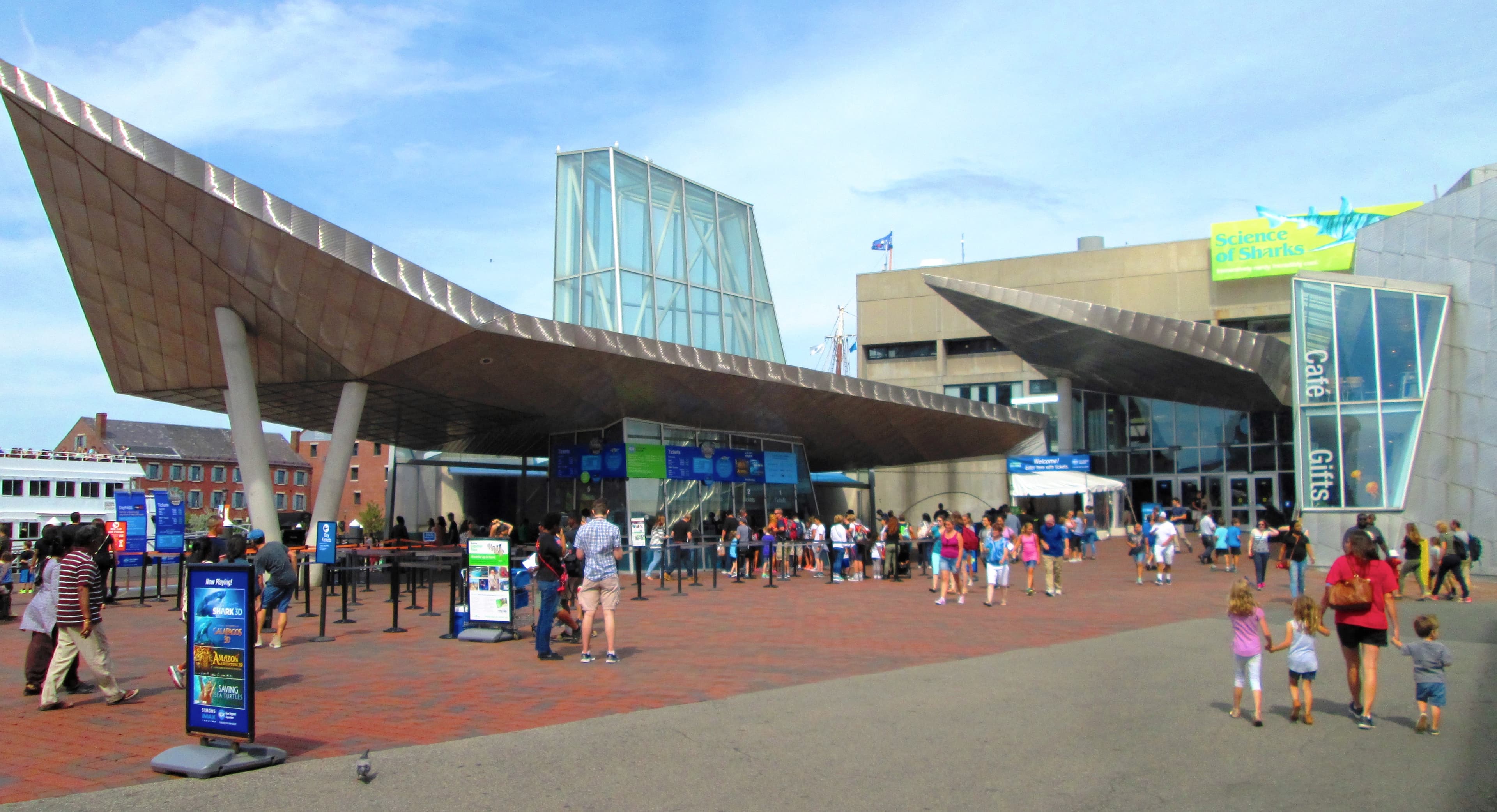
Stand on the plaza at Central Wharf on a summer morning and you will see Boston doing what it has done for three centuries: working the harbor. Ferries come and go from Long Wharf next door, the Harborwalk streams with walkers, and the downtown towers rise behind the Greenway. In the middle of it all sits a solid, concrete building with a glassy west wing — the New England Aquarium, the place where Boston goes to look at the sea from the inside.
The aquarium opened to the public on June 20, 1969, and it has been one of the city's most visited attractions ever since, drawing more than 1.3 million guests a year before the COVID-19 pandemic. It is a nonprofit, not a theme park, and that distinction shapes the whole visit. The exhibits are built around a single, spectacular idea — a four-story cylinder of seawater holding a simulated Caribbean coral reef — and around a research and rescue mission that extends well beyond the building, from the North Atlantic right whale to cold-stunned sea turtles on Cape Cod beaches. Families come for the penguins and the turtle; they leave, if the aquarium has done its job, thinking a little differently about the ocean at the end of the wharf.
The location is part of the experience. The aquarium stands at 1 Central Wharf, on the downtown waterfront between Long Wharf and the Rose Kennedy Greenway, a short walk from Faneuil Hall and Quincy Market. The Aquarium station on the MBTA Blue Line is steps away. Arrive by foot along the Harborwalk if you can: the approach from the Greenway, past the harbor seals on the plaza, is the aquarium's best overture, and it costs nothing.
1969: an aquarium to revive the waterfront
Boston has kept aquariums since the 1880s, but by the middle of the 20th century the city's last one — the South Boston Aquarium at Marine Park — had closed its doors in the 1950s, and the downtown waterfront itself was in decline. The New England Aquarium was conceived as part of the city's plan to bring the waterfront back to life. Planning began in 1962, David B. Stone led the project as president of the New England Aquarium Corporation, and Peter Chermayeff of Cambridge Seven Associates designed a modern, brutalist concrete building with a cavernous interior. Construction began on the decaying Central Wharf, and the building opened to the public in 1969.
The design made a bold structural choice that still defines every visit: the Giant Ocean Tank went up first, and the building was organized around it. The tank is the aquarium's heart, and the galleries, ramps, and walkways all answer to it. A year after opening, in 1970, the Giant Ocean Tank itself opened, and at the time it was the largest circular ocean tank in the world. The building has grown since — a glass-and-steel West Wing designed by Schwartz/Silver Architects was completed in 1998, adding a gift shop and the Harbor View Café — but the original logic has never changed: you enter, and the reef pulls you upward.
The aquarium's history also includes the expansions that never happened. In 1988 it announced plans to sell Central Wharf and build a much larger facility across the Charles River at the Charlestown Navy Yard; the project was cancelled in 1991. A later East Wing proposal was cancelled after the September 11 attacks, the Big Dig closure of Aquarium station, and rising costs. The aquarium stayed on Central Wharf, and in some ways the constraint became the character: a compact, vertical aquarium on a working pier, where the harbor is never more than a wall away.
The Giant Ocean Tank, and Myrtle
The Giant Ocean Tank is the reason to come. It is a cylindrical, 200,000-US-gallon exhibit that simulates a Caribbean coral reef, four stories tall, open at the top, and surrounded by a spiral walkway that lets you watch the reef from every angle and level through 67 acrylic windows. Inside, hundreds of tropical fish move through a reef crowded with bonnethead sharks, stingrays, moray eels, barracuda, and sea turtles. The tank was renovated and reopened in 2013 with an expanded coral reef, larger windows, a more advanced lighting array, and the Yawkey Coral Reef Center at the top, where smaller Caribbean habitats — dwarf seahorses, garden eels — get their own close-up.
The tank's most famous resident is Myrtle, a green sea turtle who has lived in the Giant Ocean Tank since 1970, when she arrived from an aquarium in Provincetown. The aquarium estimates her age at between 73 and 93 years old, which makes her one of the oldest known sea turtles in human care and, by a wide margin, the aquarium's senior resident. She is enormous — roughly 500 pounds — and unhurried, gliding past the windows while divers hand-feed the tank's animals. Generations of Boston schoolchildren have watched her on field trips; their children now do the same. If you visit, take the spiral walkway slowly, all the way to the top: the reef reads differently from each level, and Myrtle has favorite corners that the divers and regulars know by heart.
The tank is also a working exhibit, not a diorama. Divers enter the water daily to feed the animals and maintain the reef, and the aquarium runs talks at the top of the tank where staff explain how the exhibit was built and how its animals are cared for. Watching a diver hand lettuce to a 500-pound turtle while sharks cruise past is the aquarium at its most memorable — the wild and the managed, inches apart, separated by nothing but water and glass.
Penguins at the foot of the reef
At the base of the Giant Ocean Tank sits the penguin exhibit: a 150,000-US-gallon tray of saltwater holding a habitat of artificial rock islands, home to around 50 African and southern rockhopper penguins. The colony can be viewed from the spiral walkway, from the areas around the perimeter, and from every gallery level — the penguins are, quite deliberately, impossible to miss.
African penguins are the stars, and they are worth knowing properly. They are a temperate species, not an Antarctic one: in the wild they breed on the coasts and islands of southern Africa, from Namibia through South Africa, and they thrive in temperatures far warmer than the ice their cartoon cousins suggest. They are also in trouble in the wild — classified as critically endangered, threatened by climate change, habitat loss, overfishing, and pollution — and the aquarium participates in Species Survival Plans for both its penguin species. The colony has been here since the aquarium opened in 1969, when the original exhibit held just 10 African penguins; the current exhibit was designed to replicate their wild habitat and encourage natural behavior, and the birds reward that attention by being endlessly watchable — swimming, braying (African penguins are also called jackass penguins for their donkey-like call), and squabbling over rock perches.
The aquarium has also made room for old age. In recent years it created a separate "retirement island" for geriatric penguins, where older birds live with gentler slopes, more relaxed social dynamics, and daily health care — some of its residents are past 30, triple the typical wild lifespan. It is a small, humane detail, and it says a lot about how this institution thinks about its animals: not as displays with a shelf life, but as individuals with long lives.
Seals, sea lions, and the exhibits you can see for free
One of the aquarium's best features costs nothing and requires no ticket. The Atlantic harbor seal exhibit sits on the front of the main building, and its residents can be viewed for free, at any hour, without entering the building. The seals haul out on rocky outcrops modeled on the New England coast, slip into deep, cool water, and — during the day — take part in training sessions on the plaza, where visitors watch them interact with trainers. The aquarium's most famous seal, Hoover, was a "talking" Atlantic harbor seal who learned to imitate human phrases like "how are you?" and "come over here"; he passed away in 1985, but his grandson Chacoda has been learning phrases of his own.
Around the back of the building, on the Harborwalk side, the New Balance Foundation Marine Mammal Center — opened in 2009 — holds California sea lions and a northern fur seal in an open-air exhibit that is likewise visible from outside. The center's animals were deemed non-releasable after rescues on the West Coast and Alaska, and they now live out their lives where passersby can watch them play. Note for planners: the aquarium's own site currently notes that the Atlantic harbor seals will temporarily be off exhibit while their habitat is improved, so check the official site before a visit if the seals are the main draw for someone in your party.
These outdoor exhibits are the aquarium's gift to the waterfront. They turn a ticketed attraction inside out, giving the Harborwalk a reason to pause, and they connect the building to the harbor it studies: the seals and sea lions are, after all, the aquarium's neighbors in the most literal sense, animals of the same cold Atlantic water lapping the wharf.
Galleries, touch tanks, and the theatre
Four levels of smaller galleries surround the Giant Ocean Tank and the penguin habitat, open to the atrium and reached by the spiral walkway or a separate series of ramps. The Tropical Gallery holds live corals and hundreds of warm-water fishes, including a floor-to-ceiling Indo-Pacific coral reef exhibit. The Temperate Gallery features goliath groupers, lungfish, weedy seadragons, and sea jellies. The Freshwater Gallery divides between Amazon habitats — red-bellied piranhas, poison dart frogs, green anacondas, electric eels — and the Connecticut River Valley, with brook trout and Atlantic salmon. The Northern Waters Gallery contrasts New England marine habitats, centered on Stellwagen Bank National Marine Sanctuary, with the Olympic Coast of the Pacific Northwest, including shorebirds, colorful American lobsters, and giant Pacific octopuses.
For children, the hands-on exhibits are the highlight. The Edge of the Sea tide pool lets visitors touch New England tide-pool animals — sea stars, sea urchins, snails, hermit crabs, horseshoe crabs — under staff guidance. The Trust Family Foundation Shark and Ray Touch Tank, made permanent in 2011 in the West Wing, holds 25,000 gallons of water in a mangrove habitat where guests can interact with stingrays and small sharks, including leopard whiprays and brown-banded bamboo sharks; the aquarium describes it as the largest shark and ray touch tank on the East Coast.
The Simons Theatre — the Matthew and Marcia Simons Theatre, in its own building on Central Wharf — opened in 2001 as an IMAX theatre. A renovation in 2020 replaced the IMAX system with a digital projector showing 2D and 3D films on an 80-foot by 43-foot screen, and the theatre now seats 378 and hosts special events. In 2020, artist Shepard Fairey also painted the mural "A Vital and Vibrant Ocean for All," featuring a North Atlantic right whale, on the theatre's façade — a fitting billboard for what the aquarium does beyond its walls.
Conservation: right whales, rescued turtles, and the whale watch
The aquarium's research arm, the Anderson Cabot Center for Ocean Life, conducts long-running research on the North Atlantic right whale, one of the world's most endangered large whales, and the aquarium has advocated for the species — and for sustainable fishing practices and climate action — at the city, state, and federal level. Its Quincy Animal Care Center, opened in 2010, rescues and rehabilitates hundreds of sea turtles a year, many of them cold-stunned animals stranded on Cape Cod beaches, and releases them back into the wild. In the 1970s and 1980s the aquarium joined other local organizations in calling for the cleanup of Boston Harbor and the Charles River — a campaign that, ultimately, succeeded, and that is part of why the harbor outside the building is as clean as it is today.
The most direct way visitors can join that work is the New England Aquarium Whale Watch. In season, the aquarium partners with Boston Harbor Cruises to take whale watchers about 30 miles east of Boston Harbor to Stellwagen Bank National Marine Sanctuary, a rich feeding ground for humpback, finback, and minke whales, pilot whales, large pods of dolphins, and the endangered North Atlantic right whale. Trips last around 3 to 4 hours, with on-board naturalists narrating, and the boats keep a responsible distance from the animals. The whale watch is seasonal — check the official schedule before planning around it — and it is the natural sequel to a visit inside: the same ocean, the same animals, at full scale.
Why the aquarium endures
Boston has grander museums and older landmarks, but few attractions that have stayed so consistently central to the city's idea of itself. Part of it is the building's honesty: a concrete structure on a working wharf, organized around a single great tank, that has never pretended to be anything other than what it is. Part of it is the animals — Myrtle gliding past the glass, the penguins braying at the foot of the reef, the seals on the plaza — who reward repeat visits in a way static exhibits cannot. And part of it is the mission: an aquarium that treats its visitors as future stewards of the ocean, not just ticket buyers, and that backs the claim with research vessels, rescue tanks, and a whale watch.
For a first-time visitor, the formula is simple. Arrive via the Harborwalk, watch the seals on the plaza, then go inside and let the spiral walkway carry you up the reef, level by level, to the top of the Giant Ocean Tank. Linger in the galleries on the way down, touch a sea star if the tide pool is open, and leave time for the penguins — they are, after all, the animals most visitors remember first. Then step back outside, look at the harbor, and consider that the water at the end of the wharf is the same water you have just been looking at through glass. That is the aquarium's real exhibit, and it is still there when you leave.
Key Facts
- The New England Aquarium opened to the public on June 20, 1969, on Central Wharf in Boston, Massachusetts; the main building was designed by Peter Chermayeff of Cambridge Seven Associates.
- The Giant Ocean Tank, a cylindrical 200,000-US-gallon exhibit simulating a Caribbean coral reef, opened in 1970 and was the largest circular ocean tank in the world at the time; it was renovated and reopened in 2013 with an expanded reef, larger acrylic windows, and the Yawkey Coral Reef Center at the top.
- The tank is surrounded by a spiral walkway with 67 acrylic windows offering views of the reef from every angle and level.
- Myrtle, a green sea turtle, has lived in the Giant Ocean Tank since 1970, when she arrived from an aquarium in Provincetown; the aquarium estimates her age at between 73 and 93 years old.
- The penguin exhibit at the base of the Giant Ocean Tank holds around 50 African and southern rockhopper penguins in a 150,000-US-gallon habitat of artificial rock islands; African penguins have been at the aquarium since it opened in 1969, when the original colony numbered just 10 birds.
- The Atlantic harbor seal exhibit on the front of the building can be viewed for free, at any hour, without entering the building; the New Balance Foundation Marine Mammal Center (opened 2009) on the Harborwalk side holds California sea lions and a northern fur seal.
- The glass-and-steel West Wing, designed by Schwartz/Silver Architects, was completed in 1998; the Trust Family Foundation Shark and Ray Touch Tank (25,000 gallons) became a permanent West Wing exhibit in 2011.
- The Matthew and Marcia Simons Theatre opened in 2001 as an IMAX theatre; a 2020 renovation replaced the IMAX system with a digital projector on an 80-foot by 43-foot screen, and the theatre now seats 378.
- The Anderson Cabot Center for Ocean Life conducts long-running research on the North Atlantic right whale; the Quincy Animal Care Center (opened 2010) rescues and rehabilitates hundreds of sea turtles annually.
- The aquarium's whale watch runs seasonally in partnership with Boston Harbor Cruises to Stellwagen Bank National Marine Sanctuary, about 30 miles east of Boston Harbor, with trips of around 3 to 4 hours.
- More than 1.3 million guests visited the aquarium each year prior to the COVID-19 pandemic.
- Boston's earlier aquariums date to the 1880s; the last before this one, the South Boston Aquarium at Marine Park, closed in the 1950s.
- Hoover, the aquarium's famous "talking" Atlantic harbor seal who imitated phrases like "how are you?", passed away in 1985; his grandson Chacoda has been learning phrases of his own.
Visitor Details
Address: New England Aquarium, 1 Central Wharf, Boston, MA 02110 (Downtown Waterfront, next to Long Wharf and the Rose Kennedy Greenway)
Transit: Aquarium station on the MBTA Blue Line is steps from the entrance; the site is a short walk from Faneuil Hall and Quincy Market, and the Harborwalk runs past the building.
Hours/Admission: Hours and admission prices change seasonally and are not stated here as fixed facts — check the aquarium's official site (neaq.org) before visiting to confirm the day's hours, ticket prices, and any timed-entry requirements. The outdoor harbor seal exhibit on the front plaza and the Marine Mammal Center on the Harborwalk side can be viewed from outside without a ticket.
Before you go: The aquarium's own site currently notes that the Atlantic harbor seals will temporarily be off exhibit while their habitat is improved — confirm exhibit status on neaq.org if the seals are a priority. The whale watch is seasonal; confirm its schedule and departure point on the official site as well.
Best timing: Arrive via the Harborwalk from the Greenway, watch the outdoor marine mammals first, then enter and take the Giant Ocean Tank spiral walkway slowly from bottom to top. Weekday mornings are generally quieter. Allow about 2 hours inside, plus time on the plaza and Harborwalk, and pair the visit with Faneuil Hall, the North End, or a harbor ferry from Long Wharf.
Location Photography