DC's free zoo, in the middle of a forest
There is a particular kind of Washington surprise that waits for first-time visitors to the Smithsonian's National Zoo. You arrive expecting a city attraction — a gate, a ticket line, a few hours among enclosures — and instead you walk downhill into a forest. The Zoo sits on 163 acres in Rock Creek Park, in the Woodley Park neighborhood of Northwest Washington, and its paths wind through trees, over a stream valley, and up and down some of the steepest hills of any major zoo in America. It is, in the most literal sense, a park that happens to contain animals: more than 1,700 of them, representing more than 350 species, according to the Smithsonian, spread across a landscape that feels less like a theme park and more like a wooded ravine that the city agreed to share with the animal kingdom.
That setting is the point. The National Zoo is part of the Smithsonian Institution, and like the Smithsonian's museums on the National Mall, it is always free of charge — a fact the Institution states plainly on its own pages, and one that shapes the whole character of a visit. There is no admission fee standing between a family and a giant panda. Entry passes are free, though they are required and should be reserved in advance through the Zoo's official site; parking passes, by contrast, are paid. The result is a zoo that belongs to the city in a way few American zoos do: school groups, joggers cutting through on Olmsted Walk, neighbors walking dogs along the perimeter, and tourists from around the world all use the same 163 acres, and nearly two million visitors a year pass through it.
The Zoo's formal mission, as the Smithsonian states it, is to "provide engaging experiences with animals and create and share knowledge to save wildlife and habitats." That second half matters more here than at most zoos, because the National Zoo is not one campus but two: the public park in Rock Creek Park, and the Smithsonian Conservation Biology Institute, a 3,200-acre research campus in Front Royal, Virginia, where scientists conduct the veterinary and reproductive research behind many of the Zoo's breeding programs. What you see on a walk through Woodley Park is the public face of a research institution that works at field sites in dozens of countries. The pandas get the headlines, but the science is the reason the place exists.
1889: a zoo founded by Congress
The National Zoo is one of the oldest zoos in the United States, founded in 1889 as part of the Smithsonian Institution. Its early years were modest — a small collection, a new site in Rock Creek Park chosen for its woodland and water — but the ambition was scientific from the start: the Zoo was among the first in the country to establish a research program, and its animals were studied as well as displayed. Over the following century it grew into the sprawling, hilly park visitors know today, with exhibits rebuilt again and again to give animals larger, more naturalistic habitats: the old Elephant House gave way to Elephant Trails, the Bird House was renovated, and the panda habitat was rebuilt for its newest residents.
That long history is visible in the landscape itself if you know where to look. The Zoo's oldest corners carry the feel of a 19th-century park — stonework, mature trees, paths that follow the contours of the valley — while the newer exhibits are open, planted, and designed around animal behavior rather than spectator sightlines. The contrast is the story of American zoos in miniature: from menagerie to conservation center, on the same 163 acres. And through it all, the Zoo has kept its founding bargain with the public: free admission, in a park that is also a piece of Rock Creek Park's green corridor through the city.
The pandas: fifty years of pandemonium
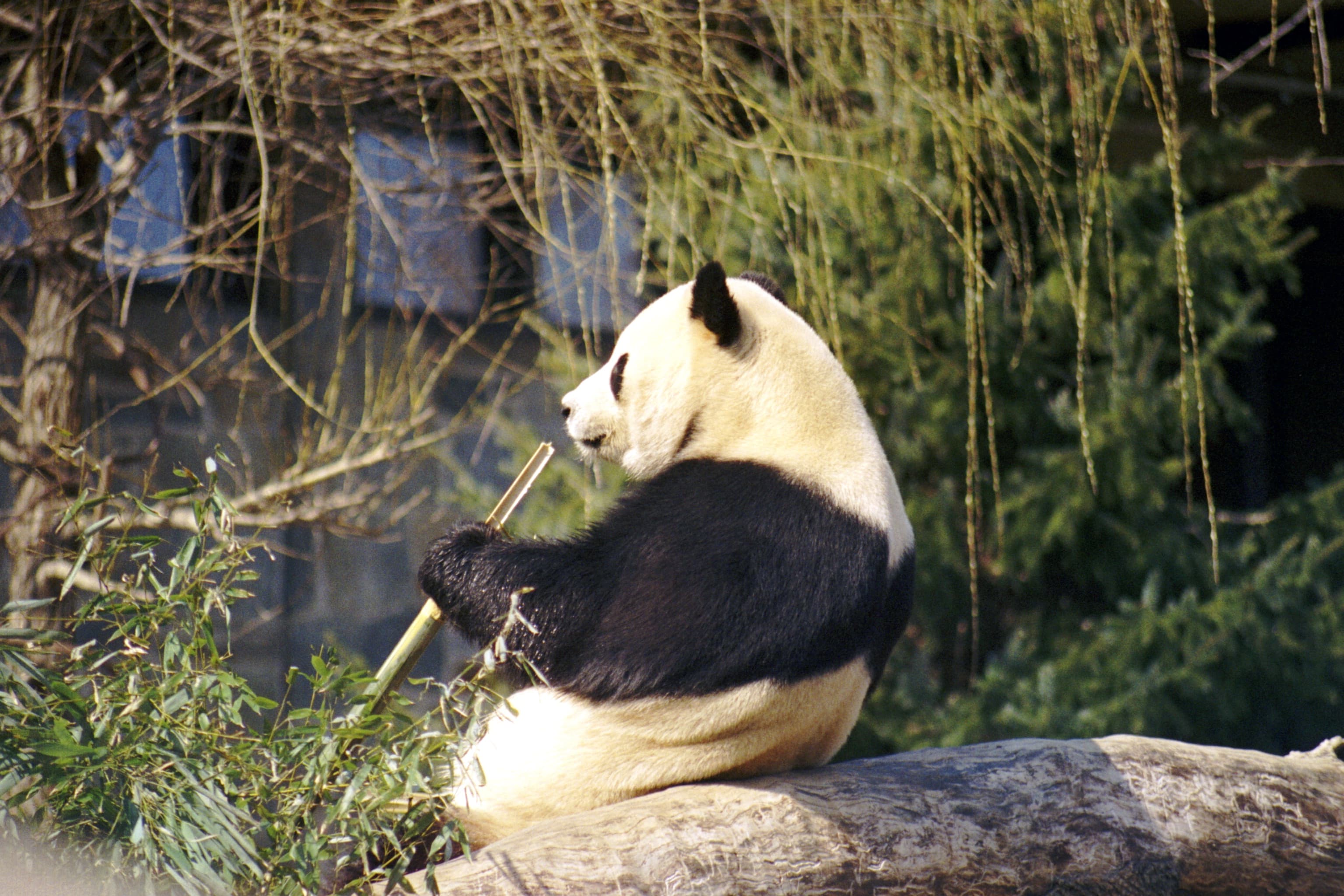
No animal has defined the National Zoo the way the giant panda has. The story begins in April 1972, when the first pair of giant pandas, Ling-Ling and Hsing-Hsing, arrived in Washington as a gift following President Nixon's historic trip to China. First Lady Pat Nixon reportedly called the resulting frenzy "panda-monium," and the word stuck — for good reason. For half a century, the Zoo's pandas have been Washington's most beloved residents, watched in person by millions and, in recent years, by millions more on the Giant Panda Cam.
The panda era has had chapters. Ling-Ling and Hsing-Hsing were followed, in December 2000, by Mei Xiang and Tian Tian, who became the Zoo's most famous pair and the parents of several cubs, including Bao Bao, born at the Zoo in 2013, and Xiao Qi Ji. In November 2023, Mei Xiang, Tian Tian, and Xiao Qi Ji returned to China at the end of their agreement, and the panda habitat stood empty for the first time in decades — an eleven-month gap that Washington felt keenly.
The current chapter began on October 15, 2024, when two three-year-old giant pandas, Bao Li and Qing Bao, flew from China to Washington Dulles International Airport and were driven by FedEx truck, with a police escort, to the Zoo. Bao Li, a male born August 4, 2021, is the son of Bao Bao — the cub born at the National Zoo in 2013 — making him the grandson of Mei Xiang and Tian Tian, and a living link back to the Zoo's earlier panda family. Qing Bao, a female born September 12, 2021, takes her name from the Mandarin words for "green" and "treasure." After a quarantine and acclimation period, the pair made their official public debut on January 24, 2025, in the renovated David M. Rubenstein Family Giant Panda Habitat, and the Giant Panda Cam relaunched the same day. Under the current agreement with the China Wildlife Conservation Association, Bao Li and Qing Bao are expected to remain in Washington until April 2034.
Seeing them takes patience and a little strategy. The pandas are solitary animals with separate habitats, divided by mesh "howdy" windows through which, the Smithsonian has noted, the pair have begun to show interest in each other. They are most often found eating bamboo — a giant panda can spend most of its waking hours at it — or napping in a tree or on a rock, and on hot days they are more likely to be inside. The indoor viewing area and the outdoor yards both reward a wait, and the crowds are thickest in the middle of the day. If the pandas are the reason for your visit, go to them first thing or late in the afternoon, and be prepared to circle back: a panda that is asleep at 10 a.m. may be wide awake, and munching, an hour later.
Asia Trail: red pandas, sloth bears, and the walk to the pandas
The pandas anchor the Asia Trail, the Zoo's upper loop, and the trail itself is worth walking slowly rather than rushing to its famous endpoint. Asia Trail is a bamboo-lined sequence of habitats for the animals that share the giant panda's part of the world: red pandas, which visitors often spot curled in the branches above the path into the panda house; sloth bears; clouded leopards, often half-hidden in foliage; fishing cats; Asian small-clawed otters; and, in an aquatic exhibit along the way, northern snakehead fish. Sculptures of Asian animals line the trail, and a bridge leads toward the Bird House — a reminder that the Zoo's trails connect rather than simply lead from one star to the next.
The Bird House itself, renovated in recent years, is one of the Zoo's quieter pleasures: a walk-through world of tropical birds, with a migratory-bird experience and outdoor aviaries. It sits just off the Asia Trail, over a bridge behind the elephants, and it is easy to miss if you follow only the main downhill flow of the crowds. That is true of the Zoo in general — its best moments are often a few steps off the main path — and the Asia Trail rewards the visitor who treats it as a walk through a habitat rather than a corridor to the pandas.
Elephant Trails: a herd with room to roam
If the pandas are the Zoo's most famous residents, the Asian elephants are its most impressive habitat. Elephant Trails, whose first phase opened to visitors in September 2010 after a multi-year, $52 million rebuild, gives the herd a home on a scale the old Elephant House never could: nearly two acres of varied outdoor yards with pools, shade structures, sand piles, and mud wallows, plus an Elephant Community Center where visitors can watch the elephants indoors year-round. A quarter-mile Elephant Trek, a walking path for the elephants themselves, winds uphill through a wooded area of the Zoo — an exhibit feature the Zoo notes is exclusive to Washington — and an Outpost courtyard offers interactive exhibits about the conservation challenges facing Asian elephants in the wild.
The herd has grown and changed over the years, including the arrival in November 2022 of two Asian elephants, Trong Nhi and her daughter Nhi Linh, as a gift from the Netherlands' Rotterdam Zoo under the Association of Zoos and Aquariums' breeding program. Watching elephants here is a lesson in patience: they bathe, forage, dust themselves, and interact with keepers in ways that repay a long look, and the mid-morning and late-afternoon hours tend to be the most active. The Community Center's displays explain how the Zoo monitors everything from trunk dexterity to family bonds, and why the breeding program matters — Asian elephants are endangered, and the Zoo's work in Washington and at its Front Royal campus is part of a coordinated effort to sustain the population in human care and protect the species in the wild.
Great Ape House, Amazonia, and the rest of the park
Beyond the pandas and elephants, the Zoo's depth is what turns a two-hour visit into a full day. The Great Ape House is home to western lowland gorillas and orangutans, and its most magical feature is the O-Line: a system of overhead cables that lets orangutans travel high above the paths between buildings, so that a visitor resting on a bench may suddenly find an ape crossing the sky overhead. It is the kind of moment no exhibit label can promise and no photograph quite captures, and it is worth keeping an eye on the cables as you walk.
Amazonia, the Zoo's indoor rainforest, is a different world altogether: warm, humid, and dense with tropical fish, birds, and plants, built around a working model of an Amazon river basin. It is also the Zoo's best refuge on a rainy or bitterly cold day, with a large seating area near the exit that makes it a natural rest stop. The American Trail, along the lower part of the park, brings the focus home to North American wildlife — California sea lions and gray seals gliding through the water, bald eagles, river otters, beavers, and ravens — while the Reptile Discovery Center, the Small Mammal House, and the Cheetah Conservation Station round out a collection that genuinely spans the continents. Families with young children will find the Kids' Farm, with its goats, cows, donkeys, and alpacas, and a play area nearby.
None of this is a checklist to be completed. The Zoo covers 163 hilly acres, and trying to see everything in one visit, at a run, is the surest way to enjoy none of it. Pick two or three anchors — the pandas, the elephants, the apes — and let the trails between them do their work.
Conservation behind the scenes
What distinguishes the National Zoo from a purely recreational zoo is the research that runs underneath the visit. The Smithsonian Conservation Biology Institute in Front Royal, Virginia, is not open to the public, but its work shapes what happens in Washington: reproductive science that has helped breed endangered species, veterinary research, and field programs run with partners in dozens of countries. The Zoo's scientists study everything from elephant communication to panda reproduction to the health of wild populations, and the findings feed back into how animals are cared for in human care and protected in the wild.
That mission is visible in the signage throughout the park, which consistently ties each exhibit to a conservation story: why Asian elephants are endangered, what threatens giant pandas in their mountain forests of central China, how the Zoo's breeding programs fit into global efforts to sustain endangered populations. It is also visible in the Zoo's seasonal rhythms — the winter ZooLights festival, when the park glows with millions of lights, is a celebration, but it is also a fundraiser for that work. A visit here is, whether or not you think about it that way, a contribution to a conservation institution. Admission is free, but the work is not.
Visiting: hills, Metro, and how to plan the day
The single most important practical fact about the National Zoo is its terrain. The park is built on a hillside in Rock Creek Park, and the main route runs steeply downhill from the Connecticut Avenue entrance to the lower exhibits, which means the walk back up is the price of the walk down. Comfortable shoes are essential, water matters on a hot day, and visitors with strollers or mobility concerns should plan their route with the hills in mind — the Zoo's paths are accessible, but they are long and steep in places. A good strategy is to enter at the top, work downhill through Asia Trail and the pandas, then loop through the lower exhibits, and take the return climb slowly, with stops.
Getting there is easiest without a car. The Zoo sits between two Red Line Metro stations: Woodley Park-Zoo/Adams Morgan, a short walk from the Connecticut Avenue entrance, and Cleveland Park, from which the walk to the Zoo is downhill along Connecticut Avenue. If you drive, reserve a parking pass in advance through the Zoo's official site — parking passes are paid, and the Zoo's own passes page lists advance and day-of prices, so check there before you go rather than assuming a figure. Entry passes are free but required for all visitors, so reserve those online too, and confirm the day's hours on the official site before visiting: Zoo hours vary seasonally, and special events such as ZooLights change the evening schedule.
Timing matters more here than at most Washington attractions. Early morning is the best time for active animals and thinner crowds, and weekday visits outside school holidays are calmer than weekends. The pandas draw their biggest crowds midday, so see them early or late. And give the Zoo at least half a day — three to four hours at a minimum, a full day if you want to linger. The Zoo is closed on some days and hours shift with the seasons, so the official site, nationalzoo.si.edu, is the last word on any given day's plan. Bring food or buy it there — there are cafés on site — and remember that you are in Rock Creek Park: the Zoo pairs naturally with a walk in the park itself, or with the Woodley Park and Adams Morgan neighborhoods just outside the gates, where the restaurants and cafés make an easy end to a long, hilly, wonderful day.
Why the National Zoo endures
Washington has grander monuments and quieter museums, but nothing else in the city does quite what the National Zoo does. It is free, which means it belongs to everyone; it is old, which means it carries more than a century of the city's history in its paths; and it is scientific, which means that behind every crowd-pleasing panda is a research program trying to keep that species alive in the wild. The pandas will always be the reason most people come, and Bao Li and Qing Bao are worthy successors to a fifty-year line of beloved bears. But the Zoo's real achievement is larger than any single animal: a 163-acre forest in the middle of the capital where a child can watch an orangutan cross the sky on a cable, an elephant take a swim, and a panda eat bamboo — for free — and walk out understanding, even dimly, why those animals matter. That is a rare thing in any city, and Washington is lucky to have it.
Key Facts
Smithsonian's National Zoo was founded in 1889 as part of the Smithsonian Institution and is one of the oldest zoos in the United States.
The Zoo's public park covers 163 acres in Rock Creek Park in the Woodley Park neighborhood of Northwest Washington, D.C., at 3001 Connecticut Ave. NW.
Admission is always free of charge; free entry passes are required for all visitors and should be reserved in advance through the Zoo's official site.
The Zoo is home to more than 1,700 animals representing more than 350 species, and welcomes nearly 2 million visitors each year, according to the Smithsonian.
The first giant pandas, Ling-Ling and Hsing-Hsing, arrived in April 1972; Mei Xiang and Tian Tian arrived in December 2000 and, with their cub Xiao Qi Ji, returned to China in November 2023.
Current giant pandas Bao Li (male, born August 4, 2021) and Qing Bao (female, born September 12, 2021) arrived October 15, 2024, made their public debut January 24, 2025, in the David M. Rubenstein Family Giant Panda Habitat, and are expected to remain until April 2034 under the agreement with the China Wildlife Conservation Association.
Bao Li is the son of Bao Bao, who was born at the National Zoo in 2013, making him the grandson of Mei Xiang and Tian Tian.
Elephant Trails, whose first phase opened in September 2010, is a multi-acre Asian elephant habitat with an Elephant Community Center and a quarter-mile Elephant Trek; two elephants, Trong Nhi and Nhi Linh, joined the herd in November 2022 as a gift from the Rotterdam Zoo.
Asia Trail features red pandas, sloth bears, clouded leopards, fishing cats, Asian small-clawed otters, and the giant pandas, with the Bird House nearby.
The Great Ape House's O-Line lets orangutans travel on overhead cables above visitor paths; Amazonia is an indoor rainforest exhibit; the American Trail features sea lions, seals, bald eagles, and river otters.
The Smithsonian Conservation Biology Institute, the Zoo's 3,200-acre research campus in Front Royal, Virginia, conducts veterinary and reproductive research and works with partners at field sites in dozens of countries.
The Zoo's second campus and research mission reflect its founding purpose, stated by the Smithsonian as providing engaging experiences with animals and creating and sharing knowledge to save wildlife and habitats.
Visitor Details
Address: Smithsonian's National Zoo, 3001 Connecticut Ave. NW, Washington, DC 20008 (Woodley Park; main entrance on Connecticut Avenue, with additional entrances off Rock Creek Parkway and at Harvard Street / Adams Mill Road)
Transit: Woodley Park-Zoo/Adams Morgan station (Metro Red Line) is a short walk from the Connecticut Avenue entrance; Cleveland Park station (Red Line) is a downhill walk along Connecticut Avenue. Several bus routes serve Connecticut Avenue.
Hours/Admission: Admission is always free, but free entry passes are required for all visitors — reserve them in advance at nationalzoo.si.edu. Parking passes are paid; the Zoo's official passes page lists advance and day-of parking prices, so check there before visiting rather than relying on a quoted figure. Zoo hours vary seasonally and special events (including winter ZooLights) change the evening schedule — confirm the day's hours on the official site before visiting.
Best timing: Arrive early for active animals and thinner crowds; see the pandas first thing or late in the afternoon rather than midday, when crowds peak. Allow at least three to four hours, ideally half a day. Wear comfortable shoes — the park is steep and hilly, with the main route running downhill from the Connecticut Avenue entrance and a long climb back up. Pair the visit with Woodley Park or Adams Morgan just outside the gates.
Smithsonian's National Zoo in Photographs: Historic Views and the Bird House