The run everyone knows
You know this staircase even if you have never been to Philadelphia. A boxer in gray sweatsuits and a wool cap jogs through the city's streets at dawn, up the broad steps of a great neoclassical building, and throws both arms into the air at the top as trumpets swell. That is the training montage from Rocky (1976), and the staircase is the east entrance of the Philadelphia Museum of Art. Seventy-two stone steps climb from Eakins Oval to the museum's front doors, and for half a century now, visitors have come here to do exactly what Rocky did: run up them, raise their arms, and feel, for a moment, like an underdog who just won.
The scene lasts only a couple of minutes in the film, and it was shot on a shoestring — Rocky was famously made for about a million dollars in 28 days — but it became one of the most recognizable moments in movie history. The song over it, "Gonna Fly Now," is now inseparable from the place: stand at the foot of the steps on any morning and you will hear someone humming it, or playing it from a phone, before they start up. The steps have been called the most famous staircase in America, and it is hard to argue. Millions of people climb them every year, and almost none of them are on their way into the museum — at least, not at first.
That is the peculiar genius of the Rocky Steps. They are a museum entrance that became a destination in its own right, a piece of civic architecture that a movie borrowed and never quite gave back. The museum, to its credit, leaned into it rather than fighting it. The steps are free, open, and public, and the climb belongs to everyone: school groups, marathon trainers, wedding parties, and first-time visitors who have waited their whole lives to do this one silly, joyful thing.
A museum staircase first
Before Rocky, the steps were simply the grand approach to one of America's great art museums — and they still are. The Philadelphia Museum of Art was founded in 1876, for the nation's Centennial, and its main building on the Benjamin Franklin Parkway opened in 1928. The building is a Greek temple in spirit: a long neoclassical facade with a colonnade, designed by Horace Trumbauer's firm with Julian Abele and Paul Philippe Cret, sitting at the end of the Parkway like a full stop at the end of a grand sentence. The Parkway itself was modeled on the Champs-Élysées, a diagonal boulevard lined with flags, fountains, and museums, running from City Hall out to the museum's front door.
The steps were designed for ceremony. They rise in broad flights from Eakins Oval — the traffic circle with the Washington Monument at its center — past fountains and sculpture to the east entrance. They were meant to make a visitor feel the museum's importance before ever stepping inside, and they still do that job. What nobody in 1928 could have predicted was that the staircase would become more famous than most of the art inside, or that the building's most photographed feature would be a fictional boxer standing outside it.
That is worth remembering as you climb: the steps are not a movie set. They are a real, working entrance to a real museum, and the building behind them holds one of the finest collections in the country. The smart visit does both — the run and the museum — in either order.
How a movie prop became a monument
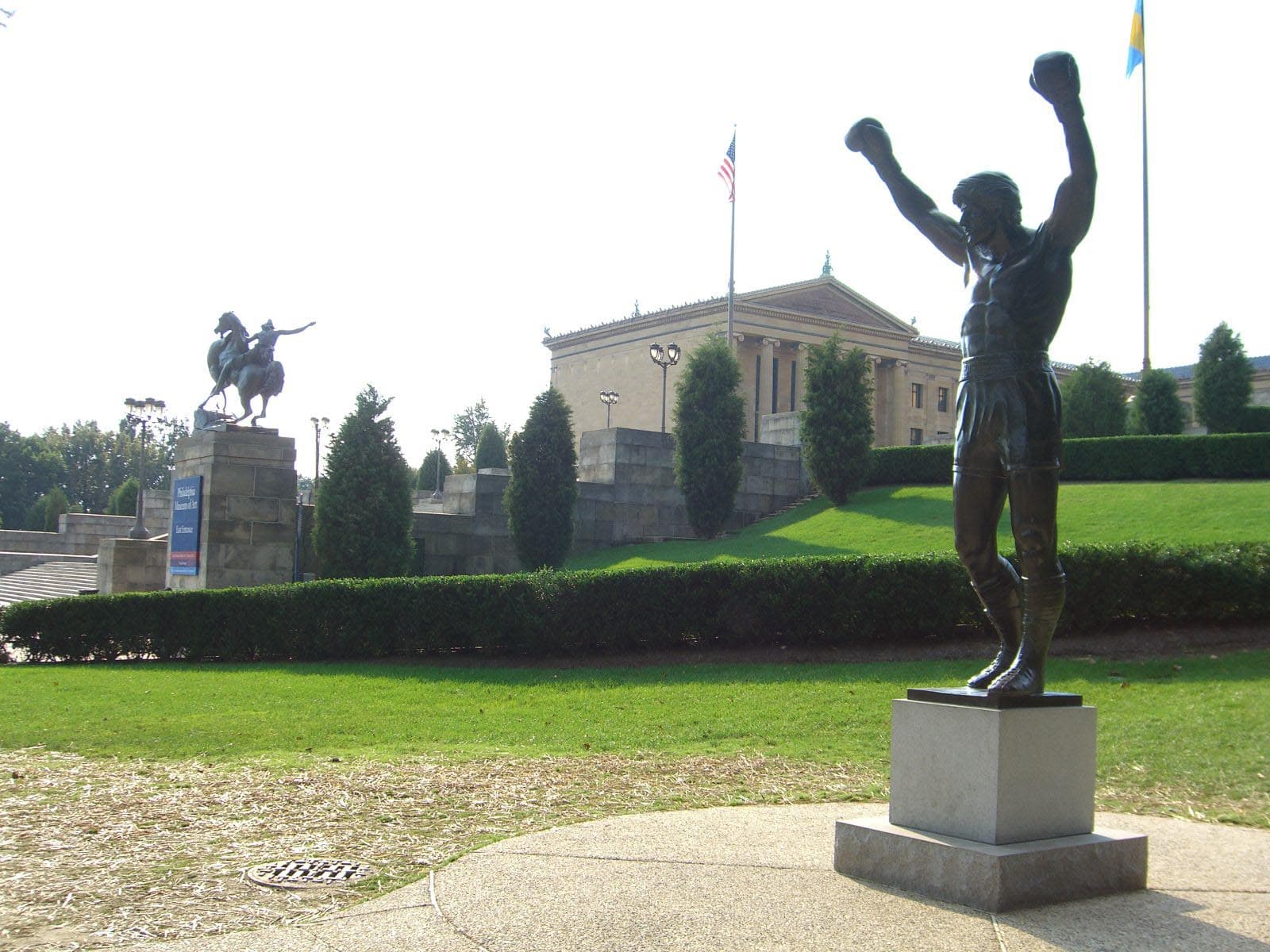
The statue came second, and it was never supposed to be a monument at all. In 1980, Sylvester Stallone commissioned Colorado sculptor A. Thomas Schomberg to create a bronze Rocky Balboa for Rocky III (1982). Schomberg, known for his athletic sculptures, modeled the figure with a life mask of Stallone and posed him in the triumphant moment: bare-chested, boxing gloves on, both arms raised overhead. In the film, the statue is unveiled in a ceremony at the top of the museum steps, a fictional tribute to a fictional champion.
After filming, Stallone gave the statue to the City of Philadelphia, and that is when the trouble started. The museum and the city's Art Commission argued over whether a movie prop belonged beside a temple of fine art. Some Philadelphians loved it as a tribute to the city's working-class roots; others thought it cheapened the museum. The city eventually moved the statue to the front of the Spectrum, the South Philadelphia sports arena, where it stood for years as a mascot for the city's teams rather than its art.
The statue kept traveling. It came back to the museum for the filming of Rocky V and other productions, then went back to the Spectrum. It was only in 2006, ahead of Rocky Balboa, that the statue returned to the museum steps for good — placed on a pedestal in a grassy area at the foot of the steps, to the right as you face the climb, where it has stood ever since. The unveiling that September drew a crowd, live music, and the debut of the Rocky Balboa trailer, and the mayor at the time called the steps one of the city's biggest tourist attractions. The debate about whether it is "art" never fully ended. The statue simply outlasted it.
A statue with many addresses
That restless history is part of the visit, because the Rocky statue has never quite stayed put — and even now, its exact placement shifts with exhibitions and events. Three casts were made of Schomberg's original sculpture. One stood in San Diego's Hall of Champions for years before Stallone bought it back at auction; it returned to Philadelphia for the city's first RockyFest in December 2024 and has since stood at the top of the steps, the original site of the film's unveiling scene. The original statue, meanwhile, has been the subject of the museum's own 2026 exhibition, "Rising Up: Rocky and the Making of Monuments," which treats the statue's journey — from prop to pilgrimage site — as a story worth telling inside the museum itself.
The practical point for a visitor is simple: expect a Rocky at the steps, expect a line to photograph him, and do not be surprised if the arrangement has changed slightly since the last photo you saw. The statue you meet is the latest chapter in a long argument about what belongs in front of a museum, and the argument is part of why the place matters. A monument that nobody argued about would not be nearly as interesting.
The view from the top
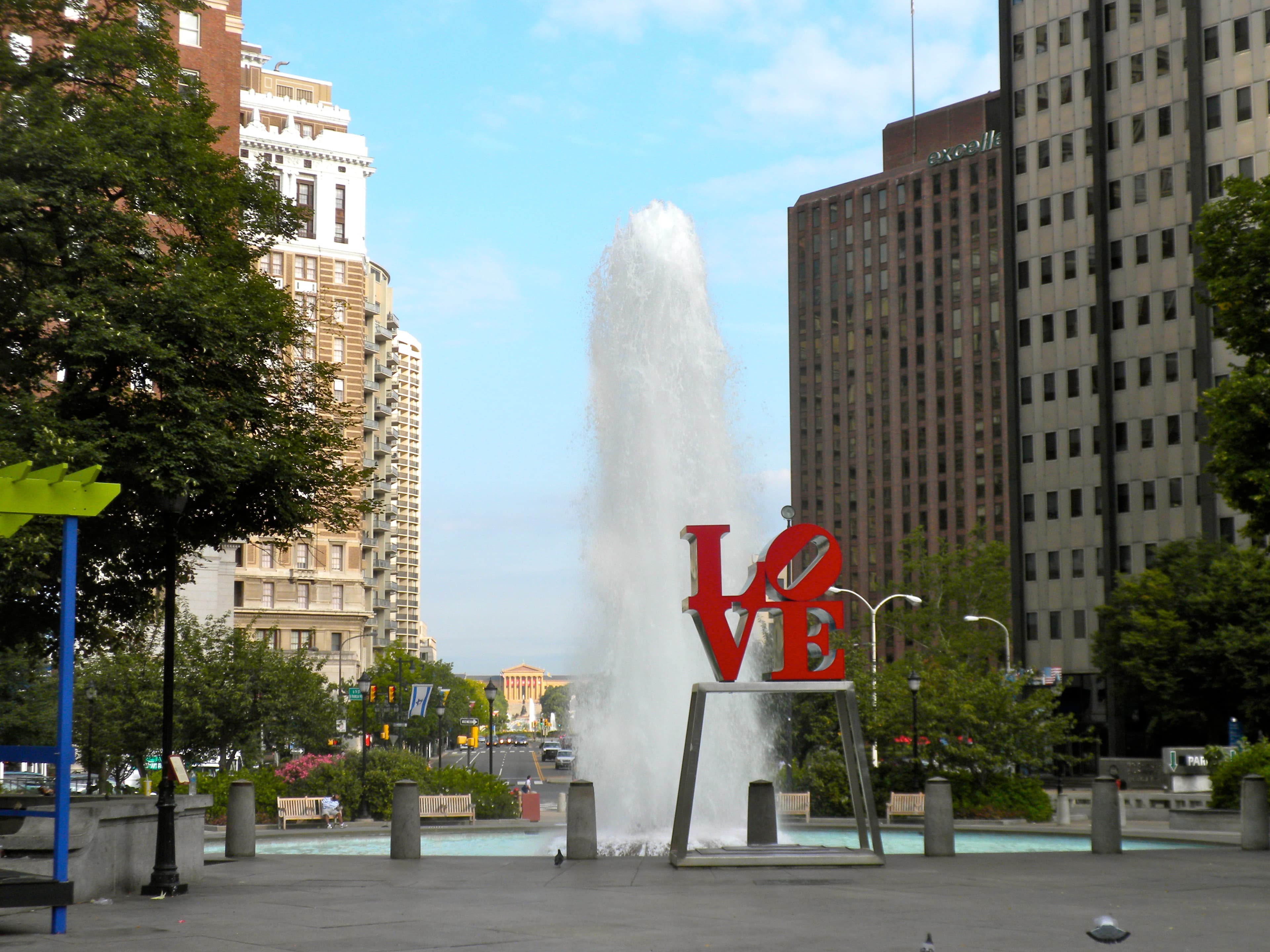
Climb the steps — run them if you like, walk them if you prefer, nobody is judging — and the reward is not just the pose. At the top, turn around. The Benjamin Franklin Parkway stretches out below you in a straight, flag-lined run all the way to City Hall, with the towers of Center City rising behind it. To one side sits Eakins Oval and the Washington Monument; along the Parkway you can pick out the Rodin Museum, the Barnes Foundation, and the Free Library. It is one of the great urban views in America, and it costs nothing.
Look down at your feet at the top of the steps, too. Set into the stone are bronze sneaker footprints marked "Rocky," placed where the character stood for his triumphant pose. Visitors stand in them to recreate the shot, arms up, with the Parkway behind them. The footprints date to the early 1990s and are easy to miss if you are not looking — one of those details that rewards slowing down after the climb.
The steps are also a stage for the city itself. They have been the backdrop for the annual Independence Day celebrations, for huge concerts including Live 8, and for championship celebrations. Two Philadelphia Inquirer journalists once spent a year interviewing the people who run them and turned the conversations into a book, Rocky Stories: Tales of Love, Hope, and Happiness at America's Most Famous Steps. The stories in it — proposals, recoveries, memorials, first visits — explain why the steps endure. People do not just come here to copy a movie. They come here to mark something in their own lives.
The people's pedestal
There is a phrase that fits this place better than "tourist attraction": the people's pedestal. The steps and the statue belong to anyone willing to climb, and Philadelphians treat them that way. On any given day you will see a bride posing with the statue, a running club doing repeats, a family from another continent taking turns with the camera, and a local on a lunch break sitting on the steps eating a sandwich, ignoring the whole spectacle. The statue's line moves quickly — most people want one photo, arms up, beside Rocky — and the mood in it is unusually good-natured. Strangers take each other's pictures. Someone always offers.
That is the real reason the Rocky Steps survive every debate about taste. The statue may have started as a movie prop, but the ritual around it is genuine: people come here to celebrate, to mourn, to protest, to rally, and to see themselves, briefly, as someone who can go the distance. A fictional boxer from Kensington gave the city a place to do that, and the city, after arguing about it for decades, kept it.
Visiting the Rocky Steps: how to do it well
Come early if you want the statue to yourself. The line for a photo with Rocky is shortest in the morning, and the light on the steps and the Parkway view is best before midday. If you want the classic photograph, stand in the bronze footprints at the top of the steps, arms raised, with the Parkway and City Hall behind you — and let someone else take it, because the shot needs distance. Then walk down to the statue at the foot of the steps, to the right as you face the climb, and join the line for the arms-up pose beside Rocky himself.
Do the climb at your own pace. Seventy-two steps is a real workout, but there are landings, handrails, and plenty of places to stop, and the steps are wheelchair-accessible. Bring water in summer; the stone reflects the heat. Afterward, consider going inside: the museum's east entrance is right there, and the Great Stair Hall inside — watched over by Augustus Saint-Gaudens's gilded Diana — is worth the visit on its own. Or walk the Parkway instead, toward the Rodin Museum and the Barnes, and make a museum day of it.
Pair the visit with the rest of Rocky's Philadelphia if you have the day. The Italian Market in South Philadelphia, where the film's famous training run winds through the stalls, is a short ride away, and a cheesesteak afterward is the traditional reward. But the steps themselves are the essential stop. Every first-time visitor to Philadelphia should climb them once, arms up, if only to understand why a staircase became the city's most beloved landmark. It is not about the movie, not really. It is about what the movie noticed: that an ordinary person, running up ordinary steps, can look, for one moment, triumphant.
Key Facts
- The Rocky Steps are the 72 stone steps leading to the east entrance of the Philadelphia Museum of Art, at 2600 Benjamin Franklin Parkway, Philadelphia.
- The steps gained worldwide fame from the 1976 film Rocky, in which Sylvester Stallone's Rocky Balboa finishes a training run by climbing them to the song "Gonna Fly Now."
- The steps appear in Rocky and four of its sequels, and the climb has become a physical metaphor for an underdog rising to a challenge.
- The bronze Rocky statue was created in 1980 by sculptor A. Thomas Schomberg as a prop for Rocky III (1982); Stallone donated it to the City of Philadelphia after filming.
- The statue was moved to the Spectrum sports arena in South Philadelphia after a debate over whether a movie prop belonged at the museum, and returned to the museum steps in 2006, placed at the foot of the steps to the right of the climb.
- Three casts of the statue were made; a duplicate cast returned to Philadelphia for the first RockyFest in December 2024 and has stood at the top of the steps.
- Bronze sneaker footprints marked "Rocky" are set into the stone at the top of the steps, where visitors pose for the triumphant-arms photograph.
- The Philadelphia Museum of Art was founded in 1876 and its main Parkway building opened in 1928; the building was designed by the firm of Horace Trumbauer with Julian Abele and Paul Philippe Cret.
- The steps have hosted the city's Independence Day celebrations and major concerts including Live 8, and were the subject of the book Rocky Stories (1996) by two Philadelphia Inquirer journalists.
- The museum's 2026 exhibition "Rising Up: Rocky and the Making of Monuments" examines the statue's journey from film prop to pilgrimage site.
Visitor Details
Address: 2600 Benjamin Franklin Parkway, Philadelphia, PA 19130 (Philadelphia Museum of Art, east entrance)
Transit: SEPTA buses run along the Benjamin Franklin Parkway and stop near Eakins Oval at the foot of the steps; check SEPTA's official trip planner for current routes and stops before visiting. The steps are a short ride from Center City.
Hours/Admission: The steps and the statue are outdoors and free to visit at any time. The museum interior is a separate ticketed attraction — hours and admission vary, so check the Philadelphia Museum of Art's official site before visiting.
Best timing: Early morning for the shortest statue photo line and the best light on the Parkway view. The climb is 72 steps with landings and handrails; bring water in summer, as the stone reflects heat.
Location Photography