The most photographed four letters in Philadelphia
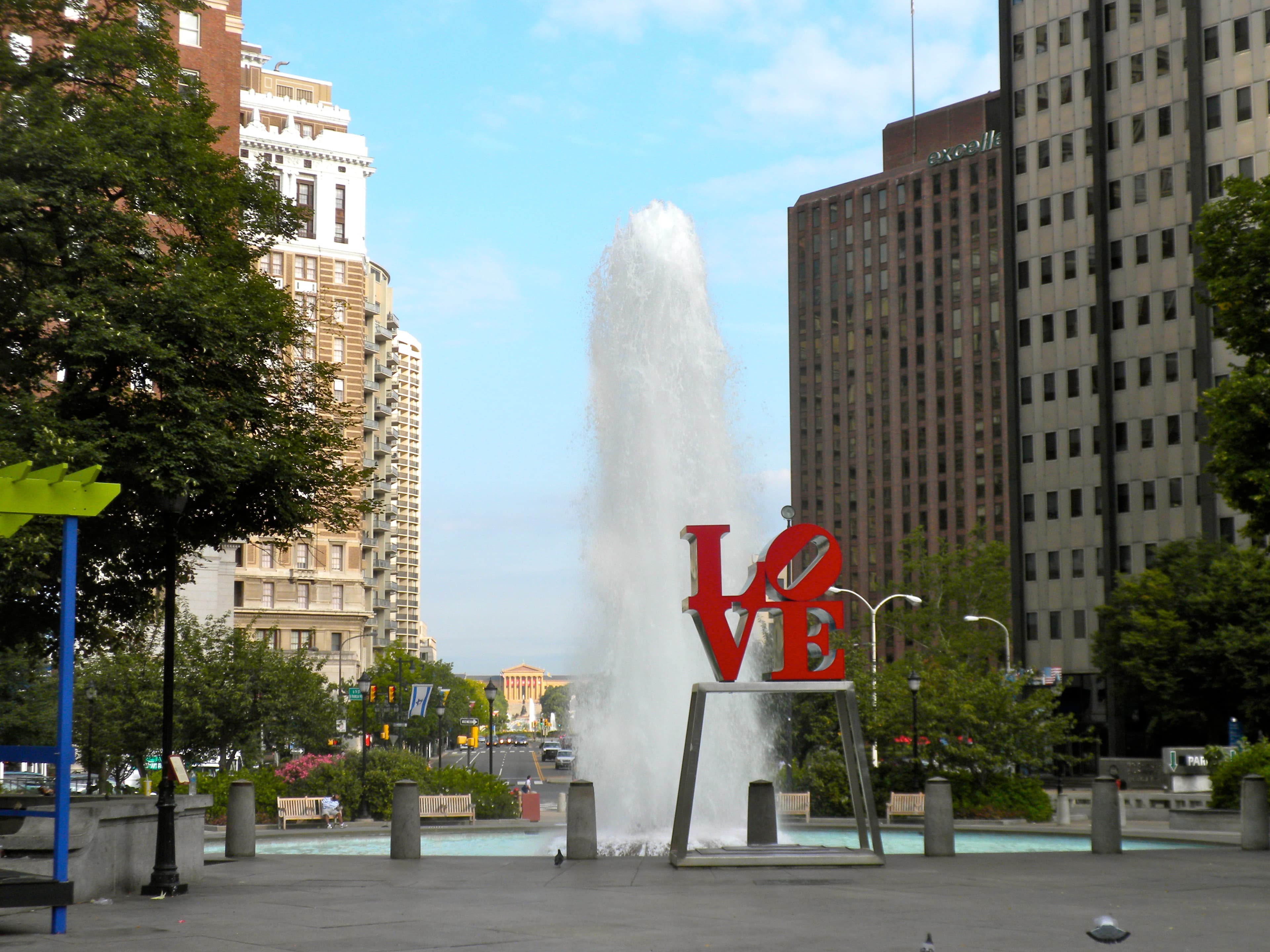
Stand at 15th Street and John F. Kennedy Boulevard in Center City, look across at the tower of City Hall, and you will see it: four block letters, stacked two over two, red and green and purple, with the O tilted on its side as if leaning in to listen. It is Robert Indiana's LOVE, and the plaza it stands on is known to everyone in Philadelphia by its nickname, LOVE Park, even though its official name is John F. Kennedy Plaza.
There are LOVE sculptures in cities around the world, and two more in Philadelphia itself, but this is the one people mean when they say "the LOVE statue." Visitors queue for their turn in front of the letters, and couples pose for engagement photos. The image has become shorthand for Philadelphia itself, the visual equivalent of the city's nickname, the City of Brotherly Love.
The design began as a painting. Indiana first produced his LOVE image as a painting in 1964, and within a few years it had been printed on a Museum of Modern Art Christmas card and a United States postage stamp. The first three-dimensional version, a twelve-foot Cor-Ten steel sculpture made in 1970, now stands at the Indianapolis Museum of Art. The Philadelphia version, in aluminum, is a later casting of the same image: L and O over V and E in bold serif type, the tilted O drawing the eye down toward the V. It is Pop Art at its most direct — a word you already know, made strange and joyful by being made into an object you can walk around.
A plaza built over a parking garage
LOVE Park was not an accident, and it was not originally about the sculpture at all. It was the work of Edmund Bacon, Philadelphia's celebrated city planner — the father of actor Kevin Bacon — and architect Vincent G. Kling. Bacon had first sketched the idea in his 1932 Cornell architecture thesis: a grand civic space at the eastern end of the Benjamin Franklin Parkway, the diagonal boulevard modeled on the Champs-Élysées that runs from City Hall to the Philadelphia Museum of Art. When Bacon became executive director of the City Planning Commission, Kling completed the architectural design, and the plaza was built in 1965.
The engineering underneath is part of the story. The plaza was constructed over an underground parking garage, which is why the original park was a hard, flat surface of granite rather than a planted garden: it was a roof as much as a park. Its original centerpiece was a single-spout fountain, added in 1969, and its curved granite steps became one of its most recognizable features. In 1967, four years after his assassination, the plaza was formally dedicated as John F. Kennedy Plaza, and a plaque at the park still records the dedication.
The setting is what makes the plaza work. LOVE Park is the visual terminus of the Benjamin Franklin Parkway, which means that standing at the sculpture you are standing at the hinge of the city's grandest axis. Look northwest and the Parkway runs straight to the Philadelphia Museum of Art, lined with flags and museums. Turn around and City Hall fills the view, its Second Empire tower and the statue of William Penn on top forming one of the great urban backdrops in America. The park is small — about half an acre — but its position makes it feel like the center of the city, because in civic terms it is.
How LOVE almost left town
The sculpture arrived as a guest and nearly left as one. For the United States Bicentennial in 1976, Indiana lent the city a large aluminum LOVE sculpture, which was installed in John F. Kennedy Plaza as part of the celebrations. It stayed on extended loan for two years. Then, in 1978, when a sale to the city could not be arranged, Indiana's New York gallery sent a truck to remove it to show it to a potential buyer.
Philadelphia erupted. Newspapers demanded to know how the city's new symbol had been allowed to slip away, and the public outcry was immediate and loud. The rescue came from F. Eugene Dixon Jr., a local businessman — the former owner of the Philadelphia 76ers — and chairman of the Philadelphia Art Commission, who purchased the sculpture and donated it to the city. It was reinstalled in the plaza later that same year, permanently this time, and the plaza has been LOVE Park in the public imagination ever since.
The sculpture has one more secret, and it is written in color. For years visitors knew LOVE as red, green, and blue. In fact, as the city discovered during the sculpture's 2018 conservation, the third color was never blue at all: it was purple. Decades of sun had faded the original purple toward blue, and a 1998 restoration had faithfully repainted it the wrong color, working from photographs that already showed the faded blue. When the artist's representatives alerted the city and archival photographs confirmed the original scheme, the sculpture returned to the plaza in February 2018 in its true colors — red, green, and purple — on a new rectangular pedestal. If the LOVE you remember is blue, you are remembering the faded version. The purple is the original.
The skateboarders' cathedral
Between the Bicentennial and the renovation, LOVE Park acquired a second fame that had nothing to do with tourists. Beginning in the 1980s, skateboarders discovered that the plaza's smooth granite, its curved steps, and its fountain ledges made it one of the finest street-skating spots anywhere. By the 1990s, skate videos and photographs shot at LOVE Park had made it one of the most recognizable skate spots in the world.
The city, however, did not see it that way. The first ban on skateboarding in the park was passed in 1984, and enforcement intensified in the early 1990s under Mayor Ed Rendell, with fines for skaters. The contradiction sharpened in 2001 and 2002, when Philadelphia hosted the X Games — a celebration of the very culture the city was policing out of its most famous skate spot — while the Street administration announced tougher enforcement and renovations designed to remove the skateable elements. In 2000 it was even a level in the video game Tony Hawk's Pro Skater 2, which introduced the plaza to millions of players who had never set foot in Philadelphia.
The most famous protest came from the plaza's own creator. In October 2002, Edmund Bacon, then 92 years old, skateboarded across LOVE Park in an act of civil disobedience against the bans and the renovations, insisting that the skaters had given his work a life he had never imagined. "Neither Vincent or I had the slightest premonition that our work would become world famous," he said of the skateboarding fame. The bans held, and the 2016 demolition removed the last of the iconic skateable features, including the famous Fountain Gap. In February 2016, before the demolition, Mayor Jim Kenney briefly lifted the ban for five days as a farewell. In 2024, the city of Malmö, Sweden, announced it was rebuilding part of the old design from the park's original granite — LOVE Park's second life, on another continent.
The park today: lawns, water, and games
What replaced the old granite plaza is a different kind of park, and it is worth judging on its own terms. From 2016 to 2018, a major reconstruction converted the largely hardscaped plaza into a greener space, with large and small lawns for casual use, two gardens and green stormwater basins planted with tropical and native species, new cafe seating, and daily recreational games such as ping-pong. The redesign kept the essential viewshed open in both directions — City Hall behind you, the Parkway ahead — and it kept the LOVE sculpture as the anchor, now on its new pedestal at the plaza's northwest side.
The fountain was redesigned rather than simply restored. Where the old single spout once stood, the new fountain in a large oval paved area features a big central jet surrounded by a "bird's nest" of smaller jets with programmable up-lighting, and on summer days it becomes a splash pad where children — and plenty of adults — cool off. The park's programming has grown with the redesign: food trucks serve lunch on weekdays, the plaza hosts concerts and civic gatherings, and in winter it becomes home to the Christmas Village, the open-air German-style holiday market that fills the plaza with wooden stalls, lights, and the smell of mulled wine.
But for a first-time visitor, the current park is easy to enjoy on its own terms: it is green where the old park was gray, it invites sitting where the old park invited passing through, and it still delivers the two things that made it famous, the sculpture and the views, in a single frame.
Visiting LOVE Park: how to do it well
Come for the photograph, but stay for the position. The classic shot frames the LOVE letters with City Hall's tower behind them, and the line for it moves quickly; if you want the sculpture to yourself, arrive early in the morning, when the plaza belongs to joggers and commuters cutting through. Then turn around and walk the Parkway: the flags, the Swann Memorial Fountain at Logan Square, and the museum district unfold in a straight, level walk of about a mile to the Philadelphia Museum of Art, and every step of it is the view the plaza was built to terminate.
Pair the visit with the two neighbors that complete the picture. Across the street, Dilworth Park at City Hall's west side offers its own lawn, cafe, and ice rink in winter, and City Hall itself runs tours of one of the largest masonry buildings in the country. A few blocks up the Parkway, Sister Cities Park holds Robert Indiana's AMOR sculpture — the same word in Spanish and Latin — a smaller sibling that makes a satisfying second photograph and a quieter one, since almost no one queues for it. The sculpture is outdoors, so weather is the only real constraint; bring water in summer, when the fountain is running and the lawns are at their most inviting.
Key Facts
- LOVE Park's official name is John F. Kennedy Plaza; it was dedicated in 1967 after President John F. Kennedy.
- The plaza was planned by city planner Edmund Bacon and designed by architect Vincent G. Kling, and built in 1965 over an underground parking garage.
- It sits across from Philadelphia City Hall and forms the visual terminus of the Benjamin Franklin Parkway, facing the Philadelphia Museum of Art.
- Robert Indiana first produced his LOVE image as a painting in 1964; the Philadelphia sculpture is an aluminum casting, first placed in the plaza for the 1976 Bicentennial.
- The sculpture was removed in 1978 when a sale fell through, then purchased and donated to the city by F. Eugene Dixon Jr., and permanently reinstalled that year.
- The sculpture's true colors are red, green, and purple — not blue; the blue was faded purple, corrected during the 2018 conservation.
- LOVE Park became one of the world's most famous skateboarding spots in the 1990s, was featured as a level in Tony Hawk's Pro Skater 2 (2000), and was the site of Edmund Bacon's 92-year-old skateboard protest in 2002.
- A 2016–2018 reconstruction replaced the hard granite plaza with lawns, gardens, stormwater basins, cafe seating, games, and a redesigned fountain with a central jet and programmable lighting.
- The park hosts seasonal events including the Christmas Village holiday market in winter, and weekday food trucks.
- A second Robert Indiana LOVE sculpture stands on the University of Pennsylvania campus, and his AMOR sculpture stands nearby in Sister Cities Park.
Location Photography