The market under the trains
Walk into Reading Terminal Market on a busy morning and the first thing you notice is not any single stall. It is the sound and the scale of the place: vendors calling out, shoppers threading the aisles with bags of produce and fresh-baked bread, and above it all, the great arched roof of the old Reading Terminal train shed. This is Philadelphia's most beloved food hall, and it is also one of the city's great historic interiors — a working public market that has never stopped feeding the city since it opened in 1893.
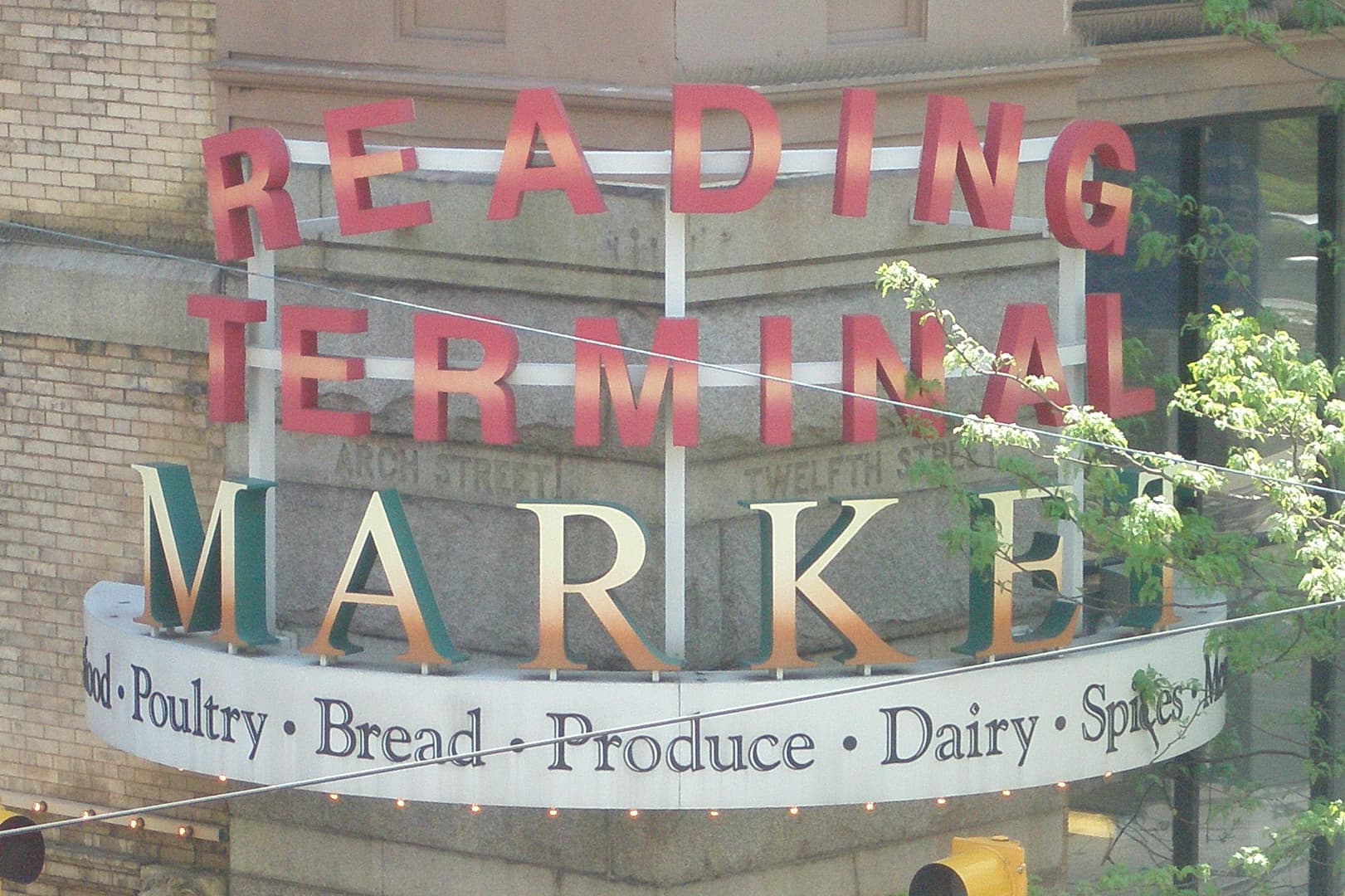
Reading Terminal Market sits at 12th and Market Streets in Center City, in the ground floor of the former Reading Terminal, once the Philadelphia headquarters and main station of the Philadelphia and Reading Railroad. Trains no longer depart from the shed above the market — the shed now forms part of the Pennsylvania Convention Center complex — but the market below carries on exactly the job it was built for: bringing farmers, butchers, bakers, and cooks from across the region together under one roof, within easy reach of the people of Philadelphia.
That continuity is what makes the market a first-time visitor's essential stop. Philadelphia has grand museums, historic halls, and famous streets, but nowhere else in the city gives you the whole of Philadelphia's food culture in a single room: Pennsylvania Dutch specialties beside Italian hoagies, Amish-baked shoofly pie beside a classic Philly cheesesteak, fresh-caught seafood beside flowers, coffee, and candy. You do not need a reservation, a ticket, or a plan. You just need an appetite and a willingness to wander.
A market born from a railroad
The story of Reading Terminal Market begins with the railroads that remade Philadelphia in the nineteenth century. By the 1880s, the city's open-air markets along Market Street — the long string of market sheds that had grown up since William Penn's time — were overcrowded, unsanitary, and in the way of a fast-growing downtown. The Philadelphia and Reading Railroad, meanwhile, needed a grand new terminal in the heart of the city. The solution, designed by the Philadelphia firm of Wilson Brothers, combined the two needs in a single building: a monumental headhouse and train shed on Market Street, with a vast public market on the ground floor beneath the tracks.
The market opened for business on February 22, 1893. Trains rumbled overhead on the elevated tracks while, below, stalls were laid out in a grid of twelve aisles running east to west and four wider avenues running north to south. Sawdust was spread on the floor to absorb spills and moisture from the cold-storage facility in the basement. The idea was practical — farmers and food dealers got a clean, covered, central place to sell — but the result was also a social institution. Philadelphians came here not only to shop but to meet, to eat, and to catch up on the news of the city.
Business boomed. By 1913, the market counted some 250 food dealers and 100 farmers working its stalls. The railroad era eventually faded: the last trains left Reading Terminal in the 1980s, and the great shed was preserved as part of the Pennsylvania Convention Center. The market itself survived the transition, was renovated, and emerged as a nonprofit institution — today it is operated as a 501(c)(3) nonprofit — with more than 70 independent merchants. That survival matters. Many American cities lost their historic public markets to supermarkets and redevelopment. Philadelphia kept its own, and kept it working.
What to eat first
First-time visitors often ask where to start, and the honest answer is that there is no single right route — but there are a few tastes that define the place. The Philly cheesesteak is the obvious one. You will find more than one stand serving thinly sliced steak on a long roll, and Philadelphians will happily debate the merits of each. Ordering is part of the ritual, and every stand has its own style, so do not be shy about asking what the house recommends.
The roast pork sandwich is the other great Philadelphia classic on offer here, and at Reading Terminal Market it has a devoted following: slow-roasted pork, sharp provolone, and garlicky broccoli rabe on a seeded roll. It is messier, richer, and less famous outside the city than the cheesesteak, which is exactly why locals love it. If you want something sweet to follow, the Amish vendors' doughnuts — sold at stalls run by Pennsylvania Dutch families who travel in from Lancaster County — are a market legend, as are shoofly pie, apple dumplings, and soft pretzels, another Philadelphia staple.
Beyond those headliners, the market rewards grazing. There are stalls for fresh produce, butchers and fishmongers, bakeries, cheese shops, coffee roasters, candy makers, and prepared foods from many of the cultures that make up modern Philadelphia, from Italian and Mexican to Middle Eastern and Southeast Asian cooking. The Pennsylvania Dutch presence is the market's signature, though: look for stalls selling scrapple, chow-chow, pickled goods, and preserves, and for the plain, practical style of cooking that has been part of this market since its earliest days. Amish vendors traditionally do not sell on Sundays, so if the Amish stalls are high on your list, plan a weekday or Saturday visit — and check the market's official site before you go, since individual merchants keep their own schedules.
The Amish stalls and the Pennsylvania Dutch table
The Pennsylvania Dutch vendors are more than a novelty at Reading Terminal Market; they are a living link to the farming communities of Lancaster County, about an hour west of Philadelphia. For generations, Amish and Mennonite families have brought their produce, baked goods, meats, and preserves to Philadelphia markets, and Reading Terminal has been their city home for much of that history. Their stalls tend to be among the busiest in the market, and their food — hearty, unfussy, and made from simple ingredients — stands in deliberate contrast to the trend-driven stalls around them.
This is also why the market feels different from a modern food hall. A food hall is usually curated by a developer; a public market grows by accretion, stall by stall, family by family, over decades. At Reading Terminal you can still see that history in the mix: third- and fourth-generation family businesses beside newer arrivals, old Philadelphia institutions beside first-time vendors testing a new idea. The market's nonprofit mission is explicitly to keep that mix alive — to keep a place in Center City where small, independent food businesses can afford to trade and where Philadelphians of every income can shop.
How to visit the market well
Reading Terminal Market is free to enter, and you pay only for what you eat or buy. That makes it an easy, low-pressure stop, but a few habits will make the visit better. Come hungry, but not in a rush. The market is at its liveliest late in the morning and around lunchtime, when the aisles are crowded and the prepared-food stalls are in full swing; if you prefer a calmer browse, an earlier visit is quieter. Bring cash as well as a card, since a few smaller stalls still prefer it, and bring a bag if you plan to shop for produce or baked goods to take home.
Do a full loop before you buy anything. The grid of aisles makes this easy: walk every aisle once, note what looks good, and then go back for the things you cannot stop thinking about. That first loop is also the best way to appreciate the building itself. Look up at the shed roof, notice the scale of the hall, and imagine the trains that once stood overhead. Then sit down. The market has communal seating, and eating shoulder to shoulder with strangers — a cheesesteak here, a pretzel there, a coffee to finish — is the whole point. This is not a place to eat alone in a corner. It is a place to join the city at its table.
Finally, step outside when you are done and look at the building from Market Street. The headhouse facade, with its arched windows and ornate detailing, is one of Center City's great landmarks, and it tells the other half of the story: this was once a cathedral of rail travel, and it is now a cathedral of food. Both versions of the building were built for the same purpose — bringing people together in the middle of Philadelphia — and both are still doing it.
Key Facts
- Reading Terminal Market opened for business on February 22, 1893, on the ground floor of the former Reading Terminal, designed by Wilson Brothers.
- The market was laid out in a grid of twelve east-west aisles and four wider north-south avenues, with trains running overhead on the terminal's tracks.
- By 1913, the market counted about 250 food dealers and 100 farmers working its stalls.
- The last trains departed Reading Terminal in the 1980s; the train shed was preserved as part of the Pennsylvania Convention Center complex.
- Today the market is operated as a nonprofit and is home to more than 70 independent merchants.
- Pennsylvania Dutch and Amish vendors from Lancaster County have sold at the market for generations; Amish stalls traditionally do not sell on Sundays.
- The market's signature Philadelphia foods include the Philly cheesesteak, the roast pork sandwich, soft pretzels, and Amish doughnuts and shoofly pie.
- The market sits in Center City at 12th and Market Streets, in the heart of downtown Philadelphia.
- Entry to the market is free; visitors pay only for food and goods purchased from individual merchants.
- Reading Terminal Market is one of the oldest continuously operating public markets in the United States.
Visitor Details
Address: 51 N 12th St, Philadelphia, PA 19107
Transit: The market is in Center City at 12th and Market Streets, served by nearby SEPTA subway and regional rail stations; check SEPTA for the route nearest your visit
Hours/Admission: Entry is free. Hours and individual merchant schedules vary — check the official site at readingterminalmarket.org before visiting for current market hours
Best timing: Late morning and lunchtime are liveliest for prepared food; earlier visits are calmer for browsing. Do a full loop of the aisles before buying, and allow at least an hour to eat and explore
Location Photography