America's most beloved ballpark
Ask a first-time visitor to Boston what they want to see, and the answer very often includes it: Fenway Park. It is not just a stadium; it is a civic landmark, a living museum, and the place where Boston's sporting identity has been staged for more than a century. Since it opened in 1912, Fenway has been the home of the Boston Red Sox, and it remains the oldest ballpark still in use in Major League Baseball.
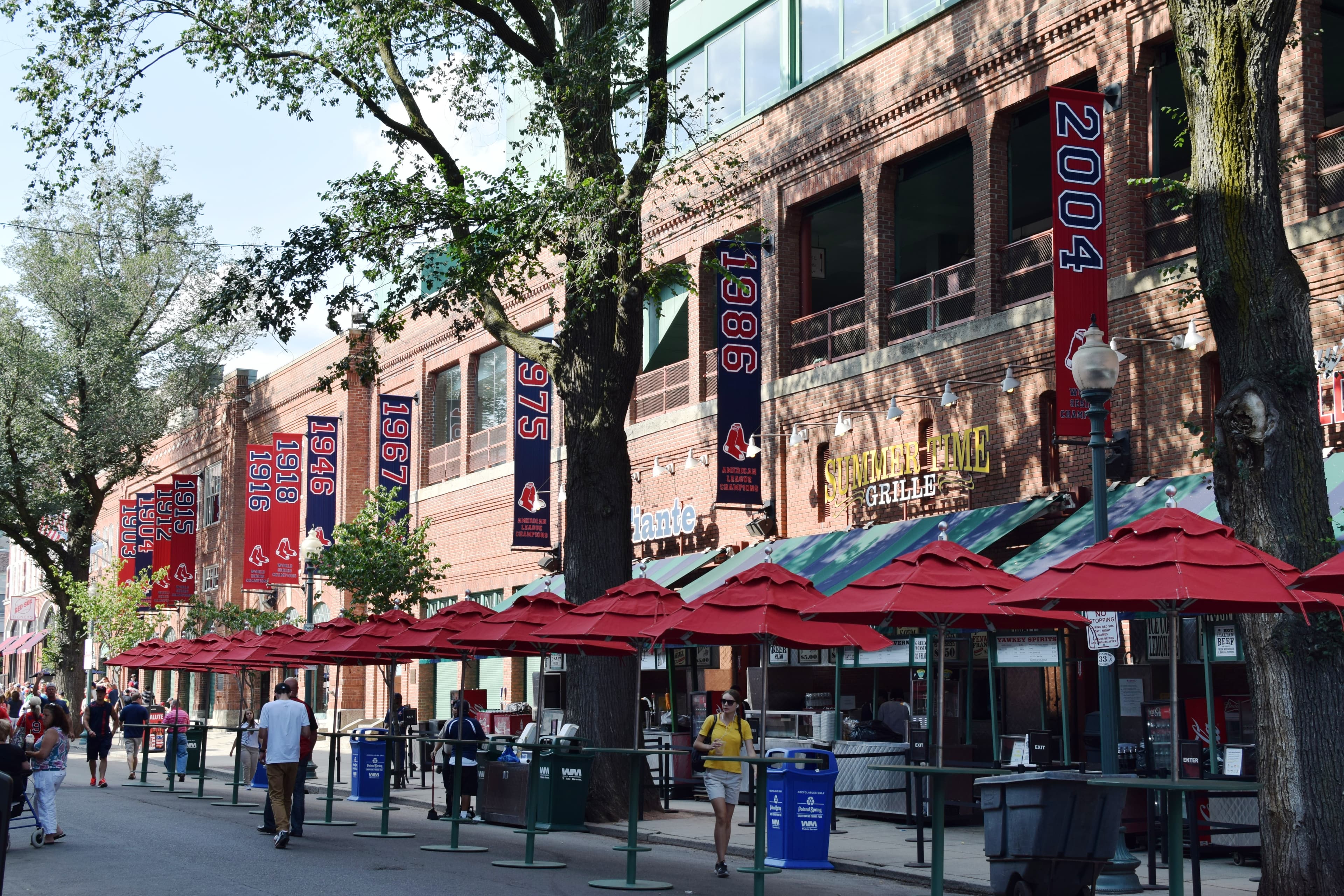
Fenway sits tight inside the city, not apart from it: a wedge of the Fenway-Kenmore neighborhood bounded by Jersey Way, Van Ness Street, Ipswich Street, and Lansdowne Street, hard against Kenmore Square. There is no sweeping plaza or suburban parking sea; fans spill out of the Kenmore MBTA stop and walk straight into the ballpark's orbit of pubs, souvenir stands, and street vendors. Fenway was built for a city that walked to the game, and it still feels that way.
Opening day, 1912: a ballpark born in the shadow of the Titanic
Fenway Park opened on April 20, 1912 — five days after the sinking of the Titanic, which overshadowed its debut. The Red Sox beat the New York Highlanders, soon to become the Yankees, 7–6 in eleven innings before about 24,000 fans. The 1912 Red Sox then won the American League pennant and beat the New York Giants in the World Series, the first of the club's championships from their new home.
Built on low-lying land near the Back Bay Fens, its irregular shape was dictated by the streets around it. Architect James E. McLaughlin designed a steel-and-concrete structure considered state of the art for its day, but the footprint forced compromises that became legends: short foul lines, a deep center field, and a towering left-field wall. Its intimate scale — every seat close to the action — has survived every renovation since.
The early years were golden: World Series titles in 1912, 1915, 1916, and 1918, powered by stars including Tris Speaker and a young pitcher-outfielder named Babe Ruth. Then came the long drought: after Ruth was sold to the Yankees following the 1919 season, Boston would not win another World Series for 86 years. That drought became part of Fenway's mythology — the "Curse of the Bambino" — until it finally broke in 2004, when the celebration spilled from Fenway across the entire city.
The Green Monster: the wall that defines the game
No feature of Fenway Park is more famous than the Green Monster, the 37-foot-2-inch wall along left field. It exists because Lansdowne Street runs directly behind it; there was no room for bleachers, so the builders put up a wall instead. The original 1912 wall was 25 feet high, topped by a slope — "Duffy's Cliff" — that made left field treacherous. In 1934, owner Tom Yawkey rebuilt the wall in its current form, adding the manually operated scoreboard that still stands in the wall today, its numbers changed by hand throughout every game.
The wall was not painted green until 1947; before that it was covered in advertisements, and for most of its history it was simply called "the wall." The "Monster" nickname came later, but it stuck, because the wall genuinely changes how baseball is played. At just 310 feet from home plate down the left-field line, it turns routine fly balls into home runs — and would-be home runs elsewhere into doubles caroming off the green surface. In 2003, seats were added atop the wall, and sitting on the Monster has become one of the most coveted perches in sports.
Above the wall rises another Boston icon: the Citgo sign in Kenmore Square, glowing over the left-field vista since 1965, part of the view from the right-field grandstand.
Famous moments and the players who made them
Fenway's history reads like a roll call of baseball greatness. Ted Williams spent his entire career with the Red Sox from 1939 to 1960, and his presence still marks the park: a single red seat in the right-field bleachers — Section 42, Row 37, Seat 21 — marks where Williams hit the longest home run ever measured inside Fenway, a 502-foot blast on June 9, 1946. Every other seat is green; that one is red, and fans make pilgrimages to it.
Carl Yastrzemski succeeded Williams as the face of the franchise, captaining the "Impossible Dream" team of 1967 to the World Series and winning the Triple Crown that year. Carlton Fisk's game-winning home run in Game 6 of the 1975 World Series — famously waved fair by Fisk himself toward the left-field foul pole, now the Fisk Pole — remains one of the most replayed moments in baseball history, even though the Red Sox lost Game 7. In 2004, the Red Sox swept the St. Louis Cardinals to win their first World Series since 1918, ending the curse on the very field where it had begun, and added further titles in 2007, 2013, and 2018.
The park's quirks have their own lore: Pesky's Pole, the right-field foul pole just 302 feet from home plate — the shortest home-run distance in the majors — named for shortstop Johnny Pesky; the "Triangle" in deep center field, where the walls meet at odd angles; and the manual scoreboard, which still carries the initials of former owners Thomas and Jean Yawkey in Morse code.
The ballpark experience: tours, traditions, and game day
You do not need to be a baseball fan to love Fenway; you only need to like places with character. The best way to see it is on a guided ballpark tour, which walks visitors through the grandstand, the press box, the Red Sox Hall of Fame, and — when available — atop the Green Monster itself. Tours are a superb option for visitors who want the history without the game-day crowds; check the official Red Sox site for current availability, since schedules vary by season and event calendar.
On game days, the ritual is half the experience. Arrive early and walk Jersey Way, the pedestrian street outside the park that fills with vendors and fans before first pitch. Inside, the traditions are fiercely kept: the singing of "Sweet Caroline" by Neil Diamond in the middle of the eighth inning, a Fenway custom since the late 1990s, has the whole ballpark on its feet, and the "Dirty Water" victory song by the Standells plays after every Red Sox win. The food is classic ballpark fare — Fenway Franks are the signature item — and the narrow concourses and wooden seats are part of the charm, not a flaw.
A note for first-timers: seats in the grandstand's older sections can have obstructed views, a legacy of the park's steel supports, so check the seating chart when choosing tickets — then walk the full circuit, from the Green Monster to Pesky's Pole to the lone red seat.
Key Facts
- Fenway Park opened on April 20, 1912, and is the oldest ballpark still in use in Major League Baseball.
- Home of the Boston Red Sox since 1912; the club won World Series titles at Fenway in 1912, 1915, 1916, 1918, 2004, 2007, 2013, and 2018.
- The Green Monster, the 37-foot-2-inch left-field wall, was rebuilt in its current form in 1934 and painted green in 1947; its scoreboard is still updated by hand.
- The park was added to the National Register of Historic Places on March 7, 2012, its centennial year.
- Pesky's Pole in right field stands just 302 feet from home plate, the shortest home-run distance in the majors.
- The lone red seat (Section 42, Row 37, Seat 21) marks where Ted Williams hit a 502-foot home run on June 9, 1946.
- The Citgo sign in Kenmore Square, visible above the Green Monster since 1965, is part of the park's famous view.
- The park's original architect was James E. McLaughlin; its irregular shape was dictated by the surrounding streets.
- Fenway has hosted World Series games, the 2010 NHL Winter Classic, concerts, and other sporting events beyond baseball.
- A ten-year renovation program in the 2000s modernized the park while preserving its historic character.
Location Photography