Arriving on a Street Marked for Demolition
Isaiah Zagar and his wife Julia arrived on South Street in 1968, at the worst possible moment on paper. The city planned to cut the Crosstown Expressway (I-695) through the neighborhood to link I-76 and I-95, and the blocks around South Street stood desolate and half-abandoned, their property values frozen by the threat of demolition. The Zagars were among the first to bet on the street anyway. They opened the Eyes Gallery at 402 South Street — a showcase for Latin-American folk art that still operates today — and set about renovating derelict buildings, with Isaiah covering walls inside and out in mosaic. The work became part of what locals called the South Street Renaissance: artists and small shopkeepers reclaiming a corridor the highway plan had written off. The expressway was never built, but the mosaics kept spreading. Over the following decades Zagar would create hundreds of mosaic murals across Philadelphia, most of them in and around South Street, turning the neighborhood itself into the first draft of his largest work.
Fourteen Years on Land He Did Not Own
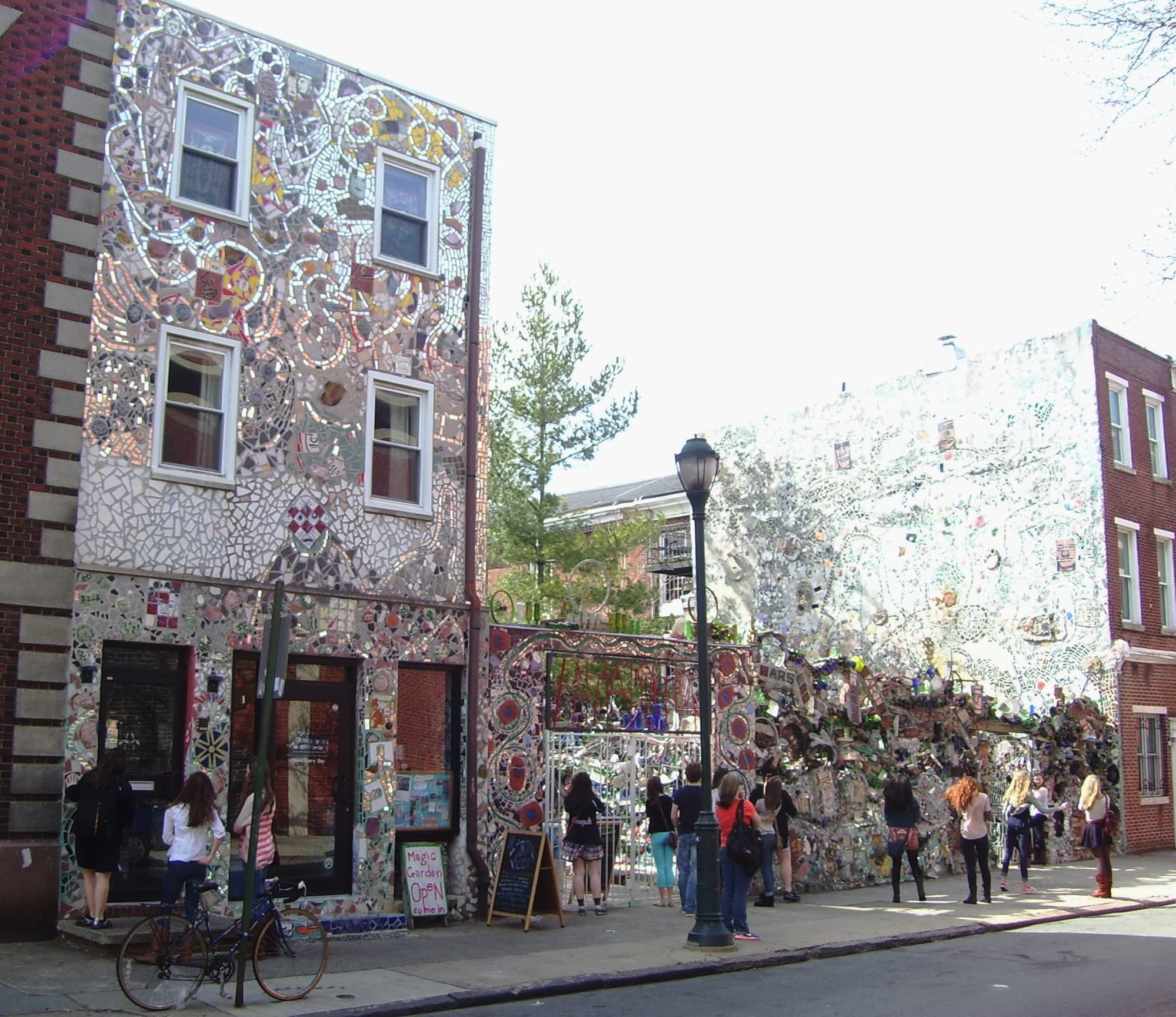
In 1986 and again in 1995, the Zagars bought buildings near 10th and South to serve as Isaiah's studio, and he mosaicked those spaces completely — floors, walls, and ceilings. Then, at 58, he turned to the two vacant lots next door. The lots belonged to a Boston-based owner; Zagar did not own them, but he had permission from the owner's local agent to beautify the space, and he began, in the mid-1990s, by embellishing the fence along South Street. Over the next fourteen years he built outward and downward: sculpting multilayered walls and structures out of found objects, digging grottos and tunnels, and covering every surface in mosaic. The materials are a catalogue of the discarded — handmade tiles, kitchen tile and china plates, mirror shards, glass bottles, bicycle wheels, and international folk art gathered on the couple's travels to Latin America, India, Morocco, Iran, China, and Indonesia. Zagar has cited the world's great visionary environments as his teachers: the Ideal Palace in France, Watts Towers in Los Angeles, the Rock Garden in Chandigarh, India, and Las Pozas in Mexico. The result occupies three city lots — half a city block — and reads as a chronicle of his life and influences, set in cement.
The Sale, the Threat, and the Neighborhood That Bought the Garden
By the early 2000s South Street had become desirable again — desirable enough that the vacant lots were now valuable. In 2004 the Boston-based owner moved to sell the land and called for Zagar's installation to be dismantled. What happened next is why the Magic Gardens still exist. Neighbors, lawyers, and art lovers who had watched the garden grow for a decade organized to save it, and the work was quickly incorporated as a nonprofit organization, Philadelphia's Magic Gardens, formed expressly to preserve it. In October 2004 the new nonprofit formally purchased the property. After the rescue, Zagar kept building with the organization's support — excavating more tunnels and grottos and embellishing every remaining surface — and the major structures were complete by 2008. The site opened to the public with tours in May 2008, run for years largely by volunteers. The Magic Gardens thus became something rarer than a saved artwork: a folk art environment whose preservation was a community act, owned by a 501(c)(3) nonprofit with its own board and staff, independent of the Zagars.
Inside the Labyrinth
The museum today consists of two indoor galleries wrapped around a bi-level outdoor sculpture garden, some 3,000 square feet of mosaicked space in all. There is no straight line through it. Staircases climb between levels, passages dip below ground into grottos, and tunnels thread under sculpted walls, so that visitors keep emerging in places they have already been, seeing them from a new angle. Every surface carries the mosaic: bottle-glass glows where light passes through it, mirrors throw fragments of the sky and of visitors themselves back at eye level, and bicycle wheels spin overhead as sculpture. Embedded in the cement are texts, figures, and folk art objects — plates, statues, and handmade tiles — layered densely enough that a second walk through the same corridor reliably turns up things the first one missed. The indoor galleries add rotating exhibitions of work by artists from around the world whose ceramics, mosaics, and outsider art connect to the museum's mission. It is Zagar's largest work, and it is deliberately overwhelming: a single artist's memory and method, built at architectural scale.
The Museum, the Studio, and the Murals Beyond the Fence
Philadelphia's Magic Gardens now preserves more than one site. The nonprofit presents tours, hands-on mosaic workshops, concerts, and educational programs at the South Street museum, and it also stewards Zagar's public murals throughout the city. In December 2023 Isaiah and Julia Zagar donated Isaiah's sprawling studio — an entire mosaicked complex south of the museum — to the organization; as the Magic Gardens Studio, it opened in August 2024 for limited tours, workshops, and programming on select dates. Zagar, working with PMG's Preservation Team, continued adding elements to the South Street site through his lifetime, so the museum has never been a frozen period piece: grouting is maintained, tiles are repaired, and the environment is conserved as the living work it was built to be. The Zagars' original Eyes Gallery still sells Latin-American art a few blocks west, and Zagar mosaics still surface on walls all over the neighborhood — the museum is the densest node of a body of work that covers much of South Street.
Why It Endures
Folk art environments usually die with their makers or with the land under them; the Magic Gardens escaped both fates because its neighbors decided, in 2004, that a decade of unofficial beauty had become a public trust. What they saved is difficult to categorize — part sculpture garden, part memoir in tile, part neighborhood commons — and that may be the point. Zagar's method was accumulation: other people's discards, other cultures' folk art, his own biography, all set into walls that anyone passing on South Street could see for free from the fence. The nonprofit that grew out of the rescue formalized that openness, keeping the site public, programmed, and conserved, and extending the same care to the artist's studio and murals. Stand in the lower garden at midday, when the mirrors and bottle glass are doing their best work, and the place makes its own argument: a vacant lot is never really vacant to an artist, and a neighborhood that defends its art ends up owning a museum unlike any other in America.
Key Facts
• Created by mosaic artist Isaiah Zagar, who with his wife Julia moved to South Street in 1968 and opened the Eyes Gallery at 402 South Street; Zagar went on to create hundreds of mosaic murals in and around the neighborhood.
• Zagar began work on the vacant lots beside his studio in the mid-1990s (the site building at 1020 South Street was purchased in 1994–95); he spent about fourteen years sculpting walls, grottos, and tunnels from found objects — tile, mirror, bottles, bicycle wheels, china, and folk art.
• In 2004 the lots' Boston-based owner moved to sell and dismantle the work; the community incorporated Philadelphia's Magic Gardens as a nonprofit, which purchased the property in October 2004.
• The museum — two indoor galleries and a bi-level outdoor sculpture garden spanning three city lots (half a city block, about 3,000 square feet of mosaicked space) — opened to the public in 2008.
• In December 2023 the Zagars donated Isaiah's studio to the nonprofit; the Magic Gardens Studio opened for limited public tours and programs in August 2024.
Visitor Details
Address: 1020 South Street, Philadelphia, PA 19147
Transit: In the South Street corridor of Center City, an easy walk from Old City and the Italian Market area; SEPTA buses serve South Street and the Broad Street Line's Lombard-South station is a short walk west — check SEPTA for current routings.
Hours/Admission: Open Wednesday through Monday, 11:00 am to 6:00 pm, for general admission, and closed Tuesdays (per the official site, checked 2026-10-21). Guided tours are offered on open days. The museum strongly advises reserving tickets online in advance — they often sell out, especially on weekends and holidays — and general admission tickets are released about a month ahead. Confirm current hours and ticket prices on the official website before visiting; do not rely on third-party listings.
Best timing: Arrive near opening on a weekday for the least crowded passages, and pick a bright day if you can — sunlight through the bottle glass and mirrors is half the show. Allow at least an hour, and walk the outdoor garden twice; the second pass reveals details the first one hides.
Location Photography