America's first zoo — and still its most surprising one
Every Philadelphian has a zoo story, and most of them start the same way: walking under the Victorian gates on Girard Avenue. The Philadelphia Zoo is not a side attraction or a rainy-day backup plan. It is one of the city's signature sights, the place a first-time visitor names alongside Independence Hall, the Liberty Bell, and the Philadelphia Museum of Art — and it has a claim none of them can match. Chartered in 1859 and opened in 1874, it is America's first zoo, a full decade and a half in the making, delayed by a civil war and built on land that already held a piece of Pennsylvania history.
What makes it worth a full day, rather than a quick photo at the gate, is that the zoo has never stood still. The Victorian garden that opened in 1874 — tree-lined walks, formal plantings, ornate ironwork, animal sculptures — is still recognizably there, and so are the original gatehouses. But layered over that 19th-century frame is one of the most inventive modern zoo designs in the world: Zoo360, a network of see-through overhead trails that lets animals leave their enclosures and travel across the zoo, sometimes directly above the visitors below. A tiger crossing overhead is not a gimmick here. It is the zoo's central idea, worked out over more than a decade: that an animal with somewhere to go is more interesting to watch, and better off, than an animal with nowhere to go.
Set aside a half day at least, and come prepared to look up. The ground-level exhibits — Big Cat Falls, the McNeil Avian Center, the PECO Primate Reserve, KidZooU — would justify the visit on their own. The trails above them are what turn a good zoo day into a story you tell afterward.
A charter, a war, and a grand opening
The zoo's story begins not with an opening but with a signature. On March 21, 1859, the Commonwealth of Pennsylvania chartered the Zoological Society of Philadelphia, largely through the efforts of Philadelphia physician Dr. William Camac, who had traveled in Europe in the 1850s, visited the London Zoo, and returned convinced that an American city should have one of its own. The charter's purpose was plain and ambitious: to purchase and collect living wild animals "for the purpose of public exhibition at some suitable place in the City of Philadelphia, for the instruction and recreation of the people."
Then the country went to war with itself, and the project sat dormant for more than a decade. The society secured land on the west bank of the Schuylkill River in Fairmount Park — about 33 acres at first, on ground previously owned by John Penn, grandson of William Penn — and waited. When the gates finally opened on July 1, 1874, more than 3,000 visitors turned out, flags flew, a brass band played, and guests paid 25 cents for adults and 10 cents for children. That charter date is the real reason Philadelphia holds the "first zoo" title: other American zoos opened their doors earlier, but Philadelphia's was the first zoological society established in the United States. It is a distinction worth knowing, and a very Philadelphia kind of first — first on paper, then, after a war, first in fact.
Opening day set the pattern for everything that followed. The zoo began as a full-fledged institution, not a menagerie: about 200 mammals, 67 bird species, and 15 reptiles, in roughly 10 to 11 acres enclosed by a cedar picket fence. Buffalo, deer, wolves, foxes, bears, monkeys, and birds filled the grounds; goat cart rides entertained children; reptiles and small mammals were housed in The Solitude, the Penn family country house already standing on the land. Visitors arrived on foot, by streetcar, by horse and carriage, and every 15 minutes by steamboat on the Schuylkill, landing at the zoo's own wharf. The Girard Avenue Bridge opened three days later. In its first year the zoo drew well over 228,000 visitors — and in 1876, with the Centennial Exhibition a few blocks away in Fairmount Park, attendance jumped to nearly 680,000, a record that stood until 1951.
The Victorian gates and The Solitude
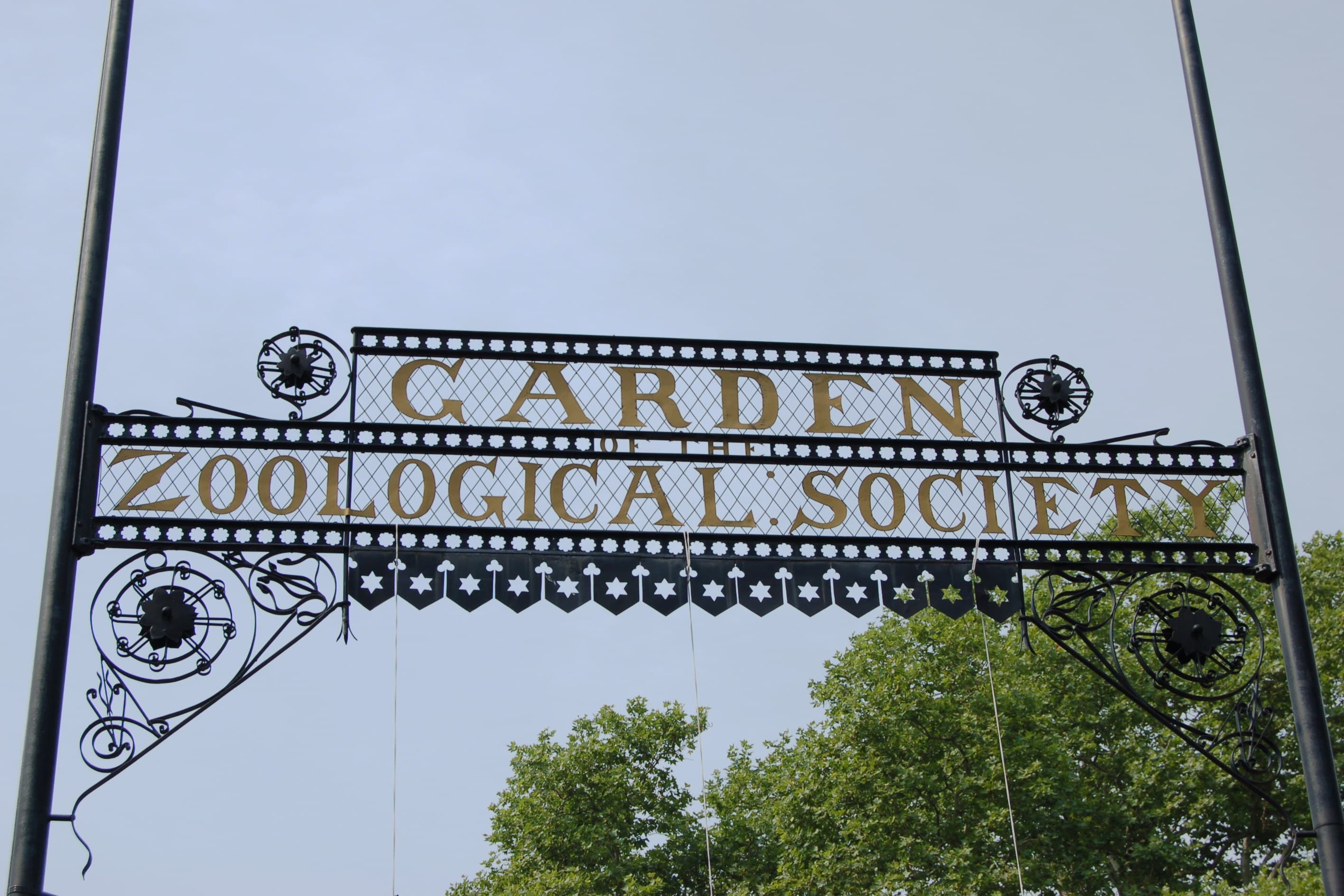
Start your visit where every visit has started since 1874: the gates. The Victorian gatehouses and gates, designed in the exuberant style associated with Philadelphia architect Frank Furness, still stand at the entrance, and walking beneath them is itself a historic experience — a rare piece of 19th-century Philadelphia that you do not look at from behind a rope but actually pass through. The zoo's Victorian garden atmosphere was deliberate from the beginning: formal shrubbery, botanical collections of more than 500 plant species, tree-lined paths, and animal sculptures were part of the design, not decoration added later. The grounds still read that way today, which is one reason the zoo feels different from a modern, concrete-and-glass animal park. It is a garden that happens to contain a zoo, and the garden is part of the exhibit.
Inside the grounds, the oldest building is not a zoo building at all. The Solitude, the neoclassical country house built by John Penn between 1784 and 1785, stands on the zoo grounds above the banks of the Schuylkill, the only surviving home of a Penn family member in the United States. Penn, William Penn's grandson, named it after the Duke of Württemberg's palace outside Stuttgart, which he had visited on a Grand Tour. The house is not open to general admission visitors — it is used for special events — but its presence changes how the zoo feels. You are walking through a landscape that was already historic before the first animal arrived, and the zoo's founders knew it: on opening day, The Solitude housed reptiles and small mammals, and it remains the grounds' quiet, elegant anchor, a reminder that this corner of Fairmount Park was a country retreat long before it was a public attraction.
The zoo's scientific ambitions were just as early. The Penrose Research Laboratory, established in 1901, was the first of its kind in any zoo, and its work on disease, longevity, and breeding helped set standards for animal care that other zoos followed. That research tradition is the thread that connects the 1874 zoo to the modern one: Philadelphia became known as one of the premier zoos in the world for breeding animals that are difficult to breed in captivity, and in 1928 it recorded the first orangutan and chimpanzee births in a United States zoo. In 1957 it opened the world's first children's zoo. Firsts, for this institution, are a habit.
Zoo360: look up
If the gates are the zoo's past, Zoo360 is its present — and the single best reason to visit now rather than at any earlier point in its 150-year history. Zoo360 is a first-in-the-world system of see-through, mesh-fenced trails that pass through treetops, cross over pathways, and connect habitats, letting animals travel and explore far beyond their home enclosures. The idea is simple and radical at once: instead of bringing visitors to the animals, let the animals come to the visitors, on their own terms.
The trails were built out in stages, and each one changed how a different group of animals moves. The Treetop Trail opened in June 2011, giving primates an overhead route through the canopy. The Great Ape Trail followed in August 2012. Big Cat Crossing, which opened in May 2014 and won a Best Zoo Exhibit award, lets tigers and other big cats cross above a visitor pathway — the moment, for many visitors, when the whole system clicks into place. The Gorilla Treeway opened in May 2015, and the Meerkat Maze in June 2016. Together, the trails link existing habitats so that animals with similar habitat needs can use each other's spaces in a kind of time-share, giving them longer routes, more variety, and more choice about their own day.
The practical advice follows from the design: do not just stand in front of an enclosure and move on. Pause under the trails, wait a few minutes, and watch the overhead routes. Animals use them on their own schedule, not yours, and the best sightings reward patience. When a tiger pads overhead, or an orangutan swings along the Treetop Trail above a path you just walked, you understand the system's point in a way no sign can explain. More than 70 zoos around the world have since copied elements of the concept — a fitting tribute for an institution that has been setting precedents since 1859.
Big Cat Falls and the big cats
The most popular ground-level exhibit, and the natural companion to Big Cat Crossing overhead, is Big Cat Falls. Opened in 2006 as a new, purpose-built big cat habitat, it replaced older, smaller cat enclosures with lush, naturalistic scenes: waterfalls, pools, authentic plantings, and viewing so close that visitors are sometimes separated from a lion or tiger by only a pane of glass. Lions, tigers, leopards, jaguars, pumas, and snow leopards are among the cats on view, and the exhibit includes a simulated research station for young visitors — a nod to the zoo's conviction, dating back to its charter, that a zoo should instruct as well as entertain.
Big Cat Falls also carries the zoo's conservation story in miniature. Many of the cats here are endangered in the wild, and the zoo's breeding and field programs are part of international efforts to keep those species going. That is not marketing language pasted onto a cat exhibit; it is the same work the Penrose Laboratory began in 1901, carried forward by a modern veterinary hospital and by partnerships with conservation groups around the world. When you watch a snow leopard in Big Cat Falls, you are watching an animal whose wild cousins are the subject of field programs the zoo supports — and the exhibit's design, with its emphasis on natural behavior rather than display, is meant to make that connection visible.
The McNeil Avian Center: birds, up close
On the quieter side of the zoo, the McNeil Avian Center is the exhibit visitors most often say surprised them. Opened on May 30, 2009, as a renovation of the zoo's classic bird house, it holds lush, walk-through habitats where visitors can discover more than 100 birds from around the world, many of them rare and endangered. The walk-through design matters: instead of peering at birds behind bars, you move through their space, and the birds — bright, loud, unbothered — move around you.
Two residents carry a particular weight. The Guam rail and the Guam kingfisher are both extinct in the wild, and the zoo's breeding work with them is part of the reason those species still exist at all. The center's multi-sensory Migration Theater follows an animated oriole named Otis on his first migration south from Fairmount Park, a 4D-style presentation that turns the abstract idea of migration — thousands of miles, navigated by a bird weighing less than an ounce — into something children can feel. It is a small theater with a large point: the birds in this building are not decorations. They are travelers, and some of them have nowhere wild left to travel to.
Pair the Avian Center with the PECO Primate Reserve, which opened on July 1, 1999, on 2.5 acres of indoor and outdoor exhibits with ten primate species, including Sumatran orangutans, western lowland gorillas, lemurs, langurs, and gibbons. The reserve was built after a devastating fire in the old World of Primates building on December 24, 1995, killed 23 animals; in the ten months that followed, the zoo installed fire detection equipment in all animal buildings, and the new reserve — open, varied, and designed around the animals' needs — became a model for what came after. It is worth knowing that history when you visit, because it explains the seriousness with which this zoo now treats animal welfare. The modern Philadelphia Zoo was, in part, rebuilt out of a tragedy, and it shows.
Conservation, children, and the rest of the day
Beyond the headline exhibits, the zoo rewards wandering. KidZooU, the Hamilton Family Children's Zoo and Faris Family Education Center, is a LEED-certified indoor-outdoor children's zoo with sheep, miniature horses, goats, chickens, ducks, and parakeets, plus a coral reef aquarium, a desert ant farm, an education center, and a playground — the descendant of the world's first children's zoo, opened here in 1957. There is a rainforest-themed carousel, a paddleboat lake, keeper chats through the day, and behind-the-scenes tours. The Rare Animal House, Penn's Woodland Trail, and the botanical collections reward the visitor who slows down between the big exhibits rather than racing from cats to primates to birds.
The conservation thread runs through all of it. The zoo works with groups around the world to protect the natural habitats of the animals in its care, and its own mission — to connect people with wildlife, create joyful discovery, and inspire action for animals and habitats — is visible in the keeper talks and the exhibit signage, which consistently tie a single animal to a wider wild population. That is the 1859 charter's "instruction and recreation" in modern form: a day out that leaves a visitor knowing something specific about a species they had never thought about before. With roughly 1,300 to 1,700 animals across more than 340 species (figures vary by source and year), and around 1.2 million visitors a year, the zoo is still doing, at scale, what it set out to do in 1874.
Visiting the Philadelphia Zoo well
The zoo rewards a plan, not a sprint. Start at the gates — take the photo, but also look at the gatehouses themselves, which are the oldest thing you will walk through all day. Then work the grounds in a loop rather than backtracking: Big Cat Falls and Big Cat Crossing for the cats, the PECO Primate Reserve for the apes, the McNeil Avian Center for the birds, and KidZooU if you have children in tow. Build in waiting time under the Zoo360 trails; the overhead crossings are the zoo's signature experience, and they happen on the animals' schedule. Check the day's keeper chats when you arrive — they are often the best part of the visit, and they change daily.
Then step back and let the setting do its work. The zoo sits in Fairmount Park on the west bank of the Schuylkill, a short distance from the Centennial District's other landmarks, and the Victorian garden — the trees, the formal plantings, the sculptures — is itself a reason to linger. Philadelphia built its zoo as a garden and a laboratory at once, and 150 years later it is still both: a place to spend a morning looking up at a tiger overhead, and a place to understand, in a concrete way, why that tiger needs a world beyond the fence. That is why it belongs on any first-time visitor's list, and why Philadelphians keep coming back long after the first visit.
Key Facts
The Zoological Society of Philadelphia was chartered by the Commonwealth of Pennsylvania on March 21, 1859, largely through the efforts of Dr. William Camac; the zoo opened on July 1, 1874, after delay caused by the Civil War, making it America's first zoo by charter.
Opening day drew more than 3,000 visitors, who paid 25 cents for adults and 10 cents for children; the zoo began with about 200 mammals, 67 bird species, and 15 reptiles, and drew well over 228,000 visitors in its first year.
The Victorian gatehouses and gates, in the style associated with Frank Furness, still stand at the entrance, in the same location as on opening day.
The zoo covers 42 acres in Fairmount Park on the west bank of the Schuylkill River, and holds roughly 1,300 to 1,700 animals across more than 340 species, with around 1.2 million visitors a year (figures vary by source and year).
The Solitude, the neoclassical country house built by John Penn, grandson of William Penn, between 1784 and 1785, stands on the zoo grounds; it is the only surviving home of a Penn family member in the United States and is not open to general admission visitors.
The Penrose Research Laboratory, established in 1901, was the first research laboratory in any zoo; in 1928 the zoo recorded the first orangutan and chimpanzee births in a United States zoo, and in 1957 it opened the world's first children's zoo.
Zoo360, a first-in-the-world system of see-through overhead animal trails, was built out in stages: Treetop Trail (June 2011), Great Ape Trail (August 2012), Big Cat Crossing (May 2014, Best Zoo Exhibit award winner), Gorilla Treeway (May 2015), and Meerkat Maze (June 2016).
Big Cat Falls opened in 2006 as a naturalistic big cat habitat with waterfalls, pools, and close viewing, housing lions, tigers, leopards, jaguars, pumas, and snow leopards among others.
The McNeil Avian Center opened on May 30, 2009, as a renovation of the classic bird house, with walk-through habitats holding more than 100 birds, including the Guam rail and Guam kingfisher, both extinct in the wild.
The PECO Primate Reserve opened on July 1, 1999, on 2.5 acres with ten primate species, replacing the World of Primates building lost to a fire on December 24, 1995.
The zoo is accredited by the Association of Zoos and Aquariums and owned by the Zoological Society of Philadelphia.
Visitor Details
Address: 3400 W Girard Ave, Philadelphia, PA 19104
Transit: SEPTA bus 38 and the Philly PHLASH serve the zoo area, and the Route 15 trolley runs nearby; check SEPTA for the current stop and route before traveling.
Hours/Admission: Hours and ticket prices change with seasons and special exhibitions, so check the official source at philadelphiazoo.org before visiting. Do not rely on third-party listings for same-day hours or prices.
Best timing: Arrive at opening, start at the Victorian gates, then loop through Big Cat Falls, the PECO Primate Reserve, and the McNeil Avian Center, with waiting time built in under the Zoo360 trails. Check the day's keeper chats on arrival. Pair the visit with Fairmount Park and the nearby Centennial District landmarks.
Location Photography