Miami's oldest neighborhood, still a village
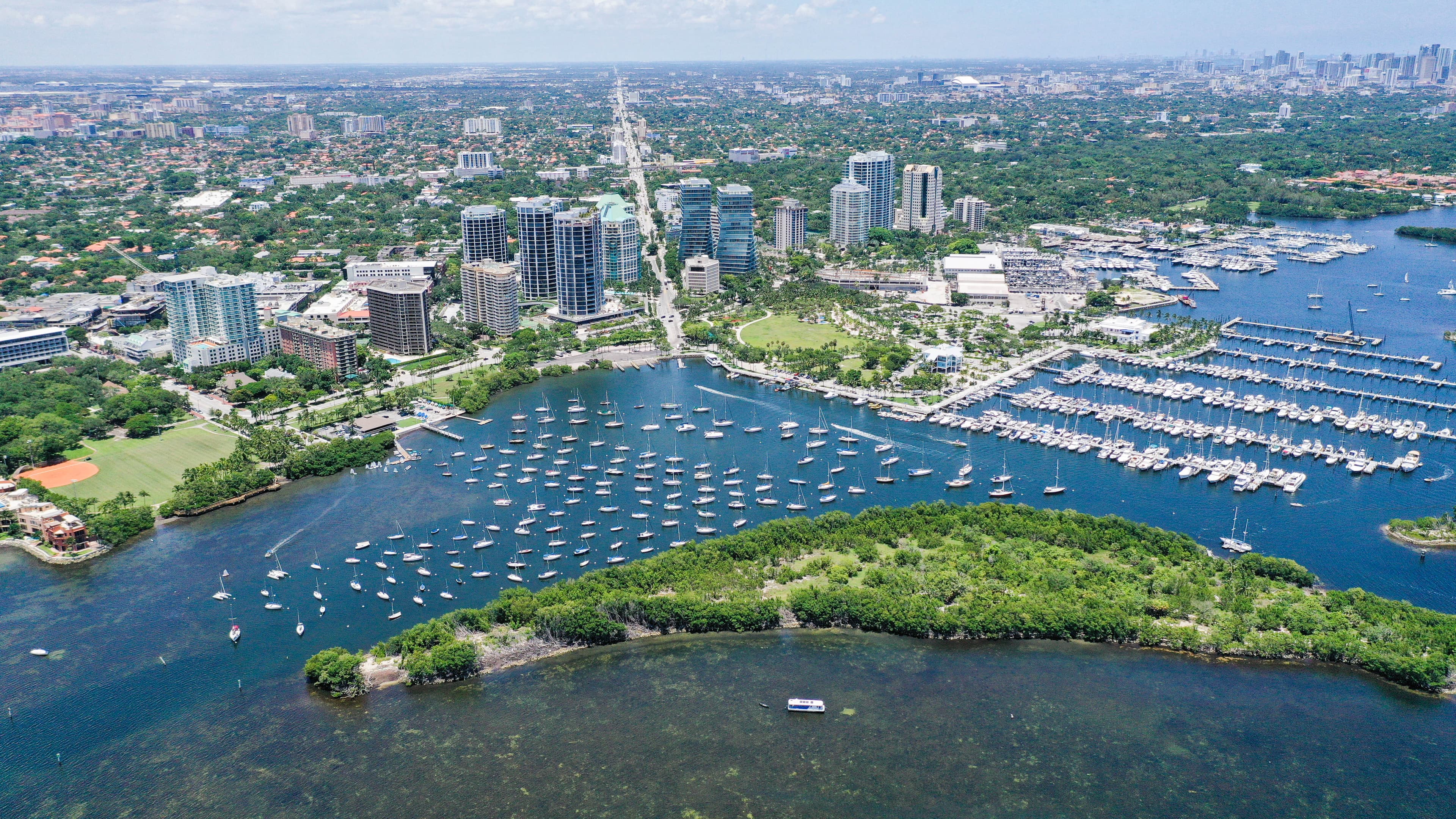
Every city has a neighborhood that predates the city itself, and in Miami that neighborhood is Coconut Grove. Known to everyone as "the Grove," it is the oldest continuously inhabited neighborhood in Miami, a leafy pocket on Biscayne Bay wedged between the high-rises of Brickell and the streets of Coral Gables. It is roughly bounded by North Prospect Drive to the south, LeJeune Road to the west, South Dixie Highway (US 1) and the Rickenbacker Causeway to the north, and Biscayne Bay to the east — about five and a half square miles, most of it under a canopy of banyans, live oaks, and royal poincianas.
What makes the Grove worth a visit is not a single attraction but the feeling of the place. Miami is a city of towers and expressways; the Grove is a village of low buildings, winding streets, and shade. Its commercial heart, the Village Center, is just three blocks radiating from the intersection of Main Highway, McFarland Road, and Grand Avenue, and from there the neighborhood dissolves into quiet residential streets, bayfront parks, and marinas. You come here to walk slowly: coffee under a banyan, a browse through a bookshop, a stroll to the water, and a sense that you have found the part of Miami that existed before the rest of it arrived.
The Grove has been many things — pioneer outpost, artists' colony, sailing capital, 1960s counterculture hub, and upscale village — and traces of every one of those lives are still visible on a single walk. That layering is the point. Unlike Miami's purpose-built attractions, the Grove was not designed for visitors. It grew, organically, from a 19th-century settlement on the bay, and it still rewards the visitor who treats it the way its first residents did: on foot, unhurried, and outdoors.
How the Grove began: pioneers, Bahamians, and the Peacock Inn
The Grove's story begins in 1825, when the Cape Florida lighthouse went into operation and the first settlers — sailors, naturalists, and artists from the Northeastern United States, Britain, and the Bahamas — began to arrive on this stretch of bayfront. The name itself dates to 1873, when Horace P. Porter, renting a home from the widow of homesteader Edmond D. Beasley, established a post office he called "Coconut Grove." The spelling was sometimes rendered "Cocoanut Grove" in the early years, but the definitive spelling was fixed when the community incorporated as a city in 1919. Six years later, in 1925, the city of Miami annexed Coconut Grove, along with most of the neighboring town of Silver Bluff, and the Grove became a neighborhood of a much larger city.
The first hotel on the South Florida mainland was built here: the Bay View Inn, later renamed the Peacock Inn, constructed in 1882 by English immigrants Isabella and Charles Peacock on the site of present-day Peacock Park. The Peacocks had owned a wholesale meat business in London; in Florida they built a simple wood-frame inn that drew scientists, writers, and nobility, many of whom stayed and became Grove residents. Bahamian laborers who worked at the Peacock Inn established the Grove's first Black settlement in the 1880s, in what is now known as the West Grove or Black Grove — a historically Bahamian community whose heritage is celebrated each June at the Goombay Festival on Grand Avenue, with Bahamian food and Junkanoo music.
Among the early settlers was yacht designer Ralph Middleton Munroe, known as "the Commodore," who built his home, The Barnacle, in 1891 on the bayfront. It is the oldest house in Miami-Dade County still standing in its original location, and it has its own article on this site — worth a visit on a Grove walk, but only one chapter of a much larger neighborhood story. The Grove's other pioneer institutions followed quickly: the Housekeepers Club, founded on February 19, 1891, by Flora McFarlane — the Grove's first schoolteacher and first woman homesteader — and five other pioneer women, became the first organized women's club in South Florida and later the Woman's Club of Coconut Grove, whose 1921 clubhouse by architect Walter de Garmo still stands on South Bayshore Drive. The Coconut Grove Library was founded in 1895 by the Pine Needles Club, a literary group of young women. This was, from the start, a community that built its own civic life before it had a city government to do it for them.
The Village Center: CocoWalk, Main Highway, and the Grove's daily rhythm
The Grove's commercial heart is the Village Center, the three blocks around Main Highway, McFarland Road, and Grand Avenue. This is where the neighborhood shops, eats, and gathers, and it is the natural starting point for a visit. The anchor is CocoWalk, the open-air shopping and dining center at 3015 Grand Avenue, with Mediterranean-style architecture, courtyards, restaurants, and a cinema. Completely redeveloped and reopened in 2023, CocoWalk is the Grove's modern living room — busy at lunch, livelier still in the evening, when the village's café tables fill and the neighborhood's long tradition as a nightlife spot, popular with locals, students, and visitors alike, comes into its own.
Around CocoWalk, the village rewards wandering. Main Highway is the Grove's main street in all but name — not really a highway at all, but a shaded, shop-lined road that runs toward the bay. Just off it sits Books & Books at 3409 Main Highway, the beloved local bookshop (with a café) that stocks more books on Miami history than anywhere else in the city and is a destination in its own right. The Streets of Mayfair, the Grove's second open-air mall, adds more shops and restaurants a short walk away. None of this is grand in scale, and that is the charm: the Grove's shopping is human-sized, outdoors, and mixed in with everyday village life — a post office, a fire station, an elementary school, and two sizable parks all sit within the same few blocks as the boutiques and bars.
Come in the morning, when the cafés are full of regulars and the light filters through the canopy, and you will understand the Grove's particular pace. It is the rare Miami neighborhood where lingering is the activity, not a pause between activities. Sit outside, order Cuban coffee, and watch the village go about its day — that is the Grove at its best.
The bayfront: Dinner Key, Pan Am flying boats, and Miami City Hall
East of the Village Center, the Grove meets Biscayne Bay at Dinner Key, and here the neighborhood's history takes a spectacular turn. Dinner Key was once a small island in the bay, joined to the mainland during World War I as a naval training field. In 1929, Pan American Airways chose it as the base for its inter-American seaplane operations, and on December 1, 1930, the first flight left Dinner Key for Panama. For the next fifteen years, Dinner Key was one of the world's great airports: the "Air Gateway between the Americas," where giant flying boats — Clippers — departed for the Caribbean and South America.
The terminal building that served those flying boats still stands, and it is one of the Grove's great sights. Designed by Delano & Aldrich and constructed in 1934, the white stucco, Art Deco terminal — once described as the largest, most modern marine air terminal in the world — has served as Miami City Hall since 1954, after the city purchased the Dinner Key site in 1946. Pan Am's final flight left Dinner Key on August 9, 1945, as land-based airports made seaplanes obsolete, and the terminal was added to the U.S. National Register of Historic Places on February 20, 1975. You can walk up to it from the marina and picture the scene: passengers boarding flying boats from the very shoreline where sailboats now bob at Dinner Key Marina, one of the largest municipal marinas in the area.
Dinner Key's later history is just as colorful. One of Pan Am's hangars became the Dinner Key Auditorium, later the Coconut Grove Convention Center, which in 1969 hosted the now-infamous Doors concert at which Jim Morrison was arrested — part of the Grove's 1960s life as the center of South Florida's youth counterculture, when the bayfront neighborhood hosted love-ins and concerts. The auditorium building was demolished in 2014, but the sailing life it overlooked continues: the Coconut Grove Sailing Club, the Biscayne Bay Yacht Club (which Munroe helped found), and the Coral Reef Yacht Club all line this shore, and on any breezy afternoon the bay is white with sails. The Grove has been called the sailing capital of Florida, and standing on the Dinner Key waterfront, watching the boats come and go, it is easy to believe.
Parks and the green canopy: Peacock Park, Kennedy Park, and the hammock
If the Village Center is the Grove's living room and Dinner Key its waterfront, the parks are its backyard — and the reason locals call the Grove one of Miami's greenest areas. The canopy is the first thing you notice: the neighborhood sits on a remnant of the once-vast tropical hardwood hammock that covered this coast, and its streets are famously shaded and lush. A "typical street in Coconut Grove" in guidebooks is a tunnel of green, and that is not an exaggeration.
Peacock Park, on the bayfront just below the Village Center, occupies the site of the Peacocks' 1882 inn and is the Grove's most central green space — a sloping lawn down to Biscayne Bay, with a playground, a basketball court, and views across the water that make it a favorite for picnics and sunset watching. It was dedicated as Peacock Park in 1973, in recognition of the Peacock family's role in the Grove's founding. A short walk north along the bay brings you to David T. Kennedy Park, a larger waterfront park with a dog park, volleyball courts, and its own stretch of bayfront, and to Regatta Park, the open green space used for community events. Further afield, the Grove's park system runs to more than a dozen neighborhood parks, from Alice Wainwright Park on the bay to Merrie Christmas Park, Blanche Park, and Elizabeth Virrick Park inland.
The greenest of the Grove's green spaces, though, is The Kampong, the eight-acre tropical garden on Douglas Road that forms part of the National Tropical Botanical Garden. Once the home of botanist David Fairchild — Chief of the U.S. Department of Agriculture's Seed and Introduction Section, who traveled the world collecting plants and brought them back to his Grove home, which he and his wife Marion purchased in 1916 — The Kampong holds thousands of rare tropical plants and fruit cultivars beneath a dense canopy. Fairchild's guests over the years reportedly included Winston Churchill, Henry Ford, and Thomas Edison. It is a quiet, extraordinary place, and the best single illustration of what the Grove's canopy can be when it is left to grow.
Culture: the Playhouse, the Arts Festival, and the Goombay and King Mango traditions
The Grove has always been a place where culture happens outdoors and in public, and its festival calendar is one of the fullest in Miami. The most prominent is the annual Coconut Grove Arts Festival, held each winter in the streets around the Village Center and Peacock Park — one of the country's major outdoor art festivals, and the event that, more than any other, announces the Grove to the wider city. It is joined by the King Mango Strut, held on the last Sunday in December, a deliberately absurd parade that began as a parody of the Orange Bowl Parade and has become a beloved Grove institution in its own right, and by the Great Taste of the Grove Food & Wine Festival in April.
The Goombay Festival, held in June on Grand Avenue, is the most historically significant of the Grove's festivals. It celebrates the Bahamian heritage of the West Grove, the community founded by the Bahamian laborers of the 1880s, with Bahamian food, Caribbean music, and Junkanoo — the street parade tradition of the Bahamas. In a city that sometimes seems to have arrived yesterday, Goombay is a reminder that one of Miami's oldest communities has been here, and celebrating, for well over a century.
The Grove's great indoor cultural landmark is the Coconut Grove Playhouse at 3500 Main Highway. Built in the late 1920s as a lavish Spanish Rococo movie palace — designed by Richard Kiehnel, it was Miami's most elaborate theater, with the largest seating capacity in the city and one of the largest Wurlitzer organs in the country — it was remodeled in the 1950s and reopened in 1956 as the Coconut Grove Playhouse, Miami's first live theater. Its opening production was the United States premiere of Samuel Beckett's Waiting for Godot, and for the next fifty years it was one of America's leading regional theaters. The Playhouse closed in 2006 and has awaited restoration since; a restoration project to return live theater to the historic building is underway, and the Playhouse's facade remains one of the Grove's most recognizable sights. Even closed, it tells the Grove's story in miniature: glamour, ambition, a long run, a fallow period, and the stubborn local belief that the place matters enough to save.
How to spend a day in the Grove
The Grove is best taken as a walk, not a checklist. Start in the Village Center with coffee and a browse at Books & Books, then wander Main Highway toward the bay, stopping at CocoWalk's courtyards on the way. From Peacock Park, follow the bayfront north past the marinas to Dinner Key, where Miami City Hall's old Pan Am terminal stands as a monument to the flying-boat age, and watch the sailboats on Biscayne Bay. Loop back inland through the shaded residential streets — the canopy is the sight here — and, if you have time, make the detour to The Kampong's tropical garden or to The Barnacle, the 1891 Munroe house that has its own article on this site.
Practicalities are simple. The Grove is served by Metrorail at the Coconut Grove and Douglas Road stations, and the Coconut Grove Connection circulator bus links the stations with CocoWalk, Peacock Park, and the bayfront. Driving is possible but parking in the Village Center fills up, especially on festival weekends; the Metrorail and a comfortable pair of shoes are the better plan. The Grove is an outdoor neighborhood, so plan around the weather: mornings are the kindest time in summer, and the canopy gives real shade even at midday.
What you will take away from the Grove is not a single postcard image but a mood: banyan shade, salt air, café tables, sailboats, and the knowledge that you have walked through the oldest neighborhood in a famously new city. Miami's story is usually told as a story of arrival — of waves of newcomers building a city from scratch. Coconut Grove is the place where that story started, and where, under the trees and beside the bay, it still feels most like home.
Key Facts
- Coconut Grove is the oldest continuously inhabited neighborhood of Miami, in Miami-Dade County, Florida; locals call it "the Grove."
- First settled in 1825, when the Cape Florida lighthouse went into operation; early settlers came from the Northeastern United States, Britain, and the Bahamas.
- The name dates to 1873, when Horace P. Porter established a post office called "Coconut Grove"; the community incorporated as a city in 1919 and was annexed by the city of Miami in 1925.
- The Bay View Inn (later the Peacock Inn), built in 1882 by English immigrants Isabella and Charles Peacock on the site of present-day Peacock Park, was the first hotel on the South Florida mainland.
- Bahamian laborers who worked at the Peacock Inn established the Grove's first Black settlement in the 1880s, in what is now the West Grove (Black Grove); the Goombay Festival celebrates this Bahamian heritage.
- The Barnacle, built in 1891 for yacht designer Ralph Middleton Munroe, is the oldest house in Miami-Dade County still standing in its original location; it has its own article on this site.
- The Housekeepers Club was founded February 19, 1891, by Flora McFarlane and five other pioneer women — the first organized women's club in South Florida — later the Woman's Club of Coconut Grove, whose 1921 clubhouse was designed by Walter de Garmo.
- The Village Center is the three blocks radiating from Main Highway, McFarland Road, and Grand Avenue; CocoWalk (3015 Grand Avenue) is its open-air anchor, redeveloped and reopened in 2023.
- Dinner Key was Pan American Airways' seaplane base: the first flight left for Panama on December 1, 1930, and the last Pan Am flight departed August 9, 1945. The 1934 terminal by Delano & Aldrich has served as Miami City Hall since 1954 and was added to the National Register of Historic Places on February 20, 1975.
- The Coconut Grove Playhouse at 3500 Main Highway opened in the late 1920s as a Spanish Rococo movie palace, reopened in 1956 as Miami's first live theater with the U.S. premiere of Samuel Beckett's Waiting for Godot, closed in 2006, and awaits restoration.
- The Kampong, an eight-acre tropical garden on Douglas Road and part of the National Tropical Botanical Garden, was the home of botanist David Fairchild, purchased in 1916.
- The Grove's major festivals: the annual Coconut Grove Arts Festival; the King Mango Strut on the last Sunday in December; the Goombay Festival in June; the Great Taste of the Grove Food & Wine Festival in April.
- The Grove is served by Metrorail at the Coconut Grove and Douglas Road stations, with the Coconut Grove Connection circulator bus linking the stations to CocoWalk and Peacock Park.
- The neighborhood covers about 5.6 square miles, corresponds roughly to ZIP Code 33133, and had a population of about 20,076 in the 2010 census.
Visitor Details
Address: Coconut Grove, Miami, FL 33133 — the Village Center is around Main Highway, McFarland Road, and Grand Avenue; CocoWalk is at 3015 Grand Avenue; Peacock Park is on the bayfront below the Village Center; Dinner Key and Miami City Hall are at 3500 Pan American Drive.
Transit: Metrorail serves the neighborhood at the Coconut Grove station (SW 27th Avenue and US 1) and the Douglas Road station (SW 37th Avenue and US 1); the Coconut Grove Connection circulator bus connects the stations with CocoWalk, Peacock Park, and the bayfront.
Hours/Admission: The Grove itself is a public neighborhood, open at all times. Hours, admission, and tour arrangements for individual sites change from time to time, so check the official source for each site before visiting. Festival dates vary by year; check the official festival pages before planning around one.
Best timing: Mornings are kindest in summer, and the tree canopy gives real shade even at midday. Allow at least half a day: a Village Center morning, a bayfront walk to Dinner Key, and an unhurried wander through the shaded residential streets. Pair the visit with nearby Coral Gables or with a bayfront drive south, and avoid driving into the Village Center on festival weekends if you can take Metrorail instead.
Location Photography