The zoo that outgrew its island
Every great zoo has an origin story, but few begin quite like Zoo Miami's. In 1948, a small traveling road show broke down near Miami, and its owner, unable to pay for the truck repairs, traded three monkeys, a goat, and two black bears — roughly $270 worth of animals — to settle the bill. Those six animals became the nucleus of the Crandon Park Zoo, a modest collection on 48 acres of Crandon Park on Key Biscayne, just off the coast from downtown Miami. Lions, an elephant, and a rhinoceros soon joined, stranded like the first six when a circus went out of business in Miami, and Galápagos tortoises, monkeys, and pheasants arrived from the Matheson plantation. By 1967 the little zoo held more than 1,200 animals and ranked among the top 25 zoos in the country.
Growth, however, was running up against geography. Key Biscayne is an island, and a zoo with ambitions needs room. In 1965 Hurricane Betsy devastated the Crandon Park Zoo and killed 250 animals, and the conversation about a new, mainland home turned serious. On December 11, 1970, Dade County officials applied for 600 acres on the former Naval Air Station Richmond property in South Dade, and construction began in 1975. The new zoo opened on July 4, 1980, as Miami MetroZoo, with a preview section of just 12 exhibits; Asia, the first major exhibit region, followed on December 12, 1981, and by then 38 exhibits across 200 acres were open to the public. On July 4, 2010 — the zoo's 30th anniversary — it took its current name, the Miami-Dade Zoological Park and Gardens, known to everyone simply as Zoo Miami.
What makes the South Dade site special is not just its size but its climate. Zoo Miami is the only tropical zoo in the continental United States, and that fact shapes everything about it. South Florida's subtropical weather lets the zoo keep animals outdoors year-round in planted, naturalistic habitats — Asian elephants, African savanna herds, Australian koalas, and Amazonian river species — in conditions far closer to their native ranges than a northern zoo could offer. It is also why the zoo feels less like a collection of enclosures and more like a botanical garden that happens to be full of animals: the trees, foliage, and even the soil in each region are chosen to mimic the animals' home ground.
Cage-free by design
Zoo Miami's signature idea, carried over from its 1980 design, is that you should not see cages. The exhibits are open and moated: animals are separated from visitors and from one another by water, walls, and landscaping rather than bars, so that looking across the African savanna you see herds apparently mingling much as they would on safari. It was one of the first free-range zoo designs in the country, and it remains the reason a visit here feels different from a traditional zoo. The main walking loop is about four miles around, past more than 100 exhibits, and the scale is the first thing every visitor remarks on — this is a place you explore, not a place you pass through.
That scale is also the main practical fact of a visit. With roughly 750 acres in total and more than 300 acres developed, Zoo Miami is the largest zoo in Florida and one of the largest in the United States by area, home to more than 3,000 animals of around 500 species and drawing more than a million visitors a year. Plan for a full day, or at least a full morning and afternoon, and take the help the zoo offers: narrated tram rides run daily, and bikes and safari cycles are available to rent, which many visitors consider essential on a hot South Florida day. Go early, when the animals are most active and the paths are still shaded, and carry water — the open, moated design that makes the habitats so beautiful also means there is little shade on the savanna stretches at midday.
Asia: tigers, elephants, and the Wings of Asia aviary
Asia was the zoo's first major exhibit region, and it is still its most celebrated. The Asian loop holds Bornean orangutans, Asian elephants, Indian rhinoceros, Sumatran tigers, bantengs, lowland anoas, Arabian oryx, Bactrian camels, Malayan tapirs, sloth bears, northern white-cheeked gibbons, and Komodo dragons, along with a wide range of Asian birds. The Sumatran tigers are the emotional center of the region: critically endangered in the wild, where only a few hundred survive on the Indonesian island of Sumatra, they are among the smallest tiger subspecies, with dense, dark striping and a distinctive ruff of facial fur. Zoo Miami's tiger births — including a critically endangered Sumatran cub born in 2024 that drew national attention — are part of the Species Survival Plan breeding program that coordinates the captive population across accredited zoos.
The region's other landmark is the American Banker's Family Aviary, Wings of Asia, a walk-through free-flight aviary that opened in December 1984 and was rebuilt in the spring of 2003 after Hurricane Andrew destroyed the original. At 54,000 square feet it is the largest open-air Asian aviary in the Western Hemisphere, a temperate mixed forest under one roof where dozens of bird species — storks, ducks, pheasants, pigeons, hornbills, and more — fly free around the path. It is also a quiet illustration of the zoo's history with hurricanes: Andrew toppled more than 5,000 trees across the grounds in August 1992 and destroyed the aviary outright, yet only five animals were killed, and the zoo reopened on December 18, 1992, after replanting thousands of trees. The tiger temple exhibit was renamed in honor of Naomi Browning, a 12-year-old zoo volunteer who was one of the storm's casualties.
Africa: the savanna loop and the giraffe feeding station
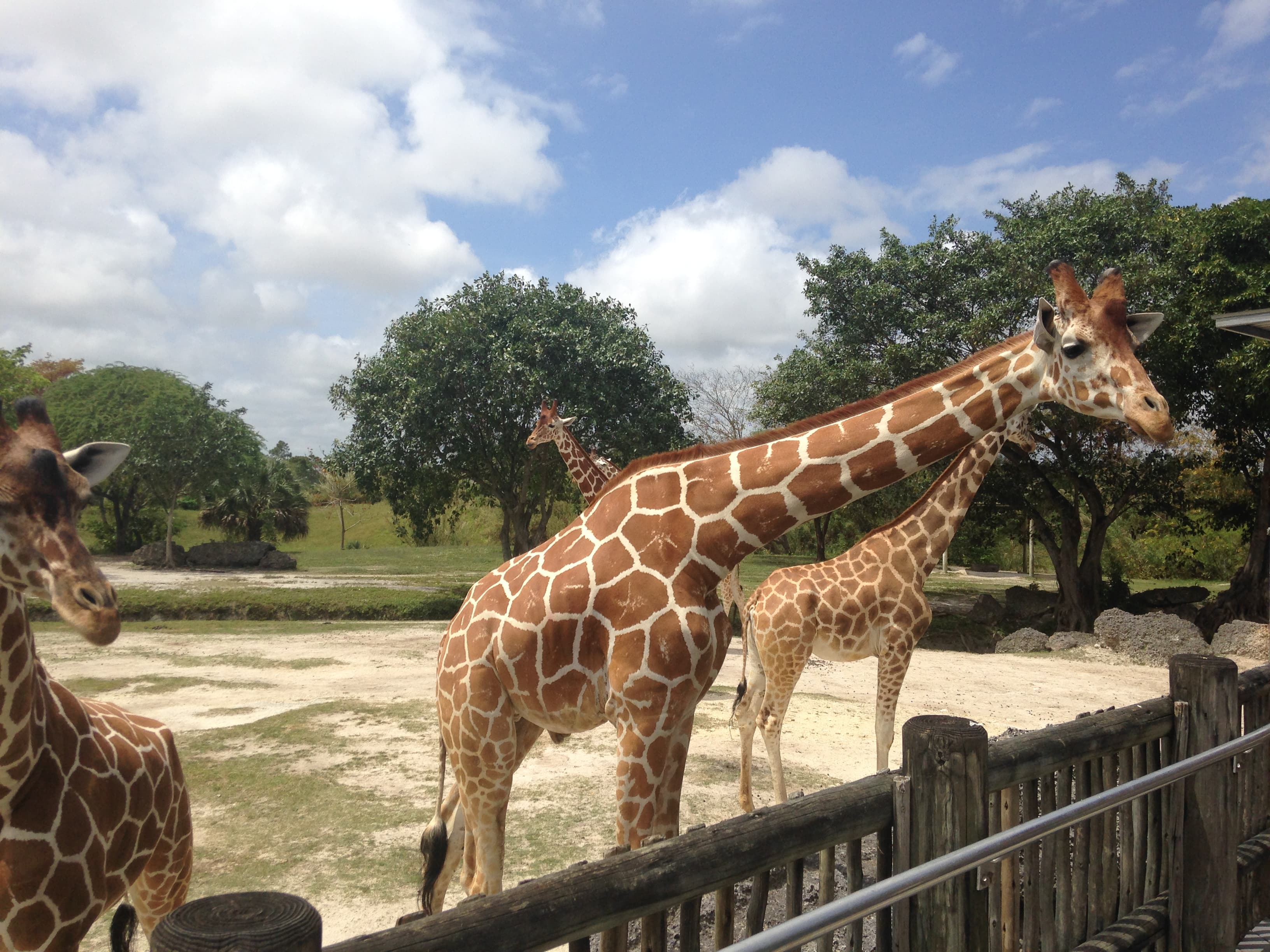
The African loop is where Zoo Miami's open-moat design pays off most visibly. Reticulated giraffes, African bush elephants, eastern black rhinoceroses, greater kudus, nyalas, slender-horned gazelles, Grevy's zebras, giant elands, chimpanzees, mountain bongos, yellow-backed duikers, and okapis live in large, planted habitats grouped by geography, so that species which coexist peacefully in the wild share sightlines here too. The zoo holds one of the most diverse collections of hoofed animals in the United States, and the African section is the place to appreciate it — a slow walk past one wide savanna vista after another, rather than a series of small cages.
The loop's most popular stop is the Samburu Giraffe Feeding Station, where visitors can feed the zoo's reticulated giraffes at eye level from a raised platform. It is the single most photographed interaction at Zoo Miami, and it captures the zoo's philosophy in miniature: the animals are not behind glass, the encounter is calm and keeper-supervised, and the giraffes, famously, are willing participants. Nearby, the Oasis Grill plaza at the northern end of the African exhibits makes a natural rest stop before the walk continues toward the Amazon and Australia regions.
Amazon and Beyond, and Australia
Amazon and Beyond, opened on December 6, 2008, occupies 27 acres in the zoo's northwest corner and is divided into four areas — Village Plaza, Cloud Forest, Amazon Flooded Forest, and Atlantic Forest — representing the cloud forests, the Amazon River basin, and the Atlantic Forest-Pantanal. Giant otters, jaguars, Orinoco crocodiles, giant anteaters, black howler monkeys, black-handed spider monkeys, Hoffmann's two-toed sloths, harpy eagles, bats, poison dart frogs, and Amazonian fish all live here, and a nearby yard holds guanacos and Chacoan peccaries. It is the zoo's most immersive region: shaded, humid, and dense, a deliberate contrast to the open savanna, and the closest the zoo comes to reproducing a rainforest walk.
The Australian habitat, opened in 1989, showcases koalas, southern cassowaries, southern hairy-nosed wombats, cockatiels, and Matschie's tree-kangaroos, with a nearby trail of Galápagos giant tortoises, babirusas, red river hogs, common warthogs, and Visayan warty pigs. Beside it stands the 800-seat Sami Family Amphitheater, named for Albert and Winifred Sami, whose anonymous gifts of an estimated $3 million supported the zoo for years; it hosts daily animal presentations, concerts, and cultural events, and since late 2024 has included rotating exhibits for animal ambassadors such as cheetahs, servals, giant anteaters, and vultures. Zoo Miami's koala story made headlines of its own: a joey born in May 2019 emerged from its mother's pouch on January 8, 2020, and was named Hope in honor of the Australian bushfire recovery.
Florida: Mission Everglades, at the front door
The newest major region is also the first one most visitors meet. Florida: Mission Everglades, which opened on December 10, 2016, as part of a $33 million project that also rebuilt the zoo's entryway, showcases the native fauna and flora of the Everglades: American alligators, American crocodiles, North American river otters, bobcats, American black bears, Florida panthers, raccoons, gray foxes, bald eagles, American white pelicans, and roseate spoonbills. Its gentle airboat-style ride, Lostman's River Ride, floats visitors through the exhibit the way a real Everglades airboat would, and the American flamingo exhibit beside the entry canopy is the zoo's welcome sign in feathers — a flock of pink against the green.
The region matters beyond its animals. The Florida panther is one of the most endangered mammals in North America, and the Everglades exhibit is Zoo Miami's statement that conservation begins at home, in the wetlands an hour's drive from the zoo's own gates. It pairs naturally with the Conservation Action Center at the junction of the zoo's main pathways, an indoor pavilion of interactive exhibits about wildlife preservation, and with Lake Iguana, the large lake at the heart of the grounds.
Conservation, and a lesson learned in public
Zoo Miami is accredited by the Association of Zoos and Aquariums, and its conservation work runs from South Florida to Southeast Asia. The zoo was a founding member of the AZA's Butterfly Conservation Initiative, which brings government agencies and conservation groups together to recover vulnerable, threatened, and endangered butterflies in North America, and its Conservation Fund has helped upgrade captive-breeding facilities in Thailand's zoos for endangered clouded leopards and fishing cats. The zoo's longtime communications director, zookeeper Ron Magill, is a familiar public face of that work in South Florida, and the zoo's breeding programs — for Sumatran tigers, koalas, and many other species — are coordinated through the AZA's Species Survival Plans.
That public role also brought a public reckoning. In May 2023, footage of Paora, a kiwi in a visitor encounter program, drew outrage from New Zealanders and conservation experts: kiwis are nocturnal and extremely sensitive to light, and the encounter put the bird under bright lights and handling that experts said violated kiwi care standards. Zoo Miami apologized on May 23, 2023, and discontinued the kiwi encounters immediately, with Magill apologizing on live television and calling the practice indefensible; Paora was later moved to a safer enclosure with filtered light, plants, and a pond, and a permanent habitat was approved with the New Zealand Department of Conservation. It is an episode the zoo does not hide from, and it is worth knowing about — not because it defines the zoo, but because the speed of the response says something about how seriously a modern accredited zoo takes its conservation mandate when the public holds it to account.
How to visit Zoo Miami well
Treat Zoo Miami as a day trip, not a stop. The zoo sits at 12400 SW 152nd Street in South Dade, well southwest of downtown Miami, and a car is by far the easiest way to reach it; public transit exists but is slow, and rideshares are the usual alternative for visitors without a car. Arrive at opening, head first to the animals that matter most to you — the giraffe feeding station and the tigers draw the longest waits later in the day — and use the tram or a rented safari cycle to cover the four-mile loop without exhausting yourself. The Wings of Asia aviary and the shaded Amazon and Beyond trails are the best midday refuges when the savanna paths are at their hottest, and the Sami Family Amphitheater's presentations are a good scheduled break between regions.
Check zoomiami.org before visiting for current hours, admission, and any special event or encounter schedules — these change with the season and are not stated here as fixed facts. Allow at least four to five hours, longer if you linger at feedings and presentations, and pair the visit with the neighboring Gold Coast Railroad Museum, which sits adjacent to the zoo and makes a natural second stop for families. What you will remember, though, is not the logistics. It is the moment on the African loop when a giraffe bends its long neck down to your outstretched hand, or the sight of a tiger moving through dappled shade in a habitat with no bars in sight — the feeling, rare in a city, of standing in a place designed around the animals rather than around the viewer.
Key Facts
Zoo Miami, officially the Miami-Dade Zoological Park and Gardens, is located at 12400 SW 152nd Street, Miami, FL 33177, in South Miami-Dade County, surrounded by Three Lakes, South Miami Heights, Palmetto Estates, and Richmond West.
The zoo traces its origin to 1948, when a stranded road show traded three monkeys, a goat, and two black bears (about $270 in truck repairs) — the founding animals of the Crandon Park Zoo on 48 acres at Crandon Park, Key Biscayne.
By 1967 the Crandon Park Zoo held over 1,200 animals and ranked among the top 25 zoos in the country; Hurricane Betsy devastated it in 1965, killing 250 animals.
On December 11, 1970, Dade County applied for 600 acres at the former Naval Air Station Richmond; construction began in 1975, and the new zoo opened on July 4, 1980, as Miami MetroZoo, with 12 preview exhibits; Asia, the first major region, opened December 12, 1981, with 38 exhibits across 200 acres open.
The zoo was renamed the Miami-Dade Zoological Park and Gardens (Zoo Miami) on July 4, 2010, its 30th anniversary.
Zoo Miami is the largest zoo in Florida and one of the largest in the United States by area: about 750 acres in total, more than 300 acres developed, over 100 exhibits, more than 3,000 animals of around 500 species, and more than one million visitors a year.
It is the only tropical zoo in the continental United States, and its exhibits are cage-free by design — open, moated habitats grouped by geographic region rather than bars.
The five main exhibit regions are Florida: Mission Everglades, Asia, Africa, Amazon and Beyond, and Australia; the main walking loop is about four miles around.
The American Banker's Family Aviary, Wings of Asia, opened in December 1984, was destroyed by Hurricane Andrew in August 1992 (which toppled over 5,000 trees and killed about 100 of the aviary's 300 birds, with only five animals killed zoo-wide), was rebuilt in spring 2003, and at 54,000 square feet is the largest open-air Asian aviary in the Western Hemisphere.
The air-conditioned monorail, built from the 1984 Louisiana World Exposition's trains and running from 1984, was decommissioned in 2022; narrated tram rides continue.
Florida: Mission Everglades opened December 10, 2016, as part of a $33 million project including a new entryway, with Lostman's River Ride; Amazon and Beyond opened December 6, 2008, on 27 acres; the Australian habitat opened in 1989, beside the 800-seat Sami Family Amphitheater.
Conservation: Zoo Miami is accredited by the Association of Zoos and Aquariums, was a founding member of the AZA Butterfly Conservation Initiative, and its Conservation Fund has supported captive-breeding facilities in Thailand for clouded leopards and fishing cats.
Notable residents past and present: Nonja, a Sumatran orangutan once believed the oldest living of her species (died 2007); Carlita, a white Bengal tiger and zoo icon for nearly two decades; Hope, a koala born in May 2019 who emerged from her mother's pouch on January 8, 2020; and Paora the kiwi, whose 2023 visitor encounters were discontinued after public outcry and an apology on May 23, 2023.
The zoo's communications director is zookeeper Ron Magill.
Visitor Details
Address: Zoo Miami, 12400 SW 152nd Street, Miami, FL 33177 (South Miami-Dade, southwest of downtown Miami)
Transit: A car is the easiest way to reach the zoo; rideshares are the usual alternative for visitors without one, and public transit to the site is slow. Inside the zoo, narrated tram rides run daily and bikes and safari cycles are available to rent — recommended given the four-mile main loop.
Hours/Admission: Hours, admission prices, and encounter schedules change with the season — check the official source at zoomiami.org before visiting to confirm current hours, ticket prices, and any timed-entry or special-event arrangements. No fixed price or hours are stated here as fact.
Best timing: Arrive at opening for the most active animals and the shortest waits at the giraffe feeding station and tiger habitat; allow at least four to five hours for the full loop. Use the shaded Wings of Asia aviary and Amazon and Beyond trails as midday refuges, catch a presentation at the Sami Family Amphitheater between regions, and pair the visit with the adjacent Gold Coast Railroad Museum.
Location Photography