From furniture warehouses to a luxury arts district
The Miami Design District does not look like a neighborhood that grew up by accident, because it did not. It looks designed, and that is the point. The district sits just north of downtown Miami, roughly between Northeast 36th and 41st Streets, between North Miami Avenue and Biscayne Boulevard, in what was historically the Buena Vista neighborhood. Long before it was a luxury destination, this stretch of warehouses and low-slung commercial buildings was home to furniture factories and showrooms, and it was known as Decorators Row — the place interior designers came to buy. Years before that, the land had been a pineapple plantation.
The transformation began in the early 2000s, when developer Craig Robins, working through his firm Dacra, began buying up warehouses across an 18-block stretch of the neighborhood. Robins had already helped revive South Beach, and he applied the same principle here on a larger scale: assemble enough contiguous property to invent a district rather than a single building, and mix culture with commerce from the start. The luxury retailers came — Christian Louboutin became the district's first true luxury retailer in 2009, and Louis Vuitton, Hermès, Cartier, and Dior followed in the early 2010s — but so did the art, at the same pace and with the same seriousness. Zaha Hadid's Elastika went into the Moore Building in 2005, Marc Newson's Dash Fence followed in 2007, and commissioned works have kept arriving ever since. The result is a neighborhood that functions as both a shopping district and an open-air museum, and it is best visited in that spirit: come for the stores if you like, but the art and architecture are free, outdoors, and everywhere.
What makes the district worth a visit even if you never buy anything is that the design is the attraction. The flagship stores are not generic boxes with logos on them; many were designed by noted architects and designers, with facades, interiors, and artworks commissioned as part of the building. The streets are walkable, shaded in places by the buildings themselves, and punctuated by courtyards and plazas that invite lingering. It is one of the few places in Miami where the right way to see it is simply to walk, slowly, and look up.
Palm Court and the Fly's Eye Dome
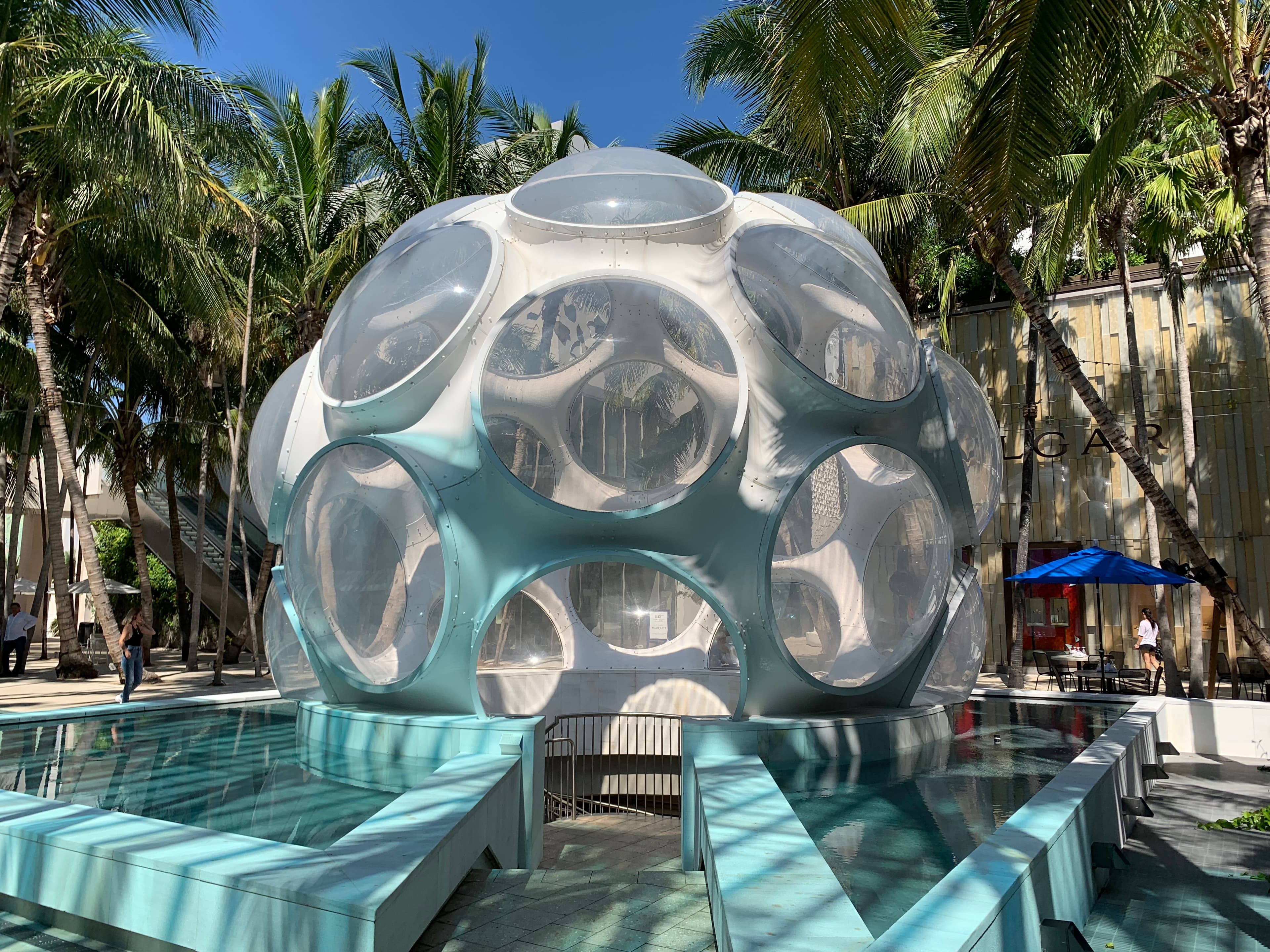
The district's heart is Palm Court, the open plaza at 140 Northeast 39th Street, and its centerpiece is one of the most photographed objects in Miami: Buckminster Fuller's Fly's Eye Dome. Fuller, the American architect and inventor best known for popularizing the geodesic dome, designed and patented the Fly's Eye Dome in 1965 as a prototype for low-cost, portable housing of the future — what he called an "autonomous dwelling machine." The dome's skin is made of circular openings, like the facets of a fly's eye, that were meant to hold windows, solar panels, and other systems.
The dome that stands in Palm Court is not Fuller's original prototype. Robins acquired one of Fuller's domes in 2011 and commissioned the Buckminster Fuller Institute to build a new edition, fabricated by DRDesign, Conform Lab, and Goetz Composites using a 3D parametric model of Fuller's original parts, cut on a five-axis CNC machine — technology that did not exist in Fuller's lifetime. The reconstruction, just over seven meters (about 24 feet) across, was engineered to withstand hurricane-force winds, given a redesigned lower edge, a joining system that keeps water out, and passive ventilation. It was installed in Palm Court in December 2014, in time for that year's Design Miami fair, set on a plinth in the middle of a small reflecting pool, slightly off the plaza's axis so that it seems to hover.
The dome is also functional in a way that is easy to miss. A spiral staircase inside the structure connects the courtyard with an underground parking garage directly beneath the plaza, so the sculpture is also a gateway: visitors cross a narrow bridge, enter the dome, and descend to the garage below. Around it, Palm Court itself is an architectural set piece, fronted by a glass building by Japanese architect Sou Fujimoto, whose shimmering blue facade reads like a waterfall. The plaza hosts performances and events, and its second floor holds the Netscape hanging chairs, where visitors can sit and gently swing above the courtyard. Stand in Palm Court at dusk, when the dome is lit and the glass glows, and you will understand why this small plaza has become the district's symbol.
Museum Garage: a parking garage as public art
If Palm Court is the district's symbol, Museum Garage is its punchline — and its most instructive building. Unveiled in 2018, the seven-story garage at the corner of Northeast 1st Avenue and Northeast 41st Street can hold hundreds of cars, but nobody comes to it for the parking. Robins commissioned Terence Riley, the former chief curator of architecture and design at the Museum of Modern Art, to select architects to design five very different facades for the building, one for each of its street-facing sides and segments. Each designer had only about four feet of depth to work with, and each produced something entirely unlike the others.
Starting from the corner of Northeast 1st Avenue and Northeast 41st Street, the facades run: Ant Farm by New York firm WORKac, which also features a street-art panel; a facade by Spanish architect Nicolás Buffe; one by Spanish firm Clavel Arquitectos; one by New York firm K/R; and one by German architect Jürgen Mayer H. The result is a single building that argues with itself — part billboard, part sculpture, part game — and it is deliberately visible from the Institute of Contemporary Art across the street, as if the garage were an exhibit the museum could claim. Walk all the way around it. The facades reward a full circuit, and the contrast between them is the point: five answers to the same question, in a structure most cities try to hide.
The garage is also a reminder of how the district treats infrastructure as a design opportunity. Nothing here is merely utilitarian if it can be made interesting, and the garage's fame — it has been photographed more than most museums — suggests the gamble worked.
Flagships, galleries, and the Moore Building
Beyond the public art, the district's other draw is the shopping itself, and it is worth being specific about what kind. The district holds dozens of flagship stores for the world's major luxury houses — Louis Vuitton, Hermès, Dior, Cartier, Fendi, Gucci, and Tom Ford among them — and many of the stores are destinations in their own right. The Hermès flagship, one of only a few of its scale in the United States, and the Fendi store, designed by Johanna Grawunder, are routinely cited as examples of how the district asked brands to build architecture, not just retail. Even if luxury shopping is not your interest, the storefronts repay attention: window displays, materials, and facades change with the seasons and with each brand's design program, and the district's streets read like an exhibition of contemporary commercial architecture.
The district's other half is its galleries and design showrooms, the legacy of its Decorators Row past. Furniture, lighting, and interior-design showrooms still operate alongside the fashion flagships, and contemporary art galleries have clustered here too, drawn by the museum presence and the foot traffic of Miami Art Week. The Institute of Contemporary Art, Miami — ICA Miami — anchors the cultural side of the district. The museum first opened in 1996 under the Museum of Contemporary Art, and after its board split from the city-run institution, it established itself as ICA Miami and opened its current purpose-built home at 61 Northeast 41st Street on December 1, 2017, just ahead of that year's Art Week. Designed by Spanish firm Aranguren & Gallegos as a kind of "magic box," the 37,500-square-foot building includes a 15,000-square-foot outdoor sculpture garden, and the museum's programming — exhibitions, performances, and talks — is one of the district's main reasons to return. Check the museum's official site before visiting for current exhibitions and admission details, since both change.
The district's oldest landmark is the Moore Building at 191 Northeast 40th Street, built in 1921 by architect David P. Davis as a furniture showroom on the site of the old pineapple plantation. Its four-story central atrium, with symmetrical mezzanines and Art Deco railings, is one of the most handsome interiors in the district, and it now houses a hotel, a private club, and restaurants. It also holds one of the district's signature artworks: Zaha Hadid's Elastika, installed in 2005, a web of white forms that stretches dramatically across the atrium above the diners below. The Moore Building is the district in miniature — a furniture-showroom past, an art-filled present, and a building that has been reused rather than replaced.
Restaurants, courtyards, and the art in between
The district's restaurants are part of the same program, and they range from chef-driven fine dining to casual counters in the courtyards. Celebrity-chef restaurants have been a feature of the district since its luxury phase began, and the courtyards — Palm Court above all, but also the smaller plazas and arcades between the blocks — are lined with cafes and food stalls where you can eat outdoors in the shade. The district's food scene changes quickly, with openings and closings common, so treat any restaurant recommendation as a starting point and check current listings before you go rather than planning a whole visit around a single table.
Between the set pieces, keep an eye out for the smaller commissioned works that make walking the district feel like a scavenger hunt. Urs Fischer's Bus Stop, installed in 2017 at Paradise Plaza, is a larger-than-life bronze skeleton seated at a bus stop that leads nowhere — a joke about waiting, in a neighborhood built for walking. John Baldessari's photographs run at billboard scale along the City View Garage, a 2015 work that turns a parking structure into a gallery wall. The Bouroullec brothers contributed a shading project, and Marc Newson's Dash Fence, a 30-meter steel fence built in 2007 for the Design and Architecture Senior High School, is still in place. None of these works is ticketed, fenced off, or explained at length; they are simply there, on the street, which is exactly how the district wants its art to be encountered.
A walking route
A good first visit takes about two to three hours and is best done on foot, in the morning or late afternoon when the light is kind and the courtyards are shaded. Start at Palm Court, at 140 Northeast 39th Street, and spend time with the Fly's Eye Dome — walk around the reflecting pool, cross the bridge, and look up through the dome's circular openings. Then walk north along the storefronts of Northeast 39th and 40th Streets, window-shopping the flagships and noting the facades, and turn into the Moore Building at 191 Northeast 40th Street to see its atrium and Hadid's Elastika overhead.
From there, head north to Northeast 41st Street and the Institute of Contemporary Art, Miami, at 61 Northeast 41st Street, and allow time for its exhibitions and sculpture garden. Finish at Museum Garage, at the corner of Northeast 1st Avenue and Northeast 41st Street, and walk all the way around it to see all five facades. If you have time, detour to Paradise Plaza for Fischer's Bus Stop, and to the City View Garage for Baldessari's photographs. End back in one of the courtyards, at a cafe table, and watch the district do what it was designed to do: mix shopping, art, and architecture into a single street scene, in a neighborhood that twenty years ago sold furniture and now sells an idea of Miami itself.
That idea is worth taking seriously. The Design District is sometimes dismissed as a luxury mall dressed up as culture, but that misses what is genuinely unusual about it. Most shopping districts treat art as decoration; this one treats art as infrastructure, commissioned at the same scale and with the same ambition as the stores. The result is a neighborhood where a parking garage is a landmark, a dome is a doorway, and a furniture warehouse became a museum district — and where the best thing to do, whatever your budget, is free: walk, look up, and let the buildings argue with each other.
Key Facts
- The Miami Design District is an 18-block neighborhood in Miami, roughly between Northeast 36th and 41st Streets, between North Miami Avenue and Biscayne Boulevard, in the historic Buena Vista area north of downtown.
- Before it was the Design District, the area was home to furniture factories and showrooms and was known as Decorators Row; years earlier the land had been a pineapple plantation.
- Developer Craig Robins, through his firm Dacra, began acquiring and redeveloping warehouses across the 18-block stretch in the early 2000s, mixing luxury retail with commissioned art and architecture from the start.
- Christian Louboutin became the district's first true luxury retailer in 2009; Louis Vuitton, Hermès, Cartier, and Dior followed in the early 2010s.
- Palm Court, at 140 Northeast 39th Street, is the district's central plaza, fronted by a glass building by Japanese architect Sou Fujimoto.
- The Fly's Eye Dome in Palm Court is a reconstruction of Buckminster Fuller's 1965 geodesic housing prototype; Robins acquired a Fuller dome in 2011 and commissioned the Buckminster Fuller Institute to build a new edition, fabricated by DRDesign, Conform Lab, and Goetz Composites using a 3D parametric model and CNC-milled components. It was installed in Palm Court in December 2014, measures just over seven meters (about 24 feet) across, sits on a plinth in a reflecting pool, and contains a spiral staircase connecting the courtyard to an underground parking garage.
- Museum Garage, unveiled in 2018 at the corner of Northeast 1st Avenue and Northeast 41st Street, is a seven-story parking garage with five different facades designed by five different architects, selected by Terence Riley, former chief curator of architecture and design at the Museum of Modern Art: WORKac (Ant Farm), Nicolás Buffe, Clavel Arquitectos, K/R, and Jürgen Mayer H. Each designer had about four feet of depth to work with.
- The Institute of Contemporary Art, Miami (ICA Miami) opened its current purpose-built home at 61 Northeast 41st Street on December 1, 2017, designed by Aranguren & Gallegos; the 37,500-square-foot building includes a 15,000-square-foot outdoor sculpture garden. ICA Miami traces its origins to a museum first opened in 1996 under the Museum of Contemporary Art.
- The Moore Building at 191 Northeast 40th Street was built in 1921 by architect David P. Davis as a furniture showroom; its four-story atrium holds Zaha Hadid's Elastika, installed in 2005.
- Other commissioned public works in the district include Marc Newson's Dash Fence (2007, for the Design and Architecture Senior High School), John Baldessari's billboard-scale photographs on the City View Garage (2015), and Urs Fischer's Bus Stop (2017, Paradise Plaza).
- The district's flagship stores include Louis Vuitton, Hermès, Dior, Cartier, Fendi, Gucci, and Tom Ford; the Fendi store was designed by Johanna Grawunder.
Visitor Details
Address: Miami Design District, centered on Palm Court at 140 Northeast 39th Street, Miami, FL (roughly Northeast 36th to 41st Streets, between North Miami Avenue and Biscayne Boulevard, north of downtown Miami). Getting there: The district is a walkable grid best explored on foot once you arrive; rideshare and bus routes serve the surrounding streets, and the district's garages — including Museum Garage — provide parking. Check current transit and parking information before visiting, since routes and arrangements change. Hours/Admission: The district's streets, courtyards, and public artworks are outdoors and free to walk at any time; individual stores, galleries, restaurants, and the Institute of Contemporary Art, Miami keep their own hours, and museum admission and exhibition details change — check the official sources (miamidesigndistrict.com and icamiami.org) before visiting to confirm current hours, admission, and exhibitions. No fixed price, fee, or hours are stated here as fact, since these change frequently. Best timing: Allow two to three hours for a first visit on foot. Morning or late afternoon gives the kindest light for photography and shade in the courtyards. A suggested route: Palm Court and the Fly's Eye Dome, the Moore Building atrium, ICA Miami and its sculpture garden, then a full circuit of Museum Garage, with detours to Paradise Plaza (Fischer's Bus Stop) and the City View Garage (Baldessari's photographs). During Miami Art Week in early December the district is at its busiest and most programmed — rewarding, but crowded.
Miami Design District in Photographs