The museum that holds the natural world
Step through the doors of the Smithsonian National Museum of Natural History on the National Mall and the first thing you meet is an elephant. Not a picture of one, not a model — a full-size African savanna elephant, trunk raised, standing 13 feet 2 inches at the shoulder in the center of a soaring rotunda, beneath a dome modeled on the Roman Pantheon. Visitors stream around it, cameras up, children pointing, and the elephant — known to generations of Washingtonians as Henry — has stood there since 1959, patiently anchoring the largest natural history collection on Earth.
That scale is the museum's real subject. The National Museum of Natural History holds more than 148 million specimens: 30 million insects, 4.5 million pressed plants, 7 million fish in liquid-filled jars, 350,000 minerals, 45,000 meteorites, and 2 million cultural artifacts. About 185 professional natural history scientists work here, the largest group of scientists dedicated to the study of natural and cultural history anywhere in the world. And yet the public face of all that research is disarmingly simple: a free museum, open nearly every day of the year, where a family can walk from a dinosaur hall into a gem vault into an ocean hall without ever leaving the building.
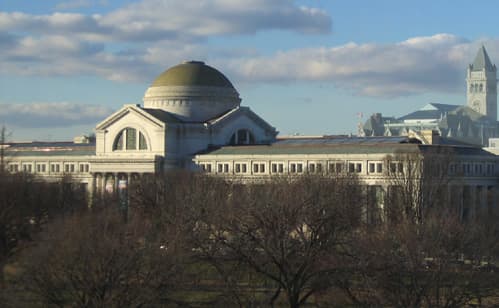
The museum opened to the public on March 17, 1910, in a Neoclassical building designed by the Washington firm Hornblower & Marshall. It was the first structure built on the north side of the National Mall under the 1901 McMillan Commission plan that shaped the Mall we know today, and it cost $3.5 million — an enormous sum for a museum at the time. The building was not fully completed until June 1911, and it originally housed not only natural history but the Smithsonian's American history, art, and cultural collections as well. Over the following century, those sibling collections moved out to their own Mall buildings, and natural history took over the whole 1.5-million-square-foot structure, with 325,000 square feet of exhibition and public space.
Henry the elephant and the rotunda
The rotunda is the museum's front room, and Henry is its host. The elephant is officially the Fénykövi Elephant, named for Josef Fénykövi, the Hungarian-born engineer and big-game hunter who shot the adult male African savanna elephant in southeastern Angola in 1955 and donated the hide to the Smithsonian rather than to a European museum. Chief taxidermist William L. Brown and assistant Norman Deaton spent roughly sixteen months mounting the specimen, and it was unveiled in the rotunda on March 6, 1959. As displayed it stands 13 feet 2 inches at the shoulder and weighs an estimated 11 tons.
The nickname "Henry" is often said to honor Joseph Henry, the Smithsonian's first Secretary, though the specimen's official designation remains the Fénykövi Elephant. The tusks you see are cast celluloid replicas; the original tusks, each about 7 feet long, were removed and placed in storage for scientific study. The elephant's marble pedestal dates to a 2015 restoration that replaced an earlier savanna diorama. Above it all rises the rotunda's Guastavino-tiled dome, modeled on the Pantheon, with balconies circling the hall and leading to the galleries above — including, one floor up, the hall that holds the museum's most famous single object.
The Hope Diamond and the Hall of Geology, Gems, and Minerals
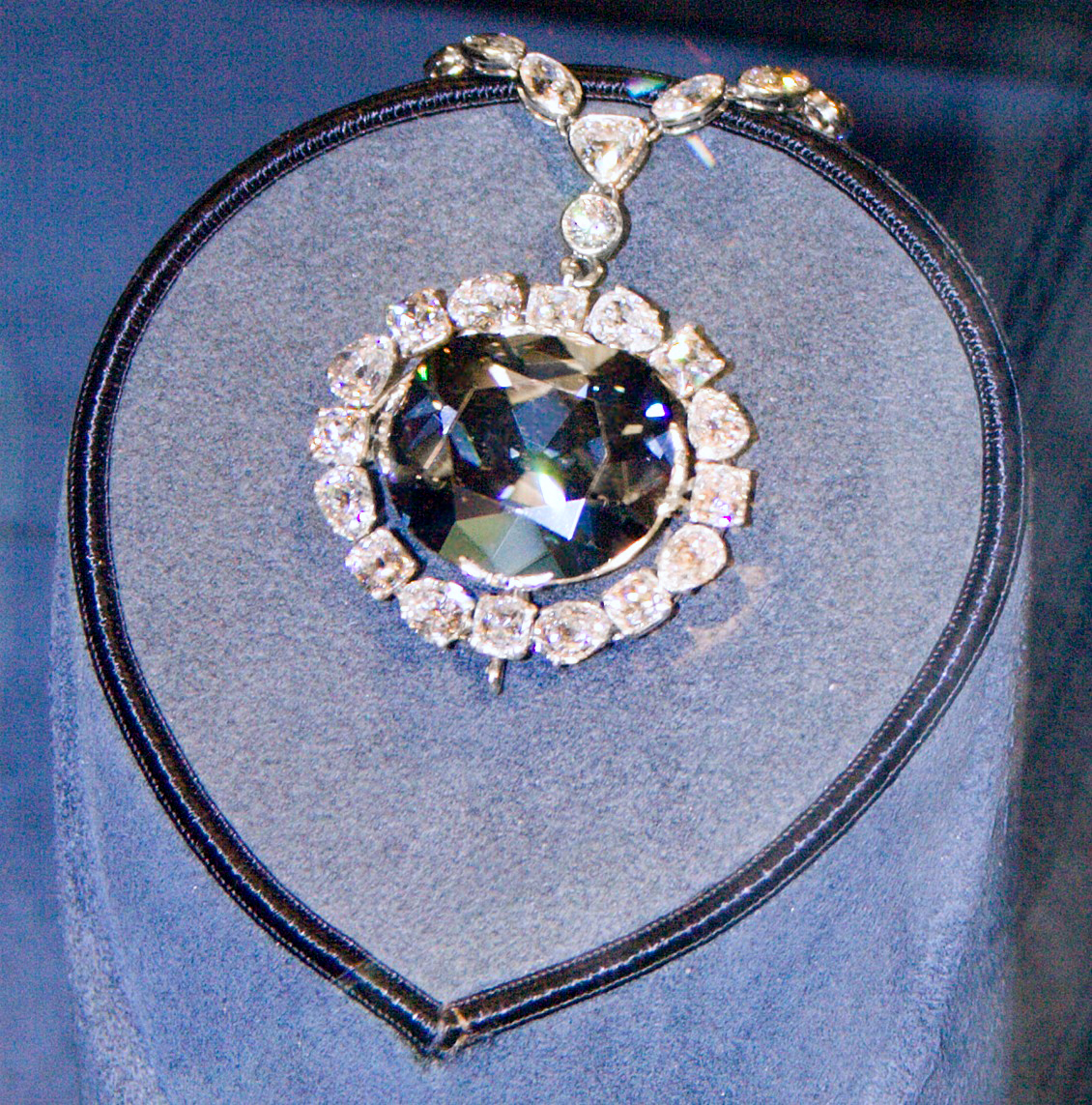
The Hope Diamond sits in the Janet Annenberg Hooker Hall of Geology, Gems, and Minerals, and it draws a line of visitors at almost any hour. The stone is a 45.52-carat deep-blue diamond, one of the most famous gems in the world, and its story reads like a novel. It was crudely finished and weighed about 115 carats when French merchant Jean Baptiste Tavernier purchased it in India in 1666. French King Louis XIV bought it in 1669 and had it recut into a 69-carat heart-shaped stone known as the French Blue. In 1792, during the French Revolution, the French Blue was stolen from the royal treasury in Paris and vanished. Its whereabouts remained unknown until a large blue diamond appeared in 1839 in the collection of Henry Philip Hope, a London banker and gem collector — and scientists are now confident the Hope Diamond, recut to its present 45.52 carats, is derived from the French Blue.
The diamond came to the Smithsonian in 1958, donated by jeweler Harry Winston, and the museum marked the 50th anniversary of the gift in 2008 with a new setting designed by Harry Winston Inc. The gem hall around it is one of the most significant collections of its kind in the world: more than 15,000 individual gems, 350,000 minerals, and 300,000 rock and ore specimens, plus some 45,000 meteorite specimens spanning every known type. Alongside the Hope Diamond, look for the Star of Asia, a 330-carat cabochon-cut star sapphire, and the Carmen Lúcia Ruby, one of the largest and most valuable Burmese rubies in the world. The hall's donors include Washington Roebling — the man who built the Brooklyn Bridge — who gave 16,000 specimens, and Frederick A. Canfield, who donated 9,000.
Deep Time: 4.6 billion years in one hall
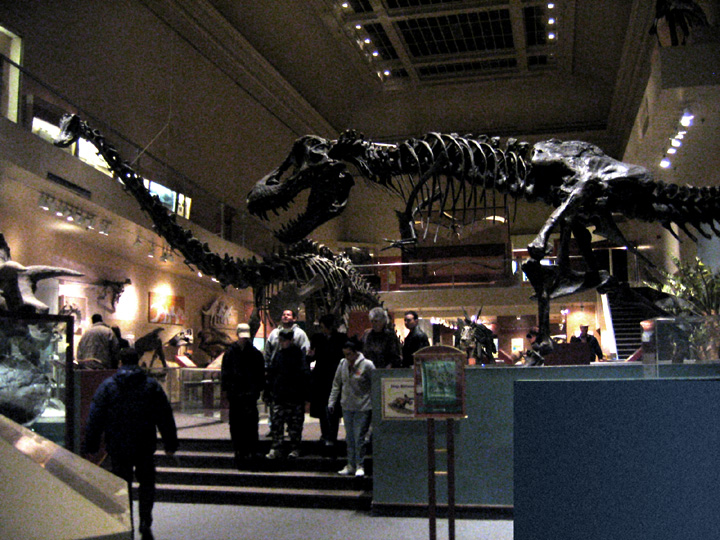
If the gem hall is the museum's jewel box, the David H. Koch Hall of Fossils — Deep Time is its epic. The hall reopened in June 2019 after a five-year renovation, funded in part by a $35 million gift announced in 2012, and it organizes the fossil collection around a single organizing idea: deep time, the almost incomprehensible scale of Earth's history. The gallery traces roughly 4.6 billion years, from the planet's formation through the first life, the age of dinosaurs, and the emergence of early humans, using dioramas, fossil casts, and interactive displays to show how life and Earth's physical systems have shaped each other.
The hall's centerpiece specimens include the museum's great dinosaur mounts — the towering skeletons that have drawn children (and adults) for generations — now presented with modern science about extinction, climate shifts, and the asteroid impact that ended the reign of the dinosaurs 66 million years ago. The previous Dinosaur Hall, which closed in April 2014 for the renovation, had displayed its skeletons beneath the gallery's skylit coffered ceilings since the early twentieth century; the Deep Time redesign kept many of the iconic specimens while reframing the story around change over geological time. It is the museum's most ambitious gallery, and the one that best explains why a natural history museum matters: it puts the human story, all few hundred thousand years of it, into its proper, humbling proportion.
Oceans, mammals, and human origins
Beyond the headline halls, the museum rewards the wanderer. The Sant Ocean Hall, which opened in 2008, centers on a life-size model of a 45-foot North Atlantic right whale suspended above the gallery floor, surrounded by exhibits on coral reefs, deep-sea vents, and the ocean's role in regulating the planet's climate. The Kenneth E. Behring Family Hall of Mammals, opened in November 2003 after a $100 million renovation, presents the diversity of mammalian life — from tiny bats to great whales — in dioramas and skeletons that trace how mammals evolved and adapted to nearly every environment on Earth.
The David H. Koch Hall of Human Origins, opened in March 2010, tells the story of human evolution over six million years, from early hominins to modern Homo sapiens, with reconstructions of early human faces, stone tools, and evidence of how climate change shaped our species' journey. The museum's seven research departments — anthropology, botany, entomology, invertebrate zoology, mineral sciences, paleobiology, and vertebrate zoology — feed all of these galleries, and about 3.5 million specimens go out on loan to researchers around the world every year. The Butterfly Pavilion, a live-butterfly experience on the museum's second floor, offers a quieter, warmer counterpoint to the grand halls; it uses timed entry, so check the museum's official visitor information before your visit.
A building that is itself an exhibit
It is worth looking up and around as you move through the museum, because the building is part of the experience. The Neoclassical facade on Madison Drive, the green dome over the rotunda, the marble staircases, and the coffered ceilings of the older galleries all date to Hornblower & Marshall's original design — and the building was listed on the National Register of Historic Places in 2023. The museum's research wings, invisible to most visitors, hold the bulk of the 148 million specimens in storage, and the institution's scientists publish research that shapes fields from paleontology to anthropology.
The museum's place on the Mall matters, too. It stands between the Washington Monument and the U.S. Capitol, on the north side of the Mall, directly across from the Smithsonian Castle's gardens. It is one of the most visited museums in the world — 3.3 million visits in 2025 — and one of the few great museums anywhere that charges no admission at all. That openness is deliberate: the Smithsonian was founded in 1846 with a bequest from English scientist James Smithson "for the increase and diffusion of knowledge," and the National Museum of Natural History is that mission at its most literal — the whole natural world, gathered, studied, and opened to anyone who walks in.
How to see it
Start in the rotunda with Henry, then take the stairs or elevator to the gem hall for the Hope Diamond — go early in the day if you want a shorter wait at the gem case. From there, work through Deep Time for the dinosaurs, the Sant Ocean Hall for the whale, and the Hall of Human Origins, in whatever order the crowds allow. If you have children, the Butterfly Pavilion and the museum's hands-on Q?rius science education center are the two stops most likely to hold their attention after the dinosaurs. And if you have a second day, pair the visit with the museum's Mall neighbors: the National Air and Space Museum to the east and the National Gallery of Art to the west, both also free.
The museum rewards slow looking. The Hope Diamond is a few inches of blue stone behind glass, but it carries four centuries of kings, thieves, bankers, and jewelers. Henry is a mounted elephant, but he is also a 1955 hunt in Angola, sixteen months of taxidermy, and sixty-six years of greeting visitors. Deep Time is a hall of old bones, but it is also the story of how a planet changes and how life changes with it. That is the museum's quiet argument, made in every gallery: that the natural world is not something distant or finished, but something still unfolding — and that a free museum on the National Mall is a good place to start understanding it.
Key Facts
The National Museum of Natural History opened to the public on March 17, 1910, in a Neoclassical building designed by Hornblower & Marshall; the building was fully completed in June 1911 at a cost of $3.5 million. It was the first structure built on the north side of the National Mall under the 1901 McMillan Commission plan, and was listed on the National Register of Historic Places in 2023.
The museum holds more than 148 million specimens — the largest natural history collection in the world — including 30 million insects, 4.5 million plants, 7 million fish, 350,000 minerals, and 45,000 meteorite specimens. About 185 professional natural history scientists work at the museum.
The rotunda's Fénykövi Elephant ("Henry") is an adult male African savanna elephant shot in southeastern Angola in 1955 by Josef Fénykövi, who donated the hide to the Smithsonian. Mounted over roughly sixteen months by William L. Brown and Norman Deaton, it was unveiled on March 6, 1959, stands 13 feet 2 inches at the shoulder, and weighs an estimated 11 tons as displayed. Its visible tusks are celluloid replicas.
The Hope Diamond is a 45.52-carat deep-blue diamond, donated to the Smithsonian by Harry Winston in 1958. It descends from the Tavernier Diamond (purchased in India in 1666), recut as the French Blue for Louis XIV in 1669, stolen from the French royal treasury in 1792, and reappearing in 1839 in the collection of Henry Philip Hope. It is displayed in the Janet Annenberg Hooker Hall of Geology, Gems, and Minerals.
The National Gem and Mineral Collection holds more than 15,000 gems, including the 330-carat Star of Asia sapphire and the Carmen Lúcia Ruby; Washington Roebling donated 16,000 specimens to the collection.
The David H. Koch Hall of Fossils — Deep Time reopened in June 2019 after a five-year renovation, tracing 4.6 billion years of Earth's history. The previous Dinosaur Hall closed in April 2014 for the renovation.
The Sant Ocean Hall opened in 2008 and centers on a life-size model of a 45-foot North Atlantic right whale. The Behring Family Hall of Mammals opened in November 2003, and the Hall of Human Origins opened in March 2010.
The museum is administered by the Smithsonian Institution (founded 1846), sits at 10th Street and Constitution Avenue NW on the National Mall, and received 3.3 million visits in 2025. Admission is free.
The museum's research is divided into seven departments: anthropology, botany, entomology, invertebrate zoology, mineral sciences, paleobiology, and vertebrate zoology. About 3.5 million specimens go out on loan each year.
Visitor Details
Address: Smithsonian National Museum of Natural History, 10th Street and Constitution Avenue NW, Washington, DC 20560 — north side of the National Mall
Transit: Federal Triangle station (Blue, Orange, and Silver lines), a short walk from the museum; Archives station (Green and Yellow lines) is also nearby
Hours/Admission: Admission to the museum is free. The museum is generally open nearly every day of the year, but hours vary seasonally and the Butterfly Pavilion uses timed entry — check the museum's official visitor information at naturalhistory.si.edu before your visit rather than relying on a fixed schedule.
Best timing: Weekday mornings for the shortest wait at the Hope Diamond case and the quietest galleries; start in the rotunda with Henry the elephant, then visit the gem hall, Deep Time, and the Sant Ocean Hall. Allow at least half a day — the museum's 325,000 square feet of exhibition space cannot be done justice in an hour.
Location Photography