The temple halfway between the White House and the Capitol
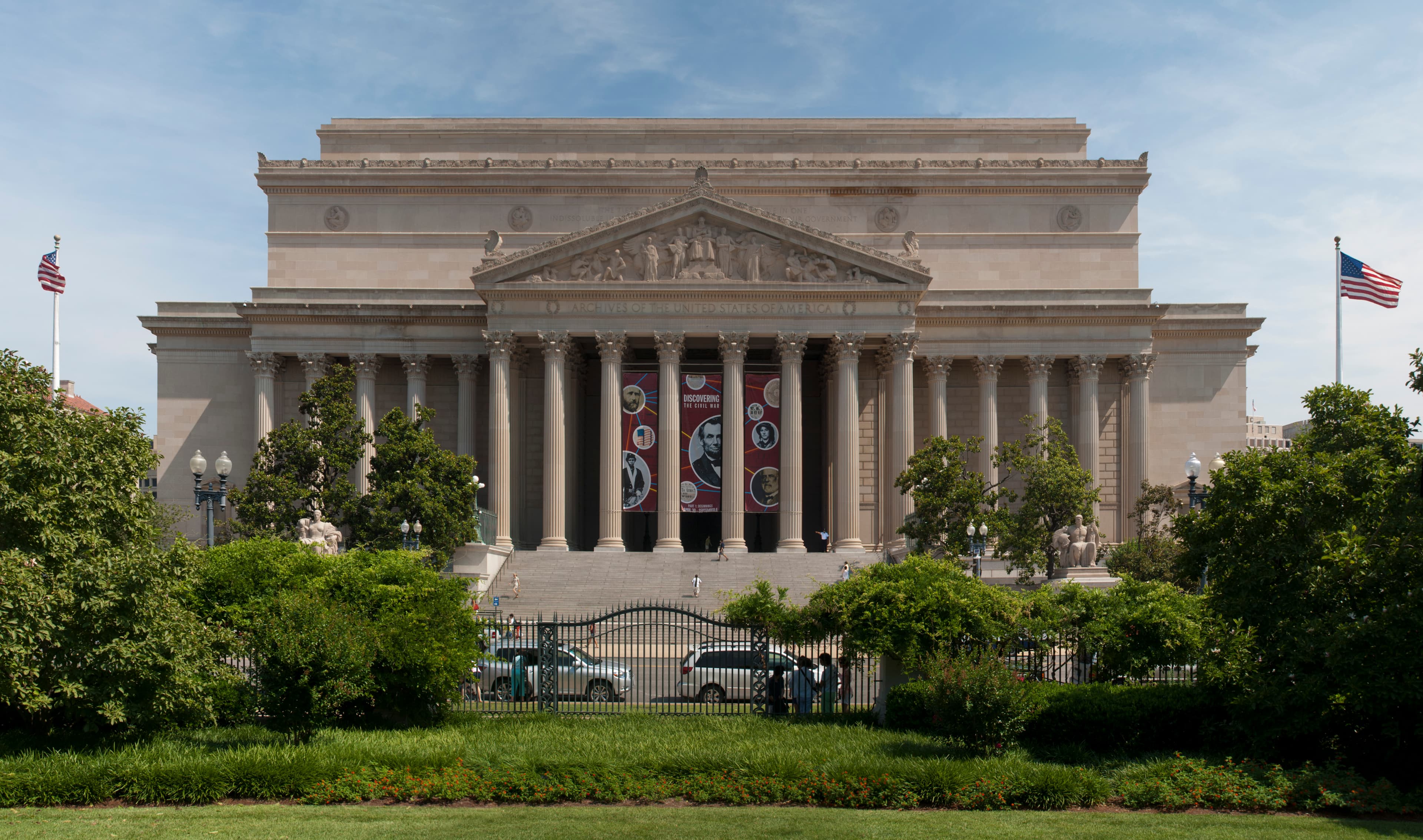
Stand on Pennsylvania Avenue between 7th and 9th Streets NW and you are standing on the exact middle of American power: the White House in one direction, the Capitol in the other, and between them a limestone temple with 72 Corinthian columns, bronze doors nearly 39 feet tall, and a moat. This is the National Archives Building, known informally as Archives I, the original headquarters of the National Archives and Records Administration. It is the place the United States keeps its own memory — and the place where any first-time visitor to Washington can stand inches away from the documents that founded the country.
The building exists because for nearly 150 years, the federal government had no proper place to keep its records at all. From the founding of the republic, agencies looked after their own papers, and too often fire, neglect, or simple disorganization destroyed them. By the early twentieth century, historians and officials were campaigning for a national archives, and in 1926 Congress finally authorized construction of an archives building as part of a massive public-buildings program that would reshape downtown Washington into the Federal Triangle.
The commission went to John Russell Pope, the architect who would later design the Jefferson Memorial and the National Gallery of Art. Pope threw out the first, more modest scheme and moved the building to the block between 7th and 9th Streets, a site he believed demanded a monument. The old Center Market that stood there was demolished to make way. Ground was broken on September 5, 1931, and President Herbert Hoover laid the cornerstone in February 1933. Building on the site was a feat in itself: the structure rises over the buried course of Tiber Creek, so workers drove 8,575 piles into the unstable soil before pouring a huge concrete bowl for a foundation. Indiana limestone clads the exterior, Massachusetts granite forms the base, and the exterior alone took more than four years to finish. Staff moved into the unfinished building in November 1935, and the building was completed in 1937.
The Charters of Freedom
Everything in the building points toward one room: the Rotunda for the Charters of Freedom. Here, under soft light and behind protective glass, rest the original Declaration of Independence, the Constitution of the United States, and the Bill of Rights — the three documents that, together, declare the nation's purpose, frame its government, and guarantee its liberties. They have been on public display in the Rotunda since 1952, when they were placed in hermetically sealed encasements filled with inert helium gas, and they were re-encased in new protective cases in 2003 after conservators found the original glass deteriorating. Each night the documents are lowered into a steel-and-concrete vault beneath the Rotunda floor, and each morning they are raised again into their display cases.
The display has grown over time. Alongside the three founding charters, the Rotunda has shown other landmark documents, including an original 1297 Magna Carta confirmed by Edward I, the Louisiana Purchase Treaty, the Articles of Confederation, and the Continental Association. In 2026 the Emancipation Proclamation and the 19th Amendment joined the display, a reminder that the story the Rotunda tells is not frozen in 1776 or 1787 but still being written. The building's galleries beyond the Rotunda — the David M. Rubenstein Gallery, the Lawrence F. O'Brien Gallery, and the Public Vaults — rotate exhibitions drawn from the billions of records the Archives holds, from presidential papers to photographs, maps, and military service files.
There is no line for any single document in the Rotunda. Visitors walk from case to case as they wish, which makes the experience feel less like a queue and more like a vigil. The room is deliberately hushed, and photography rules in the exhibition areas are strict, so the encounter stays quiet and unhurried. The Declaration itself is faded — iron gall ink on parchment does not age gracefully, and two and a half centuries of light and handling have taken their toll — but that fading is part of the point. You are not looking at a reproduction. You are looking at the thing itself, in the condition that history has left it.
A building that speaks in sculpture
Pope believed a temple of history should teach through its decoration, and the National Archives Building is one of the most symbolically dense buildings in Washington. Start outside. The 72 Corinthian columns are each 53 feet high, nearly 6 feet in diameter, and weigh 95 tons. The two bronze doors of the Constitution Avenue entrance each weigh 6.5 tons and measure 38 feet 7 inches high — for a time the largest bronze doors in the world. A granite moat rings the building, crossed only at the entrances, and swords, shields, and spear-topped gates remind you that what is inside is meant to be guarded.
The sculpture program is worth a slow walk around the whole block. On the north side, facing Pennsylvania Avenue, stand Robert Aitken's two colossal figures: an old man titled Past, inscribed "Study the Past," a paraphrase of Confucius, and a young woman titled Future, inscribed "What is Past is Prologue," from Shakespeare's The Tempest. On the south side, facing Constitution Avenue and the Mall, stand James Earle Fraser's Heritage, a woman holding a child, wheat, and an urn, inscribed with Wendell Phillips's words, "The heritage of the past is the seed that brings forth the harvest of the future," and Guardianship, a muscular figure with sword, shield, and plumed helmet, inscribed "Eternal Vigilance is the Price of Liberty," attributed to Thomas Jefferson. Each statue weighs 65 tons including its pedestal and was carved from a single slab of Indiana limestone.
Above them, the two great pediments carry the building's argument in allegory. The north pediment, by Adolph Weinman, centers on Destiny, flanked by figures representing the arts of peace and the arts of war. The south pediment, by James Earle Fraser and his wife Laura Gardin Fraser, shows the Recorder of the Archives, a seated figure holding a book and keys, receiving documents from attendants, with winged horses for aspiration, rams for parchment, and dogs for guardianship. It measures 118 feet wide and 18 feet high, among the largest pediments in Washington. The building was added to the National Register of Historic Places in 1971 and designated a National Historic Landmark in December 2023, a designation that covers this sculptural program as well as the building itself.
Inside the Rotunda: murals, marble, and light
The Rotunda rewards looking up as much as looking down at the cases. The domed hall rises 75 feet, and its walls carry two enormous murals by Barry Faulkner, commissioned in 1933 and installed in December 1936. One depicts the presentation of the Declaration of Independence; the other shows James Madison submitting the Constitution to George Washington and the Constitutional Convention. Each mural is nearly 14 feet high and 35 feet long, painted against landscape backgrounds Faulkner chose so the hall would feel open and distant rather than enclosed. Beneath your feet, the marble floor carries a great bronze medallion whose winged figures symbolize legislation, justice, history, and war and defense — the subjects of the records the building holds.
The galleries around the Rotunda are where a visit turns from reverence into discovery. The Public Vaults let you handle facsimiles and explore interactive exhibits drawn from the holdings. The Rubenstein Gallery traces the long record of rights in America, from the founding charters through the civil rights movement. The O'Brien Gallery hosts changing special exhibitions. And if your interest runs deeper, the building is also a working research center: the research entrance on Pennsylvania Avenue serves genealogists, historians, veterans seeking service records, and anyone tracing a family or a federal record. The reading rooms are quiet, staffed, and free to use, a reminder that the Archives is not only a museum but a public utility for memory.
Visiting the National Archives Building: how to do it well
Enter through the museum entrance on Constitution Avenue, between 7th and 9th Streets, and give yourself time. The Rotunda is the destination, but the building rewards a full circuit: walk the exterior first to see the statues and pediments, then enter and let the Rotunda set the tone before you explore the galleries. Come early in the day if you can, when the Rotunda is at its quietest, and pair the visit with the neighboring sights of the Penn Quarter and the Mall — the building sits within easy walking distance of the Navy Memorial, the National Gallery of Art, and the museums of the Mall, making it a natural anchor for a day downtown.
Expect a security screening on entry, and leave large bags behind if you can. The Rotunda's hush is part of the experience, so speak quietly, move slowly, and give the documents the same attention you would give any original work of art. If you are traveling with children, the Boeing Learning Center and the Public Vaults offer hands-on exhibits that make the founding story tangible. And if a document you hoped to see is off display — exhibitions rotate, and the charters themselves occasionally come down for conservation — the galleries and the building itself are more than worth the visit on their own. This is, after all, a building that was designed to outlast us all, holding the words by which the country still tries to live.
Key Facts
- The National Archives Building was authorized by Congress in 1926 as part of the Federal Triangle public-buildings program; ground was broken on September 5, 1931, staff moved in during November 1935, and the building was completed in 1937.
- The building was designed by architect John Russell Pope, who later designed the Jefferson Memorial and the National Gallery of Art.
- The Rotunda for the Charters of Freedom displays the original Declaration of Independence, Constitution, and Bill of Rights, on public display there since 1952.
- The Charters are kept in sealed helium-filled encasements, re-encased in 2003, and lowered nightly into a steel-and-concrete vault beneath the Rotunda.
- The building has 72 Corinthian columns, each 53 feet high and weighing 95 tons; its Constitution Avenue bronze doors each weigh 6.5 tons and stand 38 feet 7 inches high.
- Four colossal statues guard the entrances: Past and Future by Robert Aitken on the Pennsylvania Avenue side, Heritage and Guardianship by James Earle Fraser on the Constitution Avenue side, each weighing 65 tons with its pedestal.
- The south pediment, "The Recorder of the Archives" by James Earle Fraser and Laura Gardin Fraser, measures 118 feet wide and 18 feet high.
- The Rotunda's two murals by Barry Faulkner, installed in December 1936, depict the Declaration of Independence and the Constitution; the dome rises 75 feet.
- The building was added to the National Register of Historic Places in 1971 and designated a National Historic Landmark in December 2023.
- Beyond the Rotunda, the building holds an original 1297 Magna Carta, the Louisiana Purchase Treaty, and galleries including the Rubenstein Gallery, the O'Brien Gallery, and the Public Vaults, plus public research rooms.
Location Photography