The museum where the real things live
Ask a first-time visitor to Washington what museum they most want to see, and the National Air and Space Museum is usually at or near the top of the list — and for a reason no other museum in the world can match. This is not a museum of models and replicas. The machines on display here are, almost without exception, the originals: the actual airplane that first flew under power at Kitty Hawk, the actual airplane that first crossed the Atlantic alone, and the actual spacecraft that carried the first people to the Moon and brought them home. Standing in front of them is a different experience from reading about them, because the scratches, the worn fabric, and the scorched heat shield are the history itself.
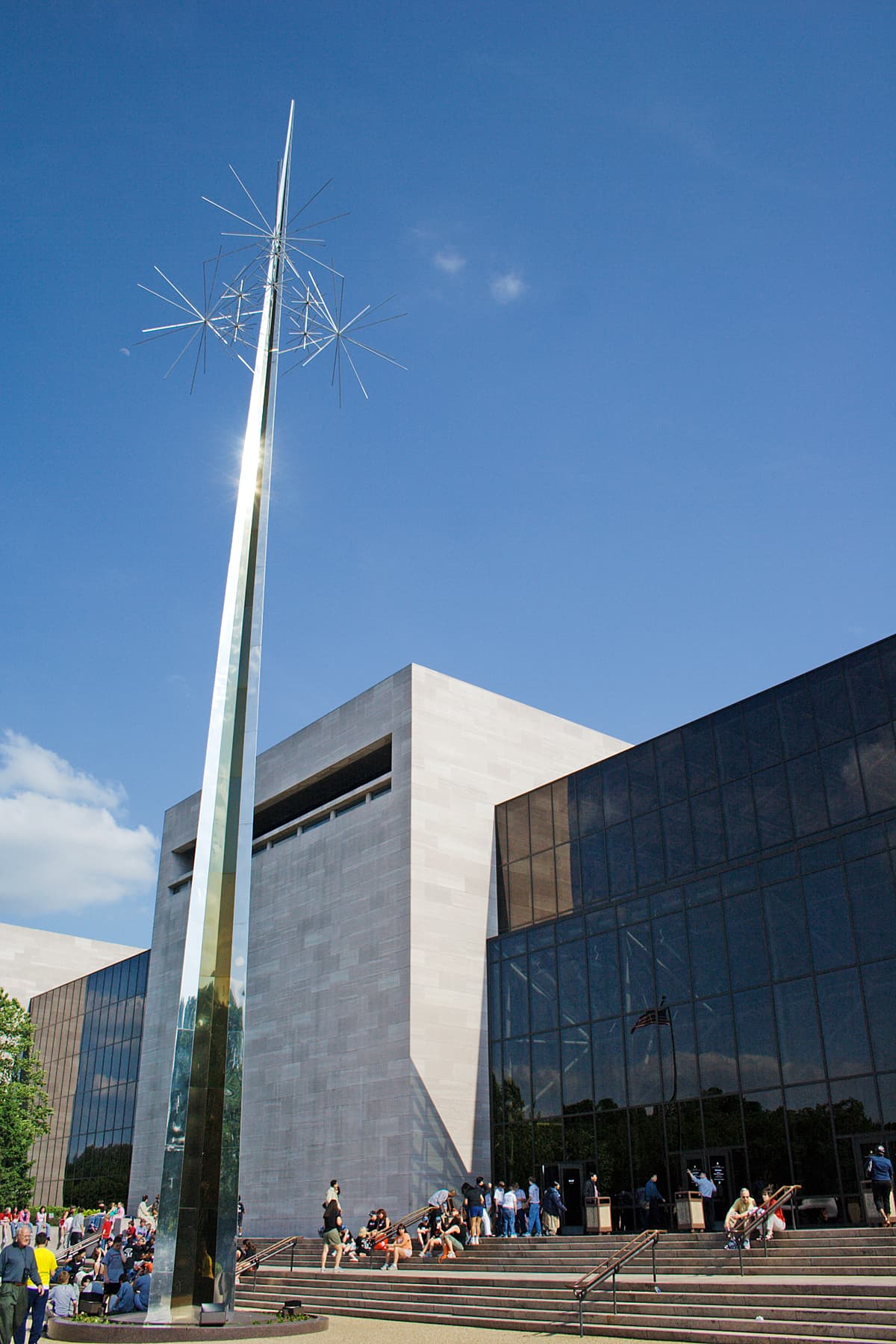
The museum sits on the National Mall between Fourth and Seventh Streets SW, a long, low building of Tennessee marble and glass designed by architect Gyo Obata and opened on July 1, 1976, as part of America's Bicentennial celebrations. It was an instant phenomenon. In some years it has drawn more visitors than any other museum in the United States, and it remains one of the most visited museums on earth. Its collection — the largest of historic aircraft and spacecraft anywhere — traces the whole arc of flight, from the first gliders and balloons of the nineteenth century through two world wars, the jet age, and the race to the Moon and beyond.
The institution behind it is older than the building. Congress established the National Air Museum in 1946, and it was renamed the National Air and Space Museum in 1966 as the space age gathered speed. Its second site, the Steven F. Udvar-Hazy Center near Dulles International Airport in Chantilly, Virginia, holds the overflow giants that cannot fit on the Mall, including the Space Shuttle Discovery. But the Mall building is the pilgrimage site, and its great hall is where the story begins.
The 1903 Wright Flyer: twelve seconds that changed the world
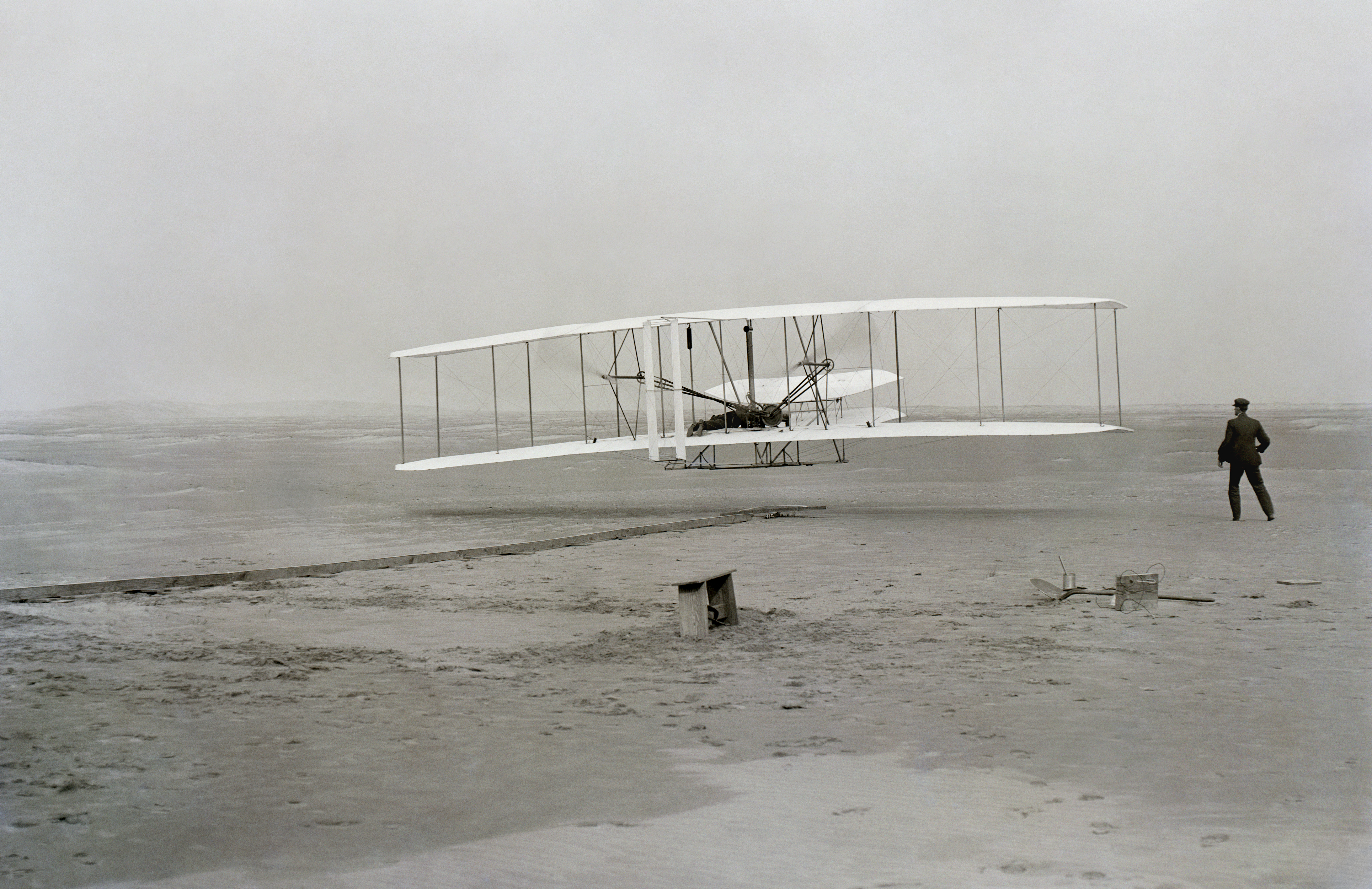
The centerpiece of the museum's story — and the object visitors ask about most — is the 1903 Wright Flyer. On the morning of December 17, 1903, at Kill Devil Hills near Kitty Hawk, North Carolina, Orville Wright lay prone on the lower wing of a fragile-looking biplane of spruce and muslin and flew 120 feet in 12 seconds into a freezing headwind. It was the first sustained, controlled, powered flight by a heavier-than-air machine with a pilot aboard. Three more flights followed that day; the last, by Wilbur, covered 852 feet in 59 seconds before a gust wrecked the machine on the ground. It never flew again.
What makes the Flyer so compelling in person is how improbable it looks. It has no wheels — it took off from a wooden rail on skids. Its 12-horsepower engine, built by the brothers with their mechanic Charlie Taylor, drove two pusher propellers through bicycle chains. Control came from wing-warping, the brothers' great insight: twisting the wings to bank, the way a cyclist leans into a turn. The Wrights were bicycle makers from Dayton, Ohio, not university engineers, and the Flyer is a bicycle shop's answer to a problem that had defeated well-funded inventors for decades.
The Flyer's road to the Smithsonian was itself long and bitter. After a dispute with the Institution over its recognition of a rival claimant, Orville sent the airplane to the Science Museum in London in 1928. It stayed there for twenty years and only came home in 1948, after Orville's death, on the forty-fifth anniversary of the first flight. It has been on display in Washington ever since, and the museum's curators are emphatic on the question every visitor asks: yes, this is the real one.
The Spirit of St. Louis: one man, one engine, one ocean
A generation later, the museum's next great icon hangs nearby: the Spirit of St. Louis, the silver Ryan NYP monoplane in which Charles Lindbergh flew alone and nonstop from New York to Paris on May 20–21, 1927. The flight took 33 hours and 30 minutes and covered about 3,610 miles, winning Lindbergh the $25,000 Orteig Prize and making him the most famous man alive.
The airplane itself tells the story of the gamble. Built by Ryan Airlines in San Diego in just sixty days, it was designed around a single engine and a single seat, with fuel tanks holding 450 gallons — more than half the airplane's takeoff weight — packed in front of the cockpit. There was no forward visibility at all: the fuel tank blocked the windshield, so Lindbergh flew by periscope and by banking to look out the side windows. He flew through the night over the Atlantic with no autopilot, fighting sleep, icing, and fog, and landed at Le Bourget Field outside Paris to a crowd estimated in the tens of thousands.
Lindbergh donated the Spirit to the Smithsonian in 1928, after its final flight from St. Louis to Washington. It has hung in the museum's great hall ever since, its silver fabric and black script lettering instantly recognizable. Seeing it in person corrects a common misconception: it is smaller than most people expect, and that smallness is the point. One man crossed an ocean in something barely bigger than a modern family car, with no radio navigation worth the name and no company but his own thoughts.
Apollo 11 and Columbia: the spacecraft that came home
If the Wright Flyer is the beginning of the story, the Apollo 11 command module Columbia is its climax. Columbia is the gumdrop-shaped capsule, scorched black by reentry heat, that carried Neil Armstrong, Buzz Aldrin, and Michael Collins to the Moon in July 1969 and was the only part of the Apollo 11 spacecraft to return to Earth. Armstrong and Aldrin descended to the lunar surface in the lunar module Eagle on July 20, 1969, while Collins remained alone in Columbia in lunar orbit — a solitary vigil that earned him the nickname the loneliest man in history, or at least in the solar system.
Columbia's display, now the centerpiece of the museum's Destination Moon gallery, rewards close looking. The heat shield's charred surface is the direct evidence of a 24,000-mile-per-hour return through the atmosphere on July 24, 1969. Nearby artifacts — Armstrong's spacesuit, lunar samples, and the tools of the mission — fill out a story that most visitors know in outline but have never seen at this scale. The gallery also looks forward, tracing lunar exploration from robotic precursors through Apollo and toward the missions of today, so the Moon landing reads not as a closed chapter but as the opening of one.
The museum's space galleries go well beyond Apollo. Friendship 7, the Mercury capsule in which John Glenn became the first American to orbit the Earth in 1962, is here, as are the Bell X-1, the rocket plane in which Chuck Yeager first broke the sound barrier in 1947, and a touchable Moon rock — a small, dark fragment of another world that visitors can actually put a hand on. For children, that Moon rock is often the memory that lasts longest.
A museum being rebuilt while you watch
One thing first-time visitors should know: the National Air and Space Museum is in the middle of a multi-year renovation that began in 2018, replacing the building's aging systems and its marble facade and rebuilding its galleries one by one. Part of the museum is closed at any given time, and some familiar artifacts may be off display or moved to the Udvar-Hazy Center during the work. The newest galleries — including Destination Moon and the World War II aviation galleries — have reopened to acclaim, but it is worth checking the museum's website before a visit to see which galleries are open on the day.
That rolling transformation is part of the visit's interest, not just a caveat. The museum is rethinking how it tells the story of flight for a new generation, with more hands-on exhibits, more room to walk around the great machines, and more attention to the people behind them — the engineers, pilots, and astronauts, but also the mechanics, mathematicians, and ground crews. The IMAX theater and the planetarium, both on site, remain popular complements to the galleries, especially for families.
Visiting the museum: how to do it well
The museum rewards a plan. Arrive when the doors open if you can, and head first to the Wright Flyer, the Spirit of St. Louis, and Columbia before the midday crowds build. The great hall alone can absorb an hour; the full museum deserves at least half a day, and enthusiasts will happily spend a whole one. Because admission is free, there is no penalty for a short, focused visit followed by a return — and the Mall location makes that easy, with the National Museum of the American Indian, the Hirshhorn, and the National Gallery of Art all within a few minutes' walk.
If you are visiting with children, the hands-on galleries and the chance to climb inside a cockpit or touch a Moon rock are the reliable favorites. If you are visiting alone, give yourself time simply to stand in the great hall and look up. The machines hanging overhead — airplanes and spacecraft suspended as if in flight — are arranged to tell the story in a single glance: from a wood-and-fabric biplane to a spacecraft, in less than seventy years. That is the whole history of human flight, and it happened within a single human lifetime.
Key Facts
- The National Air and Space Museum was established by Congress as the National Air Museum in 1946 and renamed in 1966; its Mall building, designed by Gyo Obata, opened July 1, 1976.
- It holds the largest collection of historic aircraft and spacecraft in the world, and almost everything on display is an original, not a replica.
- The 1903 Wright Flyer flew four times on December 17, 1903, at Kill Devil Hills, North Carolina; the first flight covered 120 feet in 12 seconds, the last 852 feet in 59 seconds.
- The Wright Flyer was displayed in London's Science Museum from 1928 to 1948 before returning to the Smithsonian; it has been on display in Washington ever since.
- Charles Lindbergh flew the Spirit of St. Louis solo and nonstop from New York to Paris on May 20–21, 1927, in 33 hours and 30 minutes over about 3,610 miles, winning the $25,000 Orteig Prize.
- Lindbergh donated the Spirit of St. Louis to the Smithsonian in 1928; its fuel tank blocked all forward visibility, so he flew by periscope and side windows.
- The Apollo 11 command module Columbia (CM-107) is the only part of the Apollo 11 spacecraft to return to Earth; it splashed down on July 24, 1969, after Armstrong and Aldrin walked on the Moon on July 20.
- Michael Collins remained alone aboard Columbia in lunar orbit while Armstrong and Aldrin descended in the lunar module Eagle.
- The museum's other icons include John Glenn's Friendship 7 Mercury capsule, Chuck Yeager's Bell X-1, and a Moon rock visitors can touch.
- A multi-year renovation begun in 2018 is rebuilding the museum's galleries in phases; part of the building is closed at any given time, so check airandspace.si.edu before visiting.
Visitor Details
Address: 600 Independence Ave SW, Washington, DC 20560
Transit: The museum is on the National Mall between 4th and 7th Streets SW; the closest Metro stations are Smithsonian and L'Enfant Plaza — check WMATA for the route nearest your entrance
Hours/Admission: Admission is free. Open daily 10:00 am – 5:30 pm, except December 25, per airandspace.si.edu (verified in this run). Free timed-entry passes are required for the Washington, DC location — reserve them at airandspace.si.edu before visiting. IMAX and planetarium shows are ticketed separately.
Best timing: Arrive at opening and head first to the Wright Flyer, the Spirit of St. Louis, and Columbia before the midday crowds; allow at least half a day, and check which galleries are open that day since renovation work closes parts of the museum in phases
Location Photography