A museum that breaks every rule you know
Walk into almost any great museum and the logic is familiar: rooms in chronological order, wall labels telling you what to look at, masterpieces given breathing room. The Barnes Foundation does the opposite, and that is exactly why it is famous. On the Benjamin Franklin Parkway in Philadelphia's Logan Square neighborhood, the Barnes holds one of the finest collections of Impressionist, Post-Impressionist, and early modern art on earth — 181 paintings by Pierre-Auguste Renoir, 69 by Paul Cézanne, 59 by Henri Matisse, 46 by Pablo Picasso — and hangs them the way its founder arranged them nearly a century ago: floor to ceiling, in dense symmetrical groupings, mixed with wrought iron, furniture, African sculpture, and pottery, with no wall labels at all.
The effect is startling on a first visit. A Cézanne still life hangs beside a Pennsylvania Dutch cabinet and a West African mask, not because they share a period or a place, but because their shapes, colors, and lines rhyme. That is not an accident or a curatorial whim. It is the whole point of the Barnes, and understanding why means understanding the extraordinary, stubborn, brilliant man who built it.
Albert C. Barnes and his eye
Albert Coombs Barnes was born in Philadelphia in 1872 and trained as a physician and chemist. His fortune came from medicine, not inheritance: with a partner, he developed Argyrol, an antiseptic silver compound used to treat eye infections and gonorrhea in the days before antibiotics, and built the A.C. Barnes Company around it. By 1912 he was a wealthy man with a growing itch to buy art — and, by his own later admission, not yet a good eye for it.
The turning point was an old school friend. Barnes had attended Philadelphia's Central High School with the painter William Glackens, and in January 1912 he sent Glackens to Paris with $20,000 and an open-ended commission to buy modern French paintings. Glackens returned with 33 works. Barnes followed him to Paris later that year, met the collectors Gertrude and Leo Stein, and bought his first two Matisses from them. Within a decade he had gone from novice to one of the most daring collectors alive, buying Cézanne, Renoir, and Matisse in depth while many American museums still considered them shocking, and championing artists like Chaim Soutine and Amedeo Modigliani before they were widely known.
Barnes did not collect trophies. He collected to learn, and to teach. Influenced by the philosopher John Dewey, whom he met at a Columbia University seminar in 1917, he believed that looking closely at art — at light, line, color, and space — trained the mind itself. He organized his business as a cooperative, giving his factory workers two hours a day for seminars in philosophy and art. The collection was, from the start, a school disguised as a gallery.
The Merion years and the ensembles
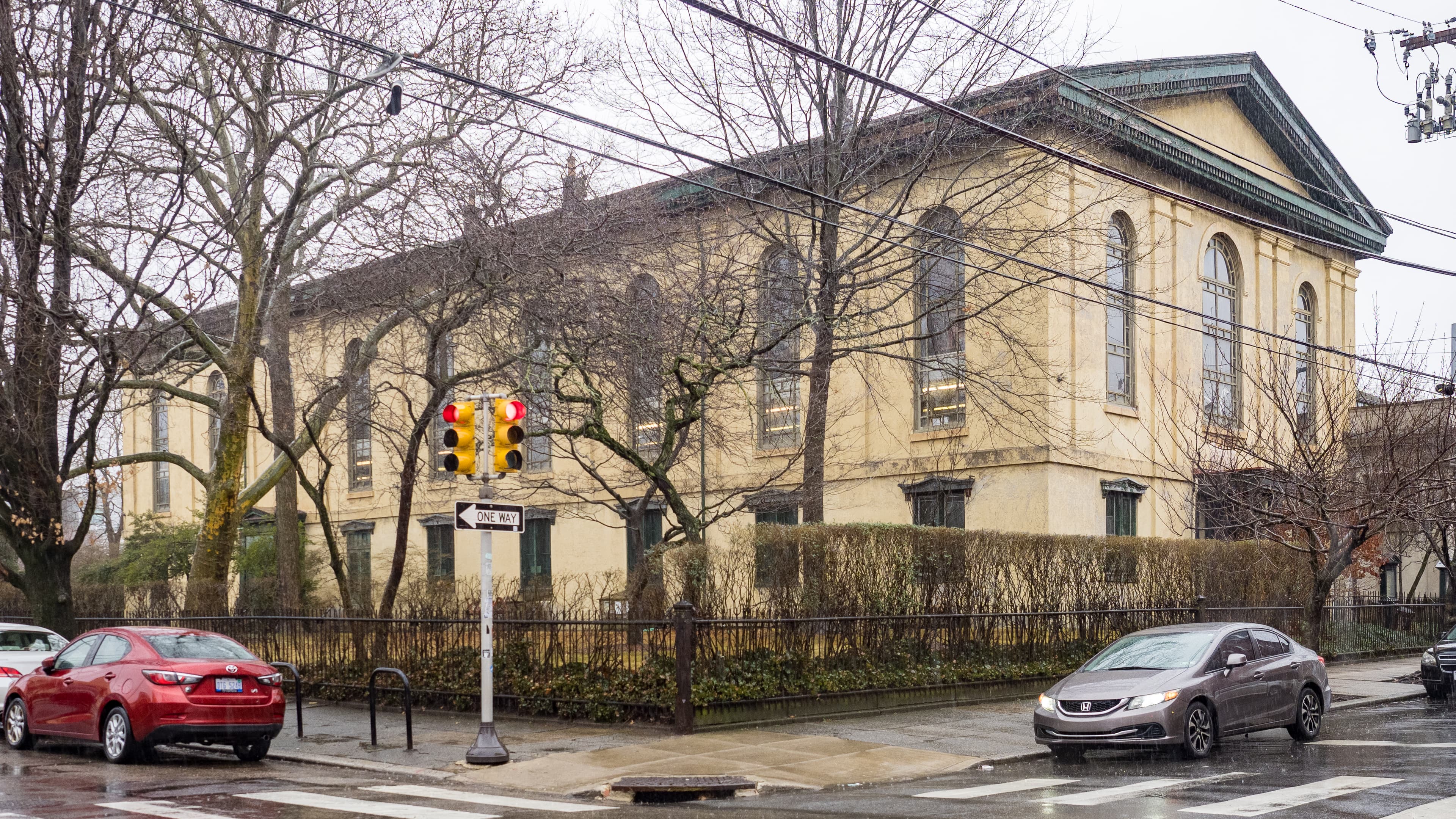
On December 4, 1922, Barnes received a charter from the Commonwealth of Pennsylvania establishing the Barnes Foundation as an educational institution. He had purchased a 12-acre property in Merion, a suburb just west of Philadelphia, with an arboretum founded by Civil War veteran and horticulturist Captain Joseph Lapsley Wilson. He commissioned the French-born architect Paul Philippe Cret — a professor at the University of Pennsylvania who also designed Philadelphia's Rodin Museum — to build a gallery there, and the Barnes Foundation officially opened on March 19, 1925.
The Merion gallery was never a public museum in the ordinary sense. Barnes's indenture of trust limited admission to just two days a week, forbade lending or selling any work, and insisted the collection remain arranged exactly as he placed it. His wife, Laura Leggett Barnes, developed the arboretum and its horticulture program from 1940. For decades, getting in required patience and persistence; public access was only gradually expanded, reaching regular public admission in 1961.
Inside, Barnes arranged the galleries into what he called ensembles: symmetrical compositions on each wall in which paintings, metalwork, furniture, and sculpture are grouped by visual relationships rather than by artist, period, or geography. There are no wall labels, because Barnes believed labels stopped people from actually looking. Instead, visitors were expected to compare, notice, and think — the method his collaborator Violette de Mazia later formalized as the Barnes Method. Matisse, who knew a thing or two about looking, reportedly called the school the only sane place in America to view art.
The ensembles are the reason a visit to the Barnes feels so different from a visit anywhere else. You do not walk a timeline of art history. You walk through one man's mind: his sense of how a Renoir nude relates to a Cézanne bathers composition, how a piece of wrought iron echoes the curve of a painted arm, how African sculpture — which Barnes collected seriously before most Western museums did — belongs in the same conversation as European modernism.
The controversial move to the Parkway
Barnes died in a car accident in 1951, and his ironclad trust began, almost immediately, to crack. The Merion building needed expensive repairs, the endowment was thin, and the restrictions on visitors and loans made fundraising nearly impossible. In 1993, breaking the indenture, the foundation sent 83 paintings on a world tour to raise money. By the late 1990s the foundation was in financial crisis and its board was in open conflict.
On September 24, 2002, the foundation petitioned the Montgomery County Orphans' Court to move the collection to Philadelphia and expand its board. After a two-year legal battle, Judge Stanley Ott ruled on December 15, 2004, that the move could proceed, backed by $150 million pledged by the Pew Charitable Trusts, the Lenfest Foundation, and the Annenberg Foundation for a new building and endowment. Opponents — including the Friends of the Barnes Foundation — fought on, arguing the move violated Barnes's will, and the dispute even became the subject of the 2009 documentary "The Art of the Steal." But the courts held, and the new building opened on the Benjamin Franklin Parkway on May 19, 2012.
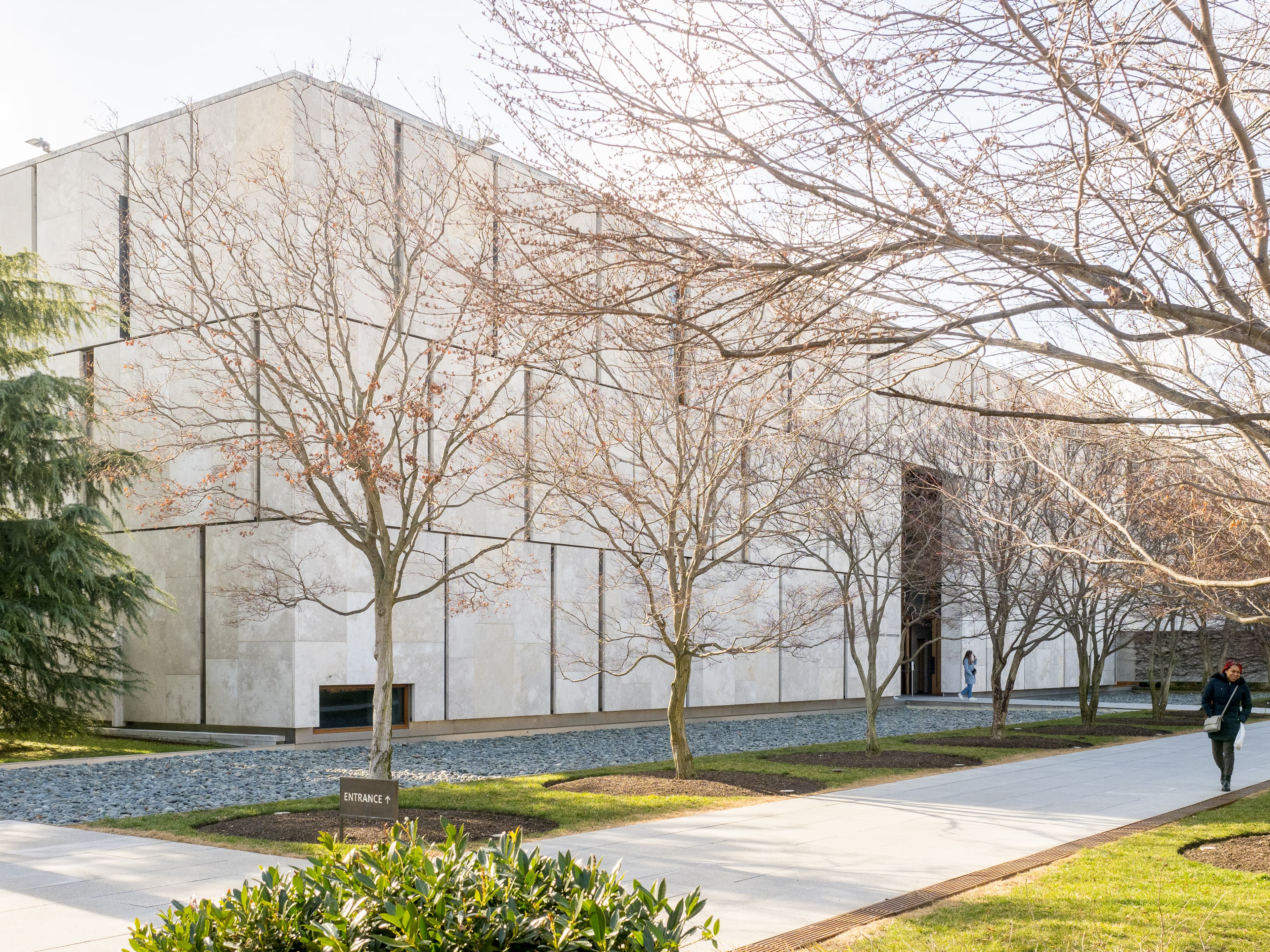
The new building, designed by Tod Williams and Billie Tsien Architects with Ballinger as associate architect and OLIN as landscape architect, is a deliberate act of fidelity and reinvention at once. It is a 93,000-square-foot building on a 4.5-acre site, wrapped in textured Ramon limestone, but its galleries replicate the scale, proportion, and configuration of the original Merion rooms — the same room sizes, the same window placements, the same dense hangs, the same mustard-toned walls. The foundation pledged that Barnes's arrangements would be reproduced exactly, and they were. What changed is everything around the galleries: natural light filtered through clerestories, classrooms, a 150-seat auditorium, a café, a shop, and a garden approach through reflecting pools and groves that landscape architect Laurie Olin designed as a "gallery in a garden." The building is LEED Platinum certified and won the 2013 AIA Institute Honor Award for Architecture.
Whether the move was a rescue or a betrayal is still argued in Philadelphia. What is not argued is the result: a collection that once admitted a few hundred visitors a week now welcomes hundreds of thousands a year, in the middle of the city's museum corridor, steps from the Rodin Museum and the Philadelphia Museum of Art.
What to see
Start with the numbers, because they still stop people cold: more than 4,000 objects, including over 900 paintings. The Renoir holdings alone — 181 works — are the largest of any museum in the world, as are the 69 Cézannes. Among the anchors, look for Cézanne's "The Card Players" and his many views of Mont Sainte-Victoire, the mountain he painted obsessively as a study in structure; Van Gogh's "Portrait of the Postman Joseph Roulin"; and Matisse's "Le Bonheur de Vivre" ("The Joy of Life"), the great 1905–06 canvas Barnes bought in 1923 that had once belonged to Gertrude and Leo Stein.
Do not miss the room with Matisse's "The Dance" murals, three large panels the artist made in 1932–33 for the arches of the Merion gallery's main room — they were designed for that exact space, and they still occupy its Parkway twin. And leave time for the works that are not French at all: the African masks and figures, the Native American ceramics and textiles, the Pennsylvania German furniture and wrought iron. Barnes hung them as equals, and seeing them that way — not in a separate "ethnographic" wing but in the middle of the conversation — remains quietly radical.
Because there are no labels, first-time visitors should use the Barnes's own tools: the Barnes Focus guide, which identifies works when you point your phone at them, or a guided tour. Both exist precisely because Barnes's no-label rule, admirable in theory, can bewilder in practice. A tour also helps with the second shock of the Barnes: the density. Walls are hung floor to ceiling, and the pleasure is not in ticking off famous names but in standing in one room long enough for the relationships between objects to emerge.
Visiting well
The Barnes rewards slowness. Unlike a big encyclopedic museum, it is compact — its galleries are a sequence of intimately scaled rooms — and trying to rush it misses the point. Give yourself at least two unhurried hours, and plan to spend most of them in the collection galleries rather than the special exhibition space. Sit down in the rooms: the seating is there because Barnes expected people to look for a long time.
Arrive through the garden, not just the door. The approach is part of the architecture: from the Parkway side you pass through OLIN's landscaped grounds, past the long reflecting pool, and by Ellsworth Kelly's 40-foot stainless steel "Barnes Totem" sculpture at the entrance court. The building's limestone facade, the water, and the trees are designed to slow you down before you ever see a painting — the Parkway's noise falling away behind you.
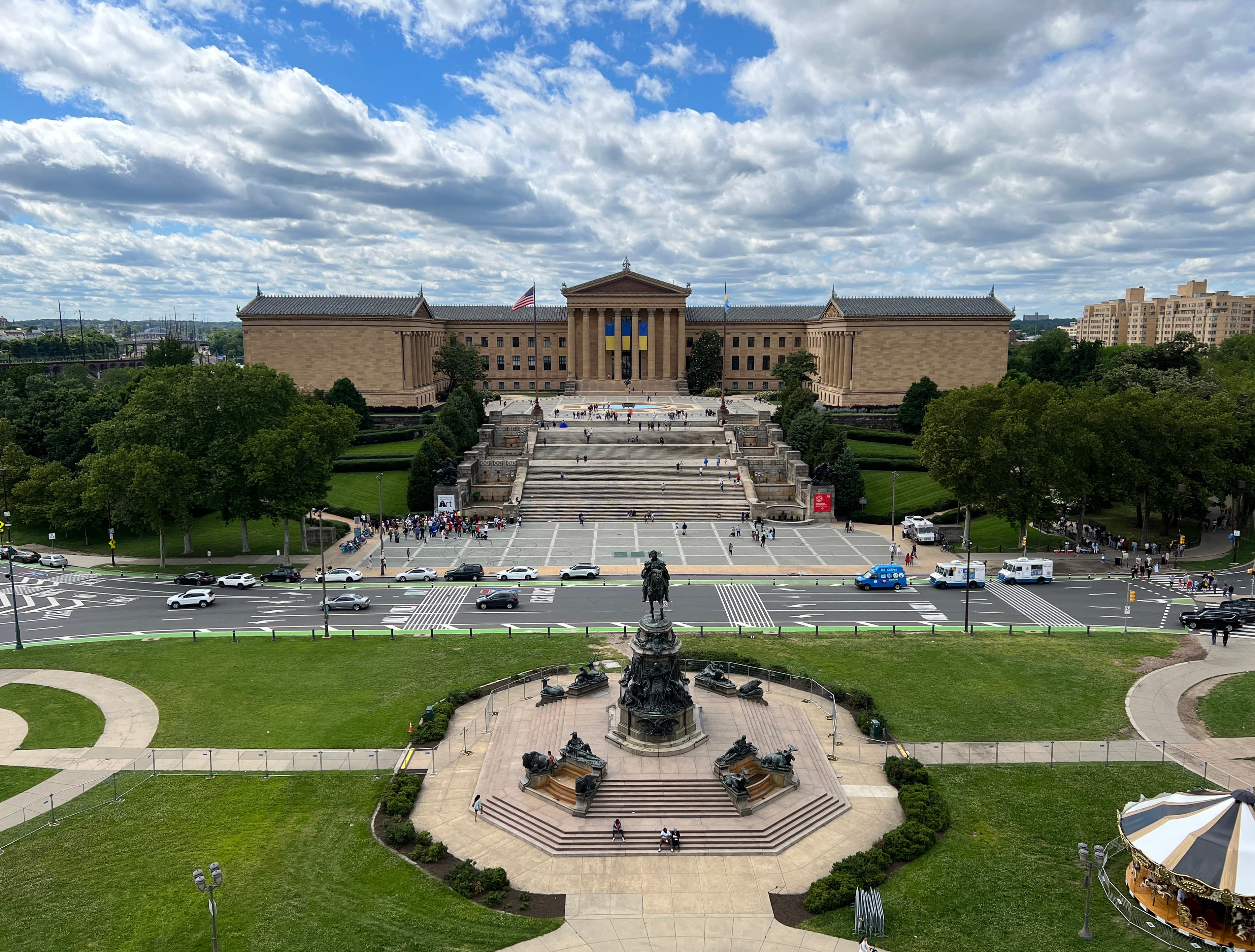
Pair the visit with the neighborhood. The Barnes sits in the heart of the Parkway museums district: the Rodin Museum is next door, the Philadelphia Museum of Art is a short walk up the Parkway, and Logan Square — with Alexander Stirling Calder's Swann Memorial Fountain at its center — is just down the hill. A Barnes morning and a Parkway afternoon is one of the best museum days in America.
One practical note, learned from the Barnes's own history: this is a popular museum with timed entry, and advance booking is strongly recommended. The days when you had to wait weeks for a Merion reservation are gone, but the Parkway Barnes still sells out at peak times, and the galleries are intentionally small. Book ahead, arrive on time, and then forget the clock.
Location Photography


Architectural & Historical Highlights
- The Barnes Foundation was chartered on December 4, 1922, as an educational institution and opened in Merion, Pennsylvania, on March 19, 1925.
- Founder Albert C. Barnes made his fortune from Argyrol, an antiseptic silver compound he co-developed, and sold his company months before the 1929 stock market crash.
- Barnes began collecting seriously in 1912, when he sent his school friend William Glackens to Paris with $20,000; Glackens returned with 33 works, and Barnes soon bought his first two Matisses from Gertrude and Leo Stein.
- The collection holds more than 4,000 objects, including over 900 paintings: 181 Renoirs, 69 Cézannes, 59 Matisses, and 46 Picassos — the largest Renoir and Cézanne holdings of any museum.
- Barnes arranged the galleries in “ensembles” — symmetrical groupings by light, line, color, and space, mixing paintings with furniture, metalwork, and sculpture — with no wall labels.
- The original Merion gallery was designed by Paul Philippe Cret on a 12-acre arboretum site; Barnes's wife Laura developed its horticulture program from 1940.
- After years of financial crisis and litigation, Judge Stanley Ott ruled on December 15, 2004, that the collection could move to Philadelphia, backed by $150 million from the Pew, Lenfest, and Annenberg foundations.
- The Parkway building, designed by Tod Williams and Billie Tsien Architects, opened on May 19, 2012; its galleries replicate the scale, proportion, and configuration of the Merion rooms.
- The 93,000-square-foot building on a 4.5-acre site is LEED Platinum certified and won the 2013 AIA Institute Honor Award for Architecture.
- Key works include Cézanne's “The Card Players” and Mont Sainte-Victoire paintings, Van Gogh's “Portrait of the Postman Joseph Roulin,” Matisse's “Le Bonheur de Vivre,” and Matisse's “The Dance” murals made for the Merion gallery.