Lectures in the Parlor at Elm Grove
William Wagner (1796–1885) was a Philadelphia merchant who spent his youth as a counting-house clerk and, in 1817–18, as a supercargo for the great merchant Stephen Girard, whose posthumous philanthropy — above all Girard College — showed him what an endowment could do. Wagner had collected natural history specimens since boyhood and joined the Academy of Natural Sciences of Philadelphia in 1815, but the turning point came on an extended European trip with his wife Louisa in 1841–42. Touring the British Museum, the Jardin des Plantes, and Berlin's natural history museum, he repeatedly found that he needed letters of introduction to get in — and decided the practice was unfair. Back home at Elm Grove, his colonial farm estate on the outskirts of the city, he built a wing he called "the Cabinet" for his growing collection, and in 1847 he began offering free science lectures there to anyone who wanted to come. The open admission was deliberate and, for the era, radical: women attended alongside men, and no one's class, race, or means decided whether they could learn. The lectures drew on the specimens he had gathered over a lifetime — shells, minerals, fossils, and mounted animals, each one a teaching prop.
An Institute Chartered to Stay Free
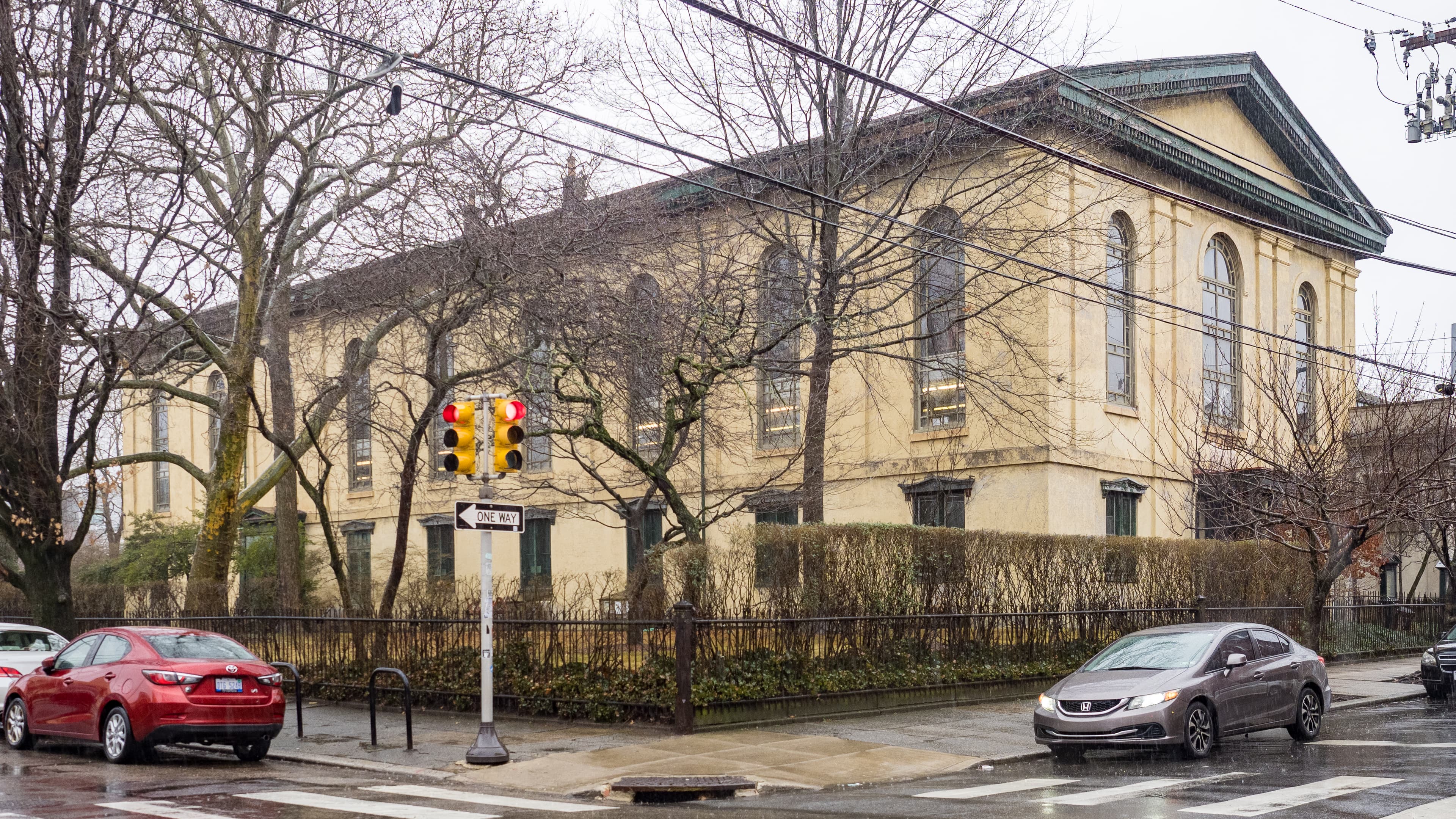
The parlor could not hold the audience. In 1855 Wagner moved the lectures to a public hall at 13th and Spring Garden Streets and, on May 21 of that year, formally incorporated the Wagner Free Institute of Science under a charter he drafted himself. He hired a faculty and offered free evening courses across the sciences — botany, chemistry, mineralogy, geology, architecture, anatomy, and more — eventually running classes on six evenings a week. In 1859 he commissioned a permanent home in North Philadelphia from architect John McArthur Jr., who would later design Philadelphia's City Hall. The building, erected between 1859 and 1865 in a Classical Revival style and opened in May 1865, combined an amphitheater-style lecture hall modeled on the Smithsonian's, laboratories and classrooms, a research library, and a three-story exhibition gallery for the collection. Wagner lectured and led the institute himself until his death in 1885, and his will provided for its future, leaving funds and income-producing Philadelphia properties so the work — and the word "Free" in its name — could continue without charging the public.
Joseph Leidy Rearranges the World
The trustees' choice to succeed Wagner was Joseph Leidy (1823–1891), a Philadelphia biologist of international reputation — the man who had described the Hadrosaurus fossil from Haddonfield, New Jersey, and pioneered the use of microscopic evidence in American science. As head of the institute's scientific and educational programs, Leidy greatly enlarged Wagner's original collection through field collecting, purchases, and exchanges, drawing in material that included paleontological specimens associated with Edward Drinker Cope. His most lasting act, though, was curatorial. Leidy personally designed and supervised a complete reorganization of the museum into a systematic display organized according to Darwin's theory of evolution: visitors walked from simpler to more complex organisms, and through geologic time, as they moved through the hall. The new display opened in 1891, the year of Leidy's death. And then — almost nothing changed. The institute kept teaching, kept its cabinets, and kept its arrangement, which is precisely why the building was designated a National Historic Landmark in 1990: it survives as an exceptional, essentially intact example of a Victorian-era science museum.
The Second-Floor Hall
The museum occupies the second floor, up a flight of stairs, and stepping into the exhibition hall is the closest thing Philadelphia offers to time travel with a naturalist's eye. More than 100,000 specimens fill the tall wood-and-glass cabinets Wagner and Leidy installed: fossils and shells, minerals that catch the light in rows, taxidermy animals, mounted skeletons — including the horse skeleton that has become something of a mascot — and study skins and birds held in the collections behind the public displays. The labels and the order are the lesson Leidy intended: case by case, the hall argues evolution by arrangement rather than by text panel. Because so little has been modernized away, the room itself is an artifact of how 19th-century Americans learned science — by looking closely at real objects, in person, in a free public room. The institute leans into that pace. Visits are self-guided, staff are on hand to answer questions, and scavenger hunts help first-time visitors and children find their way through the density of the cases.
A Library Branch and the Oldest Free Courses in America
The Wagner's educational mission has always run wider than its museum. In 1892 the first branch of what became the Free Library of Philadelphia opened inside the institute, lending books to the North Philadelphia neighborhood from the Wagner's own library rooms; that branch stayed open until 1962. The institute's research library still holds tens of thousands of volumes alongside its archives. And the evening courses Wagner started have never stopped: the institute's free adult science courses are in their third century of operation and are recognized as the oldest program devoted to free adult education in the United States. Today the program mixes those evening lectures and courses — some now offered online and at partner venues around the city — with field trips, museum tours, and an extensive children's science program built on partnerships with neighboring North Philadelphia schools. It is the same formula Wagner wrote into his 1855 charter, run from the same building: hire the teachers, open the doors, charge nothing.
The Institute Today
The Wagner sits just west of Temple University's campus, at 1700 West Montgomery Avenue, and it remains what it was built to be — a working neighborhood institution rather than a preserved relic. School groups move through the hall on weekday mornings, researchers use the collections and library, and the lecture hall still hosts the evening courses and public talks, along with community events that have ranged from science festivals to performances. Preservation support, including funding from the National Endowment for the Humanities, has helped the institute care for the landmark building and its collections while keeping admission free. In a city full of famous museums, the Wagner is the one most Philadelphians have never visited — a fact local coverage keeps rediscovering with some amazement. That obscurity is part of its value. Nothing here was arranged for spectacle. It was arranged, in 1891, for learning, and the most surprising thing about the Wagner Free Institute is how faithfully a North Philadelphia building has kept a dead merchant's promise: science, for everyone, free.
Key Facts
• Founded in 1855 by merchant and gentleman scientist William Wagner (1796–1885), who had offered free science lectures at his Elm Grove home since 1847 with open admission to women and men; his 1841–42 European tour, where collections demanded letters of introduction, convinced him science should be open to all.
• The permanent building at 1700 W. Montgomery Ave was designed by John McArthur Jr. (later the architect of Philadelphia City Hall), built 1859–1865, and opened in May 1865 with a lecture hall, classrooms, library, and exhibition gallery.
• Joseph Leidy, appointed after Wagner's 1885 death, enlarged the collection and reorganized the museum as a systematic display following Darwin's theory of evolution; the display opened in 1891 and has changed little since.
• The museum holds more than 100,000 natural history specimens in original wood-and-glass cabinets, and the building was designated a National Historic Landmark in 1990.
• The institute hosted the first branch of the Free Library of Philadelphia (1892–1962), and its free evening courses are the oldest program of free adult education in the United States — admission to the museum remains free.
Visitor Details
Address: 1700 West Montgomery Avenue, Philadelphia, PA 19121 (between N. 17th Street and N. Bouvier Street, just west of Temple University)
Transit: Broad Street subway (Orange Line, local) to Temple University / Cecil B. Moore Avenue; SEPTA Bus Route 2 to 16th Street and Montgomery Avenue (per the institute's official directions).
Hours/Admission: Museum open Tuesday through Friday, 9:30 am to 4:30 pm, and the first Saturday of the month (February–May and September–December) from noon to 4:00 pm; admission is free, and walk-ins are welcome though registration ahead is preferred (per the institute's official visit page, checked 2026-10-21). The institute closes for listed holidays and breaks — confirm the current schedule on the official site before visiting. Note: the museum is on the second floor and requires climbing a flight of stairs; the landmark building has no elevator.
Best timing: A weekday morning for the quietest hall, or a first-Saturday opening (in season) if weekdays don't work; allow an hour or more — the cases reward slow looking, and staff-led direction and scavenger hunts are available for first visits.
Location Photography