The Surgeon Who Taught With Objects
Thomas Dent Mütter (1811–1859) was one of the most celebrated medical teachers of his generation. A professor of surgery at Jefferson Medical College, famous for lectures that wove specimens from his growing personal collection into the lesson, he was among America's first plastic surgeons, known for reconstructive operations on people whose faces and bodies had been disfigured by burns, birth defects, and disease — patients polite society treated as spectacles and Mütter treated as cases to be helped. He was also the first surgeon in Philadelphia to operate using ether anesthesia. Bad health, including painful attacks of gout, forced him to retire from teaching in 1856, and he turned to the question of what would become of the collection he had spent a career assembling: bones, wet specimens, plaster casts, wax and papier-mâché models, dried preparations, and medical illustrations — more than 1,700 objects in all, each one a lesson. His answer was a trust, negotiated with the College of Physicians of Philadelphia and signed in December 1858, two months before his death at 48.
A Bequest With Conditions
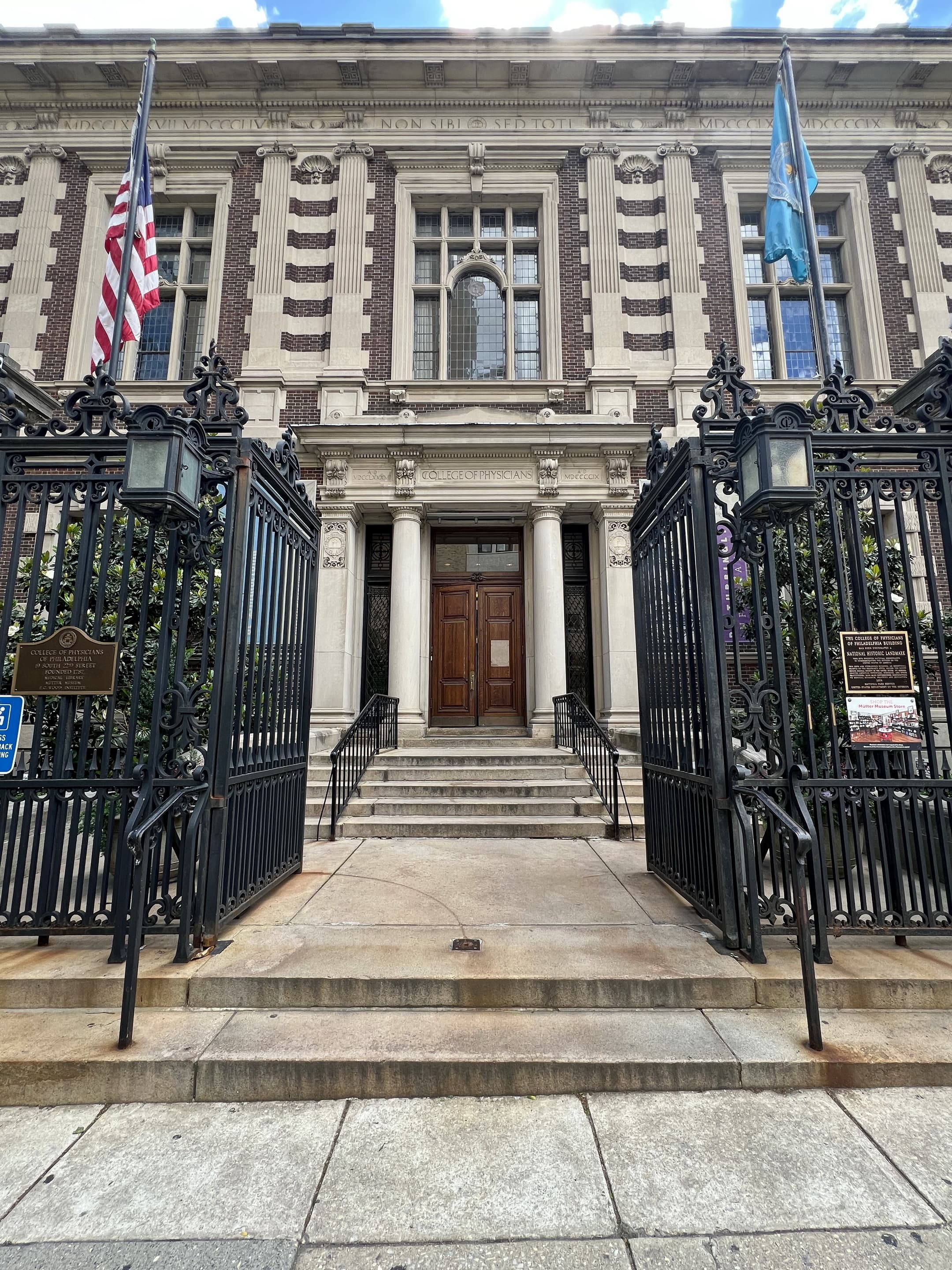
Mütter did not simply give the College his collection; he set terms, and the terms built a museum. Along with the 1,700 objects came an endowment of $30,000, whose income was to pay a curator's salary, fund a lectureship in surgical pathology, and maintain and enlarge the collection. He also required the College to erect a suitable fireproof building to house it. The College — founded in 1787 by 24 Philadelphia physicians and still the oldest private medical society in the United States — signed the agreement, and when its first real home opened at 13th and Locust Streets in 1863, the Mütter collection moved in. The museum was a professional tool: for more than a century, access belonged to medical graduates, students, and guests of the College's Fellows, and it did not open to the general public until the mid-1970s. In 1909 the College and the museum moved together into the present building at 19 South 22nd Street, a red-brick, limestone-trimmed Beaux-Arts landmark designed by Cope & Stewardson, where the museum occupies a two-story, gallery-ringed space in the building's northeast corner. The collection today holds more than 25,000 objects, including some 3,000 skeletal specimens and nearly 1,500 wet specimens.
The Hyrtl Skull Collection
The museum's most famous wall began as an argument. Josef Hyrtl, a Viennese anatomist, assembled 139 human skulls in the 19th century to demonstrate the diversity of cranial anatomy among Europeans — and thereby to disprove phrenology, the then-fashionable racial science that claimed character and intelligence could be read from the shape of the head. Each skull in the collection is inscribed with what Hyrtl recorded of the person it came from: name, age, origin, occupation, and cause of death. The effect, standing in front of the assembled rows, is the opposite of the abstraction phrenology traded in. These are not types; they are 139 individual biographies, cut short in 139 different ways, and the museum has long presented them that way — as evidence that a single measurable feature explains nothing about a human life. The collection remains one of the most studied and most photographed displays in the museum, and one of the clearest statements of its founder's purpose: look closely, and let the specimen correct the theory.
The Soap Lady
She is the museum's most quietly unsettling resident, and her label was wrong for over sixty years. In 1875, workmen exhuming bodies from a Philadelphia burial ground uncovered two corpses whose body fat had converted, in the damp ground, into adipocere — a waxy, soap-like substance that preserved their forms. The anatomist Joseph Leidy obtained both; the man went to the Wistar collection and the woman came to the Mütter, presented on November 18, 1875. The card that accompanied her said she was a woman named Ellenbogen who had died of yellow fever in 1792 and been buried near Fourth and Race Streets. In the 1940s, curator Joseph McFarland checked the story against Philadelphia's death records, church listings, and ship logs and found no Ellenbogens at all — the name, and the tidy history attached to it, appear to have been invented somewhere along the chain of custody. Later X-ray examinations redrew her again: the radiographs suggest she was younger than the label claimed, probably in her twenties, and died decades later than 1792. The museum tells this openly. The Soap Lady is displayed not as a solved curiosity but as a case study in how a specimen can be at once perfectly preserved and badly mislabeled — and in why the museum now works to recover the real histories of the people in its cases.
Einstein's Brain, and the Cabinets Around It
In the main gallery, under glass, sit 46 microscope slides, each holding a section of Albert Einstein's brain cut 20 microns thin and stained for study. After Einstein's death in 1955, the pathologist Thomas Harvey, who performed the autopsy, kept the brain for scientific research; sections eventually reached the Mütter, which is the only museum where the public can view them. Around that quiet case, the cabinets hold a century of medicine's evidence. There is the plaster death cast of the conjoined twins Chang and Eng Bunker, displayed with their conjoined liver; the malignant tumor removed from President Grover Cleveland's hard palate; tissue from John Wilkes Booth; the Chevalier Jackson Foreign Body Collection — 2,374 objects, from coins to dentures, that Dr. Chevalier Jackson extracted from patients' throats, esophagi, and lungs across a 75-year career; the fully articulated skeleton of Harry Eastlack, whose condition, fibrodysplasia ossificans progressiva, slowly turned his connective tissue to bone; and the Mütter American Giant, at 7 feet 6 inches the tallest human skeleton on exhibit in North America, standing near the much smaller skeleton of Mary Ashberry. The displays use the museum's original cabinet arrangement on purpose: this is what medical knowledge physically looked like when doctors learned by looking.
The Museum Today
The Mütter's modern era owes much to Gretchen Worden, curator from 1982 and director from 1988 until her death in 2004, who carried its specimens onto national television and argued, with humor and complete seriousness, that these remains were teachers. Attendance grew under her tenure from a few hundred visitors a year to tens of thousands; the museum now draws well over 100,000 visitors annually. The work has also turned reflective. In October 2023 the museum received a Pew Center for Arts and Heritage grant to research how its collection of human remains was acquired and to hold public discussions about the collection's future — the Soap Lady's invented label, scaled up into an institutional question. Outside, the Benjamin Rush Medicinal Plant Garden, founded in 1937, grows 50 to 60 medicinal herbs of the kind the College's founders kept in their medical chests. Mütter's founding mandate, as the College states it, was "to advance the cause of health" — and the museum still runs on his endowment's logic: hire the curator, keep the lectures going, and let the objects make the argument.
Key Facts
• Founded on Thomas Dent Mütter's bequest: articles of agreement signed December 1858, giving the College of Physicians of Philadelphia his collection of 1,700+ teaching objects plus a $30,000 endowment for a curator, a surgical pathology lectureship, and the collection's upkeep — with a fireproof building required.
• The College of Physicians of Philadelphia, founded 1787, is the oldest private medical society in the United States; the museum opened in its 13th and Locust Streets building in 1863 and moved to 19 S. 22nd Street in 1909. It opened to the general public only in the mid-1970s.
• Signature holdings: the Hyrtl Skull Collection (139 skulls assembled to disprove phrenology), the Soap Lady (body preserved as adipocere, delivered 1875, her label's story debunked by curator Joseph McFarland), and 46 slides of Albert Einstein's brain.
• The collection now exceeds 25,000 objects, including about 3,000 skeletal specimens, nearly 1,500 wet specimens, and Chevalier Jackson's 2,374 extracted foreign bodies.
Visitor Details
Address: 19 South 22nd Street, Philadelphia, PA 19103
Transit: SEPTA 22nd Street trolley station is the closest stop; SEPTA bus routes 7, 31, 44, 124, and 125 also serve the area (per the museum's transit listings).
Hours/Admission: Open Wednesday through Monday, 10 am to 5 pm; closed Tuesdays. The museum's official site recommends pre-purchasing tickets, especially on weekends, noting capacity is limited to 50 guests per half hour and walk-up entry cannot be guaranteed. Buy tickets and confirm current hours and admission prices on the official website before visiting. Photography is not permitted inside the museum — plan to look slowly instead. The Benjamin Rush Medicinal Plant Garden, on the College grounds, is at its best in the growing season.
Best timing: Weekday mornings are the quietest. Allow at least 90 minutes; the museum is compact but the labels reward reading, and the Hyrtl skulls and the Jackson foreign body drawers repay unhurried time.
Location Photography