The House That Didn't Change
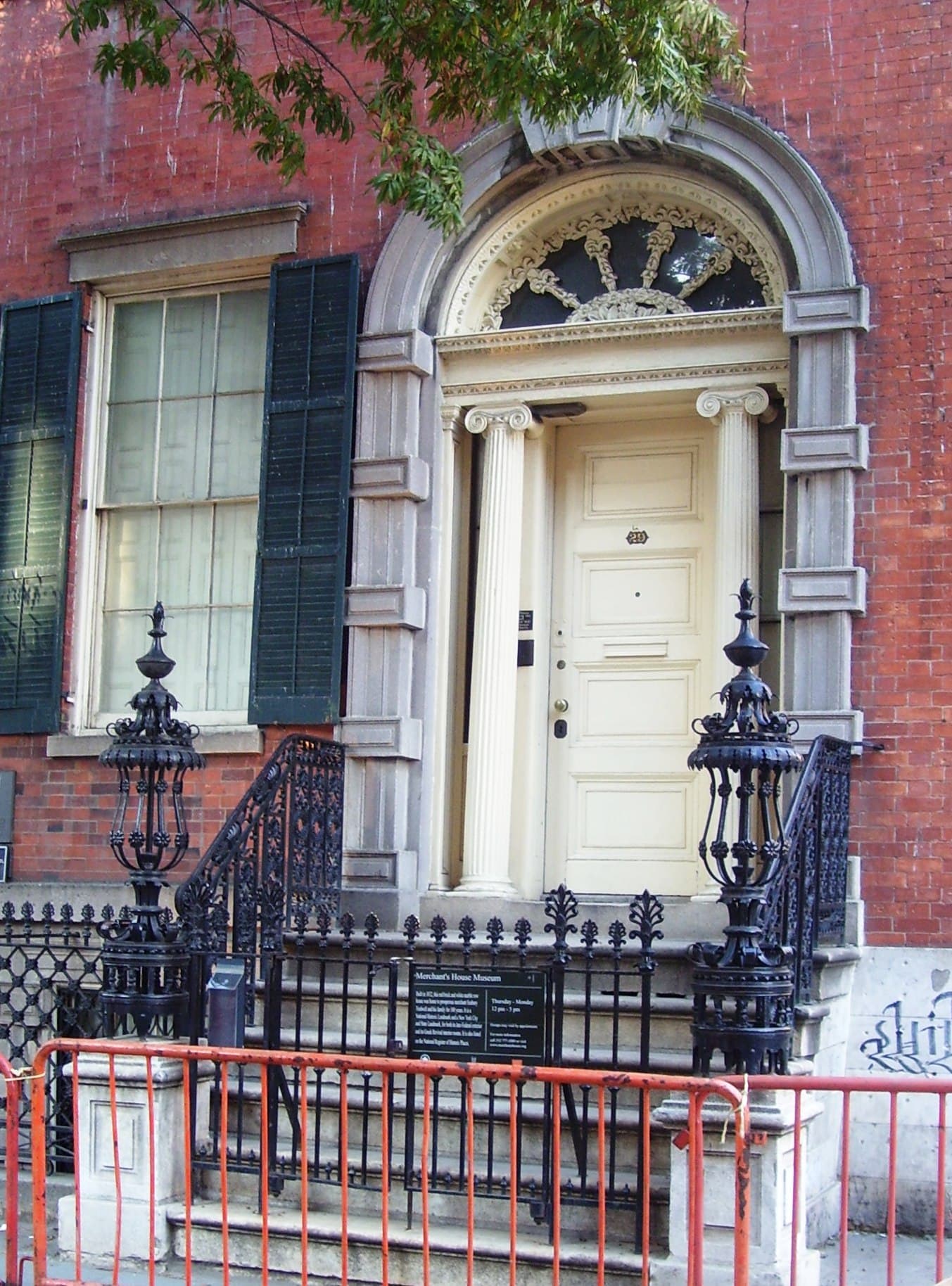
New York eats its own past. The rowhouses of the 1830s were demolished by the thousand — for tenements, for factories, for loft conversions, for glass towers. On East 4th Street in NoHo, one of them refused. The Merchant's House at 29 East 4th Street is the only 19th-century residence in Manhattan that survives with both its exterior and its interior intact — not reconstructed, not “in the style of,” but the actual rooms, with the actual furniture, dishes, clothing, and books of the family that lived there for 98 years. More than 4,500 of the Tredwells' belongings remain in the house. When the Landmarks Preservation Commission began designating individual landmarks in 1965, this was among the very first.
The effect of walking in is disorienting in the best way. The street outside is 21st-century NoHo — boutiques, the Public Theater around the corner, the rumble of the 6 train under Astor Place. Inside, it's 1835 to 1865, the decades when New York transformed from a mercantile seaport into a metropolis, and the house simply declined to participate in anything after.
A Hatter's Speculation, a Merchant's Home
The house was built in 1831–32 by Joseph Brewster, a hatter, as a speculation — one of a row of six identical houses going up on what was then a fashionable residential block. The design, a late-Federal and Greek Revival blend, is attributed to Minard Lafever, the pattern-book architect whose published designs shaped half the city's early streetscapes. In 1835 Brewster sold the house to Seabury Tredwell, a hardware merchant, for $18,000. Tredwell was 55 and retiring from the firm of Tredwell, Kissam & Co. He moved in with his wife, Eliza Parker — they'd married in 1820 — and their children. Eight children would grow up in the house: Elizabeth, Horace, Mary, Samuel, Phoebe, Julia, Sarah, and Gertrude, the youngest, born in the house in 1840.
The interiors are the argument for the museum's existence. The double parlor — two rooms divided by Ionic columns and mahogany pocket doors — carries black-and-gold marble mantelpieces, ornamental plasterwork, and 13-foot ceilings. The gas chandeliers date to the 1850s, when the house was converted from oil and candles. Upstairs, the bedrooms keep their original furniture and finishes; the fourth floor holds the servants' quarters, cited as the oldest intact Irish domestic site in New York City. Out back, a 19th-century garden. Nothing is a reproduction. The wear on the stair rail is the Tredwells' wear.
Gertrude, Who Never Left
The reason the house survived is also its saddest story. Seabury Tredwell died in 1865. Eliza followed, and the children stayed on — unmarried daughters keeping house together as the neighborhood changed around them and the family money thinned. One by one they died, until only Gertrude remained: the baby of the family, born in an upstairs bedroom in 1840, who lived in the house for 93 years and died in 1933, in the same upstairs front bedroom where she was born, in reduced circumstances, the house mortgaged.
Gertrude was by all accounts a recluse in her final decades, and she kept everything — which is why the museum has 4,500 objects instead of 45. When she died, a distant relative named George Chapman bought the house, formed the Historic Landmark Society, and opened it as a museum on May 7, 1936. The family's refusal to modernize, which must have looked like genteel poverty at the time, turned out to be an act of accidental preservation unmatched anywhere else in the city.
Upstairs, Downstairs: Bridget Murphy's New York
The Tredwells didn't live alone. Like any prosperous household of the period, they kept servants — four Irish women at a time. The 1855 census lists them by name: Ann Clark, Bridget Murphy, Mary James, and Mary Smith. Bridget Murphy had emigrated in 1852 at sixteen; Mary Smith in 1851 at fourteen. They slept on the fourth floor, cooked in the basement kitchen, and kept the gas chandeliers lit and the marble mantels polished.
The museum takes the servants' story as seriously as the family's. Its “In the Footsteps of Bridget Murphy” tour — 75 to 90 minutes — is built around the Irish women's lives: the work, the quarters, the tiny margins of freedom in a servant's day. In a city whose Irish history is usually told through tenements and labor unrest, the fourth floor of the Merchant's House offers something rarer: the rooms where Irish domestic workers actually lived, preserved with the same completeness as the parlors below. It's the part of the house that most directly connects to the immigrant city outside its walls.
The Passage in the Wall
In February 2026, the house gave up a secret it had kept for nearly two centuries. During restoration work, staff uncovered an intact early Underground Railroad passageway: a two-by-two-foot shaft with a ladder, running inside the wall between the two first-floor parlors and emerging at a bureau placed between the second-story bedrooms. The passage was built in 1832 — by Joseph Brewster, the hatter who built the house, an abolitionist — and it is the first such passageway uncovered in New York City in over a century.
The discovery reframes the building. The standard story of the Merchant's House is domestic: a merchant family, their servants, their things. The passage adds a second story, literally inside the walls — the house as a station on the clandestine network that moved enslaved people toward freedom, built into the architecture by a man whose day job was making hats. The museum is still studying the find, but its significance is already clear: the intact 1832 house turns out to have been hiding one more intact thing.
Manhattan's Most Haunted?
No account of the Merchant's House is complete without the ghosts. The house is routinely called the most haunted in Manhattan, and the ghost is always Gertrude — the daughter who never left, seen on the stairs, heard at the piano, felt in the bedrooms. The museum leans into it with candlelit ghost tours, and the lore has been fed by a century of staff stories and visitor reports.
Believe it or not, the haunting fits the house's logic. This is a building whose entire significance is continuity — the same family, the same objects, the same rooms, for a century. Gertrude's ghost is just the continuity claim made supernatural: the idea that 29 East 4th Street never really let go of its people. Whether you come for the Greek Revival woodwork, Bridget Murphy's fourth floor, or the newly found passage in the wall, you're coming for the same thing — a house that kept everything, including, some say, its last resident.
Key Facts
- Built 1831–32 by hatter Joseph Brewster as a speculation; bought 1835 by merchant Seabury Tredwell for $18,000; the Tredwell family lived there until Gertrude Tredwell's death in 1933.
- The only 19th-century Manhattan residence with original exterior and interior intact; 4,500+ original family belongings; opened as a museum May 7, 1936.
- The fourth-floor servants' quarters are the oldest intact Irish domestic site in NYC; the "Bridget Murphy" tour tells the Irish servants' story.
- In February 2026, an intact 1832 Underground Railroad passageway (2×2 ft shaft with ladder) was uncovered inside the walls — the first found in NYC in over a century.
Visitor Details
Address: 29 East 4th Street, New York, NY 10003 (during restoration, enter via Manuel Plaza at 35 East 4th Street)
Transit: 6 to Astor Place; R/W to 8th St; B/D/F/M to Broadway–Lafayette
Hours/Admission: Self-guided visits Wednesday–Sunday 1–5pm (last entry 4:30pm), tickets at the door, no reservations. General $15.50; seniors 65+ and students $10.50; under 12 free. Guided house tours and specialty tours require advance reservations. (Verified on merchantshouse.org, Oct 2026 — confirm before visiting.)
Best timing: Weekday afternoons are quietest for self-guided visits; book guided and ghost tours well ahead — they sell out.
Location Photography