Isabella: The Collector Who Started With a Vermeer
Isabella Stewart Gardner (1840–1924) was born in New York City and moved to Boston in 1860 when she married John Lowell Gardner Jr., known as Jack. The couple traveled constantly through Europe and Asia, and what began as an interest in art turned serious in 1891, when Isabella inherited a large fortune from her father. Her first major acquisition came the next year: Johannes Vermeer's The Concert (c. 1664), bought at auction in Paris in 1892. In 1894 the young art historian Bernard Berenson offered her his help acquiring Renaissance art; with his guidance she became the first American to own a painting by Botticelli, and Berenson helped her acquire nearly 70 works in all. By the late 1890s the collection had outgrown the Gardners' Back Bay house at 152 Beacon Street, and the couple decided to build a museum. Jack died suddenly in 1898, before the project could begin. Isabella carried it out alone.
Fenway Court: A Palazzo Raised on a Marsh
Weeks after Jack's death, Isabella bought land in the Fenway, then a marshy, little-developed corner of Boston near the Back Bay Fens. She hired architect Willard T. Sears to build Fenway Court, a palace modeled on the Renaissance palaces of Venice, with three floors of galleries wrapped around a glass-roofed courtyard and her own apartment on the fourth floor. Gardner was involved in every aspect of the design — Sears later quipped that he was merely the structural engineer making her design possible. Contrary to a persistent myth, the building was not shipped from Venice and reassembled; it was built in Boston from new materials, though it incorporates genuine architectural fragments removed from European Gothic and Renaissance structures. Construction ran from 1899 to 1901, and Gardner then spent a year installing the collection herself. The museum opened on January 1, 1903, with a celebration featuring members of the Boston Symphony Orchestra and a menu of champagne and doughnuts. For the next two decades she kept acquiring, arranging, and hosting artists, musicians, and scholars — Sargent, Charles Martin Loeffler, Ruth St. Denis among them — who made Fenway Court a working salon as much as a museum.
Arranged by Her Hand, Frozen by Her Will
The collection Gardner installed numbers more than 7,500 works of art, along with 1,500 rare books and some 7,000 archival objects, spanning ancient Rome, medieval Europe, Renaissance Italy, Asia, the Islamic world, and 19th-century France and America. The highlights are the kind other museums build wings around: Titian's The Rape of Europa, Rembrandt's Self-Portrait, Aged 23, Botticelli's The Story of Lucretia, Sargent's El Jaleo and his 1888 Portrait of Isabella Stewart Gardner, and the first Matisse to enter an American collection. But the installation, not the checklist, is the work of art. Paintings hang beside furniture, textiles, and ceramics from different cultures and centuries, mixed deliberately to provoke intimate responses rather than art-historical lessons. Most pieces are unlabeled, and the lighting is kept low — closer to a private house than a modern museum, exactly as Gardner intended. When she died in 1924, her will left the museum a $1 million endowment and stipulated that her collection be permanently exhibited "for the education and enjoyment of the public forever" according to her aesthetic vision: the arrangement was not to be altered, and no item was to be sold from the collection or purchased into it. That is why the Gardner still looks like one woman's house rather than an institution — because, legally, it has to.
The Courtyard: A Garden Under Glass
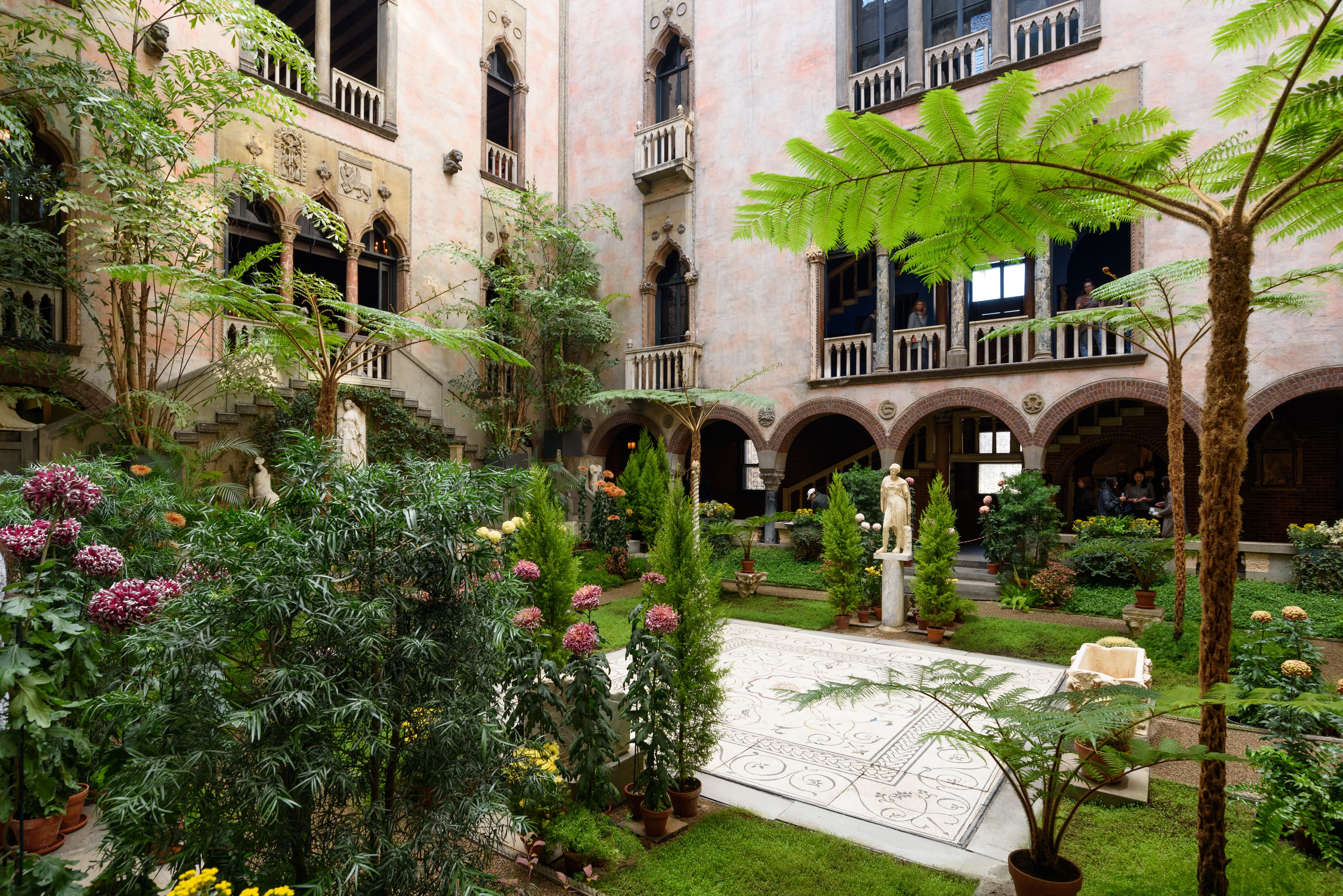
At the center of the palazzo, enclosed by the four interior facades under a glass roof carried on the building's original steel structure, is the courtyard — the museum's signature space. Three floors of galleries look down into a garden court adorned with a Roman mosaic, planted with palms, ferns, and flowering displays that bloom in every season. The displays rotate constantly, following Gardner's own tastes in gardening; the plants are grown off-site in the museum's nursery and shipped in for each seasonal installation, among them the hanging nasturtiums and hydrangeas. Visitors circulate around the courtyard on every floor but do not walk in the garden itself — it is a picture you live inside of, viewed from the cloisters and balconies she built around it. In Boston's winters, a Venetian garden in full bloom in February remains a small act of defiance.
March 18, 1990: Eighty-One Minutes and Thirteen Works
The museum's other fame is a crime. In the early hours of March 18, 1990, two men in police uniforms rang the museum intercom and said they were responding to a disturbance. The guard on duty broke protocol and let them in through the employee entrance; he and a second guard were led to the basement and restrained there, while motion detectors recorded the thieves' movements. In the second-floor Dutch Room they cut Rembrandt's Christ in the Storm on the Sea of Galilee (1633) — his only known seascape — and A Lady and Gentleman in Black from their frames; removed Vermeer's The Concert and Govert Flinck's Landscape with an Obelisk from their frames; took an ancient Chinese bronze gu from a table; and lifted a tiny Rembrandt self-portrait etching from a chest. In the Short Gallery they took five works by Edgar Degas and a bronze eagle finial from a Napoleonic flag. From the Blue Room they stole Édouard Manet's Chez Tortoni, leaving its frame behind in a security office. The thieves left at 2:45 a.m., making two trips to their car; the guards stayed handcuffed until police arrived at 8:15 a.m. Thirteen works were gone — a haul the FBI has valued at an estimated $500 million, the greatest known property theft in history. None has been recovered and no arrests have been made; according to the FBI, the art was offered for sale in Philadelphia in the early 2000s, and the thieves are believed to have been members of a criminal organization based in the mid-Atlantic and New England. The museum offers a $10 million reward for information leading to the recovery of the art, plus $100,000 for the return of the eagle finial alone. And because Gardner's will forbids rearranging her galleries, the museum repaired the five damaged frames and rehung them, empty, exactly where the paintings belong — placeholders, and a standing public appeal, in the Dutch Room today.
The Renzo Piano Wing: Growth Without Touching the Palace
By the early 2000s the palace was straining under its own success, and in 2002 the trustees concluded a new wing was necessary to preserve the historic building. In 2004 they selected the Italian architect Renzo Piano and his Building Workshop to design it — a respectful complement in scale, form, and materials, conceived so the palace itself would never have to change. Completed in 2012 at a cost of $118 million, the project added 70,000 square feet beside the original on Evans Way: a main wing that reads as four stories in glass and green copper, plus a smaller building for greenhouses and living quarters. The new wing took over the 21st-century jobs the palazzo was never built for — visitor services, a concert hall, special exhibitions, education and landscape programs — while reducing the strain on her galleries. Visitors now enter through Piano's glassy Evans Way building and pass into Fenway Court, where everything is still exactly where she left it: part working institution, part sealed time capsule, with the empty frames in the Dutch Room still waiting for the ending she would have demanded.
Key Facts
- Founded by Isabella Stewart Gardner (1840–1924); Fenway Court, designed by Willard T. Sears in the style of a 15th-century Venetian palace, opened to the public on January 1, 1903.
- Collection: more than 7,500 works of art, 1,500 rare books, and about 7,000 archival objects — including Titian's The Rape of Europa, works by Rembrandt, Botticelli, Raphael, Michelangelo, Manet, Degas, Whistler, and Sargent.
- Gardner's 1924 will endowed the museum with $1 million and required the collection to remain permanently exhibited as she arranged it — nothing moved, sold, or added.
- March 18, 1990: two thieves posing as police stole 13 works in 81 minutes, including Vermeer's The Concert and Rembrandt's Christ in the Storm on the Sea of Galilee; the FBI has valued the haul at an estimated $500 million, and no work has been recovered.
- The museum offers a $10 million reward for information leading to the art's recovery, plus $100,000 for the return of the Napoleonic eagle finial; the stolen works' empty frames still hang in place.
- The 70,000-square-foot Renzo Piano wing, completed in 2012 for $118 million, added visitor services, concerts, exhibitions, and education spaces without altering the palace.
- Listed on the National Register of Historic Places in 1983 and designated a Boston Landmark in 2013.
Location Photography


Visitor Details
Address: 25 Evans Way, Boston, MA 02115 Transit: MBTA Green Line E branch to Museum of Fine Arts station; the museum entrance is on Evans Way, a short walk from the station and next door to the Museum of Fine Arts. Hours/Admission: Per the museum's official site: open weekends 10 am–5 pm, weekdays 11 am–5 pm, Thursdays until 9 pm; closed Tuesdays. Admission: $25 adults, $22 seniors (65+), $15 students with ID, free for members and children 17 and under. Advance timed tickets are strongly recommended — the museum advises buying ahead, as tickets can sell out and may not be available at the door. Admission is free for life for anyone named Isabella (valid ID required; the museum asks Isabellas to reserve through the box office in advance). Confirm current hours and prices on the museum website before visiting. Best timing: Go on a weekday morning for the quietest galleries, and give the courtyard time at more than one floor level — the garden reads completely differently from the third-floor cloister than from the ground floor. Thursday evenings, when the museum stays open until 9 pm, are the best-value slot for the Dutch Room and its empty frames.