A gift to the nation
The National Gallery of Art exists because one man decided that America should have a national collection to rival Europe's — and gave it away. Andrew W. Mellon, the Pittsburgh banker who served as Secretary of the Treasury from 1921 to 1932, had spent the years of World War I assembling a private collection of old master paintings and sculpture. By the late 1920s he had turned his collecting toward a single purpose: a gallery for the American people.
In January 1937 Mellon formally offered his collection and the funds to build a museum to house it. On March 24, 1937 — Mellon's birthday — an act of Congress accepted the gift, and the National Gallery of Art was established. It was a remarkable act of philanthropy: the collection, the building funds, and an endowment all came from Mellon and the trust he had created, and the museum was set up as a separate institution rather than part of the Smithsonian. Mellon had already made his most daring purchases. In 1930 and 1931 his trust bought 21 paintings from the Hermitage Museum in St. Petersburg, part of the Soviet sale of Hermitage masterpieces, including Raphael's Alba Madonna, Titian's Venus with a Mirror, and Jan van Eyck's Annunciation. Those paintings became the core of the new national collection.
Neither Mellon nor his architect lived to see the building finished. Both died in late August 1937, only two months after excavation had begun on the National Mall. But the gift kept growing: Mellon's example encouraged other great collectors — Samuel H. Kress, Chester Dale, Joseph Widener, Lessing Rosenwald, and Mellon's own children, Paul Mellon and Ailsa Mellon Bruce — to give their collections too. The Gallery that opened was far richer than the one Mellon had first imagined.
The West Building: a temple of pink marble
The original museum building, now called the West Building, was designed by architect John Russell Pope, the man behind the Jefferson Memorial and the National Archives. Completed and accepted by President Franklin D. Roosevelt on behalf of the American people on March 17, 1941, it was at the time the largest marble structure in the world. Its long facade of pink Tennessee marble, with a columned portico and a great dome, runs along Constitution Avenue between 3rd and 7th Streets, anchoring the eastern end of the Mall.
Step inside and the building organizes itself around a single great space: the Rotunda. Modeled on the interior of the Pantheon in Rome, the domed hall is ringed with dark green marble Ionic columns and centered on a fountain topped by a bronze figure of Mercury, cast after a Renaissance original attributed to Giambologna. From the Rotunda, two long skylit sculpture halls run east and west, forming the building's main spine — a corridor of sculpture some 780 feet long, lined with bronze busts and classical figures under barrel-vaulted glass ceilings. Between the galleries, bright garden courts planted with flowers and small trees offer quiet places to sit, a deliberate contrast to the long marble axis.
The West Building holds the Gallery's older art: European painting and sculpture from the Middle Ages through the late nineteenth century, and American art up to the early twentieth. This is where the famous names live. The Italian Renaissance galleries include Raphael's Alba Madonna and Cowper Madonna, Titian's Venus with a Mirror, and Giovanni Bellini's Feast of the Gods. The Dutch and Flemish rooms hold Vermeer and Rembrandt, including Rembrandt's Self Portrait with Beret and Turned-Up Collar of 1659. The French galleries carry Monet, Degas, and Renoir, and the American wing holds Gilbert Stuart, Winslow Homer, and John Singer Sargent.
And then there is the painting everyone asks about. In a small, quiet gallery, behind protective glass, hangs Leonardo da Vinci's Ginevra de' Benci, painted around 1474–1478 — the only painting by Leonardo in the Americas. It is a portrait of a young Florentine noblewoman, painted on both sides of a thin wood panel, and it draws a steady, reverent crowd. It is worth seeking out early in a visit, before the galleries fill.
The East Building: I.M. Pei's geometry
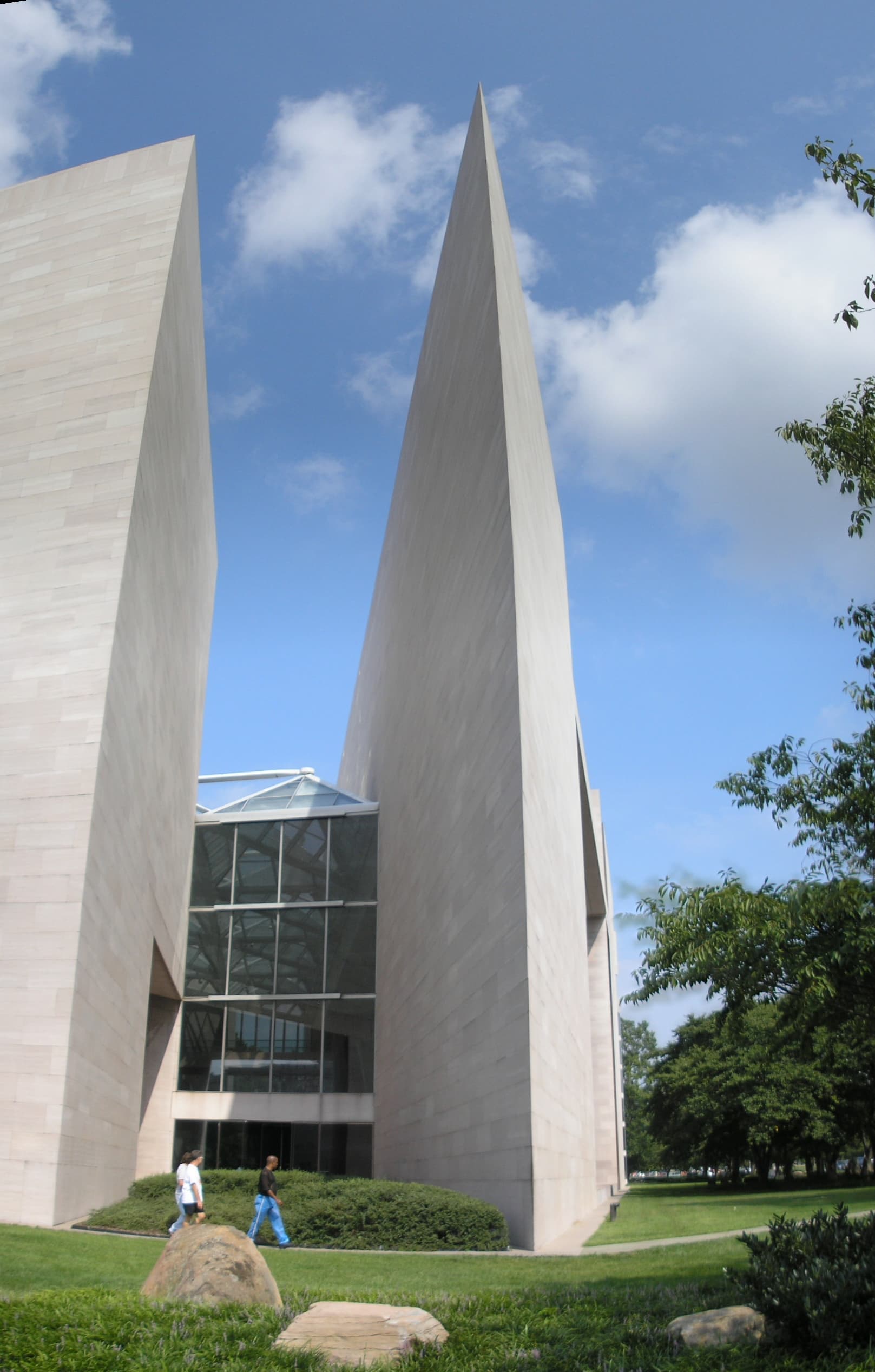
Across 4th Street stands the building that proved the Gallery was not finished in 1941. When the museum was established, Congress had reserved the neighboring plot for a second building, and in 1968 the trustees chose I.M. Pei to design it. The site was an awkward trapezoid, and Pei solved it with a single diagonal stroke — reportedly first sketched on the back of an envelope during a flight — dividing the lot into two triangles: one for public galleries, the other for a study center and offices. The triangle became the building's motif, repeated in every dimension, from the floor plan to the skylights.
The East Building opened to the public on June 1, 1978, funded entirely by Paul Mellon and Ailsa Mellon Bruce. It is clad in the same pink Tennessee marble as the West Building, so the two structures rhyme with each other across 4th Street — but where the West Building is classical and symmetrical, the East Building is angular, faceted, and unmistakably modern. Its heart is a soaring central atrium, rising some 80 feet to a steel space-frame skylight of interlocking tetrahedral glass units, with a long marble staircase descending through it. Hanging in the atrium is Alexander Calder's mobile Untitled, commissioned in 1973 and installed after the artist's death in 1976: at about 76 feet across and only some 920 pounds, it was Calder's largest and last mobile, and it turns slowly in the air currents of the hall, the first thing most visitors see.
The East Building is the home of modern and contemporary art: Picasso, Matisse, Jackson Pollock, Andy Warhol, Roy Lichtenstein, Mark Rothko, and the world's largest collection of works by Calder. The two buildings are connected beneath 4th Street by an underground walkway called the Concourse, which since 2008 has itself been a work of art: Leo Villareal's Multiverse, some 41,000 computer-programmed LED nodes running the length of the 200-foot passage in shifting patterns of light, turns the walk between the centuries into part of the visit.
The Sculpture Garden: art under the sky
The final piece of the campus arrived in 1999, when the National Gallery of Art Sculpture Garden opened on the 6.1-acre block west of the West Building, across 7th Street. Designed by landscape architect Laurie Olin, the garden sets monumental modern sculpture among native canopy trees, flowering shrubs, and winding paths of granite and crushed stone. At its center is a circular reflecting pool and fountain, which becomes an ice-skating rink in winter.
The sculptures here are the big, outdoor kind: works by Louise Bourgeois, Mark di Suvero, Roy Lichtenstein, Claes Oldenburg and Coosje van Bruggen, Tony Smith, Joan Miró, and Roxy Paine, whose stainless-steel tree Graft rises 45 feet among the real trees. In summer the garden hosts free jazz concerts on Friday evenings, and the Pavilion Café beside the fountain makes it the natural place to rest between the two buildings. It is also the most forgiving part of the museum for a first visit — no galleries, no hushed rooms, just large art in open air, free like everything else here.
Visiting the National Gallery: how to do it well
Start at the West Building's Rotunda, then let the sculpture halls carry you east and west through the old masters, with Ginevra de' Benci as your first destination and the garden courts as your resting places. Cross to the East Building through the light tunnel of the Concourse, and give yourself time in the atrium — the Calder mobile rewards a few minutes of simply standing and watching it turn. Finish in the Sculpture Garden, especially in late afternoon, when the light on the marble and the trees is at its best.
Because admission is free and the collection is enormous, the Gallery rewards repeat visits more than a single marathon. Pick one wing, see it properly, and come back: the museum is on the Mall, between the Capitol and the Washington Monument, so it pairs naturally with any walk along the nation's front lawn. Two buildings, seven centuries of art, and a garden — all free, all in one place — is why the National Gallery of Art is the first museum most first-time visitors to Washington name.
Key Facts
- The National Gallery of Art was established by an act of Congress in 1937, accepting the gift of financier and collector Andrew W. Mellon: his art collection plus funds to build the museum.
- Mellon's trust had bought 21 paintings from the Hermitage Museum in St. Petersburg in 1930–1931, including Raphael's Alba Madonna and Titian's Venus with a Mirror; these formed the core of the collection.
- The West Building, designed by John Russell Pope in neoclassical style from pink Tennessee marble, was completed and accepted by President Franklin D. Roosevelt on March 17, 1941; at the time it was the largest marble structure in the world.
- The West Building is centered on a domed Rotunda modeled on Rome's Pantheon, ringed with dark green marble Ionic columns and a fountain topped by a bronze Mercury after Giambologna.
- The West Building's collection spans European and American art from the Middle Ages through the late nineteenth century, including Vermeer, Rembrandt, Monet, and Van Gogh.
- Leonardo da Vinci's Ginevra de' Benci (c. 1474–1478), on view in the West Building, is the only painting by Leonardo in the Americas.
- The East Building, designed by I.M. Pei, opened June 1, 1978, funded by Paul Mellon and Ailsa Mellon Bruce; its trapezoidal site is divided by a single diagonal into two triangles, echoed throughout the building.
- The East Building's atrium rises about 80 feet to a tetrahedral skylight and holds Alexander Calder's mobile Untitled (1973–1976), about 76 feet across — Calder's largest and last mobile.
- The two buildings are linked beneath 4th Street by the Concourse, home since 2008 to Leo Villareal's Multiverse, roughly 41,000 programmed LED nodes along a 200-foot passage.
- The Sculpture Garden, designed by Laurie Olin, opened May 23, 1999, on 6.1 acres west of the West Building; its central fountain becomes an ice-skating rink in winter.
- Admission to both buildings and the Sculpture Garden is free of charge.
Visitor Details
Address: National Gallery of Art, National Mall between 3rd and 9th Streets NW at Constitution Avenue NW, Washington, DC 20565 — West Building at 6th Street and Constitution Avenue NW, East Building at 4th Street and Constitution Avenue NW, Sculpture Garden at 7th Street and Constitution Avenue NW
Transit: Washington Metro — Archives (Green/Yellow lines), Judiciary Square (Red line), and Smithsonian (Blue/Orange/Silver lines) stations are all within walking distance of the Mall campus
Hours/Admission: Admission is free. Hours and any special closures vary — check the official National Gallery of Art site (nga.gov) before visiting for current hours
Best timing: Weekday mornings are quietest for the Ginevra de' Benci gallery; late afternoon light is best in the Sculpture Garden; summer Friday evenings bring free jazz concerts to the garden
Location Photography