The Parkway's temple of science
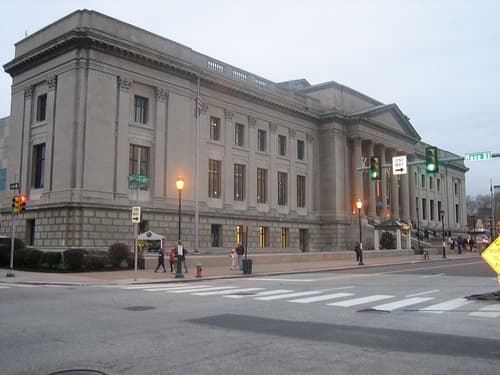
Walk northwest from Logan Circle along the Benjamin Franklin Parkway and the Franklin Institute announces itself long before you reach its doors: a long Classical Revival facade in pale stone, a grand staircase, and a stainless-steel flying boat parked out front like a punctuation mark. This is the building Philadelphians picture when they picture a science museum — and it has been doing that job, in this spot, since January 1, 1934, when it opened to the public as what its founders called a "Wonderland of Science."
The Institute is the anchor of Philadelphia's museum district, the stretch of the Parkway between Logan Square and the Philadelphia Museum of Art that also holds the Barnes Foundation, the Rodin Museum, and the Academy of Natural Sciences. But the Franklin Institute is the one that behaves least like a traditional museum. It was designed, from its first day on the Parkway, around a radical idea for 1934: that visitors should be encouraged to touch, handle, and operate the exhibits in order to learn how things work. Nine decades later, that is still the whole pitch — and the reason it remains, by its own account, the most visited museum in Pennsylvania.
What you are visiting, then, is two things at once. It is a working science center with three floors of interactive exhibits, a planetarium, and a steady run of blockbuster traveling shows. And it is a monument to Benjamin Franklin himself — scientist, inventor, printer, diplomat — whose 20-foot marble statue waits in a domed hall at the building's heart, free to enter whether or not you buy a ticket to the rest of the museum.
1824: a mechanics' institute for a new republic
The Franklin Institute is far older than its Parkway building. On February 5, 1824, Samuel Vaughan Merrick and William H. Keating founded the Franklin Institute of the State of Pennsylvania for the Promotion of the Mechanic Arts, with the stated aim of honoring Franklin and advancing the usefulness of his inventions. Philadelphia was still the young republic's workshop, and the Institute's founders believed — in the spirit of Franklin himself — that science belonged not in an ivory tower but in the hands of working people.
The early Institute did almost everything at once. It ran evening lectures and schools in mechanical and architectural drawing. In 1826 it founded the Journal of The Franklin Institute, now the second-oldest continuously published scientific journal in the country. It sponsored exhibitions of American manufactures, investigated steam engines and water power, and in 1824 began the Franklin Institute Awards, America's oldest program recognizing achievement in science and technology. Its first home was a Greek Revival building at 15 South 7th Street in Old City, built for the Institute by architect John Haviland, where it stayed from 1826 until 1933.
The 19th-century Institute also made history in quieter ways. Elizabeth Skinner was elected its first female member in 1833. In 1870 it was integrated when Philadelphia teacher and activist Octavius Catto was admitted to membership. And from September 2 to October 11, 1884, it hosted the International Electrical Exhibition, the first great electrical exposition in the United States — a fitting stage for an institution named for the man who tamed lightning, at the dawn of the electrical age.
The move to the Parkway, and the building that half a square built
By the early 20th century, the South 7th Street building had grown too small for the Institute's research, education programs, and library. The answer was the Benjamin Franklin Parkway, the grand Champs-Élysées-inspired boulevard then reshaping northwest Center City, and a site at 20th Street facing Logan Circle. Architect John T. Windrim — who had helped design the Parkway itself — drew a grand, symmetrical scheme: a completely square building wrapped around a central memorial hall for the Franklin statue.
The Great Depression had other plans. The Benjamin Franklin Memorial, Inc. raised $5 million between December 1929 and June 1930, an extraordinary feat in the teeth of the crash, but it was not enough for all four wings. Only two of Windrim's four wings were built — the two facing the Parkway — and they share their Classical Revival vocabulary with the other civic buildings around Logan Circle, which is why the whole circle reads today as one composed, Parisian set piece. Construction is dated to 1931, and the building was added to the National Register of Historic Places on January 3, 1985.
The building's incompleteness is part of its charm once you know to look for it: the Institute is a grand gesture that ran out of money at exactly the wrong moment and opened anyway, in the worst year of the Depression, betting that a city with little to spare would still come to learn. The bet paid off. On August 25, 1934, just months after opening, the Institute hosted the world's first public demonstration of an all-electronic television system, by Philo Taylor Farnsworth — the new building announcing, in its first year, that the future would be demonstrated here first.
Memorial Hall: Franklin, 20 feet tall
Every visit should start where every visit actually starts, whether you plan it or not: Memorial Hall. Step inside the main entrance and you are in an 82-foot cube of marble beneath a domed ceiling weighing 1,600 tons, modeled after the Parthenon in Rome. Seated at its center, on a 92-ton pedestal of white Seravezza marble, is Benjamin Franklin himself — a 20-foot, 30-ton statue sculpted by James Earle Fraser between 1932 and 1938.
Fraser's Franklin is not the jolly kite-flyer of popular cartoons. He is seated, massive, and thoughtful, a statesman-scientist in marble, and the hall treats him the way a national memorial should: with quiet, height, and light. Congress designated the space the Benjamin Franklin National Memorial in 1972, and it is one of only a handful of national memorials in the country managed by a private institution. Admission to Memorial Hall itself is free, which makes it one of the great no-cost sights in Philadelphia — and a perfect first stop even on a day when you do not plan to tour the whole museum.
The hall also stages Benjamin Franklin Forever, an hourly 3.5-minute multimedia presentation that plays across the entire rotunda, and the Institute's Frankliniana Collection — Franklin's 1777 Nini Medallion, his ceremonial sword from the court of Louis XVI, the odometer he used to measure Philadelphia's postal routes — rotates through display in the Pendulum Staircase nearby. If you only remember one image from the Franklin Institute, it will probably be this one: Franklin, twenty feet tall, presiding over a room built like a temple.
Hands-on since 1934: the Giant Heart and the museum that wants to be touched
Past Memorial Hall, the museum keeps its founding promise with a literalness no other Philadelphia museum attempts. The signature experience is the Giant Heart, a two-story walk-through model of a human heart that has been a Philadelphia icon since it opened in 1954. You climb through chambers, hear the lub-dub, and emerge with a bodily sense of how a heart works that no diagram can give. In November 2024, for the Institute's bicentennial, the Heart became the centerpiece of Body Odyssey, a new exhibit on health and the human body that added experiences around other biological systems, biotech, and personal health — including, the Institute says, a moment where you can feel your own heartbeat pulsing from the Giant Heart.
Around it, the permanent floors reward wandering. Your Brain explores the physiology and neurology of the brain across some 70 interactive experiences, including an 18-foot climbing structure that simulates neural pathways firing. Electricity traces Franklin's own discoveries into the modern world, with a sustainable dance floor and LEDs that respond to cell-phone signals. The Amazing Machine shows off little-seen pieces from the Institute's collections, including Maillardet's automaton, an 18th-century clockwork marvel. SportsZone turns physics into soccer, surfing, and basketball challenges. And the Joel N. Bloom Observatory, remodeled in 2006, puts five telescopes — including a 10-inch Zeiss refractor — at visitors' disposal for public observing nights under the guidance of chief astronomer Derrick Pitts.
This is the point of the place, and it is worth slowing down for: the Franklin Institute is not a museum of things behind glass. It is a museum of things you are supposed to operate, and it judges itself by whether you leave understanding something you did not understand when you walked in.
Trains, planes, and the Wright brothers
The Institute's most improbable exhibit is also its heaviest. The Baldwin 60000, a one-off experimental steam locomotive built by the Baldwin Locomotive Works in Eddystone, Pennsylvania, in 1926 — so numbered because it was the 60,000th locomotive Baldwin built — weighs about 350 tons with its tender and was rolled into the museum while the building's walls were still going up. Baldwin's owner Samuel Vauclain donated it in 1933, and it took five days to move the 350-ton machine five blocks over light trolley tracks to its current home. It has been there ever since, and since November 2024 it anchors the Hamilton Collections Gallery, which displays hundreds of objects from the Institute's nationally significant collections alongside it.
The aviation story is just as strong. The Franklin Airshow holds the largest collection of artifacts from the Wright brothers' workshop anywhere, including their newly restored Wright Model B airplane. Outside, in front of the museum, sits the Budd BB-1 Pioneer, the world's first stainless-steel airplane, built by Philadelphia's Edward F. Budd Manufacturing Corporation and on display since 1935 — the gleaming machine you see before you ever buy a ticket. Space Command, meanwhile, lets visitors track their own houses in real time via satellite among real space suits and artifacts. The Institute's collections, in other words, are not replicas and dioramas: they are the real machines, at full scale, in the middle of the city.
Stars overhead, and the blockbuster habit
Look up, and the Institute's ambitions get even bigger. The Fels Planetarium, funded by Samuel Simeon Fels and opened in 1933, was only the second planetarium built in the United States, after Chicago's Adler. Reconstructed in 2002 with a new 60-foot dome, it remains one of the finest places in Philadelphia to sit in the dark and watch the universe explained — a direct descendant of the Institute's 19th-century mission to bring new science to the public first.
The traveling-exhibit habit is just as old. The Institute has hosted some of the biggest shows ever to tour America — King Tut, Body Worlds, Galileo, the Dead Sea Scrolls, Harry Potter: The Exhibition, Disney100 — and that habit has occasionally produced headlines of its own. In December 2017, during a party at the museum, a guest slipped into a closed Terracotta Army exhibit and broke the thumb off one of the warriors on loan from China; the thumb was recovered and the guest later sentenced to probation. In 1940, a press agent's April Fools' prank — a fake announcement that Franklin Institute astronomers had confirmed the world would end the next day — caused a genuine citywide panic before the Institute disavowed it. The Institute has been, for two centuries, a place where science meets the public in ways nobody quite plans.
Visiting the Franklin Institute well
The Franklin Institute rewards a half-day, not a dash. Start at Memorial Hall — it is free, it is magnificent, and it orients everything that follows around the man the museum is named for. Then pick two or three themes and go deep rather than racing through all three floors: the Giant Heart and Body Odyssey for families, the locomotive and aviation halls for machine lovers, Your Brain and Electricity for the curious adult. Check the day's live science demonstrations and planetarium showtimes when you arrive; they are often the best part of the visit, and they change.
Then step back outside and let the Parkway do its work. The Institute sits at the Logan Square end of the museum district, so pair it with the Barnes Foundation or the Rodin Museum next door, or walk the Parkway toward the Philadelphia Museum of Art, stopping at the Swann Memorial Fountain at the center of Logan Circle — Alexander Stirling Calder's 1924 fountain of Philadelphia's three rivers, a long-standing Philadelphia tradition for wading on hot days. From the Institute's front steps, the whole City Beautiful idea is laid out in front of you: a boulevard, a circle, a fountain, and a temple of science at its heart. That is the Franklin Institute's real exhibit, and it is free.
Key Facts
- The Franklin Institute was founded on February 5, 1824, by Samuel Vaughan Merrick and William H. Keating as the Franklin Institute of the State of Pennsylvania for the Promotion of the Mechanic Arts, named for Benjamin Franklin.
- Its original home was a Greek Revival building at 15 South 7th Street in Old City, built for the Institute by John Haviland, occupied from 1826 to 1933.
- The current building at 222 North 20th Street on the Benjamin Franklin Parkway was designed by John T. Windrim in the Classical Revival style; construction is dated to 1931 and it opened to the public on January 1, 1934.
- Only two of Windrim's four planned wings were built, the two facing the Parkway; the Benjamin Franklin Memorial, Inc. raised $5 million between December 1929 and June 1930 despite the Great Depression.
- The building was added to the National Register of Historic Places on January 3, 1985 (reference number 85000039).
- Memorial Hall, modeled after the Parthenon, is an 82-foot cube under a 1,600-ton domed ceiling; James Earle Fraser's seated Franklin statue is 20 feet tall, weighs 30 tons, and sits on a 92-ton white Seravezza marble pedestal. The hall was designated the Benjamin Franklin National Memorial in 1972, and admission to Memorial Hall is free.
- The Giant Heart, a two-story walk-through model, has been a Philadelphia icon since 1954 and is now the centerpiece of Body Odyssey, which opened in November 2024 for the Institute's bicentennial.
- The Fels Planetarium, funded by Samuel Simeon Fels, opened in 1933 as the second planetarium in the United States; it was reconstructed in 2002 with a 60-foot dome.
- The Baldwin 60000 locomotive, built in 1926 as Baldwin's 60,000th locomotive and weighing about 350 tons with its tender, was moved into the building while its walls were still under construction and donated to the Institute in 1933; it anchors the Hamilton Collections Gallery, opened November 2024.
- The Franklin Airshow holds the largest collection of artifacts from the Wright brothers' workshop; the Budd BB-1 Pioneer, the world's first stainless-steel airplane, has stood in front of the museum since 1935.
- The Institute hosted the International Electrical Exhibition in 1884, the world's first public demonstration of all-electronic television on August 25, 1934, and the Franklin Institute Awards, begun in 1824, are America's oldest science and technology awards program.
- The Journal of The Franklin Institute, founded in 1826, is the second-oldest continuously published scientific journal in the United States.
Visitor Details
Address: 222 N 20th St, Philadelphia, PA 19103
Transit: SEPTA buses 7, 32, 33, 38, 48, 49 and the Philly Phlash serve the Parkway; Suburban Station is the nearest regional rail station, a walk east toward Logan Square
Hours/Admission: Hours and ticket prices change with seasons and special exhibitions, so check the official source at fi.edu before visiting. Admission to Memorial Hall (the Benjamin Franklin National Memorial) is free.
Best timing: Arrive at opening and start at Memorial Hall, then pick two or three exhibit themes rather than trying to cover all three floors. Pair the visit with the Barnes Foundation or Rodin Museum nearby, and finish with a walk to the Swann Memorial Fountain at Logan Circle.
Location Photography