The museum Boston built for itself
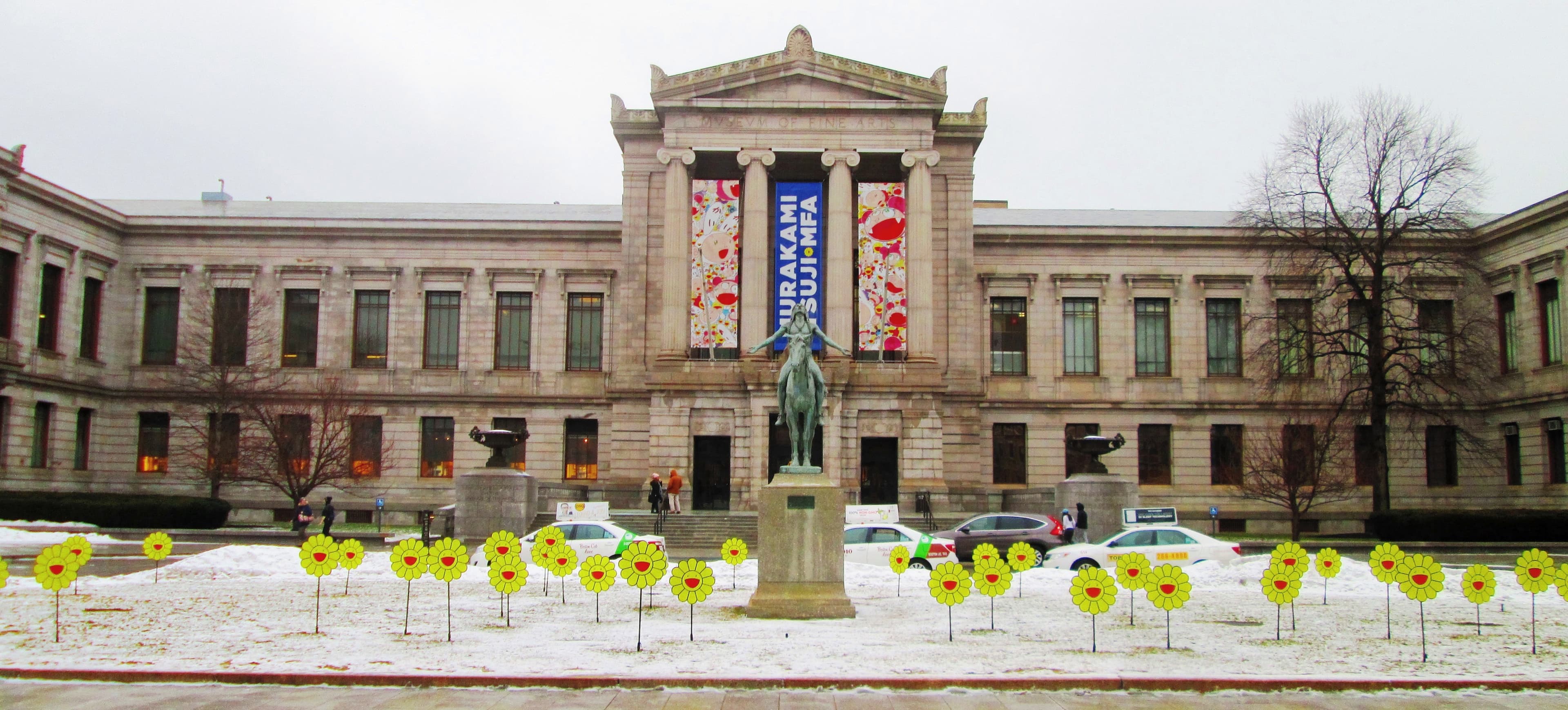
Stand on Huntington Avenue in the Fenway, in front of the Museum of Fine Arts, and the building tells you what kind of city Boston thinks it is. A 500-foot granite facade, a grand rotunda, and a long flight of steps: this is not a museum tucked apologetically into a side street but a civic temple set squarely on the "Avenue of the Arts," facing the street with the confidence of an institution that has been collecting the world's art for more than 150 years. Inside are more than 500,000 works — over 8,000 paintings alone — spanning 6,000 years, from Egyptian funerary art to contemporary installations. It is one of the most comprehensive collections in the Americas, and for a first-time visitor to Boston it is the single essential museum: the place where the city's ambitions, its old money, its immigrant stories, and its artistic obsessions all hang on the walls together.
The MFA was founded in 1870, and its first home was modest: the top floor of the Boston Athenæum, with most of its initial collection drawn from the Athenæum's own art gallery. Boston in 1870 was a city of merchants, publishers, and Brahmin families who had spent the previous half-century traveling Europe and coming home with art — and with the conviction that their city deserved a museum to rival the ones they had seen abroad. In 1876 the young museum moved into its own building on Copley Square, a highly ornamented Gothic Revival structure designed by John Hubbard Sturgis and Charles Brigham, built almost entirely of brick and English terracotta. That building is gone now — after the museum moved out in 1909 it was demolished, and the Copley Plaza Hotel (today the Fairmont Copley Plaza) rose on its site in 1912 — but the move to Copley Square marked the moment the MFA stopped being a borrowed room and became a public institution. Its first director, Charles Greely Loring, a former Union Army general, led it from 1876 until early 1902.
A granite palace, built in stages
The museum's present home began in 1907, when the trustees hired architect Guy Lowell to design a museum that could be built in sections as funding became available — a practical plan that shaped the building's whole character. The first section of Lowell's neoclassical design, completed in 1909, gave the museum its identity: the long granite facade on Huntington Avenue, the grand rotunda, and the exhibition galleries behind them. The museum moved to the Fenway that year, next door to the recently opened Isabella Stewart Gardner Museum, and the Fenway has been Boston's museum quarter ever since.
The building kept growing the way Lowell planned, one benefactor at a time. The wing along the Fenway, housing painting galleries, was funded entirely by Maria Antoinette Evans Hunt and opened in 1915. From 1916 through 1925, John Singer Sargent — Boston's most famous painter, back from London — painted the frescoes that adorn the rotunda and its colonnades, using the young Black model Thomas McKeller as his inspiration for Apollo and the other Greek gods of the murals. The Decorative Arts Wing followed in 1928 and was expanded in 1968; an addition by Hugh Stubbins and Associates came in 1966–1970, another by The Architects Collaborative in 1976, and the West Wing, designed by I. M. Pei and opened in 1981, now houses contemporary art as the Linde Family Wing. Each addition is a different era's idea of what a museum should look like, and walking the building is a walk through a century of museum architecture.
Outside, the grounds grew too. The Tenshin-en Japanese garden, designed by the Japanese professor Kinsaku Nakane, opened in 1988 and was renovated in 2015; its kabukimon-style entrance gate was built by Chris Hall of Massachusetts using traditional Japanese carpentry techniques. The Norma Jean Calderwood Garden Court and Terrace opened in 1997, giving the museum its cafe, restaurant, and gathering space. And out front, on the Huntington Avenue steps, stands the statue every visitor photographs: Cyrus Dallin's Appeal to the Great Spirit, a bronze equestrian figure of a Native American man with arms outstretched to the sky, modeled in 1908 and installed outside the museum's main entrance on January 23, 1912. It was meant to be temporary and never left; it has become the museum's unofficial emblem, and in recent years the MFA has used it as a starting point for public conversations about how Native peoples are represented in art — surrounding it with community questions and Native-written commentary rather than letting it stand uncommented.
The collections: where to start in 500,000 works
No one sees the whole MFA in a day, and the honest advice is not to try. The museum's collection is encyclopedic — the word museums use when they mean "a bit of everything, at world-class depth" — and the way to enjoy it is to pick three or four wings and let the rest go. Here is where first-time visitors should start.
Begin with the Art of the Americas Wing, the museum's newest great space and its best argument for itself. Opened on November 20, 2010, with a free Community Day that drew more than 13,500 visitors, the wing was designed by the London firm Foster + Partners and holds more than 5,000 works from North, Central, and South America across three millennia, arranged chronologically over four floors in 53 galleries, including nine period rooms. Its centerpiece is not a painting but a room: the Ruth and Carl J. Shapiro Family Courtyard, a 12,000-square-foot glass-enclosed gathering space linking the historic 1909 building to the new wing, dominated by Dale Chihuly's 42.5-foot Lime Green Icicle Tower, a cascade of green glass that hangs like a frozen waterfall. The wing won the Boston Society of Architects' Harleston Parker Medal in 2014. In the American galleries, look for John Singleton Copley's portraits of Revolutionary Boston, Winslow Homer's seascapes, and the colonial silver — Paul Revere's work among it — that ties the museum directly to the city's founding story.
Then go to the European paintings, where the MFA's great boast lives: it holds more Monets than any museum outside Paris. The Impressionist galleries — Monet, Renoir, Degas, Van Gogh, Gauguin, Cézanne — are the museum's most crowded rooms for a reason, and they reward slow looking: Monet's grainstacks and Rouen cathedrals, painted in series to catch changing light, are the kind of works that teach you how to see. Nearby hang the Dutch masters, the Italian Renaissance, and the French academic paintings, including works by the Boston painters who studied in Paris and brought the style home.
The third essential stop is the Art of Asia, anchored by one of the finest Japanese collections outside Japan — ukiyo-e woodblock prints, screens, ceramics, and Buddhist sculpture, much of it collected in the late 19th century when Boston scholars were among the first Westerners to take Japanese art seriously. The Japanese galleries connect directly to the Tenshin-en garden outside, and the pairing is deliberate: art and landscape as one experience. Beside it, the Art of the Ancient World holds the museum's Egyptian and Nubian treasures — the MFA's archaeologists excavated in Egypt and Sudan in the early 20th century, and the collection that resulted includes mummies, jewelry, and sculpture that rival anything outside Cairo — along with Greek and Roman marble, including the celebrated Chios head, a Hellenistic goddess of the 3rd to 2nd century B.C.
Smaller corners reward the curious. The musical instruments collection includes the Bunworth harp, a great Irish cláirseach made in 1734. The prints and drawings collection is among the largest in the country. And throughout the museum, the MFA's online database — with information on more than 346,000 objects — means anything that catches your eye can be looked up later from home, a quiet superpower for a museum this large.
A museum still arguing with itself
The MFA's recent history is part of the visit, not separate from it. In the mid-2000s the museum launched a seven-year campaign that raised over $500 million for the new wing, the endowment, and acquisitions. In 2011 it sold eight paintings by Monet, Renoir, Pissarro, Sisley, and Gauguin at Sotheby's for $21.6 million to help pay for Gustave Caillebotte's Man at His Bath, a purchase that made headlines and arguments in equal measure. In November 2020 the staff voted to unionize, and in November 2021 MFA workers went on strike for the first time, over wages, job security, and diversity — a dispute that played out in public and ended with a contract. In September 2022 the museum announced a rebranding and renewed community outreach, alongside the visit of Kehinde Wiley's portrait of Barack Obama and Amy Sherald's portrait of Michelle Obama, on loan from the National Portrait Gallery. None of this is ancient history; it is a museum in a living city, negotiating — sometimes loudly — what a public art museum owes its workers, its neighbors, and its visitors. The galleries are calmer than the headlines, but the headlines are part of why the place matters.
That is the real reason to come. The MFA is not a warehouse of pretty things; it is Boston's argument with itself about beauty, made in granite and glass over 150 years. The Brahmin collectors who founded it, the immigrant artists who filled its school, the archaeologists who dug in Nubia, the union staff who keep it running, the visitors who crowd the Monet rooms — all of them are in the building, in one way or another. Give it a full morning, or a full day if you have it. Start at the Huntington Avenue steps under Dallin's statue, walk the rotunda under Sargent's murals, and then choose your wings: Americas, Europe, Asia, the ancient world. Sit in the Shapiro Courtyard under Chihuly's green glass tower when your feet give out. Then step outside, walk the Fenway, and look back at the granite facade — the building Lowell designed to grow, still growing, still collecting, still arguing.
Key Facts
- The Museum of Fine Arts, Boston was founded in 1870 and was first housed on the top floor of the Boston Athenæum, with most of its initial collection from the Athenæum's art gallery.
- In 1876 it moved to a Gothic Revival building on Copley Square designed by John Hubbard Sturgis and Charles Brigham; after the museum left in 1909, that building was demolished and replaced by the Copley Plaza Hotel in 1912.
- Charles Greely Loring, a former Union Army general, served as the museum's first director from 1876 to early 1902.
- The current Huntington Avenue building was designed by Guy Lowell to be built in stages as funding became available; the first section, with its 500-foot granite facade and grand rotunda, was completed in 1909, when the museum moved to the Fenway.
- The Fenway-side painting wing, funded entirely by Maria Antoinette Evans Hunt, opened in 1915.
- John Singer Sargent painted the rotunda and colonnade frescoes from 1916 to 1925, using Thomas McKeller as his model for Apollo and the other Greek gods.
- Later additions include the Decorative Arts Wing (1928, expanded 1968), Hugh Stubbins and Associates (1966–1970), The Architects Collaborative (1976), and the I. M. Pei West Wing (1981, now the Linde Family Wing for Contemporary Art).
- Cyrus Dallin's Appeal to the Great Spirit (modeled 1908) was installed outside the main entrance on January 23, 1912, as a temporary installation that was never removed.
- The Tenshin-en Japanese garden, designed by Kinsaku Nakane, opened in 1988 and was renovated in 2015; the Norma Jean Calderwood Garden Court and Terrace opened in 1997.
- The Art of the Americas Wing and the Ruth and Carl J. Shapiro Family Courtyard, designed by Foster + Partners, opened on November 20, 2010, with more than 13,500 visitors on opening day; the wing holds more than 5,000 works in 53 galleries, and the courtyard features Dale Chihuly's 42.5-foot Lime Green Icicle Tower. The wing received the Harleston Parker Medal in 2014.
- The museum holds more than 500,000 works of art, including over 8,000 paintings, and more Monets than any museum outside Paris; its online database covers more than 346,000 objects.
- The MFA's staff unionized in November 2020 and struck for the first time on November 17, 2021; a rebranding and community-outreach renewal was announced in September 2022.
Visitor Details
Address: Museum of Fine Arts, Boston, 465 Huntington Avenue, Boston, MA 02115, in the Fenway–Kenmore neighborhood
Transit: Museum of Fine Arts station on the MBTA Green Line (E branch), directly in front of the museum; Ruggles station on the Orange Line and MBTA Commuter Rail is a short walk away
Hours/Admission: Hours and admission change seasonally and by program — check the museum's official visitor information at mfa.org before your visit rather than relying on a fixed schedule, and note that the museum regularly offers free and discounted admission programs.
Best timing: Weekday mornings are the quietest, especially in the European painting galleries; Wednesday through Friday evenings are the museum's late nights. Plan a route before you arrive — Art of the Americas Wing, European paintings, Art of Asia, and Art of the Ancient World make a strong first visit — and build in a rest in the Shapiro Family Courtyard midway. Pair the visit with the neighboring Isabella Stewart Gardner Museum, a ten-minute walk away, for a full Fenway museum day.
Location Photography