A museum a century in the making
There are sights on the National Mall that every first-time visitor to Washington names without thinking — the Washington Monument, the Lincoln Memorial, the Capitol — and since September 24, 2016, there has been a newer one on that list: the National Museum of African American History and Culture, known to almost everyone as the NMAAHC, and affectionately as the Blacksonian. It is the Smithsonian Institution's nineteenth museum, and the only national museum devoted exclusively to documenting African American life, history, and culture. It occupies the last available building plot on the Mall itself, a five-acre site at the northeast corner of the Washington Monument grounds, bounded by Constitution Avenue and 14th and 15th Streets NW — and its bronze, crown-shaped building is now as much a part of the Mall's skyline as the white marble around it.
The museum took a very long time to arrive. The idea of a national museum honoring African American achievement dates back to 1915, when Black veterans of the Union Army met in Washington and formed a committee to build a memorial to African American achievements; Congress appointed a commission in 1929, but the project stalled for lack of funding and support. Proposals came and went for decades. The modern push began in earnest in the 1970s and 1980s, championed in Congress in later years by Representative John Lewis, who carried the legislation through repeated defeats. Congress finally authorized the museum in December 2003, a site on the Mall was selected in 2006, and a design by the team of Freelon Adjaye Bond/SmithGroup was chosen in 2009. Construction began in February 2012. When the doors opened in 2016, the dedication ceremony was led by President Barack Obama, the nation's first Black president, before a crowd on the Mall — a moment the museum itself now treats as part of its own history.
That long road matters to a visit, because the museum was not assembled from an existing collection. Under its founding director, Lonnie Bunch III, the Smithsonian spent more than a decade gathering objects from scratch — donations from families, churches, fraternal lodges, attics, and basements across the country — before the building even opened. The result is a collection of more than 40,000 objects, of which roughly 3,500 are on display at any one time. Many of them are not grand state treasures but intimate, personal things: a hymnal, a uniform, a lunch-counter stool, a trumpet, a dress worn on a historic night. That is the museum's method, and its power: it tells a vast national story through objects that once belonged to particular people.
The corona: a crown on the Mall
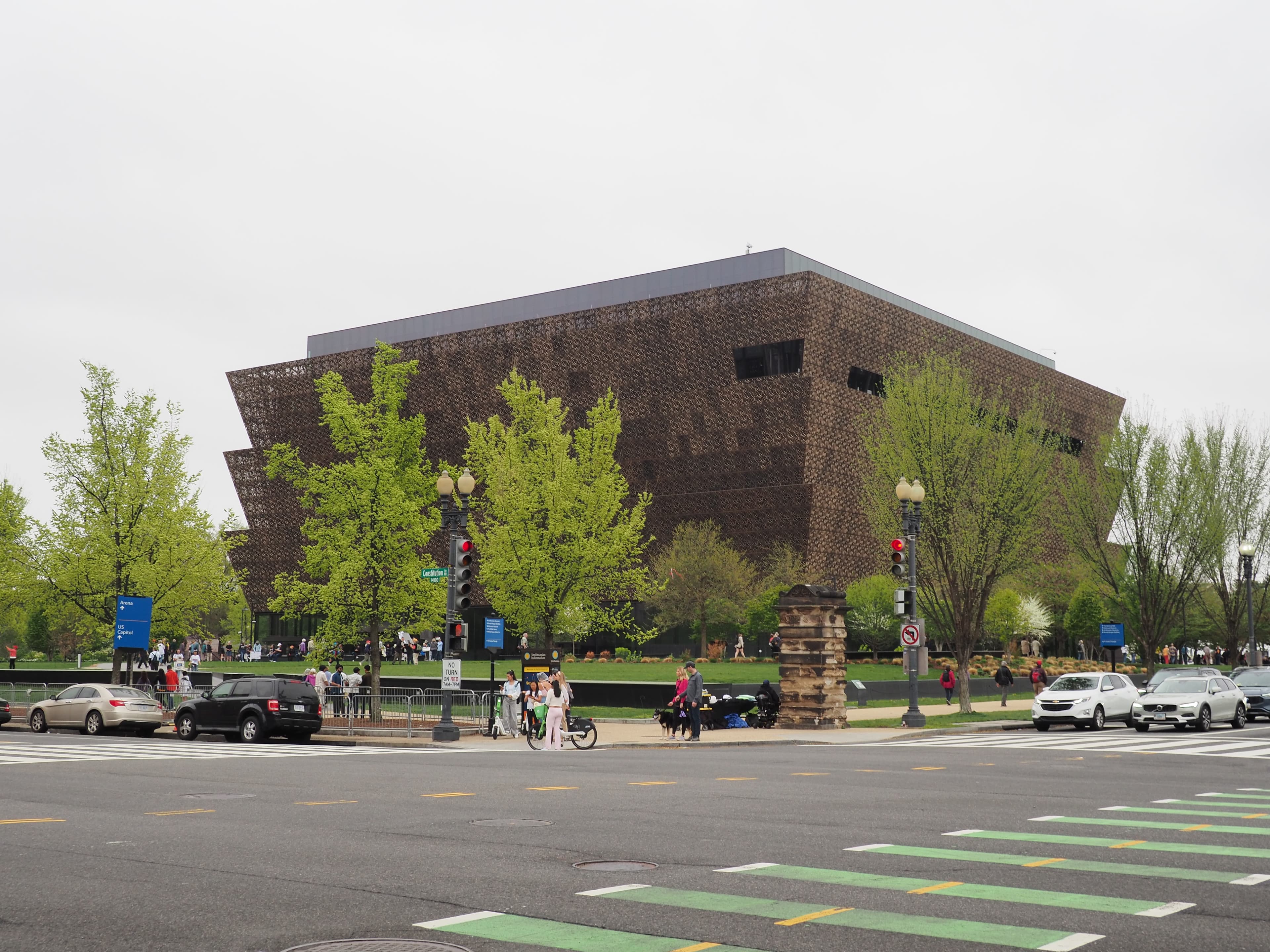
You notice the building before you enter it, and that is intentional. The museum's defining feature is its corona — a three-tiered, outward-flaring crown of some 3,600 bronze-colored, perforated cast-aluminum panels that wraps the upper stories of the building. The design architect, David Adjaye, working with Philip Freelon as architect of record, drew the form from two sources. The first is the crown of the Yoruba caryatid column, a carved wooden post from West African tradition whose capital resembles a crown. The second is the ornamental ironwork forged by enslaved and free African American craftsmen in cities such as New Orleans and Charleston — a tradition of skilled Black artistry that the corona's lattice pattern echoes in contemporary form.
The corona does more than symbolize. Its angled tiers echo the slope of the Washington Monument's capstone just to the west, tying the newest building on the Mall to one of its oldest monuments, while its bronze tone deliberately breaks with the white marble and granite of its neighbors — a visible statement that this museum belongs on the Mall but does not blend into it. The perforated panels filter daylight into the galleries behind them, and at night the building glows from within. Beneath the corona, a deep porch canopy shelters the entrance facing Madison Drive and a shallow reflecting pool, and the surrounding grounds are planted with trees and shrubs native to the American South. Walk around the building before going in: from Constitution Avenue you see the crown against the sky, and from the south side you see how much of the museum — roughly half its volume — sits below ground, out of sight, like the history it holds.
Descending into history
The museum's architecture tells you how to visit it. The history galleries are below ground, and the intended route begins by descending — an elevator ride down to the lowest level — and then walking upward through time. It is a deliberately physical journey: you go down into the past and climb, gallery by gallery, back toward the present and the light.
The lowest galleries cover slavery and freedom, from the fifteenth century through 1877: the transatlantic slave trade, the economics of enslavement, the daily lives of enslaved people, and their resistance, faith, and family life under a system designed to deny all three. Among the large-scale installations are a reconstructed slave cabin from South Carolina and a segregated railway car, objects at full scale that make abstract history concrete in a way no label can. The next level carries the story through segregation, from 1877 to 1968 — the era of Jim Crow, of migration north, of the long struggle for civil rights — and the uppermost history gallery brings it to the present, from 1968 onward: the aftermath of the civil rights movement, Black achievement and continuing struggle in American life, and the museum's own opening as part of that story.
This is, by design, the hardest part of the visit, and the museum does not soften it. Some spaces are set apart as quiet memorial rooms, distinct from the open galleries, and visitors are asked to treat them with corresponding respect. Photography rules vary by gallery, and it is worth following the posted guidance rather than assuming. Allow real time here — the history galleries alone can absorb two hours — and do not feel obliged to read every label. The galleries are built to be walked through as a narrative: follow the chronology, pause at the objects that stop you, and keep moving when you need to. The building's design is doing part of the work for you: you are climbing out of the depths as the story moves toward the present, and the architecture makes that ascent feel earned.
The culture galleries: music, stage, and sport upstairs
Above ground, the mood changes. The culture galleries, on the museum's upper floors, celebrate African American achievement in music, theatre, visual art, and sport — the fields where Black creativity has shaped American culture most visibly, and often most joyfully. There are galleries devoted to music in all its forms, from gospel and blues to jazz, rock and roll, and hip-hop, with instruments, costumes, and recordings; to the stage and screen, where Black performers, writers, and directors remade American entertainment; and to sport, where athletes broke barriers and became national icons. The objects here are the ones visitors often photograph and remember — stage costumes, championship memorabilia, album art — but the argument of these galleries is serious: that African American culture is not a sidebar to American culture, but one of its main engines.
The contrast between the two halves of the museum is the point. Downstairs, you have walked through oppression and resistance; upstairs, you see what that resistance produced — a culture of extraordinary range and influence, made under conditions that often denied its makers credit, pay, or even safety. Visitors who only do the history galleries, or only the culture galleries, miss the museum's central idea: that these are one story, not two. The building's vertical journey — down into history, up into culture — is the museum's thesis in architectural form.
The Contemplation Court and the Sweet Home Café
Between the galleries, the museum gives you two places to breathe, and both are worth building into your visit. The Contemplation Court is a circular, light-filled room on an upper level, centered on a cylindrical waterfall that falls into a shallow pool. It is designed as a space for reflection, and visitors treat it that way: voices drop, people sit on the surrounding benches, and the sound of falling water fills the room. After the intensity of the history galleries, it is not a luxury but a necessity — a pause the building insists on, and one you should take.
The other is the Sweet Home Café, on the museum's lower level, which serves dishes drawn from the food traditions of the African diaspora — the cooking of the American South, the Caribbean, the African continent, and the northern cities of the Great Migration, among others. It is a full-service restaurant, not a museum snack bar, and it is popular; lines form at lunch, and it is worth planning around. Eating here is not a break from the museum's subject but a continuation of it: food, like music, is one of the ways a culture survives and travels, and the café's menu is organized to make that argument plate by plate.
How to visit well
The NMAAHC rewards a plan, and the first part of the plan is time. This is not a museum to dash through in an hour. Most visitors need at least three hours, and four or five is not excessive if you want both the history and culture galleries plus the Contemplation Court and the café. Start with the history galleries — descend first, while your energy is fresh — and work upward chronologically, then move to the culture galleries above. If you arrive and the history galleries feel overwhelming, it is perfectly reasonable to take the Contemplation Court break in the middle and return; the museum is designed for that rhythm.
Admission to Smithsonian museums is free, but timed-entry passes have applied at the NMAAHC at various times since it opened, particularly during busy periods, so check the museum's official site at nmaahc.si.edu before visiting to confirm the current entry arrangements, hours, and any pass requirements. Do not rely on a guidebook or an old blog post for this — the policy has changed more than once. The museum sits on the Mall between the Washington Monument and the National Museum of American History, so it pairs naturally with a Mall day: the Monument, the American History museum, and the World War II Memorial are all within a short walk, and the Federal Triangle and Smithsonian Metro stations serve the area. Wear comfortable shoes; you will be on your feet, and the route through the history galleries is a long, slow climb.
One more practical note: this is among the most visited museums in the country — more than a million visitors in a recent year — and the history galleries in particular can feel crowded. Arriving early in the day helps, and so does patience. The crowds are part of what the museum is: a place Americans come, in large numbers, to confront a history that was long left out of the nation's museums. That is worth remembering when the galleries are full.
Why the NMAAHC belongs on a first visit
Washington's Mall is, in a sense, America's front lawn — the place where the nation puts the stories it wants to tell about itself. For most of the Mall's history, the story of African Americans was told there only in fragments, or not at all. The NMAAHC changed that, and it did so on the most prominent remaining site the Mall had to offer, in a building that refuses to be modest about its presence. Its corona is now one of the most recognizable silhouettes in the city, and its galleries draw visitors who come to Washington for the monuments and leave having spent their longest, most affecting hours here.
For a first-time visitor, the museum is also the most complete single introduction to a subject that runs through every other sight on the Mall. The Lincoln Memorial's promise, the Jefferson Memorial's contradictions, the World War II Memorial's roll of the fallen, the Capitol itself — all of them read differently after a visit here, because the NMAAHC tells the part of the American story that those monuments assume but do not always name. Walk its galleries, sit by the waterfall, eat in the café, and then walk back out onto the Mall: the monuments will still be there, in the same white marble, but you will see them, and the country they commemorate, more clearly.
Key Facts
The National Museum of African American History and Culture (NMAAHC) is a Smithsonian Institution museum on the National Mall in Washington, DC, devoted exclusively to African American life, history, and culture.
The museum was authorized by Congress in December 2003 (legislation championed in its later years by Representative John Lewis) and opened to the public on September 24, 2016, with a dedication ceremony led by President Barack Obama.
The museum's site is a five-acre plot at the northeast corner of the Washington Monument grounds, bounded by Constitution Avenue and 14th and 15th Streets NW — the last available building site on the National Mall.
The design team was Freelon Adjaye Bond/SmithGroup; David Adjaye was the design architect and Philip Freelon the architect of record. The design was chosen in 2009; construction began in February 2012.
The building's defining feature is the corona, a three-tiered crown of about 3,600 bronze-colored, perforated cast-aluminum panels, inspired by the crown of the Yoruba caryatid column and by ornamental ironwork forged by enslaved and free African American craftsmen. Its angled tiers echo the Washington Monument's capstone.
The building has five stories above ground and five below; roughly half its volume sits below grade. The history galleries occupy the below-ground levels and run chronologically from slavery through segregation to the present; the culture galleries above cover music, theatre, visual art, and sport.
The collection holds more than 40,000 objects, of which roughly 3,500 are on display; founding director Lonnie Bunch III spent more than a decade assembling the collection from scratch before the museum opened.
The Contemplation Court is a circular room with a cylindrical waterfall, designed as a space for reflection; the Sweet Home Café serves dishes drawn from the food traditions of the African diaspora.
The museum is the Smithsonian's nineteenth museum and, in 2022, welcomed more than 1,000,000 visitors, making it one of the most visited museums in the United States.
The museum is located at 1400 Constitution Avenue NW, Washington, DC 20560, on the National Mall, between the Washington Monument and the National Museum of American History.
Visitor Details
Address: National Museum of African American History and Culture, 1400 Constitution Avenue NW, Washington, DC 20560 (National Mall, between the Washington Monument and the National Museum of American History)
Transit: Federal Triangle station and Smithsonian station (both served by the Blue, Orange, and Silver Metro lines) are the nearest stops; the museum is a short walk from either, and several bus routes run along Constitution Avenue and 14th Street NW.
Hours/Admission: Admission to Smithsonian museums is free, but timed-entry passes have applied at the NMAAHC at various times, particularly during busy periods — check the official source at nmaahc.si.edu before visiting to confirm current hours, entry arrangements, and any pass requirements. Do not rely on older guides for entry policy.
Best timing: Allow at least three hours, and four to five if you want the full history and culture galleries plus the Contemplation Court and the Sweet Home Café. Start with the below-ground history galleries and work upward chronologically, take a break in the Contemplation Court between sections, and arrive early in the day for the quietest galleries. Pair the visit with the Washington Monument, the National Museum of American History, and the World War II Memorial, all within a short walk.
Location Photography