The museum that invented the modern art museum
There is a short list of New York sights a first-time visitor names without thinking — the Statue of Liberty, the Empire State Building, Times Square, Central Park — and the Museum of Modern Art belongs on it. Not because it is the biggest museum in the city (it is not; the Met is far larger), and not because it is the oldest (it is not that either). MoMA belongs on the list because it invented the thing it is. Before MoMA, there was no museum in America devoted to the art of its own time. The idea that a museum could collect living artists, show film and photography and design alongside painting, and treat the present as seriously as the past — that idea started here, in 1929, in six rented rooms on the twelfth floor of the Heckscher Building at Fifth Avenue and 57th Street.
The museum's founding is inseparable from three women: Abby Aldrich Rockefeller, Lillie P. Bliss, and Mary Quinn Sullivan. In the summer of 1929 they invited a small group of supporters to join them in establishing a museum of modern art, and they hired a brilliant 27-year-old scholar, Alfred H. Barr Jr., as its first director. MoMA opened to the public on November 7, 1929 — nine days after the Wall Street Crash — with an exhibition of Cézanne, Gauguin, Seurat, and van Gogh. The timing could hardly have been worse, and the museum could hardly have been bolder: it announced, in the first week of the Depression, that modern art mattered enough to deserve a museum of its own.
Barr's vision shaped everything that followed. He did not think of modern art as a single style but as a web of movements — painting, sculpture, photography, film, architecture, design — each with its own department, each collected with the same seriousness. That structure survives at MoMA today, and it is why a visit here feels different from a visit to an encyclopedic museum. You are not walking through the history of art. You are walking through an argument about what modern art is, made by the institution that first made the argument.
From rented rooms to 53rd Street
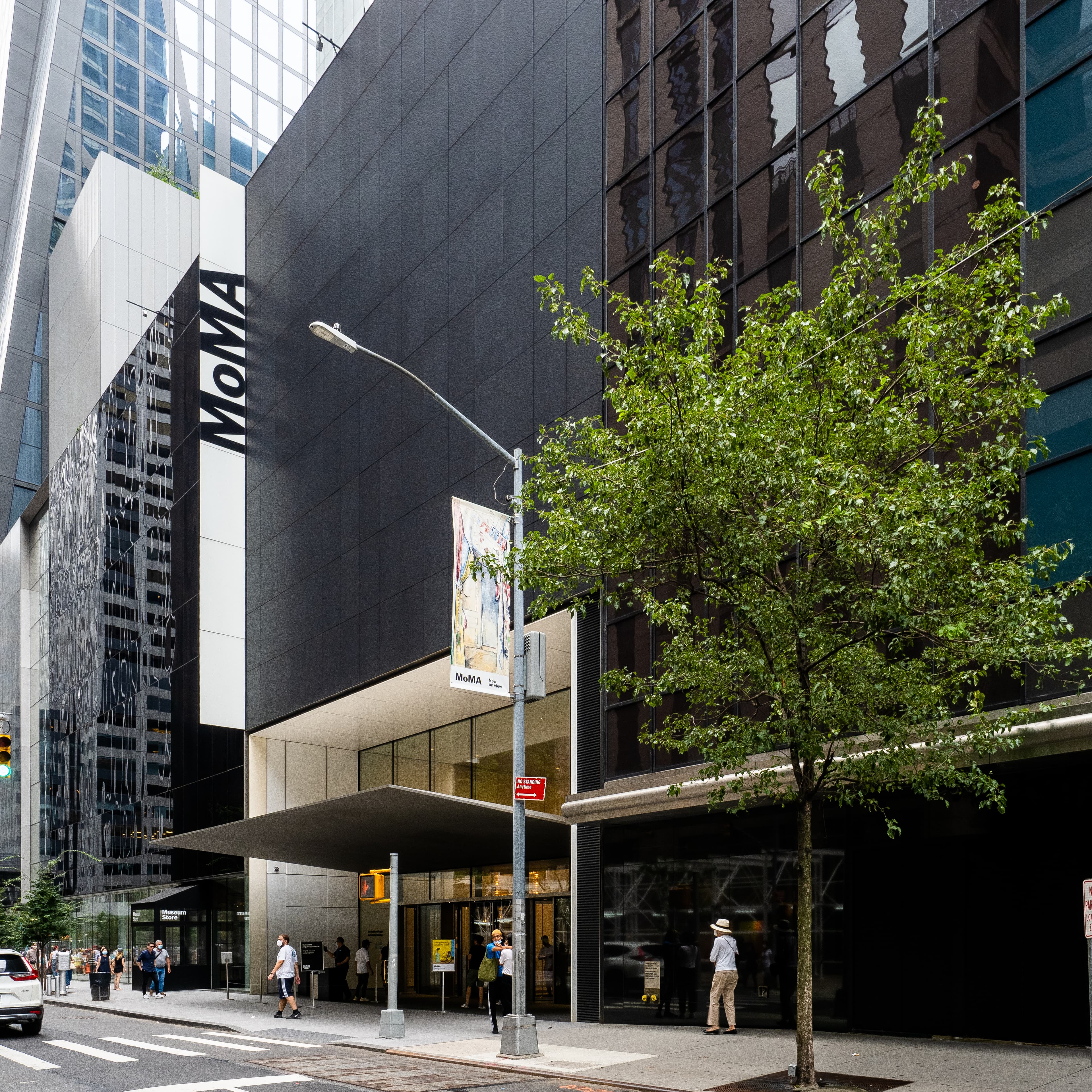
MoMA's early years were nomadic. The museum moved several times in its first decade, and its future was far from secure — Abby Rockefeller's husband, John D. Rockefeller Jr., was initially opposed to the museum and to modern art itself. But Rockefeller eventually came around, donating the land for a permanent home, and in 1939 MoMA moved to its present address at 11 West 53rd Street, between Fifth and Sixth Avenues, into a building designed in the International Style by Philip L. Goodwin and Edward Durell Stone. The new building opened on May 10, 1939, with an address broadcast by radio from the White House by President Franklin D. Roosevelt, before a crowd of some 6,000 people.
That 1939 building is the core of the museum you visit today, though it has been expanded and reworked repeatedly. A sculpture garden opened the same year, designed by Barr and curator John McAndrew, and it was later redesigned by architect Philip Johnson and named for Abby Aldrich Rockefeller — the Abby Aldrich Rockefeller Sculpture Garden, an outdoor room of trees, pools, and monumental sculpture in the middle of Midtown, and still one of the most peaceful places in Manhattan. In 1984 came a substantial enlargement by Cesar Pelli; in 2004, a sweeping expansion and redesign by Yoshio Taniguchi; and in 2019, the most recent transformation, by Diller Scofidio + Renfro with Gensler, which added gallery space, a new street-level presence, and a rethought hang of the collection. Each expansion has made the same bet: that MoMA's job is not to preserve a moment in modern art but to keep pace with it.
The paintings everyone comes to see
MoMA's collection spans the late 19th century to the present and numbers more than 200,000 works — paintings, sculptures, photographs, prints, drawings, films, design objects, and architectural holdings. But a first visit is really about a handful of paintings that have become part of the world's visual vocabulary, and MoMA hangs them where you can find them.
Start with Vincent van Gogh's The Starry Night, painted in 1889, the swirling night sky over Saint-Rémy that is arguably the most famous painting in America. Nearby hangs Claude Monet's great Water Lilies triptych, three vast panels of shimmering water that fill a whole gallery and reward a long, slow look. Then there is Pablo Picasso's Les Demoiselles d'Avignon, painted in 1907, the fractured, confrontational canvas that helped launch Cubism and that still stops visitors in their tracks more than a century later. Around them: Henri Rousseau's The Sleeping Gypsy, Salvador Dalí's The Persistence of Memory with its melting watches, Piet Mondrian's Broadway Boogie Woogie, Jackson Pollock's drip paintings, and Andy Warhol's Campbell's Soup Cans. These are not just famous pictures. They are the pictures that taught generations of Americans what modern art looks like, and seeing them in person — at full scale, with real paint — is a different experience from knowing them on a poster.
The point of a MoMA visit, though, is not only the icons. The museum's great strength is its depth: whole floors of modern masters, rooms devoted to photography and to design, and a rotating program of special exhibitions that means no two visits are quite the same. The fifth-floor collection galleries, where the most famous paintings hang, are the natural first stop; the floors above and below them reward anyone who keeps going. Do not rush past the design collection, either — MoMA was one of the first museums to treat chairs, posters, and household objects as art, and its design galleries are among the most quietly surprising rooms in the building.
The sculpture garden: Midtown's outdoor room
If the paintings are MoMA's headline, the sculpture garden is its secret. The Abby Aldrich Rockefeller Sculpture Garden sits at the heart of the museum complex, open to the sky, planted with trees, and arranged around reflecting pools. Monumental sculptures stand on the lawns and terraces, and the glass walls of the surrounding galleries let you look out onto it from several floors. It is a place to sit down between galleries, to let the paintings settle, and to watch the city through the trees — and it is also, in its own right, one of the great designed outdoor spaces in New York.
The garden matters because it embodies Barr's idea of what a modern museum should be: not a temple sealed off from the city but a place where art and everyday life sit side by side. Sculpture outdoors, in weather and daylight, changes with the hour and the season in a way gallery art does not. Come in late afternoon, when the light slants across the pools, and the garden is at its best. And if the museum feels crowded — it often does — the garden is where you catch your breath before going back in.
Film, photography, and design: MoMA beyond painting
One of Barr's most radical decisions was to treat film as art. MoMA established its Film Library in 1935, one of the first film archives in the world, and its film program — screenings in the museum's theaters, retrospectives, and a collection that spans the history of cinema — remains one of the institution's proudest achievements. The same instinct drove the photography department, one of the first of its kind, and the architecture and design department, founded in 1932 with MoMA's first exhibition of international modern architecture. These were not side projects. They were the point: Barr believed modern life itself — its movies, its buildings, its chairs — deserved a museum.
That breadth is still MoMA's signature. A single visit can take you from Van Gogh to a retrospective of a living filmmaker, from a gallery of Bauhaus furniture to a room of contemporary photography. The museum's partnership with MoMA PS1, the contemporary art center in Long Island City, Queens, which began in 2000, extends that reach further into the art of the present. If you leave MoMA thinking only of the famous paintings, you have missed half of what it does — and the museum's smaller, stranger galleries are often the ones visitors remember best.
How to visit MoMA well
MoMA rewards a plan. The museum is large but not overwhelming — most visitors see it comfortably in two to four hours — and the collection galleries on the upper floors are the place to start, before the crowds thicken around the icons. Go to The Starry Night and Les Demoiselles d'Avignon early in your visit if they matter to you, then let the rest of the day unfold: the design galleries, the photography rooms, the sculpture garden, and whatever special exhibition is on. The museum's free audio guides and its floor-by-floor layout make it easy to navigate without a strategy, but a little patience pays off: the famous paintings are worth waiting a minute for, and the quieter galleries are worth the walk.
Pairing MoMA with its neighborhood is easy. The museum sits in the heart of Midtown, steps from Fifth Avenue shopping, Rockefeller Center, and St. Patrick's Cathedral, and a short walk from Central Park. It is the natural anchor of a Midtown day, and the sculpture garden's calm is the perfect counterweight to the avenue's bustle. Come out of the museum, cross to the park or down to Rockefeller Center, and you will understand why MoMA chose this address: it is not tucked away from New York. It is in the middle of it.
Why MoMA endures
Nearly a century after it opened in six rented rooms, MoMA is still the institution other modern art museums measure themselves against — not because it has the most art, but because it had the idea first, and has kept renewing it ever since. It survived the Depression, outgrew three homes, and rebuilt itself four times, each time betting that modern art was not finished. The paintings on its walls are the evidence: Van Gogh's sky still swirls, Picasso's Demoiselles still confront, Monet's water still shimmers, and each generation finds something new in them.
For a first-time visitor, MoMA is also the most efficient possible introduction to modern art. In a few hours you can stand in front of the works that defined a century, in the museum that defined how those works are shown. Walk the collection floors, sit in the sculpture garden, and let the museum make its old argument again: that the art of our own time is worth a building of its own, in the middle of the greatest city in the world.
Key Facts
- The Museum of Modern Art (MoMA) was founded in 1929 by Abby Aldrich Rockefeller, Lillie P. Bliss, and Mary Quinn Sullivan; Alfred H. Barr Jr. was its first director.
- MoMA opened to the public on November 7, 1929, in six rooms on the twelfth floor of the Heckscher Building at Fifth Avenue and 57th Street, nine days after the Wall Street Crash; its first exhibition showed Cézanne, Gauguin, Seurat, and van Gogh.
- MoMA moved to its permanent home at 11 West 53rd Street in 1939, into an International Style building by Philip L. Goodwin and Edward Durell Stone that opened on May 10, 1939, with a radio address from President Franklin D. Roosevelt.
- The Abby Aldrich Rockefeller Sculpture Garden opened in 1939 (designed by Barr and curator John McAndrew) and was later redesigned by Philip Johnson and named for Abby Aldrich Rockefeller.
- MoMA's collection spans the late 19th century to the present and includes more than 200,000 works across painting, sculpture, photography, prints, drawings, film, design, and architecture.
- Collection highlights include Van Gogh's The Starry Night (1889), Monet's Water Lilies triptych, Picasso's Les Demoiselles d'Avignon (1907), Rousseau's The Sleeping Gypsy, Dalí's The Persistence of Memory, Mondrian's Broadway Boogie Woogie, Pollock's drip paintings, and Warhol's Campbell's Soup Cans.
- MoMA established its Film Library in 1935, one of the first film archives in the world; its Department of Architecture was founded in 1932.
- Later expansions: Cesar Pelli (1984), Yoshio Taniguchi (2004), and Diller Scofidio + Renfro with Gensler (2019).
- MoMA and MoMA PS1, the contemporary art center in Long Island City, Queens, entered into a partnership in 2000.
- MoMA is located at 11 West 53rd Street, Manhattan, between Fifth and Sixth Avenues, in Midtown Manhattan.
Visitor Details
Address: The Museum of Modern Art, 11 West 53rd Street, New York, NY 10019 (Midtown Manhattan, between Fifth and Sixth Avenues)
Transit: Fifth Avenue/53rd Street station (E and M trains) is steps from the museum; the 57th Street area and Rockefeller Center stations are a short walk away. Several bus routes run along Fifth Avenue and 53rd Street.
Hours/Admission: Hours, admission prices, and any free or discounted admission days change from time to time — check the official source at moma.org before visiting to confirm current hours, ticket prices, and timed-entry requirements. Special exhibitions may carry separate arrangements.
Best timing: Arrive early in the day for the quietest galleries and the shortest waits at the most famous paintings; allow at least two hours, and three to four if you want the design, photography, and film galleries as well as the icons. Take a break in the Abby Aldrich Rockefeller Sculpture Garden between floors, and pair the visit with Rockefeller Center, St. Patrick's Cathedral, Fifth Avenue, or Central Park, all within a short walk.
Location Photography