A village of science on Biscayne Bay
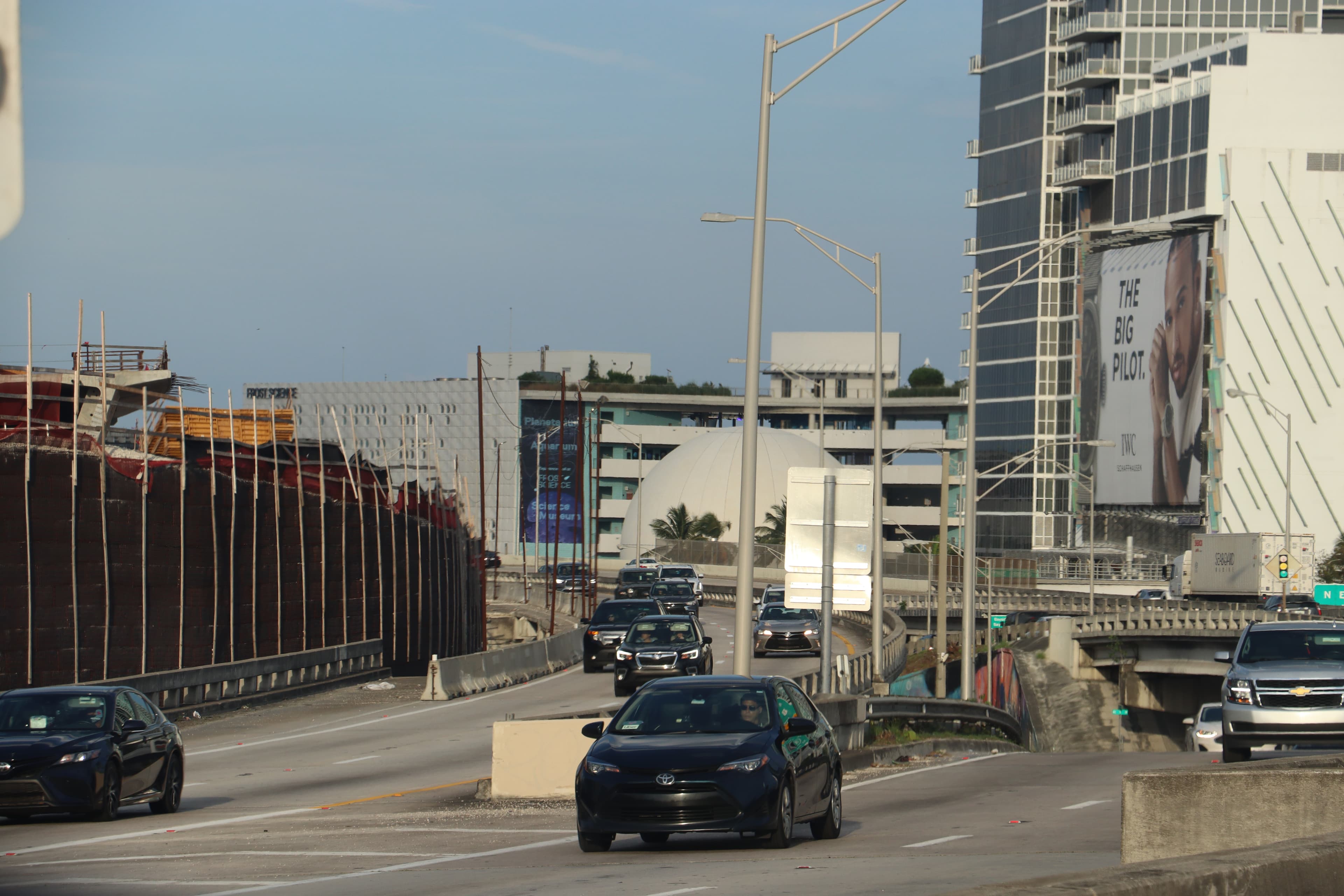
Stand on the MacArthur Causeway heading into downtown Miami and one building on the bayfront stops the eye: a cluster of white, faceted forms gathered around a great sphere, with a conical tower rising beside it like a glass sail. That is the Phillip and Patricia Frost Museum of Science — Frost Science, to everyone in Miami — and it is the single best answer to the question of what a modern science museum is supposed to be. It is not one museum but three, stacked into a single waterfront campus: an aquarium, a planetarium, and a science museum, sharing an open-air courtyard and a view across Biscayne Bay to the cruise ships at PortMiami.
The museum sits in Maurice A. Ferré Park, the downtown waterfront park Miami calls Museum Park, shoulder to shoulder with the Pérez Art Museum Miami. Together the two museums anchor the city's cultural bayfront, a short walk from the Metromover and the Adrienne Arsht Center. But where its neighbor is a temple of quiet looking, Frost Science is a temple of touching, climbing, peering, and gasping. Children press their hands to stingray tanks. Adults stand beneath a 31-foot circular window with sharks gliding overhead. And in the dark of the planetarium, 250 people at a time tilt their heads back and leave the planet altogether.
What you are visiting is also one of Miami's great second acts. The institution behind Frost Science is more than 75 years old, but the building on the bay is not yet a decade old. It is the product of a small children's museum that kept outgrowing its homes, a county bond vote, a $35 million naming gift, a construction saga that nearly sank the project, and an opening day — May 8, 2017 — that Miami had waited years to celebrate. Understanding that story makes the building itself make sense: every part of it, from the open-air atrium to the rooftop terrace, was designed to connect the science inside to the city, the bay, and the sky outside.
1949: a children's museum in a borrowed house
Frost Science began as the Junior Museum of Miami, founded in 1949 by the Junior League of Miami. Its first home was a house at the corner of Biscayne Boulevard and NE 26th Street, and its first exhibits were the kind a community could assemble by hand: donated and loaned objects, Seminole artifacts, and a live beehive. It was a museum built on the conviction that children learn science by getting close to it, not by reading about it from a distance — a conviction the institution has never abandoned.
The museum grew fast. In 1952 it moved into the Miami Women's Club building on North Bayshore Drive and renamed itself the Museum of Science and Natural History. A Guild formed in 1953 to staff the museum with volunteers, run the shop, and lead tours. By 1960 the museum had a home of its own: a new building on three acres of the historic Vizcaya estate in Coconut Grove, built and furnished rent-free by Miami-Dade County. Six years later, in 1966, the Space Transit Planetarium opened on the same grounds, and it became one of the most beloved institutions in South Florida — the place where generations of Miami schoolchildren first saw the stars explained, and where the nationally syndicated astronomy show Star Gazers, hosted by Jack Horkheimer, was produced for public television.
For 55 years the Coconut Grove museum did its work in 48,000 square feet: a Sea Lab, hurricane exhibits, a wildlife center, summer camps, and field trips that are still a shared memory for Miamians of a certain age. But by the 2000s the building was showing its age, the planetarium's equipment was decades old, and the museum had long since outgrown its rooms. Miami, meanwhile, was remaking its downtown waterfront. The question was no longer whether the science museum needed a new home, but where that home would be — and how big Miami was willing to dream.
The move downtown: a bond, a gift, and a very difficult birth
The answer began with voters. In 2004, Miami-Dade County voters approved the Building Better Communities bond program, which set aside $165 million for a new science museum. In 2009 the City of Miami agreed to lease the museum four acres in Museum Park, on the bayfront in downtown Miami, beside the site where the Pérez Art Museum Miami would also rise. In March 2011, Miami native Phillip Frost and his wife Patricia committed $35 million toward the new building — the largest single gift in the institution's history, and the reason the museum bears their names.
Grimshaw Architects, the London-based firm with a New York studio, designed the new campus, with Miami's Rodriguez & Quiroga Architects in an executive role. The design rejected the idea of a single sealed box. Instead, four buildings stand in an open-armed arrangement around a central, open-air atrium: the Aquarium, the Frost Planetarium, and the North and West Wings, with parking tucked underneath. The buildings are oriented to catch the prevailing breezes off Biscayne Bay, and the faceted white skin of the wings — often compared to fish scales — gives the whole complex its unmistakable look from the causeway and the water.
Getting it built was harder than designing it. Groundbreaking came in early 2012, but the $305 million project ran into financial trouble, construction delays, and a board crisis so severe that in 2016 the museum's entire 40-member board resigned en masse under pressure from funders and the county, to be reconstituted as a condition of continued support. Miami-Dade commissioners approved tens of millions more in public money to finish the job. For a time, it was genuinely unclear whether the gleaming bayfront campus would ever open at all.
It did — on May 8, 2017, to crowds that had waited through years of delays. In its first year, more than a million visitors came through the doors, far surpassing expectations. The old Coconut Grove site closed in 2015, and its grounds have since been cleared for the Vizcaya Village project. The museum that had started in a borrowed house on Biscayne Boulevard now had a 250,000-square-foot home on the bay, LEED Gold-certified, built to run partly on sun, wind, and water — the building itself an exhibit about sustainability.
The Aquarium: descending the Gulf Stream
The heart of Frost Science is the Aquarium, and the heart of the Aquarium is the Gulf Stream tank: a three-level, cone-shaped, 500,000-gallon saltwater tank that you experience from top to bottom, the way a diver would. The design is the museum's great conceptual trick. You do not just look at a tank; you descend through an ecosystem.
Start at the top, on the Vista level, an open-air terrace where the tank meets the sky. Here the exhibit recreates the surface world of South Florida: the shallow waters and mangrove edges of the Everglades and the bay, with views out over the downtown skyline and the cruise ships at PortMiami. It is the only aquarium level in America where the animals' backdrop is a working port and a city skyline, and the juxtaposition is the point — this is a museum about the living systems that surround Miami, not about some abstract ocean far away.
Descend to the Dive level, and the water deepens around you. Coral, reef fish, rays, and sea turtles glide past at eye level, and the interpretive panels shift from the shoreline to the reef — the living architecture of the Florida Reef Tract, the only barrier coral reef in the continental United States, which runs just offshore from the museum's front door.
Keep going down to the Deep, and you arrive at the museum's signature moment: the oculus. Thirty-one feet across, a lens of acrylic 13 inches thick, it forms the bottom of the Gulf Stream tank, and you stand beneath it looking up as hammerhead sharks, tuna, rays, and schooling fish pass overhead. It is the most photographed spot in the museum, and the photograph does not do it justice — the feeling is less like looking at an aquarium than like standing on the seafloor while the ocean moves above you. The oculus is why the Aquarium is shaped like a cone, and why the whole building is organized around it: everything in Frost Science leads, sooner or later, to looking up.
Around the Gulf Stream tank, the Aquarium's other galleries fill in the rest of South Florida's water story: touch tanks where you can feel a stingray or a sea star, jellyfish drifting in backlit cylinders, and exhibits on the coral reefs, the bay, and the conservation work — including the museum's MUVE program, which enlists volunteers in restoring coastal habitats — that connects the animals in the tanks to the water outside the windows.
The Planetarium: 250 seats under a white sphere
If the Aquarium is the museum's heart, the Planetarium is its crown — literally. The great white sphere you see from the causeway is the Frost Planetarium, a 250-seat theater under a 67-foot dome, with a 16-million-color, 8K projection system that wraps the audience in a nearly 360-degree image. It is one of the most advanced planetariums in the United States, and it is the direct descendant of the Space Transit Planetarium that Miamians loved in Coconut Grove.
The shows change with the seasons, but the formula does not: a journey narrated in the dark, from the surface of the Earth to the far edge of what telescopes can see, with the dome doing work no flat screen can do. On Friday evenings the planetarium has traditionally turned to laser shows set to the music of bands like Pink Floyd and Queen, a direct inheritance from the old planetarium's laser nights and one of the museum's most beloved traditions. Check the day's show schedule when you arrive; the planetarium is a separate timed experience within the museum, and the popular shows fill up.
The planetarium also anchors the museum's astronomy identity in a city with a complicated relationship to the night sky. Miami's light pollution makes real stargazing hard, which is exactly why a domed theater that can show you a perfect dark sky matters here. The museum's rooftop terrace, above the galleries, offers the counterpoint: a real sky, a real horizon, and one of the best panoramic views in downtown Miami — the bay, the port, the skyline, and the causeway, all in one sweep. Go up at golden hour if you can.
The galleries: flight, the Everglades, and the human body
Between the Aquarium and the Planetarium, the North and West Wings hold the museum's permanent and rotating galleries, and they reward the same unhurried wandering the Aquarium does. Feathers to the Stars traces the story of flight from feathered dinosaurs to the space age, with specimens, models, and interactives that let you feel the physics rather than just read about it. The River of Grass gallery is the museum's love letter to the Everglades — an interactive, digital exploration of the slow-moving sheet of water that defines South Florida's ecology, and of the animals, from alligators to wading birds, that depend on it. It is the gallery that most directly answers the question of why a science museum in Miami should be about Miami: the Everglades begin an hour west of the museum's front door, and the water in the River of Grass exhibit is the same water, in a sense, that fills the bay outside.
The human body gets its own wing of attention in the MeLab and the health galleries, where exhibits on the brain, the senses, and the body turn visitors into test subjects — measuring reaction times, testing perception, and exploring how the mind constructs the world from incomplete information. The Power of Science gallery, the museum's permanent exhibition on the nature of scientific thinking itself, asks a question most science museums skip: not just what we know, but how we know it, and how science changes its mind when the evidence changes.
Rotating special exhibitions keep the museum new for repeat visitors. In recent seasons these have ranged from a behind-the-scenes look at the science of Pixar animation to exhibitions on sharks, developed with researchers at Florida International University's Center for Coastal Oceans Research, that draw on the museum's own Biscayne Bay backyard — identified as a nursery for the endangered hammerhead shark. Whatever is on when you visit, expect it to be hands-on: Frost Science's exhibits are built to be operated, not just observed, and that is a deliberate inheritance from the Junior Museum of 1949.
The building as an exhibit
It is worth spending part of your visit just looking at the building, because Grimshaw designed it to teach. The open-air atrium between the four buildings is not a lobby in the usual sense; it is a breezeway, cooled by the bay wind, that makes the museum's relationship to Miami's climate physical. You feel the wind, you see the sky, and you understand why the wings are faceted and white — to throw off the sun — and why the living green roof and the solar panels are where they are. The museum collects rainwater, reuses water, and draws its saltwater exhibits from the bay; the building's systems are part of the story the exhibits tell about living sustainably in a coastal city.
That is also why the rooftop matters. Frost Science is one of the few museums in America where the roof is a destination in its own right: a terrace with a panorama of the bay, the port, and the skyline that puts the whole visit in context. You have just descended through the Gulf Stream and flown to the stars; now you stand above the city and see where the water, the sky, and the skyline actually meet. It is the museum's quiet thesis, stated without words: science is not something that happens somewhere else. It happens here, in this bay, under this sky, in this city.
Visiting Frost Science well
Frost Science rewards a half-day, not a dash. Start at the top of the Aquarium and work your way down — Vista, Dive, Deep — so the oculus is the climax, not the first thing you see. Then take a planetarium show, timing it to the schedule posted on arrival, and leave time for the galleries and the rooftop. Families with small children should budget extra time for the touch tanks and the interactive galleries, which are the parts children remember longest; adults traveling without children should not skip them either, because they are where the museum's science is most direct.
Then step outside and let Museum Park do its work. Frost Science shares the park with the Pérez Art Museum Miami, so the two make a natural pairing: science in the morning, art in the afternoon, or the reverse, with lunch in the park between them. The Metromover's Museum Park station is steps away, and the park's bayfront promenade is one of downtown Miami's best free walks. From the rooftop, from the Vista level, and from the promenade, the same view repeats at different scales: the bay, the city, and the museum's white sphere and cone, holding their own against the skyline. That is Frost Science's real exhibit, and it is the reason a first-time visitor to Miami should put it on the list alongside the beaches and the Art Deco District. Miami is a city built on water, on flight paths, and on looking up — and this is the museum that explains why.
Key Facts
The Phillip and Patricia Frost Museum of Science (Frost Science) is Miami's only combined science museum, planetarium, and aquarium, at 1101 Biscayne Blvd in Maurice A. Ferré Park (Museum Park), Downtown Miami.
The institution was founded in 1949 as the Junior Museum of Miami by the Junior League of Miami, first housed in a house at Biscayne Boulevard and NE 26th Street; it was renamed the Museum of Science and Natural History in 1952.
The museum moved to a 48,000-square-foot building on the Vizcaya estate in Coconut Grove in 1960, and the Space Transit Planetarium opened there in 1966; the Coconut Grove site closed in 2015.
In March 2011, Phillip and Patricia Frost committed $35 million toward the new building; Miami-Dade County voters had approved $165 million for it in the 2004 Building Better Communities bond program, and the City of Miami leased the museum four acres in Museum Park in 2009.
The new 250,000-square-foot campus, designed by Grimshaw Architects with Rodriguez & Quiroga Architects, opened on May 8, 2017, at a cost of about $305 million; it is LEED Gold-certified and consists of four interconnected buildings — the Aquarium, the Frost Planetarium, and the North and West Wings — around an open-air atrium, with parking underneath.
The Aquarium's Gulf Stream tank holds 500,000 gallons of saltwater across three levels — the Vista (top, open-air), the Dive (middle), and the Deep (bottom) — ending in a 31-foot-diameter oculus lens of acrylic 13 inches thick at the tank's base.
The Frost Planetarium seats 250 under a 67-foot dome with a 16-million-color, 8K projection system; it is the successor to the Space Transit Planetarium, which produced the nationally syndicated Star Gazers astronomy show hosted by Jack Horkheimer.
Permanent galleries include Feathers to the Stars (flight from dinosaurs to space), the River of Grass (the Everglades), the MeLab and health galleries (the human body and brain), and the Power of Science (how scientific knowledge is made).
The museum is accredited by the American Alliance of Museums, is a Smithsonian Institution affiliate, and a member of the Association of Science and Technology Centers; its MUVE volunteer program restores coastal habitats around Biscayne Bay.
The museum's construction was delayed by financial trouble, and in 2016 its entire 40-member board resigned en masse before being reconstituted as a condition of continued public and private support.
Visitor Details
Address: 1101 Biscayne Blvd, Miami, FL 33132 (Maurice A. Ferré Park / Museum Park, Downtown Miami)
Transit: Metromover — Museum Park station is steps from the museum; Metrobus and Brightline (MiamiCentral, then Metromover or a short ride) also serve downtown; paid parking is available in the museum's garage and nearby lots
Hours/Admission: Hours and ticket prices change with seasons and special exhibitions, so check the official source at frostscience.org before visiting. Planetarium shows are timed and can fill up — check the day's schedule on arrival.
Best timing: Arrive at opening, start at the top of the Aquarium (Vista level) and descend to the oculus, then take a planetarium show and finish on the rooftop terrace. Pair the visit with the Pérez Art Museum Miami next door in Museum Park, and allow a half-day.
Location Photography