The man the marble honors
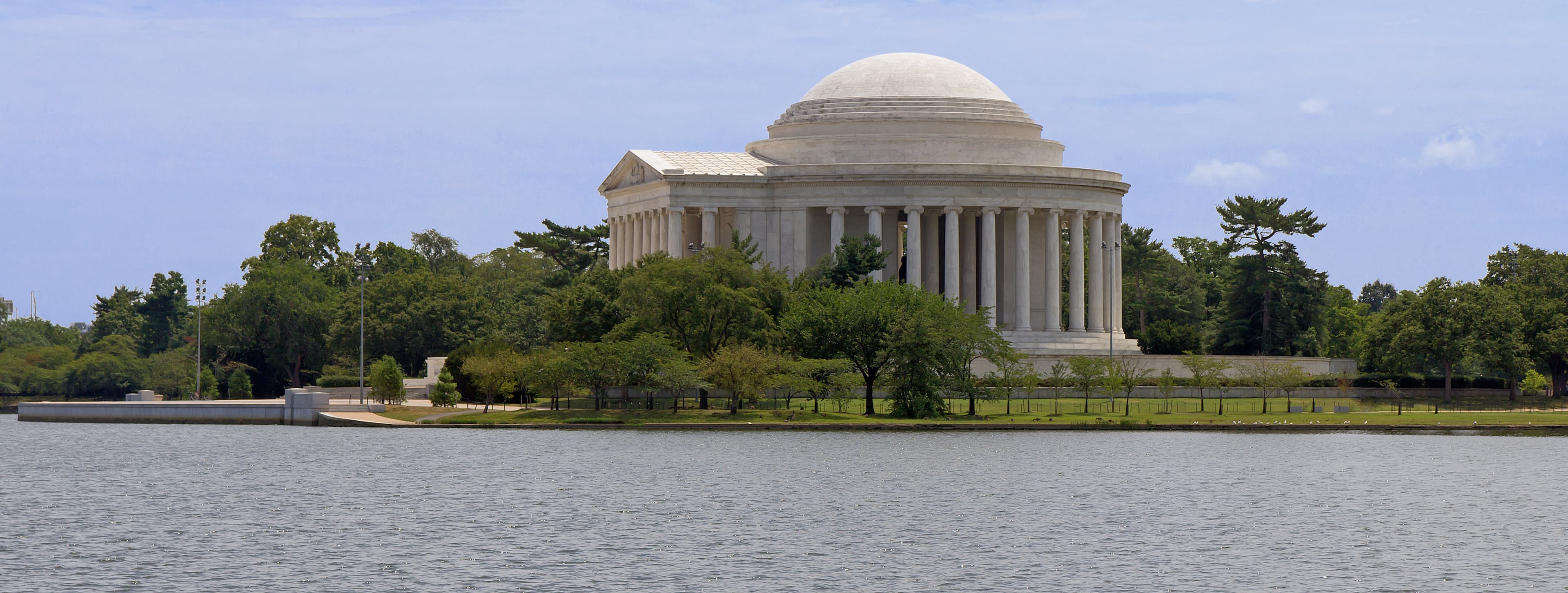
Every first-time visitor to Washington has a list, and the Jefferson Memorial is on all of them — yet it feels nothing like the crowded monuments around it. Set apart on the far side of the Tidal Basin, a white dome rising above the water and the cherry trees, it is the place Washington goes quiet. The memorial honors Thomas Jefferson, the third president of the United States and the principal author of the Declaration of Independence, and it was designed to look the way Jefferson himself liked buildings to look: classical, calm, and certain that reason could order the world.
Jefferson was born on April 13, 1743, in Virginia, and his life reads like a catalog of the early republic. He wrote the Declaration of Independence in 1776, when he was 33. He served as minister to France, as the first secretary of state under George Washington, as vice president under John Adams, and as president himself from 1801 to 1809 — the presidency that bought Louisiana from France and doubled the size of the country. After leaving office he founded the University of Virginia, designing its Rotunda himself, and retired to Monticello, the hilltop house he had designed and redesigned for decades.
He was also a man of deep contradictions, and any honest visit has to hold both halves at once. The man who wrote that all men are created equal enslaved people at Monticello throughout his life, and never freed most of them. The memorial does not resolve that contradiction; it stages it. You stand beneath his words about liberty, and you know who was denied it. That tension is part of why the place still matters: it is not a shrine to a finished story, but a room where Americans keep arguing with their own founding promises.
A Pantheon on the Tidal Basin
The memorial's story starts with Franklin Roosevelt. In 1934, after reading a biography of Jefferson by his friend Claude Bowers, Roosevelt asked the Commission of Fine Arts about building a memorial to Jefferson, and Congress created the Thomas Jefferson Memorial Commission that year. The commission chose John Russell Pope as architect — the same Pope who had designed the National Archives Building and the original west building of the National Gallery of Art. Pope prepared four plans for four different sites, and the commission chose the most prominent: the south shore of the Tidal Basin, directly south of the White House, completing the four-point plan laid out by the McMillan Commission in 1901, with the Lincoln Memorial to the west, the Capitol to the east, and the White House to the north.
Pope's design looked deliberately backward. He modeled the memorial on the Pantheon in Rome — a circular, domed temple ringed with columns — and on Jefferson's own Rotunda at the University of Virginia. The building is a circle of white Imperial Danby marble from Vermont, resting on granite and marble terraces, with a shallow dome over a circular colonnade of 26 Ionic columns, each 43 feet tall. A flight of granite and marble stairs climbs from the Tidal Basin to a portico with a triangular pediment, carved by Adolph Alexander Weinman, showing the Committee of Five presenting the Declaration of Independence to Congress: Jefferson, John Adams, Benjamin Franklin, Roger Sherman, and Robert Livingston.
Pope died in 1937, before construction began, and his partners Daniel P. Higgins and Otto R. Eggers carried the design through. Construction started on December 15, 1938, and Roosevelt himself laid the cornerstone on November 15, 1939. The project cost about $3 million, and it was not built without a fight. The Commission of Fine Arts published a pamphlet in 1939 opposing both the design and the site, and Washingtonians protested the removal of elm and cherry trees — including rare stock from Japan's 1912 gift — that stood in the way. In November 1938, women protesters chained themselves to cherry trees around the construction site, in what became known as the Cherry Tree Rebellion. Revised plans saved most of the trees, and the opposition faded.
The memorial was dedicated on April 13, 1943, the 200th anniversary of Jefferson's birthday, in the middle of the Second World War. Roosevelt, who had championed it, gave the dedication address. It was a wartime dedication for a peacetime idea: that a republic built on words could survive a war against tyranny.
The statue and the words on the walls
Step inside, and the memorial becomes a room for reading. The interior is white Georgia marble, with a floor of pink Tennessee marble and a massive Indiana limestone dome overhead, its lower section coffered and lit to throw light down on the statue. And the statue is the point of the whole building: a 19-foot, 10,000-pound bronze of Jefferson by sculptor Rudulph Evans, standing on a black Minnesota granite pedestal inscribed with the dates 1743–1826, holding the Declaration of Independence in his left hand, gazing north across the basin toward the White House.
Evans won the commission in a 1939 competition that drew 101 entries. But when the memorial opened in 1943, his statue was not ready: wartime material shortages meant the bronze could not be cast, so the dedication ceremony looked upon a plaster cast painted to look like bronze. The real statue, cast by the Roman Bronze Works of New York, was finally installed in April 1947, four years after the dedication.
Around the statue, four panels carry Jefferson's words, chosen by the Memorial Commission to represent the core of his thought. On the southwest wall are excerpts from the Declaration of Independence, including the sentence every American schoolchild knows: "We hold these truths to be self-evident: that all men are created equal, that they are endowed by their Creator with certain inalienable rights, among these are life, liberty, and the pursuit of happiness." Note the spelling on the wall: "inalienable," as in Jefferson's draft, rather than "unalienable," as in the published Declaration.
The northwest panel carries the Virginia Statute for Religious Freedom of 1777, the law Jefferson counted among his proudest achievements — the principle that no one should be compelled to support any religious worship, and that all people should be free to profess their opinions in matters of religion. The northeast panel draws on A Summary View of the Rights of British America, Notes on the State of Virginia, and his letters. The southeast panel carries his 1816 letter to Samuel Kercheval: "I am not an advocate for frequent changes in laws and constitutions. But laws and institutions must go hand in hand with the progress of the human mind."
Above them all, inscribed in the frieze beneath the dome, runs the sentence Jefferson wrote to Benjamin Rush on September 23, 1800: "I have sworn upon the altar of God eternal hostility against every form of tyranny over the mind of man." It is the line that names the whole building: a temple built against tyranny, in the mind above all.
The Tidal Basin and the cherry blossoms
The memorial's setting is half its beauty. The Tidal Basin is a man-made reservoir in West Potomac Park, built by the Army Corps of Engineers between 1882 and 1909 to flush silt from the Washington Channel with the tides. Its banks are ringed with Japanese flowering cherry trees, a gift from the people of Japan first planted in 1912 — about 3,020 trees, most of them Yoshino cherries, whose pale pink and white blossoms open before their leaves each spring.
For about two weeks a year, usually in late March and early April, the basin becomes the most photographed place in America. The National Park Service tracks the buds through six stages toward "peak bloom," defined as the day 70 percent of the Yoshino blossoms are open, and the National Cherry Blossom Festival draws more than a million visitors. The classic view is from the basin's northern edge at sunrise: the memorial's dome across still water, framed by blossom, with the Washington Monument behind you.
But the basin repays a visit in every season. In summer the walk around the water is shaded and far less crowded than the Mall. In autumn the cherry trees turn gold and red, and the paths are nearly empty. And the basin has its own history: the ground here was once a whites-only swimming beach, opened in 1918 on the site of the future memorial and closed in 1925 rather than integrate. The memorial's grounds, designed by landscape architect Frederick Law Olmsted Jr., were deliberately kept simple — evergreens and lawns, so that nothing competes with the marble and the water.
The memorial after dark
If you can only make one trip, make it at night. The memorial is floodlit after dark, and the crowds that fill it by day thin to a handful of people. The marble glows against the sky, the dome reflects in the basin, and the chamber — open to the elements on all sides, as Pope designed it — becomes a place of real stillness. Rangers and regulars will tell you that night is when the building works best: no lines, no noise, just the statue, the words, and the water.
The view from the top step is part of the design. Stand there and you look straight across the basin to the Washington Monument and, beyond it, the White House — the axis Pope and the McMillan Commission intended, tying Jefferson's memorial to the seat of the presidency he held. Turn around and you see the statue framed by columns, lit from below, with the frieze inscription circling overhead. Photographers come for this shot at dusk, when the sky behind the dome goes pink and the lights have just come on; arrive a little before sunset and stay for the change.
The lower level of the memorial holds a small museum about Jefferson's life and political career, and a gift shop. It is worth a few minutes, especially the exhibits on the Declaration's drafting, but the chamber upstairs is the experience. Give it time: read all four panels slowly, walk the full circle of the colonnade, and sit on the steps facing the water before you leave.
Visiting well
The memorial rewards an unhurried visit. Come early in the morning or after dark for the quietest experience; midday, especially during cherry blossom season, is the busiest. Pair it with the other Tidal Basin memorials — the Franklin Delano Roosevelt Memorial and the Martin Luther King Jr. Memorial are both a short walk around the water — or walk the full basin loop, about two miles, for the classic views from every angle.
Wear comfortable shoes: the memorial sits apart from the main Mall museums, and the walk from the nearest Metro is long. The Smithsonian station, on the Blue, Orange, and Silver lines, is the closest stop, roughly a mile away, and the walk across the Mall and around the basin is itself one of Washington's great strolls. Parking along Ohio Drive is limited and fills quickly in blossom season, so transit or a long walk is the better plan. The memorial is wheelchair accessible, with ramps and an elevator to the chamber level.
One honest warning: the Tidal Basin's seawall has been sinking and flooding at high tide for years, and the National Park Service has been rebuilding it — so parts of the basin walk may be under construction when you visit, and paths may detour. Check the Park Service's site before you go, and treat any detour as part of the visit: the basin is a living landscape, still being repaired, just like the ideas the memorial honors.
Key Facts
- The Jefferson Memorial honors Thomas Jefferson, third president of the United States and principal author of the Declaration of Independence.
- It was designed by John Russell Pope, inspired by the Roman Pantheon and Jefferson's Rotunda at the University of Virginia; after Pope's death in 1937, Eggers & Higgins completed it.
- Construction began December 15, 1938; the cornerstone was laid by Franklin Roosevelt on November 15, 1939; the memorial was dedicated April 13, 1943, the 200th anniversary of Jefferson's birth, during World War II.
- The building cost about $3 million and is built of white Imperial Danby marble from Vermont, with a Georgia white marble interior, pink Tennessee marble floor, and Indiana limestone dome.
- The circular colonnade has 26 Ionic columns; the memorial is about 165 feet in diameter with a dome rising 129 feet.
- Rudulph Evans's 19-foot, 10,000-pound bronze statue of Jefferson was installed in April 1947; a painted plaster cast stood in its place at the 1943 dedication because of wartime material shortages.
- The pediment sculpture by Adolph Alexander Weinman depicts the Committee of Five presenting the Declaration of Independence to Congress.
- Four wall panels carry Jefferson's writings: the Declaration of Independence, the Virginia Statute for Religious Freedom (1777), selections on liberty and government, and his 1816 letter to Samuel Kercheval.
- The frieze inscription — "I have sworn upon the altar of God eternal hostility against every form of tyranny over the mind of man" — comes from Jefferson's September 23, 1800 letter to Benjamin Rush.
- The memorial stands on the Tidal Basin in West Potomac Park, ringed by Japanese cherry trees from Tokyo's 1912 gift; it was listed on the National Register of Historic Places on October 15, 1966, and ranked fourth on the American Institute of Architects' list of America's favorite architecture in 2007.
Location Photography