A Resort Strip Built Out of a Boom and a Hurricane
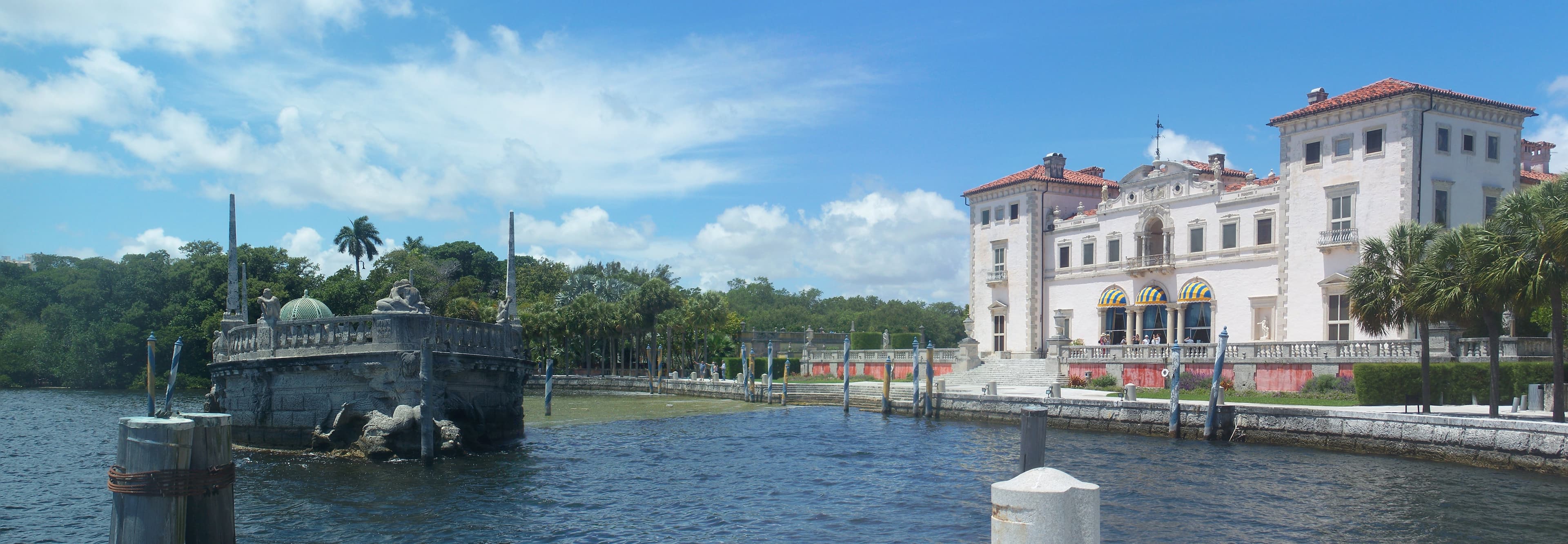
Miami Beach was barely a city when its defining architecture arrived. Developers drained mangrove swamp and pumped up sand in the 1910s and 1920s, and the first resort hotels that rose along the ocean were built in Mediterranean Revival style — stucco walls, red-tile roofs, and Spanish flourishes suited to a fantasy of the Riviera. Then the Florida land boom collapsed in 1925, and the Great Miami Hurricane of 1926 smashed what remained, leaving some 25,000 people homeless across the region. Rebuilding happened under hard times, and hard times produced a new style. Between the late 1920s and the early 1940s, small and mid-sized hotels and apartment houses went up across South Beach in the streamlined, machine-age idiom of Art Deco: cheaper to build than the old revival piles, optimistic by design, and meant to promise vacationers that the future was still coming. The result, compressed into roughly a square mile, is the largest collection of Art Deco architecture in the world — about 960 historic buildings inside the district's boundaries, most raised between 1923 and 1943.
How to Read a Deco Facade
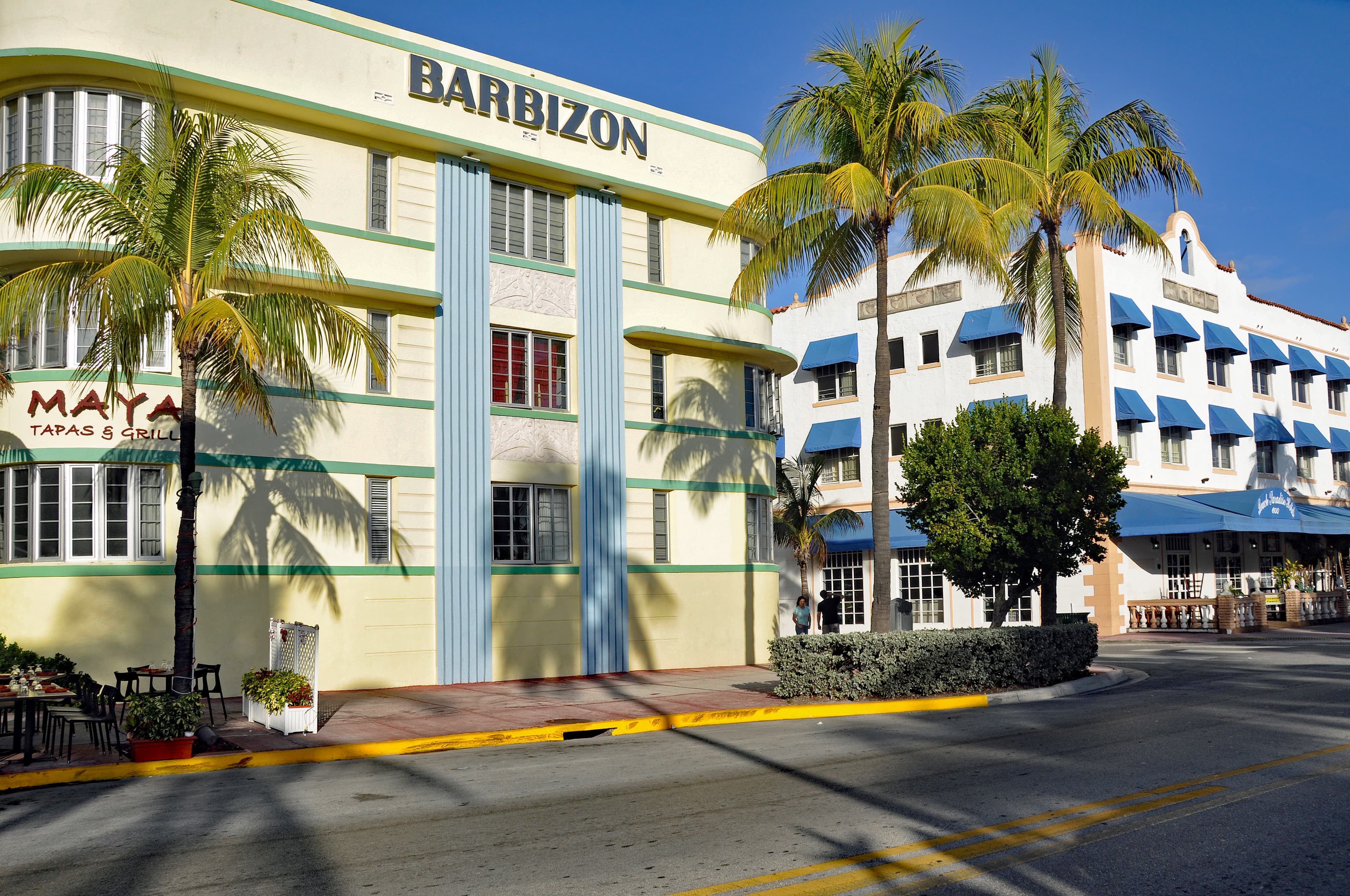
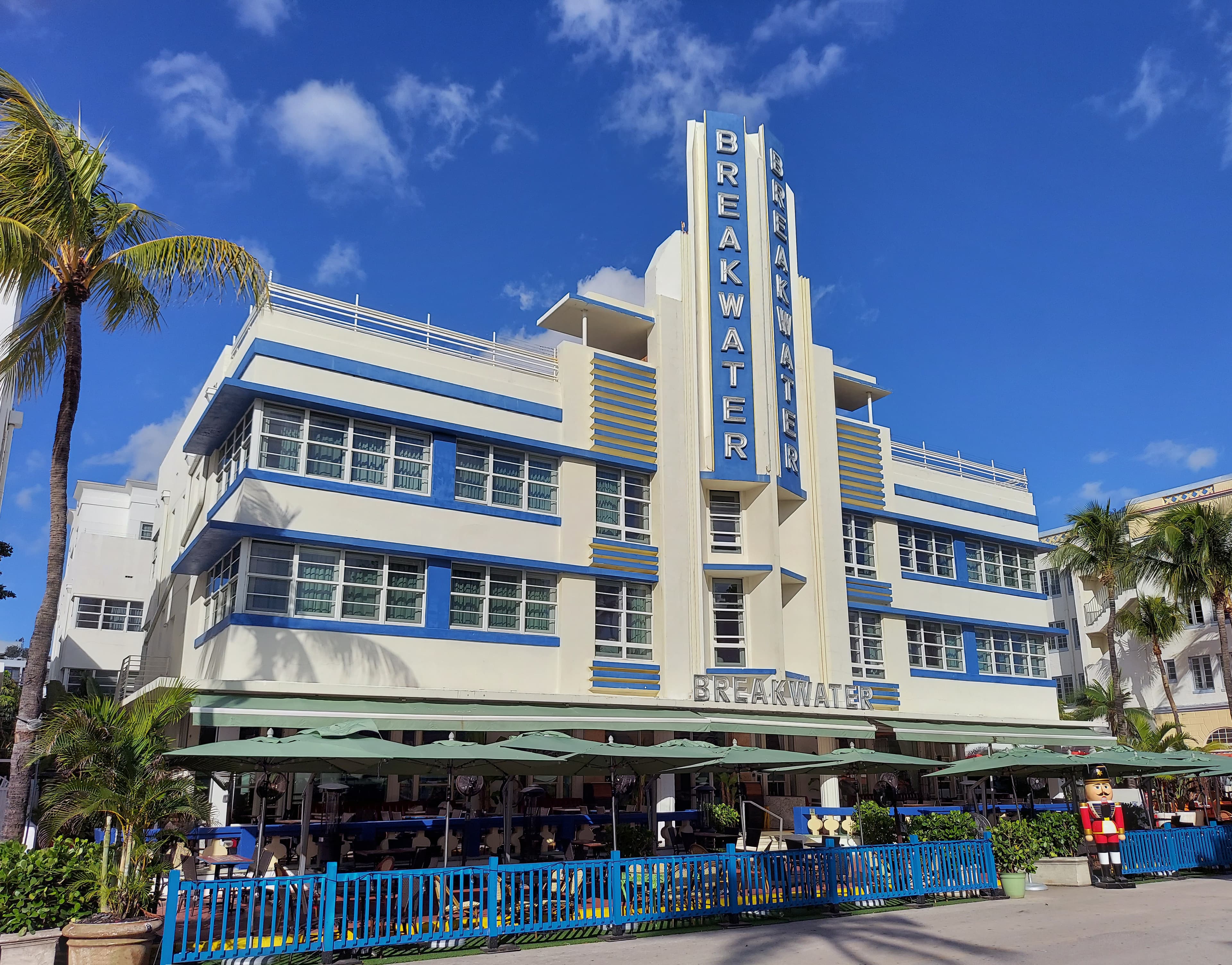
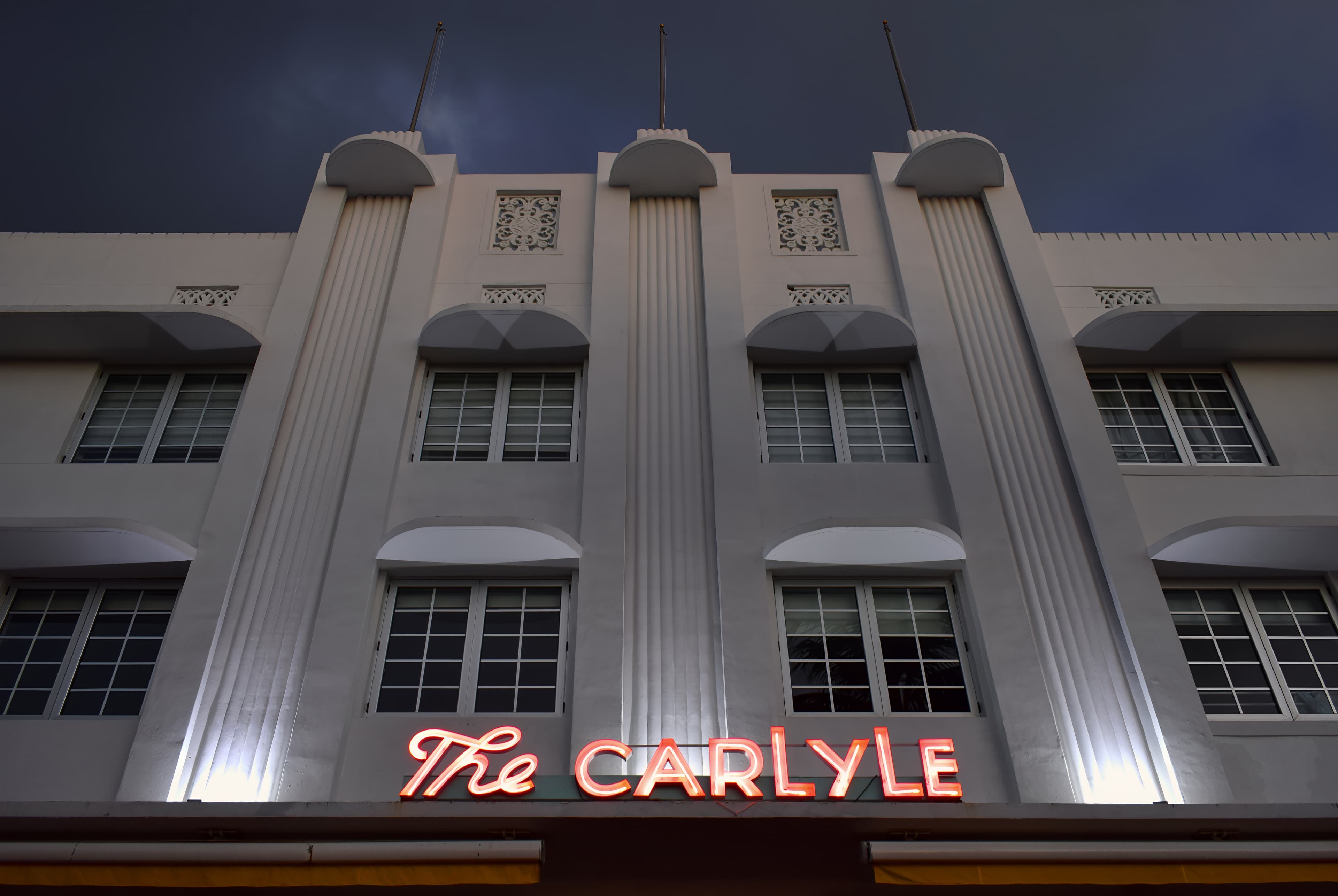
The Ocean Drive hotels, facing Lummus Park and the beach between 5th and 15th Streets, reward a slow walk and a little vocabulary. Look first for symmetry: a central bay stepping up to a sign tower, flanked by identical wings. Then the "eyebrows" — thin concrete ledges that shade the windows like the brim of a hat — and the rounded corners and porthole windows borrowed from the ocean liners these buildings were imitating. Neon signage was designed into the facades from the start, not tacked on later, and vertical sign towers made each small hotel legible down the length of the street. Glass block, terrazzo floors, and neon tubing do the decorative work that carved stone did in older styles, and everything is washed in the famous pastels: flamingo pink, seafoam, butter yellow, powder blue. Interior lobbies extend the theme — terrazzo floors in geometric patterns, coved ceilings, and relief ornament of flamingos, sunbursts, and frozen fountains. These were budget buildings dressed in the language of luxury and speed, designed to be read from a moving car or a beach chair, and the tropical palette — whatever later restorers added, the pastel scheme Capitman's league championed drew on the buildings' own original washes of color — sets them apart from the white and gray Deco of New York or Chicago. A handful of architects produced an outsized share of it — Henry Hohauser, L. Murray Dixon, and Albert Anis among them — stamping block after block with variations on the theme: the Breakwater's sign tower rising like a ship's funnel, the Colony's blue neon, the Carlyle's clean moderne lines. The umbrella term "Art Deco" covers real variety here, from the decorated early buildings through the pared-down Streamline Moderne of the late 1930s to surviving Mediterranean Revival neighbors like the Amsterdam Palace.
Decline, and the Woman Who Stood in Front of the Bulldozers
By the 1970s the district was in trouble. The little hotels had become cheap retirement residences and then simply cheap rooms; paint faded, neon died, and developers eyed the oceanfront land for high-rises. Barbara Baer Capitman, a former journalist who had moved to Miami Beach in 1973 after her husband's death, saw what the locals had stopped seeing. In 1976 she and a small group of preservationists founded the Miami Design Preservation League and began a campaign of candlelight vigils, protest marches, and lobbying — Capitman and her allies famously put their bodies in front of bulldozers. They did not save everything: the Senator and New Yorker hotels were demolished despite the fight. But the campaign built the political case, and on May 14, 1979, the Miami Beach Architectural District was placed on the National Register of Historic Places — an extraordinary designation for a district made almost entirely of 20th-century buildings, most of them younger than the people voting on them.
Pastels, Neon, and a Second Life
Listing alone does not repaint a facade. Through the 1980s the preservation league pushed owners toward restoration and toward color, arguing that the buildings had originally been painted in soft washes and that pastel was both history and marketing. It worked. Restored hotels reopened as boutique properties, sidewalk cafés filled in along Ocean Drive, and the district became a global image: the television series Miami Vice, premiering in 1984 and filmed on location in South Beach, beamed the pastel strip into living rooms worldwide, and fashion photographers followed. Capitman's son Andrew bought and restored the Cardozo Hotel on Ocean Drive, whose café became a gathering spot for artists and designers. Barbara Capitman died in 1990, with the revival she started still gathering speed; 10th Street was later renamed Barbara Capitman Way, and a memorial bust of her now stands in Lummus Park, across from the Cardozo. The league's Art Deco Weekend, a street festival founded in 1978, still draws crowds to Ocean Drive every January.
One Stop Among Many: The Mansion at 1116 Ocean Drive
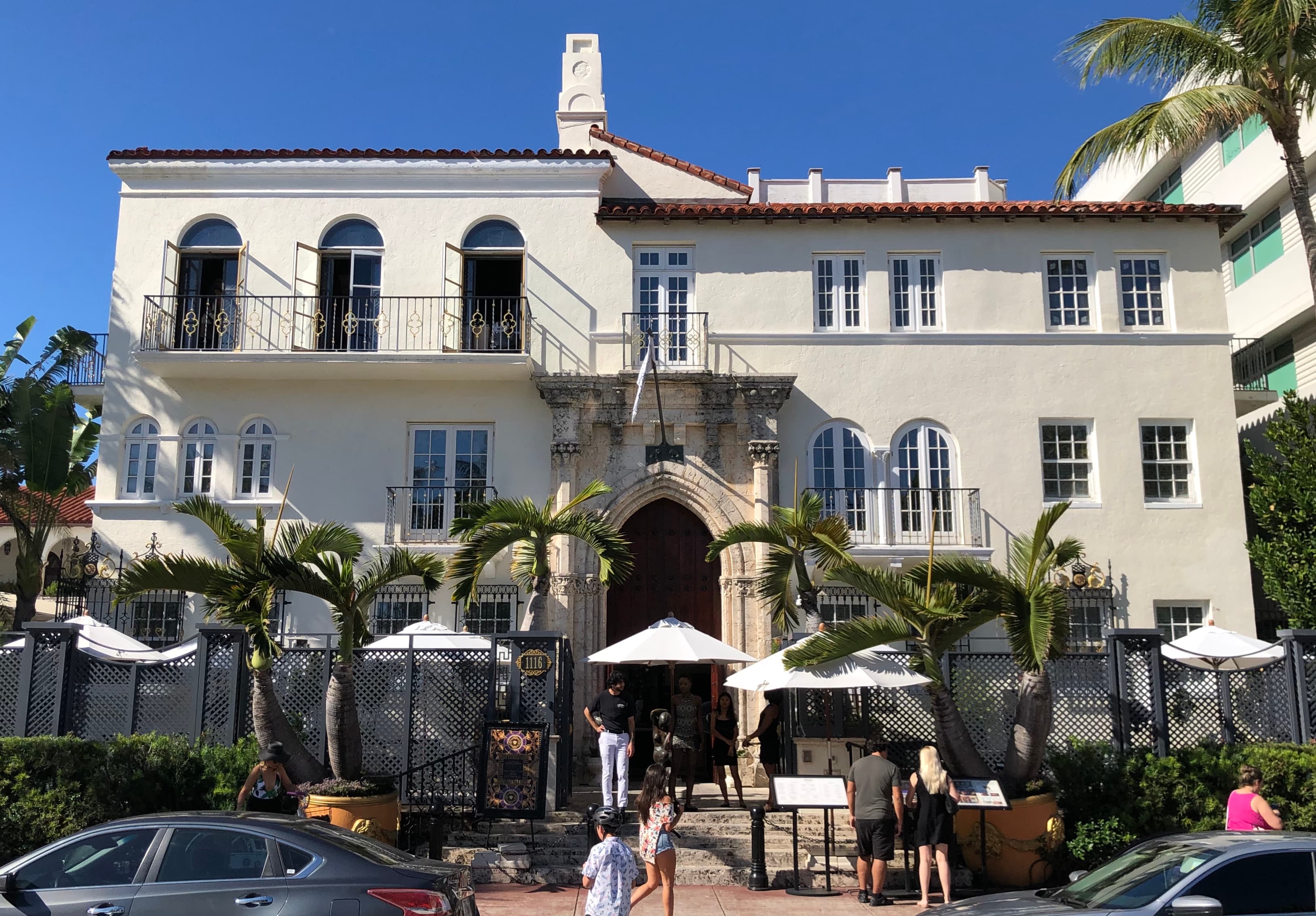
The district's single most photographed address is not, strictly speaking, Deco at all. Casa Casuarina, at 1116 Ocean Drive, is a Mediterranean Revival mansion built in 1930 for Alden Freeman, an heir to a Standard Oil fortune, who modeled it on the Alcázar de Colón in Santo Domingo — a block of the original Dominican structure is set into the wall by the entrance. After decades as an apartment building called the Amsterdam Palace and a long slide into disrepair, it was bought in 1992 by Italian designer Gianni Versace, who restored it as a private palace, demolished the hotel next door for a mosaic pool, and was murdered on its front steps on July 15, 1997 — the crime that fixed the house in the world's memory. It operates today as a luxury boutique hotel, The Villa Casa Casuarina. From the sidewalk it is one ornate gate among a mile of facades, which is the right way to take it: a famous stop on a street where the real attraction is the ensemble.
Seeing the District Well
Ocean Drive is the postcard, but the district rewards wandering a block or two inland: Collins Avenue carries its own run of deco and moderne hotels, Washington Avenue holds the 1927 Old City Hall and the Blackstone, and Española Way offers a Mediterranean Revival village built in the 1920s. The Miami Design Preservation League's Art Deco Welcome Center at 1001 Ocean Drive is the natural starting point, with a small museum and the league's guided walking tours of the district. However you walk it, the district is best understood as a survivor twice over — first of the hurricane and Depression that shaped its style, then of the wrecking-ball era that nearly erased it. What Capitman's campaign proved, and what every repainted eyebrow and relit neon sign since has confirmed, is that a city's most valuable landmark is sometimes not a single great building but a whole streetscape that a generation decided, just in time, not to throw away.
Key Facts
- The Miami Beach Architectural District (Art Deco Historic District) was added to the National Register of Historic Places on May 14, 1979, and contains about 960 historic buildings across roughly a square mile of South Beach — the largest collection of Art Deco architecture in the world.
- Most of the district was built between 1923 and 1943, after the 1925 land-boom collapse and the Great Miami Hurricane of 1926; dominant styles include Art Deco, Streamline Moderne ("Tropical Deco"), and earlier Mediterranean Revival.
- Barbara Baer Capitman co-founded the Miami Design Preservation League in 1976 and led the campaign — vigils, marches, and confrontations with demolition crews — that won the district its listing; she died in 1990, and 10th Street is now Barbara Capitman Way.
- The league's Art Deco Weekend festival has run since 1978, and its Art Deco Welcome Center at 1001 Ocean Drive offers exhibits and guided walking tours.
- Casa Casuarina at 1116 Ocean Drive (built 1930, Mediterranean Revival) was Gianni Versace's home from 1992 until his murder on its steps in 1997; it is now The Villa Casa Casuarina boutique hotel.
- Signature architects include Henry Hohauser, L. Murray Dixon, and Albert Anis; signature details include "eyebrow" window shades, sign towers, portholes, glass block, and pastel stucco.
Visitor Details
Address: The district centers on Ocean Drive between 5th and 15th Streets, Miami Beach, FL 33139; start at the Art Deco Welcome Center, 1001 Ocean Drive. Casa Casuarina is at 1116 Ocean Drive.
Transit: Miami Beach is reached from downtown Miami by bus across the MacArthur Causeway; within South Beach, the free Miami Beach trolley's South Beach loop stops throughout the district. Rideshares and garages (e.g., on Collins Avenue) serve drivers; street parking is scarce.
Hours/Admission: The district itself is public streetscape, open at all hours and free to walk. The Art Deco Welcome Center and its guided walking tours run on the Miami Design Preservation League's schedule — check mdpl.org for current tour times and ticket prices before going. Casa Casuarina is a private hotel and restaurant; the interior is for guests, and the famous facade and gates are viewed from the sidewalk.
Best timing: Early morning for the east-facing Ocean Drive facades in full sun and thinner crowds, then again at dusk when the neon comes on and the pastel washes turn to glow. Art Deco Weekend in January is the district's biggest celebration; allow at least half a day for a walking tour plus a slow Ocean Drive pass.