A Hilltop Called Mount St. Sepulchre
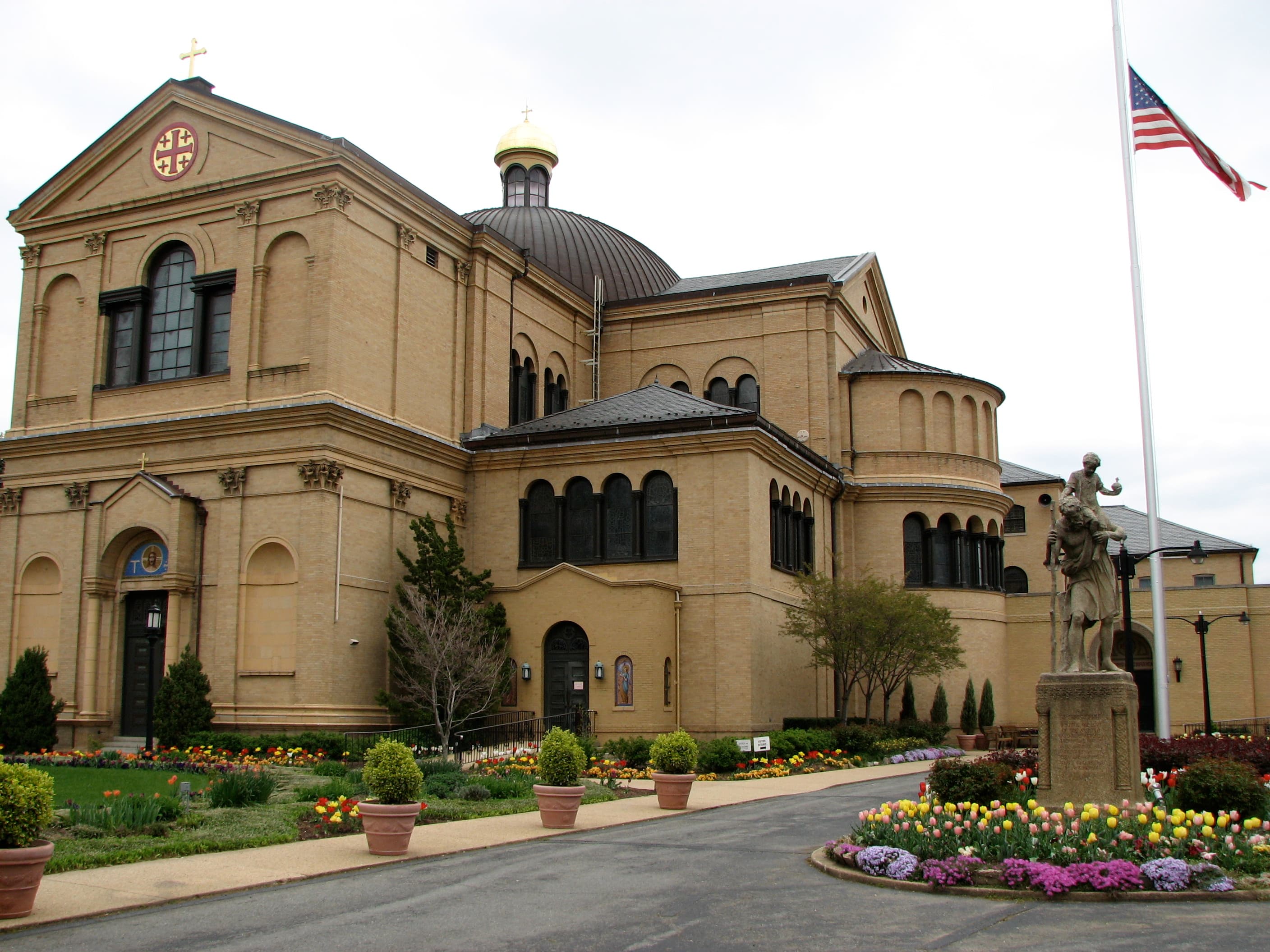
Brookland, in Northeast Washington, is a neighborhood of porches, gardens, and Catholic institutions — locals have long called it "Little Rome." Its highest devotional ground is a wooded hill at 14th and Quincy Streets NE that the Franciscan friars named Mount St. Sepulchre. On its 44 acres stands the Franciscan Monastery of the Holy Land in America: a friary anchored by the Memorial Church of the Holy Sepulchre, ringed by gardens, a cloister-like portico, and a scatter of shrines. Nothing about the leafy approach prepares you for what the place actually is. This is a scale model of the sacred geography of two continents — the Holy Land above ground, and ancient Rome below it.
One honesty note belongs at the front, because the friars themselves make it: everything here is a replica. The shrines are full-size recreations built to evoke the originals in Jerusalem, Bethlehem, Nazareth, Lourdes, Assisi, and Rome, measured and photographed on site by the founders so that Americans who could not travel could stand somewhere that felt like the real places. The catacombs under the church are not an excavated ancient burial ground; they are a deliberate, carefully made reproduction of Rome's underground cemeteries. Knowing that does not diminish the experience. In some ways it sharpens it — this is a monument to longing, built by people who believed a copy, honestly made, could carry real devotion.
A Holy Land in America
The idea began with the U.S. Commissariat of the Holy Land, established in New York City in 1880 by the Very Reverend Charles A. Vassani to support the Franciscans' work at the shrines overseas — the order has cared for the Holy Land's Christian sites for centuries. Vassani and Father Godfrey Schilling began planning something more ambitious than fundraising: a "Holy Land in America," with a Holy Sepulchre of its own. Their first choice was a high hill on Staten Island overlooking New York Harbor. The plan later shifted to a wooded hilltop in Brookland, and in 1897, after Vassani's death, Father Schilling purchased the abandoned McCeeney Estate and moved in with six Brothers, who lived in the derelict house while the work began.
Schilling traveled to the Holy Land to take measurements and photographs of the holy sites themselves, so the Washington reproductions would follow the originals rather than imagination. Ground was broken in February 1898 and the cornerstone laid on Saint Joseph's Day. The church was completed and dedicated in 1899, and consecrated in September 1924, on the twenty-fifth anniversary of its dedication. The surrounding shrines, gardens, and portico grew over the following years. The complex — formally the Franciscan Monastery and Memorial Church of the Holy Land — was listed on the National Register of Historic Places on January 17, 1992. Technically, the community is a friary, a home for friars rather than monks; "monastery" survives by tradition and because, by now, it is simply the landmark's name.
Leonori's Neo-Byzantine Church
The Memorial Church of the Holy Sepulchre was designed by the Roman architect Aristide Leonori, who would go on to design work including the Cathedral Basilica in St. Louis. Its plan loosely follows the fivefold Jerusalem cross, and its neo-Byzantine massing — domed, solemn, and Eastern-looking against the Washington sky — deliberately recalls both the Church of the Holy Sepulchre in Jerusalem and Hagia Sophia in Constantinople, with Romanesque touches worked in. It is one of the most architecturally distinctive churches in the city, and it announces the monastery's method from the street: quotation as devotion, every form pointing somewhere older and farther away.
Around the church runs the Rosary Portico, designed by John Joseph Earley, the Washington innovator in decorative concrete. Its fifteen chapels depict the mysteries of the Rosary, and each carries plaques with the Hail Mary in nearly two hundred ancient and modern languages. The portico echoes the cloisters of St. John Lateran and St. Paul's Outside the Walls in Rome, while symbols drawn from the Roman catacombs decorate the church facade above it — a first hint of the world waiting below. Attached to the church is the neo-Romanesque monastery building, with the friars' archive and library, and gardens roll away downhill: formal plantings near the church, more than a thousand roses, and woodland paths below.
Down Into the Replica Catacombs
The lower level of the church is where the visit turns strange and moving. On the guided tour — and this matters for planning: the catacombs and lower church can only be seen on a guided tour, with the guide, and the lower level is reached by stairs — you descend into a recreation of the catacombs of Rome: low, narrow, dim passages lined with burial niches in the early Christian manner, shrines, and altars modeled on what the founders documented in Italy. The route also takes in the Purgatory Chapel and the lower-level grottoes of the Visitation and the Nativity. It is a constructed underground, and the tour says so; the power of the place comes from how seriously the construction takes its subject.
One thing down here is not a copy. The catacombs hold the bones of Saint Benignus of Armagh, an early Irish martyr, brought from the Roman catacombs themselves and originally kept in the cathedral of Narni, Italy, before coming to Washington. That single authentic relic, resting inside a reproduction, captures the whole monastery in miniature: the replicas are the setting, built with scholarly care, but the devotion they were built to hold is entirely real. Above ground, the same pattern repeats — full-size replicas of the Holy Sepulchre and Mount Calvary shrines inside the church, the Grotto of the Nativity and the Annunciation reproduced from Bethlehem and Nazareth, and, out in the gardens, a Lourdes grotto and a replica of the Porziuncola, the little Assisi chapel where St. Francis began his work.
Gardens, Roses, and Quiet
However you arrive — as a pilgrim, an architecture student, or a Brookland neighbor out for a walk — the grounds are the monastery's gift to the city. Visitors of all faiths are welcome to wander the church and gardens on their own; only the lower level requires the tour. The upper gardens are formal, framed by the Rosary Portico, with boxwood, statuary, and seasonal plantings. The lower gardens loosen into woodland, where paths wind past the Stations of the Cross, grottoes, and small chapels, and where the volunteer Franciscan Monastery Garden Guild tends vegetables and leads garden walks in season. On a weekday morning the hill can feel almost empty — birdsong, a friar crossing the portico, the dome of the church over the trees.
That quiet is the point the founders were building toward. The Commissariat's work was always practical — train friars for service in the Holy Land, support the shrines and the people around them, and give Americans who would never cross the ocean a place to make a pilgrimage anyway. A century and a quarter on, the monastery still does all three jobs from one Brookland hilltop, and it remains what it was designed to be: not the Holy Land, and never pretending to be, but the closest and most loving evocation of it that American brick, concrete, and conviction could build.
Key Facts
- The Franciscan Monastery of the Holy Land in America (Mount St. Sepulchre) stands at 1400 Quincy St NE in Brookland, on 44 acres; listed on the National Register of Historic Places on January 17, 1992 (reference no. 91001943).
- Founded from the U.S. Commissariat of the Holy Land (est. 1880); Father Godfrey Schilling bought the McCeeney Estate in 1897, ground was broken in 1898, and the church was dedicated in 1899 and consecrated in 1924.
- The Memorial Church of the Holy Sepulchre, designed by Aristide Leonori, is neo-Byzantine, its plan loosely following the fivefold Jerusalem cross and recalling Jerusalem's Holy Sepulchre church and Hagia Sophia.
- All shrines are replicas: full-size recreations of the Holy Sepulchre, Mount Calvary, the Nativity and Annunciation grottoes, a Lourdes grotto, and the Porziuncola, built from measurements and photographs taken at the originals.
- Beneath the church is a recreation of the Roman catacombs, accessible only on the guided tour; it holds the genuine relics of St. Benignus of Armagh, brought from the Roman catacombs via Narni, Italy.
- The Rosary Portico (John Joseph Earley) has 15 chapels with the Hail Mary in nearly 200 languages; gardens hold 1,000+ roses. Per the monastery's official site (myfranciscan.org), there is no tour fee; donations are appreciated.
Visitor Details
Address: Franciscan Monastery of the Holy Land in America, 1400 Quincy St NE, Washington, DC 20017 (at 14th and Quincy Streets NE, Brookland).
Transit: Brookland–CUA station (Metro Red Line), then about a mile's walk east through Brookland or a connecting bus; free parking is available on site for drivers.
Hours/Admission: The church and gardens can be visited on your own; the catacombs and lower church are seen only on the guided Church and Catacomb Tour. Per the monastery's official site (myfranciscan.org, verified for this article), tours run Monday–Saturday at 10 a.m., 11 a.m., 1 p.m., 2 p.m. and 3 p.m., and Sunday at 1 p.m., 2 p.m. and 3 p.m.; there is no tour fee, donations are appreciated, and groups of six or more should reserve. Check the official site for current tour times before a special trip. Note: the lower church is reached by stairs only and is not wheelchair accessible.
Best timing: A weekday morning tour for the quietest catacombs and empty gardens; late spring pairs the visit with the rose gardens in bloom, and Saturday garden tours run in season (see the official calendar).
Franciscan Monastery of the Holy Land in America — Context Photography