The Ship That Never Sails
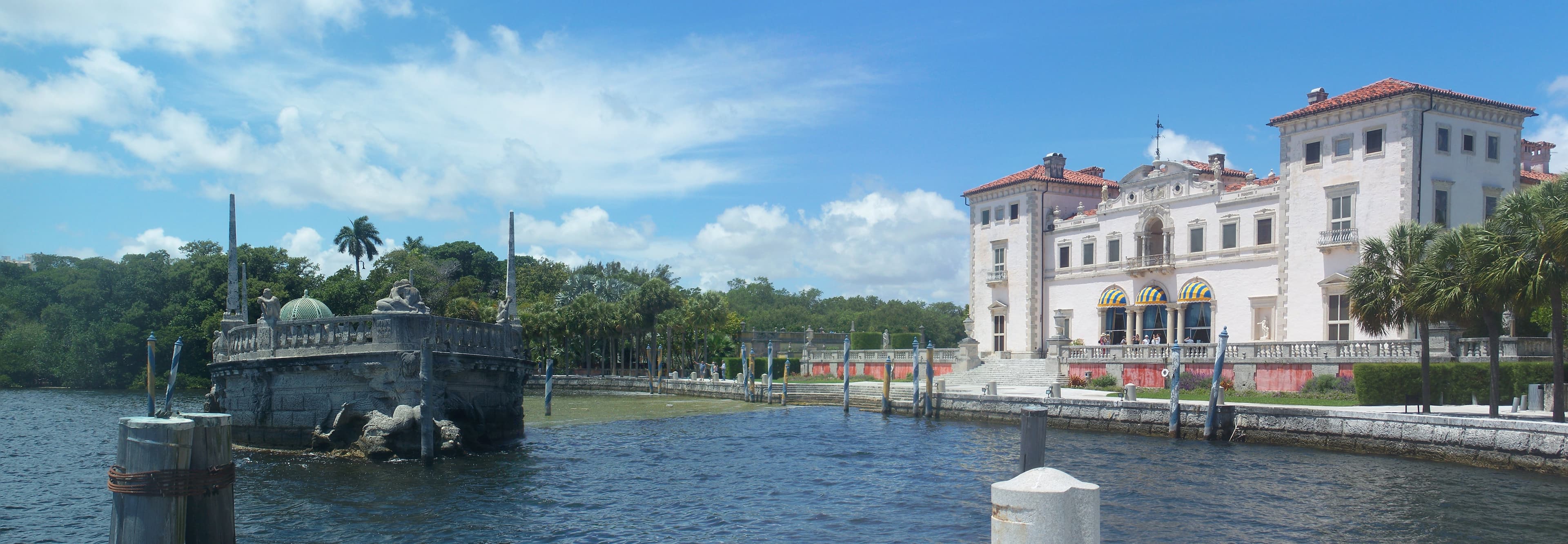
Walk out of Vizcaya's east loggia, cross the terrace, and look down into Biscayne Bay. Riding at anchor in the shallows, apparently forever, is a ship — high-prowed, carved with figures, with obelisks at its corners. It has never carried anyone anywhere. The Barge, as it is simply called, is a monumental breakwater built of stone in the form of a boat, set in the water directly in front of the Main House of the estate that industrialist James Deering built between 1914 and 1922 as his winter home. Deering wanted Vizcaya approached and seen from the sea, and the east front — the bay front — is the house's grand, symmetrical face. The Barge completes the composition: part sculpture, part stage set, part seawall. In Deering's day it was not a ruin or a monument but a destination in its own right, planted with full-grown trees, shaded by a latticework pavilion, and spouting fountains, reached the only way it has ever been reached — by boat, for parties on the water. It is the first clue that Vizcaya's famous house is only half the architecture on the site.
Calder's Caribbean Bestiary in Stone
The Barge was sculpted by Alexander Stirling Calder (1870–1945) — father of the mobile-maker Alexander Calder — and Vizcaya's own catalog calls it the most outstanding of the estate's twentieth-century features. Commissioned in 1915, Calder designed the figures in his studio; plaster models were made from his clay originals and shipped to Miami by train, where a team of stonecutters roughed out the work in coral stone before Calder arrived on site in 1917 to finish the carving. The program is a fantasy of the sea rendered in limestone: mermaids and tritons at prow and stern, a reclining sea mother, eight grotesque masks along each side, and carvings representing mythical Caribbean creatures — the delights and terrors of the ocean, in the Smithsonian's summary, localized to Florida waters. Egyptian obelisks punctuate the composition. The collaboration was not frictionless: Deering objected that one of the female figures' proportions were too generous, and Calder, who did not wish to rework the stone, relented only when additional compensation was agreed. The episode is a small, perfect window into how Vizcaya was made — an exacting patron, first-rate artists, and money closing every argument.
A Breakwater First, and the Hurricanes' Target
For all its ornament, the Barge had a job. Vizcaya's terrace and seawall face open water, and the stone hull was built to break the force of waves and calm the water immediately offshore — an artificial harbor wall disguised as a Roman pleasure barge. The disguise has paid for its keep in exposure. Standing alone in the bay, the Barge takes the full force of every storm that crosses Biscayne Bay, and it has suffered significant hurricane damage since the great hurricane of 1926; the Smithsonian's sculpture inventory records extensive damage again in Hurricane Andrew in 1992, with restoration under way at the time of its survey. Trees, pavilion, and fountains are long gone; waves and salt have softened the carving. What remains reads less as Deering's party deck than as a wreck that refused to sink — and preservationists treat it accordingly, as one of the estate's most significant and most threatened works. From the terrace it still does its double duty, quieting the water and framing the view, a piece of infrastructure that happens to be a masterpiece of American sculpture.
Across the Avenue: The Village That Fed Vizcaya
Now turn around, walk out the west gates, and cross South Miami Avenue. Here, on about 12 acres, stands the other Vizcaya — the one on almost no postcards. Vizcaya Village was the estate's working farm and service compound, modeled on the self-sufficient villages of the Italian estates that inspired the main house, built at a time when Miami was still a raw outpost and everything an estate of this size consumed had to be produced, repaired, or stored on the property. At its height the village comprised a dozen or more buildings — sources count 12 original buildings; a museum tour document records fifteen originally, of which eleven survive — including a dairy barn, a chicken house, a stable, a farmhouse, a wagon shed, staff housing including the superintendent's house, a garage, blacksmith's and mechanic's shops, a paint shop, greenhouses, and gardens that grew produce and flowers for the house. This was the estate's engine room: the village fed Deering's guests and staff, housed workers, maintained the machines, and watered the grounds. When the main house was a museum piece in the making, the village was a farm that happened to share its fence.
The Village's Long Second Life
The village outlived its purpose in stages. From the 1950s its buildings served as offices for the county Parks Department, and around 1960 the old Miami Science Museum rose on part of the grounds. Deering's heirs had donated the main estate to Miami-Dade County in 1952, and Vizcaya opened as a public museum in 1953 — but the village stayed the backstage, half-seen across the avenue. Its restoration is now the museum's great project. A master plan to revitalize the village was approved by the Miami-Dade County Commission in 2017; the science museum's departure let Vizcaya reclaim and reforest that land, the superintendent's house became offices, the paint shop a horticultural complex, and a café and community garden opened on weekends. The current phase focuses on restoring five historic buildings — the chicken house, dairy barn, farmhouse, stable, and wagon shed — toward classrooms, workshops, a teaching kitchen, and a center for learning, a campaign given major momentum by a $20 million gift announced in 2025. It is a telling shift in what historic houses are for: the servants' and farmers' Miami, not just the millionaire's, is now the part of the estate being rebuilt first. The story the museum wants to tell is the whole one at last: the villa and the village, the mermaids in the bay and the cows across the street, as a single built world — which is how Deering's architects, F. Burrall Hoffman, designer Paul Chalfin, and landscape architect Diego Suarez, designed it between 1914 and 1922.
Key Facts
- Vizcaya, at 3251 South Miami Avenue in Coconut Grove, was built 1914–1922 as the winter estate of James Deering; the Main House was designed by architect F. Burrall Hoffman with artistic director Paul Chalfin and landscape architect Diego Suarez. It opened as a public museum in 1953 and is a National Historic Landmark (designated 1994).
- The Barge is a monumental stone breakwater in Biscayne Bay in front of the Main House, shaped as a boat and functioning to calm the water offshore. Sculpted by Alexander Stirling Calder (commissioned 1915; carved on site by 1917), it is decorated with mermaids, tritons, grotesque masks, mythical Caribbean creatures, and Egyptian obelisks; in Deering's time it carried trees, a latticework pavilion, and fountains, and was reached by boat.
- The Barge has suffered repeated hurricane damage, notably in 1926 and in Hurricane Andrew (1992); its plantings and pavilion are lost and the carving is weathered, making it one of the estate's most threatened features.
- Vizcaya Village, across South Miami Avenue from the Main House, was the estate's working farm: about 12 acres with a dairy barn, chicken house, stable, farmhouse, wagon shed, garage, workshops, staff housing, and greenhouses. Eleven historic buildings survive.
- A county-approved master plan (2017) is restoring the village as a community and education hub; the first restoration phase targets five buildings (chicken house, dairy barn, farmhouse, stable, wagon shed), supported by a $20 million gift announced in 2025.
Visitor Details
Address: 3251 South Miami Avenue, Miami, FL 33129 — the Main House, gardens, and Barge are on the bay (east) side of the avenue; Vizcaya Village is directly across South Miami Avenue on the west side.
Transit: The estate is served by the Vizcaya Station of the Miami Metrorail, a short walk away. Free parking is available on site on the village side of the avenue.
Hours/Admission: Vizcaya Museum and Gardens is open to the public most days and closed on Tuesdays and certain holidays, per its official site; the Village grounds have their own, more limited public hours and programming (including a Sunday farmers market). Do not rely on third-party listings — check vizcaya.org for current hours, admission fees, and which village buildings are open before you go.
Best timing: Morning, for the classic east-front view of the house with the Barge in the bay before the midday heat, then cross the avenue to the village while the light is still good. Allow half a day for house, gardens, and village together; the Barge itself is viewed from the terrace and seawall — it is not open to boarding.
Location Photography