A Gift Built in Nagoya
Shofuso — Japanese for "Pine Breeze Villa" — was conceived in the aftermath of war as an act of friendship. The Museum of Modern Art in New York had begun its "House in the Garden" exhibition series in 1949, and its curators proposed a Japanese house as the third exhibit, recognizing how closely traditional Japanese architecture corresponded to Western modernism. John D. Rockefeller III and MoMA curator Arthur Drexler traveled to Japan in February 1953 to seek support; the Japan-America Society agreed to sponsor the project and declared the house should be donated by Japan as a gift to the American people to promote cultural exchange, raising ¥18.5 million from 270 corporations and individuals, with government and private support. Japan's National Forestry Agency granted special permission to harvest hinoki cypress, then in short supply. A Rockefeller committee recommended a 17th-century shoin-zukuri house as the style that most typically represents traditional Japanese architecture, and chose architect Junzō Yoshimura unanimously to design it. Pre-assembly began in January 1953 at the Nagoya workshop of master carpenter Heizaemon Ito, the 11th generation of a family that had served as master carpenters to the Tokugawa shogunate since the 17th century, using traditional methods and hand tools that minimize the use of structural nails.
Two Seasons in the MoMA Courtyard
The house was disassembled, shipped to New York, and reassembled in MoMA's courtyard by a team led by Yoshimura, completed in mid-June 1954 with the help of Hawaiian Nisei carpenters. It opened to the public on June 19, 1954; Japanese Prime Minister Shigeru Yoshida visited that November, escorted by John D. and Blanchette Rockefeller. American visitors responded to exactly what its makers hoped they would notice — the beauty of natural wood, the simple interior, and the flexible plan created by sliding partitions. The exhibition closed on October 16, 1955, after drawing almost a quarter of a million visitors across two seasons, roughly three times the attendance of MoMA's two previous house exhibitions. Unlike its predecessors, Shofuso was not meant to disappear afterward. MoMA received a number of inquiries about a permanent home, and the final decision was to offer the house as a gift to the Fairmount Park Commission in Philadelphia — a choice likely inspired by the Japanese garden already established in Fairmount Park.
A Site That Was Already Japanese
Philadelphia's ground was ready because it had been Japanese, on and off, for eighty years. The site in West Fairmount Park stands where the Centennial Exposition of 1876 first introduced many Americans to Japanese design. In the early 20th century the spot held the Nio-Mon Temple Gate, a building dating to around 1600 from Hitachi Province that had been exhibited at the 1904 World's Fair in St. Louis and then relocated to Fairmount Park; the area around it was landscaped with a Japanese garden and lotus pond in 1909, funded by John T. Morris and built by landscape designer Y. Muto. Fire destroyed the Temple Gate on the evening of May 6, 1955 — the same year Shofuso's MoMA run ended — leaving, as fate would have it, an ideal vacant site. In 1958 the carpenter Okumura and the gardener Sano, who had built Shofuso at MoMA, returned from Japan to reconstruct it in Philadelphia, and the house in its present setting opened to the public on October 19, 1958.
Shoin-Zukuri, and Waterfalls on Paper
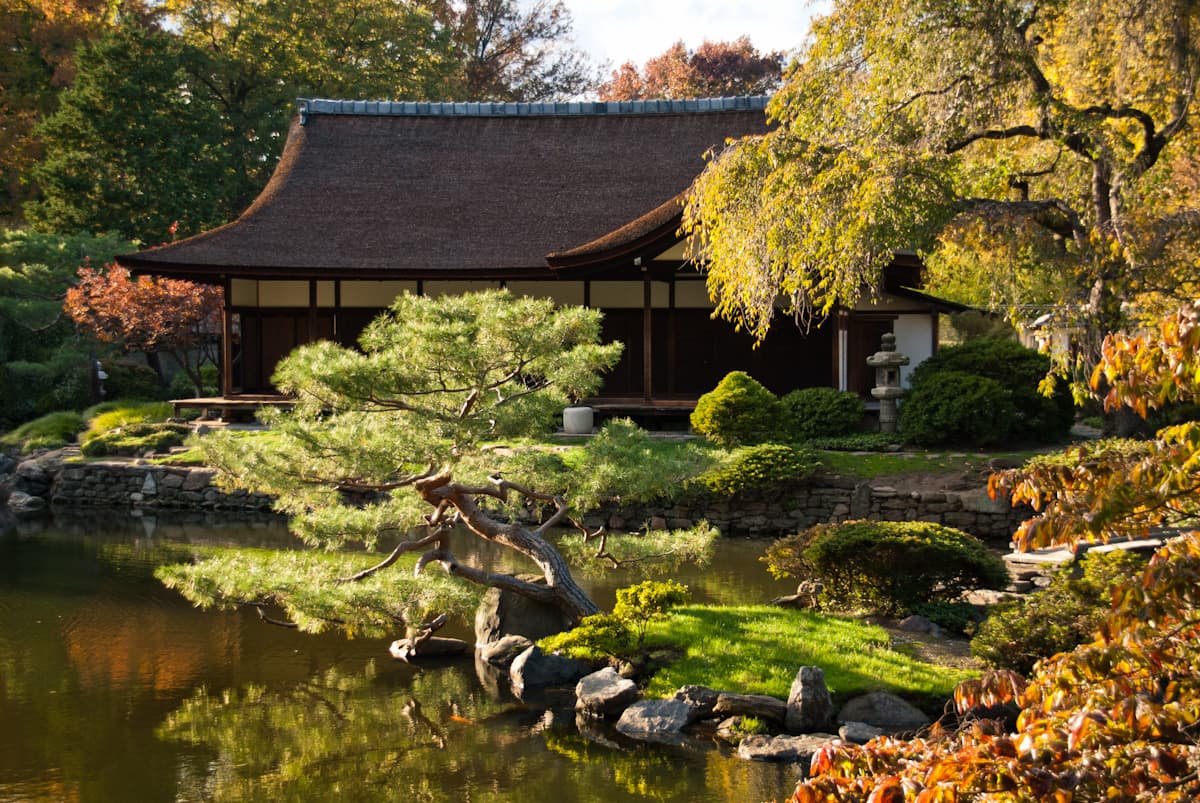
Shofuso was modeled after the guest house of Kojo-in, a sub-temple of Mii-dera in Ōtsu built in 1601, which contains all four major components of shoin-zukuri architecture: an attached desk, a staggered shelf, a tokonoma alcove, and a chodai-gamae, or built-in ornamental doorway. Yoshimura did not copy Kojo-in; he adapted its proportions for the MoMA courtyard and added a kitchen, a bath, and a tea house modeled on a celebrated example at Juko-in in Kyoto, to make a functional house that would teach American visitors how the style works. Inside, tatami floors, shoji and fusuma partitions, and the famous hinoki bark roof — built from cypress harvested by special permission — carry that lesson. The interior's art has its own history: the original murals by Kaii Higashiyama were destroyed by vandalism, and in 2007 the Nihonga painter Hiroshi Senju donated twenty new waterfall murals, painted on specially made mulberry paper in a custom "Shofuso color" blended from pigments extracted from elements of the house and garden. The City of Philadelphia dedicated them on April 27, 2007, and Shofuso became the first and only place in the United States to house contemporary Japanese art within traditional Japanese architecture in this way.
The Garden by Tansai Sano
The garden that frames the house is a work of the same seriousness. It was designed by Tansai Sano, a Kyoto landscape architect whose family had been caretakers of the famous dry garden at Ryōan-ji temple for six generations; eighty main stones were shipped from an old temple site in central Japan for the MoMA installation. When Shofuso moved, Sano modified his design for the Philadelphia ground originally laid out by Muto in 1909, installing a waterfall and a new planting scheme, and Ken Nakajima made further changes, including the berm, during the 1976 restoration. The result, about 1.2 acres, combines three gardens in one walled site as the operating society describes them: a viewing garden with a koi pond, island, and tiered waterfall; a tea garden with a traditional tea house; and a courtyard garden. It has been ranked the third-best Japanese garden in North America by the Journal of Japanese Gardening in 2004, 2008, and 2013, out of more than 300 gardens surveyed.
Restoration, Stewardship, and a Seasonal House
Shofuso suffered from lack of maintenance in its first Philadelphia decades. In 1975 Mayor Frank Rizzo asked the Consulate General of Japan in New York about restoring it for the American Bicentennial; the Japan-America Society raised ¥55 million to fund a complete restoration of house and garden in June 1976, carried out by Japanese artisans. To secure its ongoing care, the Friends of the Japanese House and Garden was incorporated in February 1982; that non-profit administered Shofuso until 2016, when it merged with the Japan America Society of Greater Philadelphia, which now operates, maintains, and preserves the city-owned site. Shofuso draws more than 30,000 visitors a year, is listed on the Philadelphia Register of Historic Places (2013), and is a contributing structure to the Fairmount Park National Historic District. It is, by design, a seasonal house — the official site announced a March 19 opening day for its 2025 season after winter closure — so its calendar is part of its character: a building made of wood, paper, and bark that rests through the Philadelphia winter and reopens with the cherry blossoms.
Key Facts
• Built in 1953 in Nagoya, Japan, designed by architect Junzō Yoshimura and built under master carpenter Heizaemon Ito (11th generation) using traditional techniques and materials, as a gift from Japan to the American people symbolizing post-war peace and friendship.
• Exhibited in the Museum of Modern Art courtyard in New York from June 19, 1954 to October 16, 1955, drawing almost 250,000 visitors, then gifted to the Fairmount Park Commission and reconstructed in West Fairmount Park, opening there on October 19, 1958.
• A 17th-century-style shoin-zukuri house modeled on the 1601 Kojo-in guest house, with tatami rooms, a tea house, and a hinoki bark roof; its site had held a Japanese garden since 1909 and the c. 1600 Nio-Mon Temple Gate until fire destroyed the gate in 1955.
• The 1.2-acre garden was designed by Tansai Sano, further modified by Ken Nakajima in 1976, and ranked third among Japanese gardens in North America by the Journal of Japanese Gardening in 2004, 2008, and 2013.
• Restored by Japanese artisans in 1976 for the Bicentennial; since 2007 it has housed twenty waterfall murals donated by Hiroshi Senju. Owned by the City of Philadelphia and operated by the Japan America Society of Greater Philadelphia; more than 30,000 visitors a year.
Visitor Details
Address: Horticultural and Lansdowne Drives, West Fairmount Park, Philadelphia, PA 19131
Transit: West Fairmount Park location near the Horticulture Center; driving and SEPTA bus access serve the park — check the official site at japanphilly.org/shofuso for current directions, parking, and group tour information.
Hours/Admission: Shofuso is seasonal and closed in winter — the official site listed March 19 as opening day for the 2025 season, and other official listings describe a season running through the fall (generally April through October, Wednesday through Sunday in past seasons). Do not rely on a fixed schedule from third-party listings: confirm the current season's opening and closing dates, daily hours, and admission prices on the official website before visiting, and book tickets there where offered.
Best timing: Spring for cherry blossoms around the Subaru Cherry Blossom Festival season, and fall for maple color in the viewing garden. Arrive earlier in the day for a quieter house; allow about an hour for the house, the Senju murals, and the pond, waterfall, and tea gardens.
Location Photography