The building at the center of the city
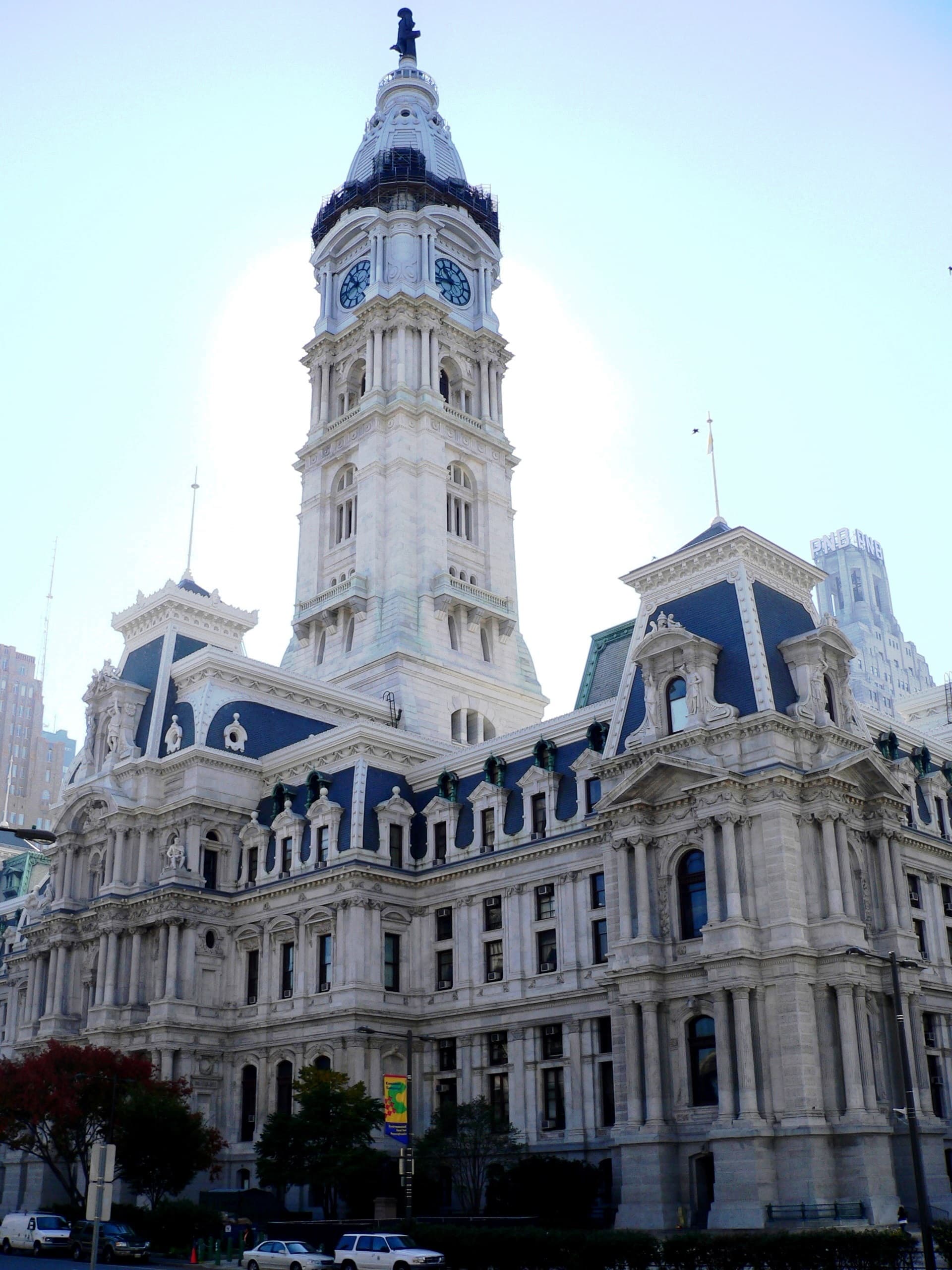
Stand at the crossing of Broad and Market Streets, in the middle of Center City, and you cannot miss it: Philadelphia City Hall rises 548 feet over Penn Square, its white limestone tower topped by a bronze figure with a broad-brimmed hat, gazing out over the city he founded. It is the seat of Philadelphia's municipal government — home to the Mayor's Office, the City Council chambers, and courtrooms — but it is also the city's most recognizable landmark, its silhouette on postcards, news broadcasts, and the mental map of nearly every Philadelphian.
City Hall sits on land William Penn reserved as a public square when he laid out the city in 1682. Originally known as Centre Square, later renamed Penn Square, it was one of the five original squares of Penn's plan, positioned at the geometric center of the grid between the Delaware and Schuylkill rivers. Penn intended it as the focus of public life — the place for government, religion, and the marketplace. It took nearly two centuries for that vision to be built in stone, and only when construction began in 1871 did Centre Square finally become the center Penn had drawn.
Second Empire design and construction, 1871–1901
City Hall was designed by Scottish-born architect John McArthur Jr., with Thomas Ustick Walter as consultant, in the French Second Empire style — the ornate, mansard-roofed idiom of Napoleon III's Paris, all high roofs, dormers, pavilions, and sculptural excess. Construction ran from 1871 to 1901, a thirty-year project that cost about $24 million at the time. Portions of the building were already in use long before it was finished: the mayor moved into completed offices in 1889, and the Supreme Court of Pennsylvania opened its permanent courtroom in 1891, while the tower was topped out in 1894 and the interior was not completed until 1901.
The building's scale is staggering, and it is achieved without a steel frame. It is a masonry structure whose weight is borne by granite and brick walls up to 22 feet thick, faced principally in limestone, granite, and marble, and built from more than 88 million bricks. With nearly 700 rooms, it is the largest municipal building in the United States and one of the largest in the world. When its tower was completed in 1894, it became the world's tallest habitable building — and the first secular building to hold that distinction, after nearly four thousand years in which the record had belonged to religious structures, from the Great Pyramid of Giza to Europe's cathedrals. It kept the title until the Singer Building surpassed it in 1908, and it remained the tallest building in Philadelphia until 1987. Designated a National Historic Landmark in 1976 and named a National Historic Civil Engineering Landmark in 2006, it was voted 21st on the American Institute of Architects' list of Americans' 150 favorite structures in 2007.
The original design called for virtually no sculpture. That changed thanks to stonemason William Struthers and sculptor Alexander Milne Calder, who together covered the building in more than 250 sculptures — allegorical figures, artists, educators, engineers, animals, seasons, virtues, and trades, all meant to express American ideals. Look closely at any facade and the stone seems alive: pediment groups representing the quarters of the globe crown the central pavilions, flanked by caryatids, while keystones, medallions, masks, and grotesques crowd every arch and cornice. Many sit so high they can barely be seen from the street, which is part of the point — the building rewards the visitor who stops, looks up, and takes the time to read the stone.
William Penn statue and the height tradition
The tower's crowning glory is the 37-foot bronze statue of William Penn, one of Calder's 250 sculptures for the building. Cast at the Tacony Iron Works in Northeast Philadelphia, it was hoisted to the top of the tower in fourteen sections in 1894, seven years before the building was declared complete. Weighing 53,348 pounds, it is the tallest statue atop any building in the world. Calder wished Penn to face south toward the Delaware River, so the sun would light his face for most of the day; in reality the statue faces northeast, toward Penn Treaty Park in Fishtown, the site traditionally associated with Penn's treaty with the Lenape, and toward Pennsbury Manor, his country home in Bucks County.
For decades, Penn's hat set the city's skyline. By an informal gentlemen's agreement, no building in Philadelphia was to rise higher than the statue, and the rule held until One Liberty Place surpassed it in 1986. Local folklore turned the breaking of the agreement into the "Curse of Billy Penn": after it fell, the city's professional sports teams went without a championship, and the statue was twice dressed for luck — in a Phillies cap in 1993 and a Flyers jersey in 1997 — with both teams losing. The supposed curse ended in 2008, when the Phillies won the World Series, a year after a small William Penn statuette had been affixed to the final steel beam of the Comcast Center during its topping-out ceremony.
Below the statue, the tower itself is a marvel of Victorian engineering. Each of its four clock faces measures 26 feet in diameter — larger than the 23-foot dials of Big Ben — and four bronze eagles, each weighing three tons with 12-foot wingspans, perch above the clocks. The observation deck sits directly below the base of the statue, about 500 feet above street level, reached by a small six-person elevator whose glass panels reveal the iron superstructure that caps the tower and supports the statuary and clocks. The deck is now enclosed in glass, replacing the chain-link fencing that once surrounded it.
The courtyard and the interior
Walk through any of the four great archways — one in the middle of each side of the building — and the noise of Broad and Market Streets falls away. City Hall is organized around a central courtyard, a stone-paved open space ringed by the building's facades, where the carved ornament is suddenly at eye level and the tower looms directly overhead. The courtyard is the building's secret room: a quiet, echoing space in the middle of the busiest intersection in the city. Four ornamental courtyard gates, based on an original architectural sketch, were installed in December 2015 as part of the building's long restoration, which began in 1992 and was largely completed by 2007.
Inside, the grandeur continues — and so does the sense that this is a building still at work. The Council Chambers sit on the fourth floor, and the building houses the Mayor's Office, the Civil Trial and Orphans' Court divisions of the Court of Common Pleas, and chambers for the Supreme Court of Pennsylvania. The grand interiors include the Mayor's Reception Room, with its blue-and-gold ceiling and red marble columns, and Conversation Hall, known for its magnificent chandelier, along with wide marble staircases, stained glass, and hand-carved woodwork. In the 1950s the city investigated tearing City Hall down for a new building elsewhere, but abandoned the plan because demolition would have cost too much — a lucky reprieve. Note that this is a working government building, so public access to interior spaces can vary with official business; the courtyard and exterior, by contrast, can be enjoyed any time you pass through.
City Hall today and Dilworth Park
Today City Hall anchors a transformed public realm. On its west side lies Dilworth Park, the plaza that replaced the old concrete apron with lawns, seating, fountains, and a programmable public space that hosts seasonal events and, in winter, an ice rink. It is the city's front lawn in all but name: office workers eat lunch there, visitors photograph the tower from its steps, and at Christmas the plaza glows against the white stone. Across the street to the east, LOVE Park continues the axis toward the Benjamin Franklin Parkway, so City Hall sits at the hinge between Philadelphia's historic core and its museum district.
The building has also become a film star, appearing in movies from Rocky (1976) and Trading Places (1983) to Philadelphia (1993) and National Treasure (2004) — a testament to how instantly its tower reads as "Philadelphia" on screen. But its real role is simpler and more everyday. It is where Philadelphians meet, where protests gather, where weddings are photographed on the steps, and where the city's grid — Penn's original plan — visibly radiates outward in all four directions. Come at dusk, when the tower clock glows and the limestone turns a soft rose in the fading light, and you will understand why a building that took thirty years to build still feels like the center of the city: it was drawn that way in 1682, and it has been earning the spot ever since.
Key Facts
- Philadelphia City Hall was built 1871–1901 in the French Second Empire style, designed by John McArthur Jr. with Thomas Ustick Walter as consultant.
- At 548 feet (167 meters), it was the world's tallest habitable building from 1894 to 1908, and the first secular building to hold that record.
- It is a masonry building with granite and brick walls up to 22 feet thick, faced in limestone, granite, and marble, with nearly 700 rooms — the largest municipal building in the United States.
- The tower was completed in 1894; the interior was finished in 1901; the building cost about $24 million at the time.
- The 37-foot bronze William Penn statue by Alexander Milne Calder weighs 53,348 pounds, was cast at Tacony Iron Works, and was hoisted to the tower in fourteen sections in 1894.
- More than 250 sculptures by Calder adorn the building inside and out, from allegorical figures to animals, seasons, and trades.
- Each tower clock face is 26 feet in diameter — larger than Big Ben's 23-foot dials — and four bronze eagles of three tons each perch above the clocks.
- The observation deck sits about 500 feet above street level, directly below the statue, reached by a six-person elevator.
- An informal gentlemen's agreement kept all Philadelphia buildings below Penn's hat until One Liberty Place surpassed it in 1986, giving rise to the "Curse of Billy Penn" folklore.
- City Hall sits on Penn Square (originally Centre Square), one of William Penn's five original squares from his 1682 plan, at the crossing of Broad and Market Streets.
- Designated a National Historic Landmark in 1976; a comprehensive exterior restoration ran from 1992, largely completed by 2007.
Photo Gallery