A Castle on New Hampshire Avenue
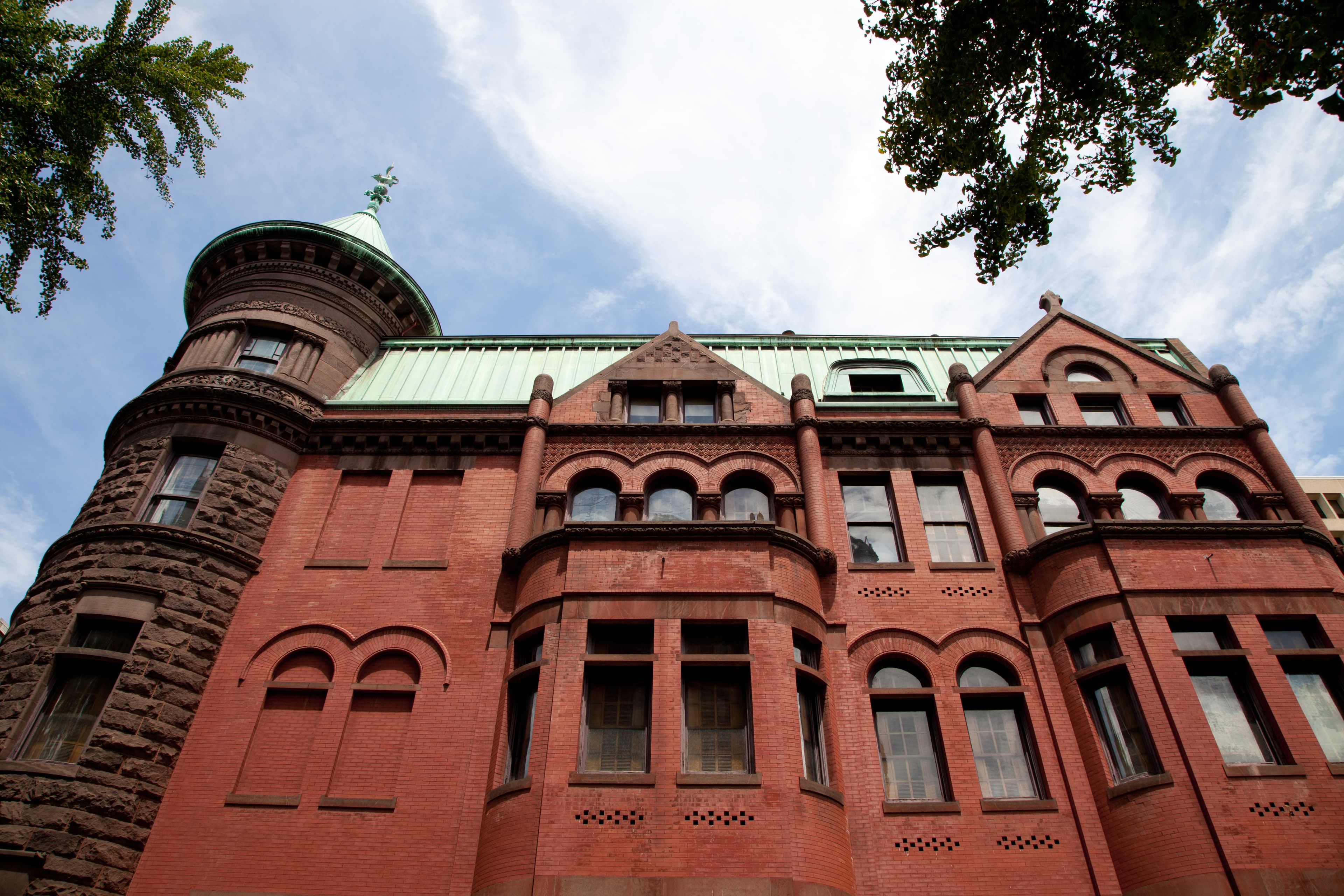
Walk south from Dupont Circle down New Hampshire Avenue and the streetscape suddenly gives way to something out of a Bavarian storybook: a heavy stone mansion of turrets, bays, and carved arches, rising behind its garden wall at the corner of Sunderland Place. This is the Heurich House — the Christian Heurich Mansion, known across Washington as the Brewmaster's Castle — built between 1892 and 1894 for the man who brewed most of the beer the capital drank, to designs by architect John Granville Meyers in the late-Victorian, Richardsonian Romanesque taste. It has been listed on the National Register of Historic Places since 1969.
What makes it extraordinary is not the stonework but the survival. The museum describes the house as one of the most intact late-Victorian interiors in the country, and the claim holds up: the first two floors are preserved with most of the family's original furnishings, hand-painted ceiling canvases, and carved mantels in place. Washington has grander houses, but almost none where a family of the 1890s simply seems to have stepped out for the afternoon. The Heurichs lived here for more than sixty years — Christian until his death in 1945 at 102, his widow Amelia until 1956 — and because the house then passed directly to a historical society rather than being emptied and sold, the twentieth century largely left it alone.
From Haina to the Capital: The Brewer's Rise
Christian Heurich was born in 1842 in the village of Haina in Thuringia, the third of four children of the local innkeeper, who was also the village butcher and brewer. He learned brewing from his father and through apprenticeships, but by fourteen both parents were dead, and the orphaned teenager spent years working across Europe. In June 1866, at the urging of his older sister Elizabeth, who had settled in Baltimore, he emigrated to the United States — by the oft-told account, with about $200 to his name and a determination to own a brewery of his own.
He got his chance in Washington in 1872, leasing a brewery on 20th Street NW; within a year its owner had died, and in 1873 Heurich married the owner's widow, Amelia Mueller Schnell, taking control of the business that became the Chr. Heurich Brewing Co. It grew into the city's longest-operating brewery (1872–1956), and by the 1890s Heurich was the District's second-largest landowner and its largest employer outside the federal government. In 1894 he opened a vast new fireproof brewery on the Potomac with a capacity of 500,000 barrels a year; its site is now occupied by the Kennedy Center. His Senate Beer became the capital's hometown lager, and Heurich — philanthropist, patriarch of the German-American community, still running his company past the age of 100 — was known as the world's oldest brewer when he died in 1945, at 102.
Built Against Fire
The castle on New Hampshire Avenue is best understood as an insurance policy you can live in. Fire had burned Heurich's breweries three times — a chimney spark, a worker smoking in the stables, and an explosion in the malt mill in 1892 — and the man who rebuilt his brewery in fireproof form that same decade applied the same obsession at home. The mansion was Washington's first fireproof residence: a structure of poured concrete and steel, with masonry interior walls and metal lath, engineered so that there was essentially nothing in its bones to burn. Its fifteen fireplaces — marble and onyx, each with an individually hand-carved mantel and cast-bronze fireback — were decorative from the day they were installed and were never used. The house was heated, sensibly and safely, by steam radiators.
For a house built like a vault, it was wired like a laboratory. Heurich filled it with the newest domestic technology of the 1890s: full indoor plumbing, central heating and circulating hot water, an elevator shaft, a central vacuum system, and light fixtures designed to burn both gas and electricity — a hedge by a man who had seen too many new technologies arrive to trust that electricity was not a passing fad. The second wife for whom the house was planned, Mathilde Daetz, worked closely with the New York interior firm the Huber Brothers on its decoration, and German craftsmen executed much of the carving. Mathilde died in 1895, barely a year after the house was finished; she never really lived in the home she had so carefully designed.
Inside the Time Capsule
A guided tour moves through the public rooms, and the cumulative effect is density: hand-carved wood everywhere, stained glass, gilded details, and ceiling canvases executed by craftsmen who had worked at the White House and the Capitol. The entrance hall was staged to impress, with its onyx-and-marble staircase. Below stairs, the basement holds the room that explains the fortune: the bierstube, a German beer hall in miniature, paneled and mottoed, where Heurich received his brewers and friends — though his third wife, the temperance-minded Amelia, converted it to the family's breakfast room, and the mottoes about never suffering thirst watched over coffee instead.
The private floors are the real rarity. The boudoir preserves the family's own objects, down to children's toys; the master bathroom's porcelain fixtures, installed before 1900, still gleam; a hidden stairwell for the staff threads discreetly through the plan. Houses of this era usually survive as shells refilled with period furniture borrowed from elsewhere. Here the furnishings and family collections are substantially the Heurichs' own, because the family never dispersed them and the Historical Society of Washington, headquartered here from 1956 to 2003, kept the interiors intact even while working among them.
Prohibition, Widowhood, and a Near Miss
The brewery that paid for all this had to survive the driest decades in American history. When Prohibition arrived, Heurich pivoted to a business that shared his plant's machinery: ice. His ice works supplied a city of iceboxes, and the income kept the empire — and the house — intact until repeal, when Senate Beer flowed again. He died in 1945, still the company's active manager. Amelia Louise Heurich, his third wife and the mother of his children, remained in the house until her death in 1956, and in her will she deeded the mansion to the Historical Society of Washington, D.C., which made it its first headquarters.
That gift nearly unraveled half a century later. In 2003 the Historical Society moved out and put the house on the open market, and Washington held its breath: a 31-room mansion on prime Dupont Circle land, protected outside by its historic listing but vulnerable inside, was exactly the kind of property that becomes a restaurant or a gut renovation. Heurich's grandchildren stepped in, the newly formed Heurich House Foundation purchased the house, and the mansion became the historic house museum it is today — preserved in perpetuity, and reinterpreted around the immigrant and working people who built and staffed it, and the present-day Washington craftspeople the museum now supports.
Beer in the Garden Again
The happiest footnote is that you can drink beer again at the Brewmaster's Castle. The museum's garden hosts 1921, a biergarten serving local craft beer behind the carriage house. And the Heurich name is back on tap: through a collaboration with Lost Lagers and Right Proper Brewing Co., the museum has revived the brewery's historic Senate brands — Senate Beer, Senate Maerzen brewed from a 1933 recipe, and Senate Bock — poured at museum events and in the garden. Christian Heurich, who outlived Prohibition, would presumably have approved: the castle he built against fire now keeps his beer, and his family's life, safely on display.
Key Facts
- Built 1892–1894 to designs by architect John Granville Meyers for brewer Christian Heurich (1842–1945); listed on the National Register of Historic Places on June 23, 1969 (reference no. 69000296).
- A 31-room mansion of poured concrete and steel — Washington's first fireproof residence — built after fires destroyed parts of Heurich's breweries three times. Its 15 marble and onyx fireplaces, each with a hand-carved mantel, were never lit; steam radiators heated the house.
- Equipped with cutting-edge 1890s technology: full indoor plumbing, central heating, an elevator shaft, a central vacuum system, and combination gas-and-electric light fixtures. First two floors survive with most of the family's original furnishings.
- Heurich immigrated from Thuringia, Germany, in 1866 and built the Chr. Heurich Brewing Co. (1872–1956), the city's longest-operating brewery and, at its peak, its largest non-governmental employer; its 500,000-barrel-a-year Potomac River brewery stood where the Kennedy Center stands today. He died at 102, still its active manager — the world's oldest brewer.
- Deeded by Heurich's widow Amelia to the Historical Society of Washington, D.C., in 1956 and used as its headquarters until 2003; rescued from the open market that year by the Heurich House Foundation, which operates it as a museum today.
Visitor Details
Address: Heurich House Museum, 1307 New Hampshire Avenue NW, Washington, DC 20036, just south of Dupont Circle (garden entrance via 1921 Sunderland Place NW).
Transit: Dupont Circle Metro station, Red Line (south exit), a short walk; the D6 bus and the Dupont Circle–Georgetown–Rosslyn Circulator stop within a block. No parking on site; street parking and garages are nearby, and bike racks are on site.
Hours/Admission: The house is seen only on guided tours, which are offered on limited days — historically Thursday through Saturday — alongside special tours and programs; the 1921 biergarten in the garden keeps separate seasonal hours (in recent seasons, Wednesday–Friday afternoons/evenings and weekend afternoons). Tour capacity is small and tickets sell through the museum's site, so check heurichhouse.org for current tour days, times, and ticket prices before going rather than relying on listings elsewhere. This is a small historic-house museum, not a walk-in Smithsonian — plan and book ahead.
Best timing: Book a Saturday house tour, then stay for the biergarten as it opens; in December, the museum's multi-day Christmas Markt fills the house and garden with local makers, and Oktoberfest weeks bring the revived Senate Beer flights to the garden.
Heurich House Museum — Context Photography