A Port Town Older Than the Capital
Georgetown sits at the fall line of the Potomac River, the farthest point upstream that ocean-going boats could navigate, and that geography made it a port before it made it a neighborhood. A tobacco inspection house went up around 1745 on a site already used for trading, and in 1751 the Maryland legislature authorized the purchase of 60 acres from George Gordon and George Beall for £280; the town was surveyed in February 1752. Whether it was named for King George II or for the two Georges who sold the land is still argued. What is certain is the arithmetic: Georgetown predates the District of Columbia by 40 years. When George Washington negotiated the land deals for the new federal capital — some of them over dinners in Georgetown taverns — he was dealing with an established town that had its own mayor, its own banks, and its own shipping trade. The Old Stone House on M Street, built in 1765, is the oldest standing structure in Washington, and it was already a quarter-century old when the capital arrived. Georgetown kept its own municipal government until Congress folded it into the District in 1871, and its street names were not made to conform to Washington's until 1895. The honest version of the port story includes its darkest trade, too: enslaved people were sold in Georgetown from pens near M Street and Wisconsin Avenue until the slave trade was banned in the District in 1850, and Black Georgetownians — enslaved and free — made up a large share of the town's population; Mount Zion United Methodist Church, founded by that community, is the oldest Black congregation in Washington and still worships here.
The Canal That Made It Rich
By the 1820s the Potomac had silted up badly enough to threaten the port, and Georgetown's answer was the Chesapeake and Ohio Canal. Construction began on July 4, 1828 — President John Quincy Adams turned the first shovelful — with Georgetown as the eastern terminus of a waterway meant to reach the Ohio River country. It never got there: the canal reached Cumberland, Maryland, in 1850, 184.5 miles west, eight years after the rival Baltimore and Ohio Railroad got there first, and it never turned a real profit. But for Georgetown the canal was a second life. Coal, flour, lumber and stone came down it for nearly a century; mills along the Georgetown waterfront used its water for power, and canal boats were loaded and unloaded within sight of M Street. The C&O ceased commercial operations in 1924 after years of floods, passed to the National Park Service in 1938, and is now the Chesapeake and Ohio Canal National Historical Park. In Georgetown the canal runs elevated above the streets on its stone bed, crossed by small bridges, and the towpath that mules once walked is where the neighborhood now goes running.
Brick Rows and a Law That Froze Them in Place
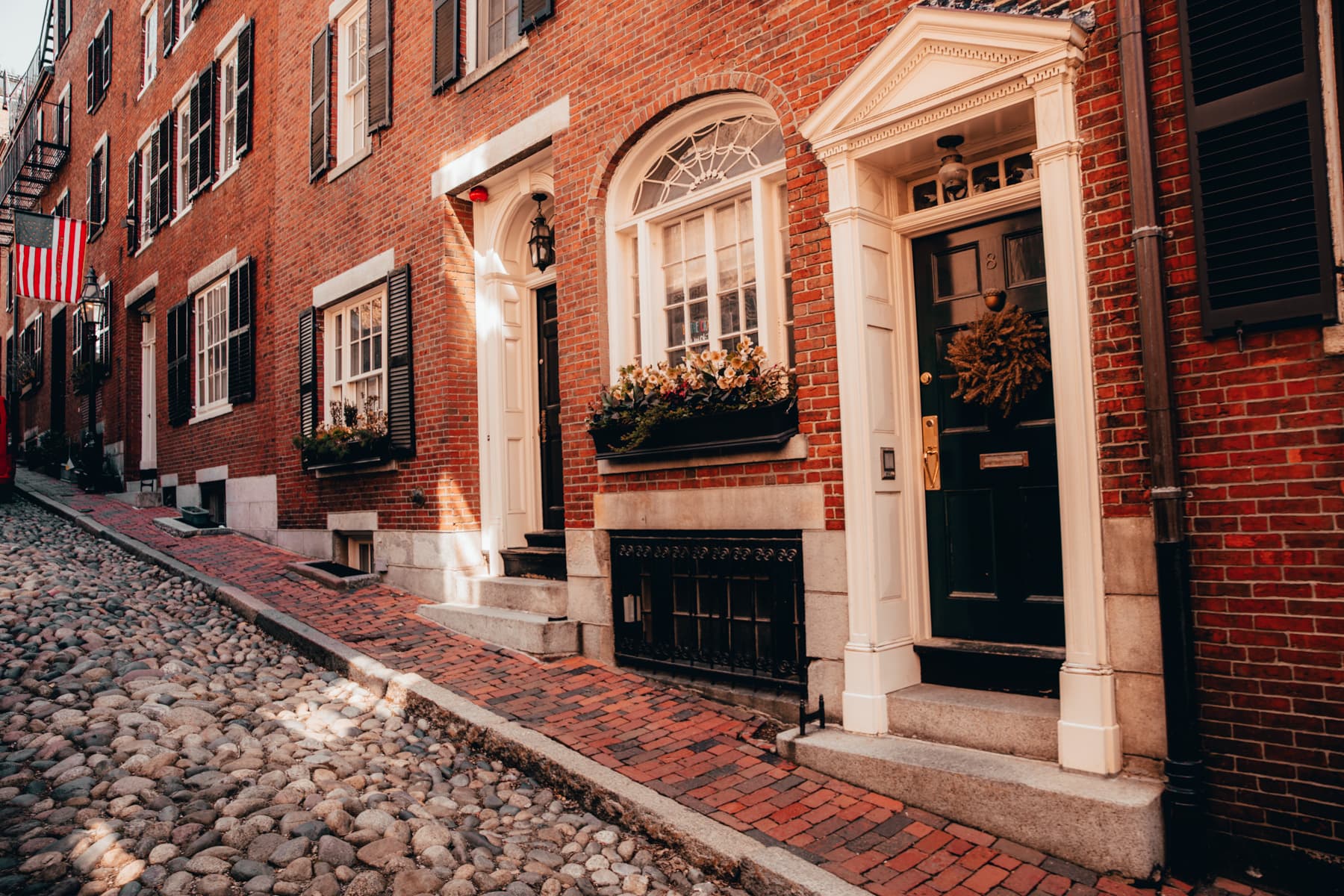
Above the canal, the residential streets — N, O, P and Q, running between numbered streets in the low thirties — hold one of the finest collections of early American housing anywhere: Federal and early Victorian row houses in brick, many of them built for the merchants, ship captains and mill owners the port made wealthy. N Street is the showpiece, a procession of Federal facades, fanlights and iron fences. The reason so much of it survives is partly luck — Georgetown's economy cooled in the late 19th century, and nobody had the money to tear the old houses down — and partly law. In 1950 Congress passed the Old Georgetown Act, one of the earliest historic-preservation statutes in the country, requiring review of any exterior change in the district; in 1967 the whole neighborhood was designated a National Historic Landmark District. The result is a streetscape that is genuinely old rather than recreated — though preservation came with a price tag that transformed Georgetown from a mixed, working neighborhood into one of the most expensive in the capital.
M Street and Wisconsin Avenue: The Crossroads
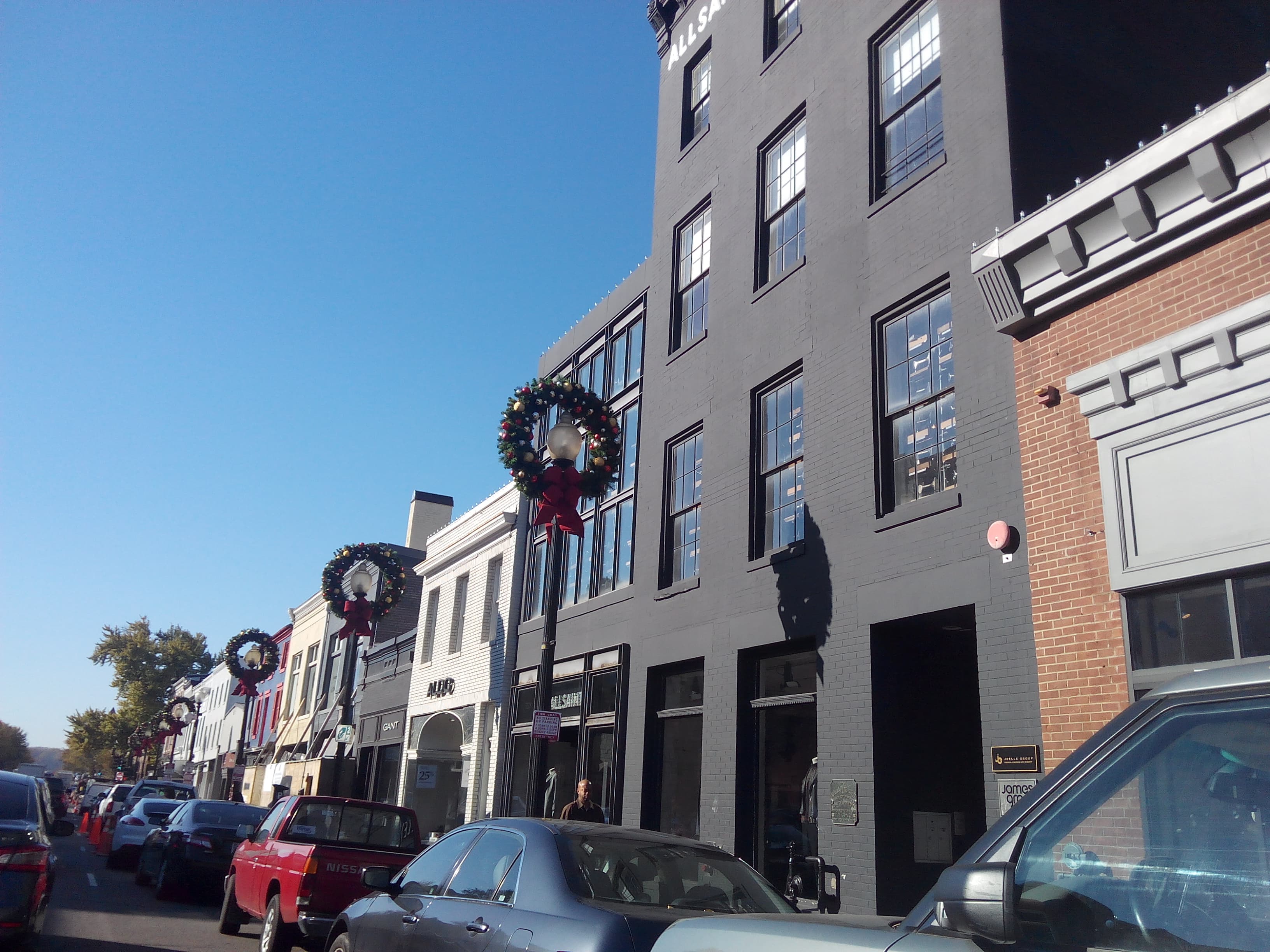
Every Georgetown walk eventually funnels into the crossing of M Street and Wisconsin Avenue, the neighborhood's commercial heart since the horsecar era. M Street runs along the old port road; Wisconsin Avenue climbs the hill from the river. Today the blocks around the intersection hold national retailers in 19th-century storefronts, the Georgetown Park mall, and a famous density of restaurants — and the sidewalks on a Saturday can feel like the whole city funneling through one intersection. Just south, down the hill toward K Street, is the waterfront: Washington Harbour's fountains and riverside restaurants, and Georgetown Waterfront Park, whose lawns and promenade were completed in 2011 on land that was industrial for two centuries — parking lots, a cement plant and an incinerator stood here within living memory. The park's arc of shade pergolas echoes the smokestack era it replaced, and on summer evenings the promenade fills with rowers coming off the river and diners watching the light change over Rosslyn across the water. From the park the view takes in the Key Bridge, Theodore Roosevelt Island and the Kennedy Center upriver. The neighborhood's newer landmark sits at the foot of 36th Street: the steep flight of steps at Prospect Street, made famous by the 1973 film The Exorcist — covered in its own story elsewhere on this site.
A University Founded With the Republic
Georgetown University occupies the hill at the neighborhood's western edge, and it is nearly as old as the town's second act: founded in 1789 by John Carroll, the first Catholic bishop in the United States, it is the country's oldest Catholic and Jesuit university. Its landmark is Healy Hall, a soaring Flemish Romanesque pile of Potomac granite and brick built between 1877 and 1879, whose clock tower is visible from across the river in Virginia. The university's presence shapes the surrounding blocks — students in the row houses west of Wisconsin, bookshops and bars on the neighborhood's edges — and its hospital and law-adjacent graduate programs make it one of the District's largest employers. A few blocks northeast, Dumbarton Oaks offers the neighborhood's most refined hour: a 1920s estate on R Street, home to Robert and Mildred Bliss, where in 1944 diplomats meeting in its music room drafted the proposals that became the framework of the United Nations. Harvard now runs it as a research institute and museum, and Beatrix Farrand's terraced gardens behind the house remain one of the great designed landscapes in America.
The Kennedy Years — and Georgetown Now
Georgetown's 20th-century fame arrived with a young Massachusetts senator. John F. Kennedy proposed to Jacqueline Bouvier in 1953 at Martin's Tavern on Wisconsin Avenue, a neighborhood institution since 1933. As a senator he bought the Federal row house at 3271 N Street, and it was from that house that he departed for his inauguration in January 1961. After his assassination, Jacqueline Kennedy returned to Georgetown — first to a borrowed house on N Street, then to 3017 N Street, which she bought in 1964 — and the neighborhood became, for a generation, shorthand for Washington's political-social world of dinner parties and deal-making. That world has largely moved on to restaurants and lobbying firms downtown, but the physical Georgetown the Kennedys knew is intact, protected by the 1950 Act. What the neighborhood is now is something rarer than a museum: a fully inhabited, fully working piece of the 18th-century city — expensive, crowded, beloved, and still the first place Washington takes visitors who want to see where the capital actually began.
Key Facts
- Founded in 1751 as a Maryland tobacco port at the head of navigation on the Potomac — 40 years before Washington, DC; it kept its own municipal government until 1871.
- The Old Stone House (1765) on M Street is the oldest standing structure in Washington, DC.
- The Chesapeake and Ohio Canal, begun in 1828 with Georgetown as its eastern terminus, reached Cumberland, Maryland, in 1850 and operated commercially until 1924; it is now a National Historical Park administered by the NPS.
- The Old Georgetown Act of 1950 — among the earliest preservation laws in the US — protects the neighborhood's exteriors; Georgetown was designated a National Historic Landmark District in 1967.
- Georgetown University, founded in 1789 by John Carroll, is the oldest Catholic and Jesuit university in the United States; its landmark Healy Hall was built 1877–1879.
- John F. Kennedy proposed to Jacqueline Bouvier at Martin's Tavern (1953) and lived at 3271 N Street as a senator; Jacqueline Kennedy bought 3017 N Street in 1964 after his assassination.
- Dumbarton Oaks, the Bliss estate on R Street, hosted the 1944 conference whose proposals became the framework of the United Nations.
Visitor Details
Address: The neighborhood centers on the intersection of M Street NW and Wisconsin Avenue NW, Washington, DC 20007. A good walking loop: start at the C&O Canal at 1057 Thomas Jefferson Street NW (the NPS canal visitor center), climb to M Street and Wisconsin, then walk the residential blocks of N and O Streets between 31st and 34th.
Transit: Georgetown has no Metro station of its own — a fact of neighborhood life since the 1970s. The nearest stations are Foggy Bottom–GWU (Blue/Orange/Silver) and Rosslyn, across the Key Bridge in Virginia, each roughly a 15-minute walk; DC Circulator and Metrobus routes run along M Street and Wisconsin Avenue. Driving is possible but street parking is scarce and mostly restricted to short stays.
Hours/Admission: A neighborhood is open around the clock and free to walk. Individual sites set their own terms: the NPS C&O Canal visitor center and the Old Stone House keep daytime hours (check nps.gov before going); Dumbarton Oaks' museum is free and its gardens are ticketed and seasonal — check doaks.org for current hours and admission.
Best timing: Early morning on a weekday, when the canal towpath is quiet and the residential streets belong to dog walkers; late afternoon for the waterfront, when the sun drops behind the Key Bridge. Cherry-blossom season and Georgetown University graduation weekend are the most crowded times of year.
Georgetown — Context Photography