A Market That Is Really a Neighborhood
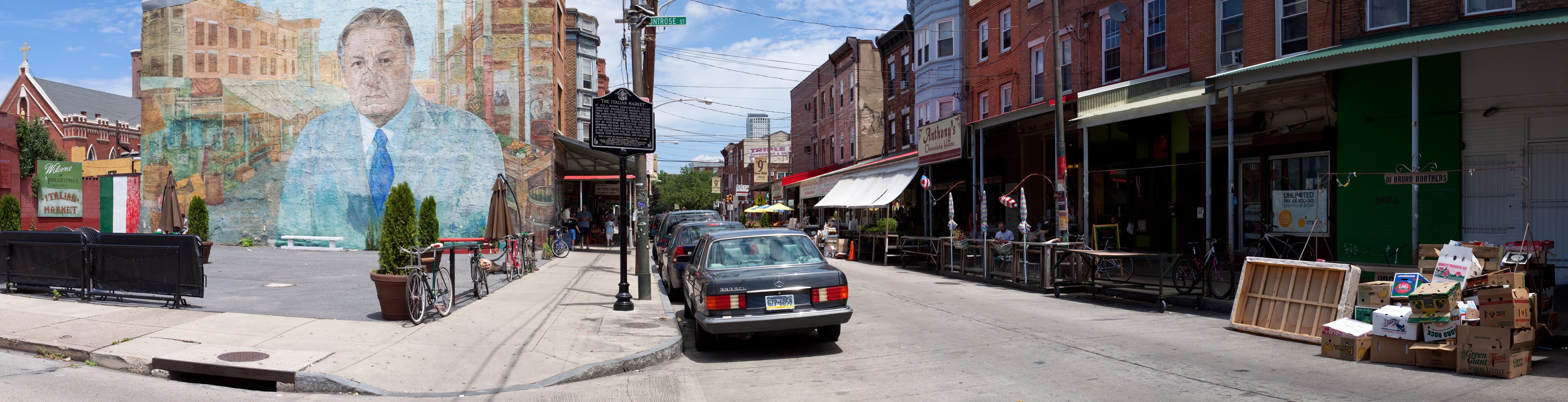
The Italian Market is not a hall, a shed, or a festival ground. It is a stretch of ordinary city street — South 9th Street in South Philadelphia — that has been doing double duty as a marketplace for roughly a hundred and forty years. Its formal name is the South 9th Street Curb Market, and the "curb" is the point: the commerce happens on the sidewalk and at the street edge, under metal awnings that run block after block, where vendors wheel out carts and crates of produce in the morning and the neighborhood does its daily shopping in the open air. The historic heart of the market runs along 9th Street between Christian Street and Washington Avenue, inside a commercial district the vendors themselves chartered in 1915 as the South Ninth Street Business Men's Association. Today the market is generally reckoned to stretch from Fitzwater Street in the north to Federal Street in the south, with the name "Italian Market" also covering the surrounding blocks of rowhouses between South Street and Wharton Street.
That double identity — a market that is also a residential neighborhood — is what sets it apart from America's famous food halls. People do not just browse here; they live above the shops, argue over tomatoes in two or three languages, and buy dinner from families their grandparents bought dinner from. It is often described as the oldest continuously operating outdoor market in the United States, and unlike most claimants to that title, it never had to be revived. It simply never closed.
Boardinghouses, Pushcarts, and a Charter
The market grew up outside the grid of William Penn's planned city, in the cheaper blocks south of it where new arrivals could afford to land. Italians began settling the area around 1884, when Antonio Palumbo opened a boardinghouse that received Italian immigrants and helped them find their footing. Shops followed the boardinghouses: by the first decade of the 20th century, 9th Street was lined with stores serving the new community, and many of the market's present-day vendors trace their founding to exactly those years. The street's early commerce was never exclusively Italian — Jewish businesses were part of the Ninth Street Market from its inception — but Italian families gave it its name, its food, and its accent.
In 1915 the merchants organized formally, incorporating the South Ninth Street Business Men's Association (the charter was recorded in 1916) to promote and protect the curb market — one of several Philadelphia established in the early 20th century, and the one that outlasted the rest. On October 12, 2007, Pennsylvania dedicated a state historical marker to the "South 9th Street Curb Market" at the northeast corner of 9th and Christian Streets, honoring a market that had grown from pushcarts into a Philadelphia icon without ever moving indoors.
The Family Names Over the Doors
Walk the market slowly and the storefronts read like a genealogy. Di Bruno Bros., founded in 1939, is the market's most famous cheese shop, its 9th Street store stacked with wheels and wedges from Italy and beyond. Isgro's Pastries has been filling cannoli since 1904. Fante's Kitchen Shop, founded in 1906, sells the pasta makers, espresso pots, and kitchen tools the neighborhood's cooks actually use. Butchers like Cannuli's and Esposito's still break down meat the old way, spice merchants sell from barrels, bakeries turn out rolls for the sandwich shops, and the curb stands out front pile produce in the open air — much of it priced for working families rather than tourists, because the first customers every morning are still the neighbors.
The continuity is the attraction. Stands and stores here pass from parents to children to grandchildren, and a vendor's family history is often just the market's history in miniature: an arrival around the turn of the century, a cart, a stall, a storefront, a century. Vendors who founded businesses in the market's first decade have descendants still trading on the same street.
The Cheesesteak Corner at the South End
At the market's southern end, where 9th Street meets Passyunk Avenue, the neighborhood produced Philadelphia's most famous food fight. In 1930 Pat Olivieri, who ran a hot dog stand at that corner, grilled up sliced beef and onions for himself — a passing cab driver wanted one too — and the cheesesteak was born. Pat's King of Steaks still operates at the same spot, at 1237 East Passyunk Avenue, in the wedge-shaped building under the neon crown. In 1966 Joey Vento opened Geno's Steaks directly across the street, wrapped it in enough neon to be seen from orbit, and the rivalry became permanent: two shops, one intersection, open late, and a city divided by loyalty. Ordering at either window is a small ritual with its own dialect, and the corner functions as the market's unofficial southern gate — the place every food pilgrimage to 9th Street eventually ends up.
The Rocky Run
The market's most famous customer never bought anything. In Rocky (1976), Sylvester Stallone's training run takes him straight through the Italian Market at dawn — and in the scene everyone remembers, a vendor recognizes him and tosses him an orange, which Rocky catches one-handed without breaking stride. The market returned in Rocky II, and the sequence fixed 9th Street in the global imagination as the real, working Philadelphia that the movies usually skip: not monuments, but produce crates and awnings and men who start work before the sun does. Television kept coming back — the series Hack filmed episodes here, and It's Always Sunny in Philadelphia shot a season-five episode in the market. For years a giant mural of former mayor Frank Rizzo, himself an Italian Philadelphian, looked over 9th and Montrose; at Mural Arts' request it was painted over in June 2020, a sign that the neighborhood keeps renegotiating its own story on its own walls.
The New Layers: Puebladelphia and Little Saigon
The most Italian thing about the Italian Market today is that it keeps absorbing newcomers exactly the way it was built. In recent decades Mexican immigrants have opened stores, restaurants, and taquerias all through the market — so thoroughly, especially at its southern end, that writers now call the area "Puebladelphia," after the state of Puebla many families come from. A Business Association of Mexican Merchants now operates alongside the old Italian institutions, and in 2024 it held its first annual Day of the Dead festival on the street. Along Washington Avenue, the market's midsection, Philadelphia's Little Saigon is intertwined with the Italian blocks: Vietnamese pho restaurants, Chinese apothecaries, and Korean and Chinese-run businesses trade beside the pasta shops. Latino immigrants work throughout the market, and the awnings now shelter produce for three continents' cuisines at once.
That layering was stress-tested in 2020, when the market's outdoor format turned out to be its strength: shoppers could buy in the open air, restaurants spilled into streeteries and parklets, and several boarded-up storefronts came back to life. The annual Italian Market Festival still closes the street each spring for music and food, but the honest summary of the neighborhood is quieter than any festival: a street that has fed immigrants for a hundred and forty years, still feeding them, one generation and one language at a time.
Key Facts
The Italian Market is the popular name for the South 9th Street Curb Market in South Philadelphia — widely described as America's oldest continuously operating outdoor market, with roots in the Italian immigration of the 1880s.
Italians began settling the area around 1884, when Antonio Palumbo opened a boardinghouse for immigrants; many current vendors trace their businesses to the first decade of the 20th century.
The merchants organized as the South Ninth Street Business Men's Association in 1915 (charter recorded 1916); Pennsylvania dedicated a historical marker to the market at 9th and Christian Streets on October 12, 2007.
Long-running family businesses include Isgro's Pastries (1904), Fante's Kitchen Shop (1906), and Di Bruno Bros. cheese shop (1939).
Pat's King of Steaks (founded 1930 by Pat Olivieri, inventor of the cheesesteak) and Geno's Steaks (founded 1966) face off across 9th Street and Passyunk Avenue at the market's south end.
Rocky (1976) filmed its famous training run through the market — including the tossed-orange moment — and the street has since layered in Mexican ("Puebladelphia") and Southeast Asian (Little Saigon, along Washington Avenue) businesses alongside the Italian originals.
Visitor Details
Address: South 9th Street between Fitzwater and Federal Streets, Philadelphia, PA 19147 — the classic heart is 9th Street between Christian Street and Washington Avenue; the cheesesteak corner (Pat's and Geno's) is at 9th and Passyunk Avenue, at the south end. A good walk: start at 9th and Fitzwater, stroll south under the awnings to Washington Avenue, then continue to the cheesesteaks at Passyunk.
Transit: SEPTA's Broad Street Line stops at Ellsworth-Federal and Lombard-South, a few blocks west of 9th Street; SEPTA buses serve 9th Street and Washington Avenue, and the market is a 15-minute walk south from the Old City historic district.
Hours/Admission: The market street itself is a public street — open at all hours and free — but the curb stalls and most shops generally operate Tuesday through Sunday, roughly mid-morning to late afternoon, with shorter Sunday hours and many vendors closed on Mondays; hours are set by each vendor and vary by season, so check italianmarketphilly.org before a Monday or early-morning trip. The cheesesteak shops at Passyunk keep much longer hours than the stalls.
Best timing: Saturday morning is the market at full strength — every stand out, every shop open, chefs and neighbors shopping shoulder to shoulder. Go hungry, bring cash for the curb stalls (cards are fine in most storefronts), and graze your way south: cannoli at Isgro's, cheese at Di Bruno's, then the Pat's-versus-Geno's decision at the end. The annual Italian Market Festival each spring is the street's biggest party.
Italian Market Gallery