A Ruin That Shouldn't Exist
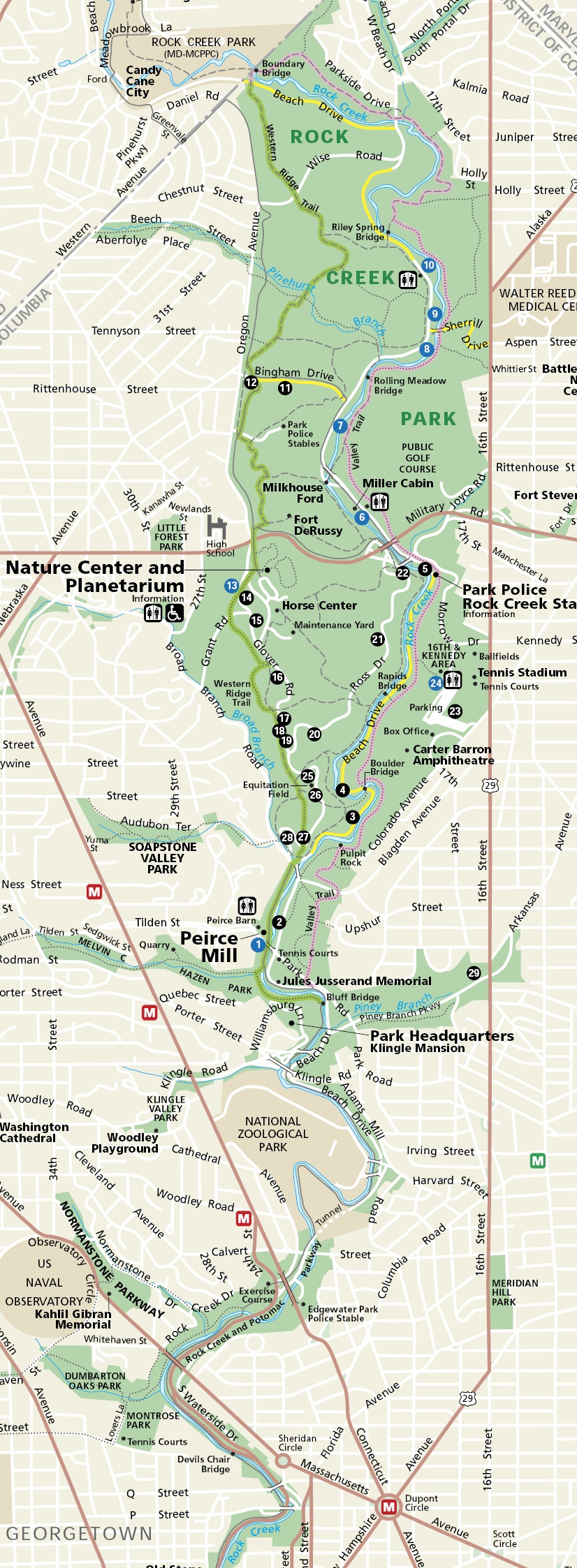
Walk the trails near the Rock Creek Park Horse Center, past the stables and the park's maintenance yard, and for decades you could step off the path and find something that looked impossible: row after row of enormous carved stones stacked in the trees, some piles rising close to twenty feet. Cornices jut at odd angles. Fluted fragments, carved moldings, and plain ashlar blocks wear coats of moss and mildew. There is no sign, no plaque, and no official trail to them. Longtime Washingtonians call them the Capitol Stones, and the ridiculous-sounding rumor attached to them is true: these are pieces of the United States Capitol itself, taken off the building's east front and left in the woods.
The stones cover roughly 15,000 square feet of forest floor a few hundred feet southeast of the maintenance yard, according to Monument Lab's survey of the site. Some blocks are featureless slabs. Others carry the fingerprints of early nineteenth-century craft — quarry marks, tooled grooves, and decorative carving. They read less like construction debris than like the remains of a classical building that was dismantled and never cleared away, which is, in essence, exactly what they are.
The East Front Comes Down, 1958–1962
To understand the piles, start at the Capitol in the 1950s. The building's east front — the side facing the Supreme Court — was still the original sandstone front, much of it dating to the rebuilding after British troops burned the Capitol in the War of 1812; some stones in the park may date as early as 1818. In 1954, President Dwight D. Eisenhower appointed J. George Stewart, a former one-term congressman from Delaware with no training as an architect, as Architect of the Capitol. Stewart championed a major extension of the east front: push the facade outward, add office space, and replace the weathered sandstone with marble. Preservationists objected, but House Speaker Sam Rayburn backed the project, and it went ahead.
Demolition began in 1958 and the work ran into the early 1960s. The east front was extended 33.5 feet, and a marble duplicate of the old sandstone front was built in front of the original wall. The old portico was dismantled piece by piece. Its twenty-four Corinthian columns — the ones that had stood since 1828 — were treated as treasures and eventually became the National Capitol Columns at the National Arboretum. Everything else, some two hundred tons of stone in several hundred blocks, became a problem nobody had planned for. Under the law governing the Capitol's fabric, the material could not simply be sold off or thrown away. Each block was cataloged as it came down, and then the stones began a long exile.
Twenty Years in Storage, Then the Woods
The blocks were first stored at the Capitol itself, then moved to an unused yard at the Capitol Power Plant, where they sat until 1975. That year the power plant was renovated and expanded, and responsibility for the stones passed, through a chain of defunct commissions, to the House and Senate office building commissions. Those commissions arranged for the National Park Service to store the material at the back of an NPS maintenance yard in Rock Creek Park. It was meant to be storage. It became, for nearly fifty years, a place.
Later Capitol renovations added more stone to the piles. Because the site was never an official attraction, it developed the way unofficial places do: word of mouth, then guidebooks, then geotagged maps. Climbers scrambled on the stacks; photographers came for the eerie sight of classical carving returning to forest. Reporting over the years stressed the ambiguity — the stones sat on National Park Service land, but ownership and upkeep were murky, and neither the Architect of the Capitol nor the Park Service maintained them as a site. Architecture historian Bill Lebovich has pointed out what the piles quietly preserve: pristine evidence of two-hundred-year-old stone construction, from quarry grooves to Cornish carving details, of a kind you cannot study on the finished building.
"Not Abandoned," the Agencies Insist
For the record, both agencies reject the word "abandoned." The Architect of the Capitol's own writing on the stones notes that pieces have been pulled from the piles over the years for small restoration jobs at the Capitol and the White House — the yard functioned, however invisibly, as a working stone bank for the building it came from. The U.S. Capitol Historical Society has even cut some stones down into bookends. That dual identity is the whole fascination of the place: officially, it was always just storage, a supply closet with no door. Unofficially, it became the one spot in Washington where you could put your hand on the Capitol's original fabric — no tour, no ticket, no rope — and read two centuries of masonry craft in the grooves, quarry marks, and carving that the finished, painted building keeps out of reach. The tension between those two identities is what the removal fight has really been about.
Fenced Off — and Being Removed
Anyone writing about the Capitol Stones today has to say plainly what older guides do not: the era of wandering among the stacks is over. In the summer of 2021, fencing went up around the site with "Area Closed" signage, cutting off the clearing behind the maintenance facility next to the Rock Creek Horse Center. In August 2022, the Architect of the Capitol confirmed the stones would be moved to the AOC's storage area at Fort Meade, Maryland, where the public will not have access to them. The move was requested by the National Park Service, in the AOC spokesperson's words, "for safety, realignment and preservation purposes," and was expected to take several years.
The announcement drew a public fight. Delegate Eleanor Holmes Norton pressed the agencies to keep at least a few stones in Rock Creek Park with signage explaining their history, and the Well News reported that the NPS and AOC committed to keeping some stones in the park — though which, and how many, was left unclear. Other pieces have quietly been reused over the years for small restoration jobs at the Capitol and the White House. What a visitor can see today is therefore limited and changing: the fenced stacks, visible through the fence from the trail near the Horse Center, for as long as they remain. Treat the fence and closure signs as the rule, not a suggestion.
Key Facts
- The Capitol Stones are several hundred sandstone and marble blocks — about 200 tons — removed from the U.S. Capitol's original east front during the 1958–1962 extension, when a marble duplicate front was built 33.5 feet east of the old wall.
- Much of the stone dates to the Capitol's rebuilding after the War of 1812 fire; some blocks may date to 1818. Blocks were cataloged as they were removed.
- The stones were stored at the Capitol Power Plant until 1975, then transferred to the back of a National Park Service maintenance yard in Rock Creek Park, near the Horse Center and stables off Glover Road NW.
- The site was never an official attraction: no signage, no maintaining agency as a visitor site. Fencing and "Area Closed" signs went up in 2021.
- In 2022 the Architect of the Capitol confirmed the stones are being moved over several years to AOC storage at Fort Meade, Maryland (no public access); the NPS and AOC committed to keeping some stones in Rock Creek Park after Delegate Eleanor Holmes Norton's intervention, details unresolved in reporting.
- The famous sibling pieces — the east portico's 1828 Corinthian columns — are the National Capitol Columns at the U.S. National Arboretum.
Visitor Details
Address: Rock Creek Park, near the Rock Creek Park Horse Center, 5100 Glover Road NW, Washington, DC (the stones are behind the nearby NPS maintenance yard; the site is unmarked).
Transit: The site is a 2–3 mile walk from the nearest Metro stations (Tenleytown-AU, Red Line, is the usual starting point); most visitors arrive by car via Glover Road or on foot on park trails from the Nature Center at 5200 Glover Road NW. Confirm current trail and road conditions on the NPS Rock Creek Park website.
Hours/Admission: Rock Creek Park is free and open during daylight hours year-round. IMPORTANT: The Capitol Stones site itself is fenced and closed — view only from outside the fence, obey posted closure signs, and do not climb on the stones. Because removal to Fort Meade is underway on a multi-year timeline, the piles may be partly or wholly gone; check recent NPS/AOC updates before making a special trip.
Best timing: Pair a fence-line look with a hike on the Western Ridge Trail and a stop at the Rock Creek Park Nature Center and Planetarium (5200 Glover Road NW). Go in late autumn through early spring, when the leaves are down and the stacks are easiest to see through the trees.
Rock Creek Park — Context Photography